Micro Ch 10 (Metabolism)
 Call Kai
 Learn
Learn Practice Test
 Spaced Repetition
 Match
Match Flashcards
 Knowt Play
1/29

Earn XP
Description and Tags
(metabolism)
Name | Mastery | Learn | Test | Matching | Spaced | Call with Kai |
|---|
No analytics yet
Send a link to your students to track their progress
30 Terms
Metabolism
Sum of all the chemical reactions in a cell, includes: catabolism and anabolism
Anabolism
•Buildup of small molecules
•Products are large molecules
•Photosynthesis
•Mediated by enzymes
•Energy is required (endergonic)
Catabolism
•Breakdown of large molecules
•Products are small molecules
•Glycolysis, Kreb’s cycle
•Mediated by enzymes
•Energy released (exergonic)
Dehydration Reaction
glycosidic bond between two glucose molecules to generate maltose requires the removal of water molecule and energy from ATP
Hydrolysis
breaking peptide bond between two amino acids requires a water molecule that adds an H and OH to amino acids
Apoenzyme
protein component of an enzyme
Cofactors
non-protein
Holoenzyme
aponenzyme + cofactor
noncompetitive inhibition
the regulator molecule does not bind in the same site as the substrate
Ribozymes
are RNA molecules that catalyze reactions on other RNA.
constitutive enzyme
always present and in relatively constant amounts, regardless of the cellular environment.
enzyme induction
enzymes appear (are induced) only when suitable substrates are present
endergonic:-require the addition of energy
ATP
a three-part molecule consisting of a nitrogen base (adenine) linked to a 5-carbon sugar (ribose), with a chain of three phosphate groups bonded to the ribose.
Photophosphorylation
the ATP is formed through a series of sunlight-driven reactions.
What is glucose broken by?
glycolysis
Denaturation
loss of a protein
Phosphorylation
Creatine Phosphate + ADP à creatine + ATP
Oxidative Phsophorylation
electron transport chain
Chemiosmosis
Anaerobic Respiration
no oxygen required
Denitrification- reduce nitrite to nitric oxide, nitrous oxide, and nitrogen gas
Aerobic respiration
-converts glucose to CO2 and allows the cell to recover significant amounts of energy
Fermentation
incomplete oxidation of glucose or other carbohydrates in the absence of oxygen.
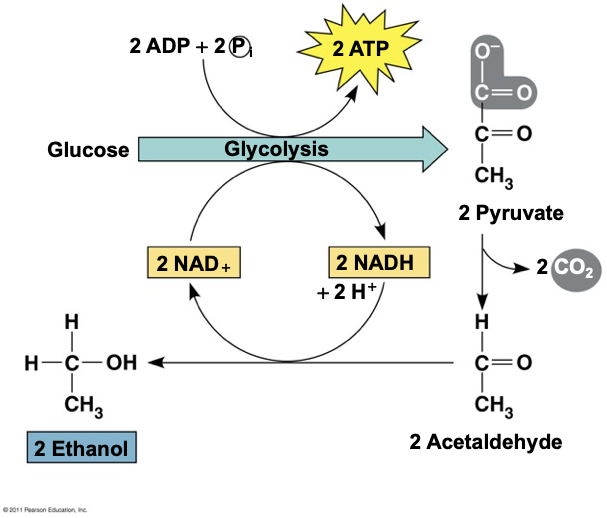
Alcoholic fermentation
in yeast or bacterial species that have metabolic pathways for converting pyruvic acid to ethanol. decarboxylation of pyruvic acid to acetaldehyde, followed by a reduction of the acetaldehyde to ethanol. In oxidizing the NADH formed during glycolysis, NAD is regenerated, which allows the glycolytic pathway to continue.
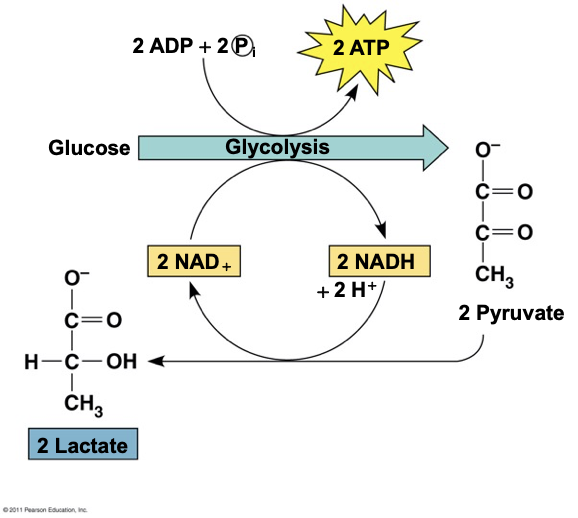
Lactic acid fermentation
Mycobacterium
Obligate aerobes require oxygen for metabolism
Staphylococcus, E. coli
Facultative anaerobes can use oxygen, but also have anaerobic methods of energy production
Beta oxidation
2-carbon units are successively transferred to coenzyme A, creating acetyl CoA, which enters the Krebs cycle.
amphibolism
to integrate catabolic and anabolic pathways to improve cell efficiency
loss of electrons from the photocenter has two major effects
It creates a vacancy in the chlorophyll molecule forceful enough to split an H2O molecule into hydrogen (H+) (electrons and hydrogen ions) and oxygen (O2)
Photophosphorylation
located in this same thylakoid uses the energy from H+ transport to phosphorylate ADP to ATP.
Amphibolic metabolism
can integrate catabolic and anabolic pathways to improve cell efficiency