semantic memory
 Studied by 0 people
 Call Kai
 Learn
Learn Practice Test
 Spaced Repetition
 Match
Match Flashcards
 Knowt Play
1/29

There's no tags or description
Looks like no tags are added yet.
Name | Mastery | Learn | Test | Matching | Spaced |
|---|
No study sessions yet.
30 Terms
What is semantic memory a subset of?
Declarative memory
What is Semantic Memory?
General knowledge about the world
Abstracted from any one experience
(usually) shared with the community (because they are facts)
What provides evidence for the independence of episodic and semantic memory?
Dementia starting in the anterior frontal and temporal lobes initially presents as a pure semantic deficit, patients have intact episodic memory function and preform similar to controls on recall of episodic details
Interdependence of semantic and episodic memory
Due to the overlapping in our everyday lives older memories go semanticiztion, meaning older memories rely more on semantic information (e.g., as a child you remember lots of details about a vaction, but as you get older you remember year, location, ect)
What is the speed of semantic recall is informed by?
How semantic information is organized and the syntax of a given question. An example would be to name a fruit that starts with the letter P vs name a word that starts with p that is also a fruit
First question: we take all the words we know and filter for all the fruits, and then for which fruits start with p
Second question: look at all the words with p we know, then find the subset of fruit, much more to look through
what does recall for semantic facts vary depending on
Existing expertise, the more you know about a topic the easier it is to sort through the information you know to locate what you need to find

Hierarchical Network Model
Concepts are represented by nodes that are arranged in a hierarchical fashion. Each node is associated with multiple features. Features are shared by all items in sub nodes are stored in the superordinate node
The model predicts that T/F judgements are dependent on the nodal separation of objects and their associated properties
Areas in which the Hierarchical Network Models do not predict recall performance
Familiarity: Semantic judgements are significantly faster for items that are familiar rather than unfamiliar regardless of nodal distance
Typicality: Decisions about category membership depend on how representative the exemplar is of that category (ducks have wings but ostriches don’t)
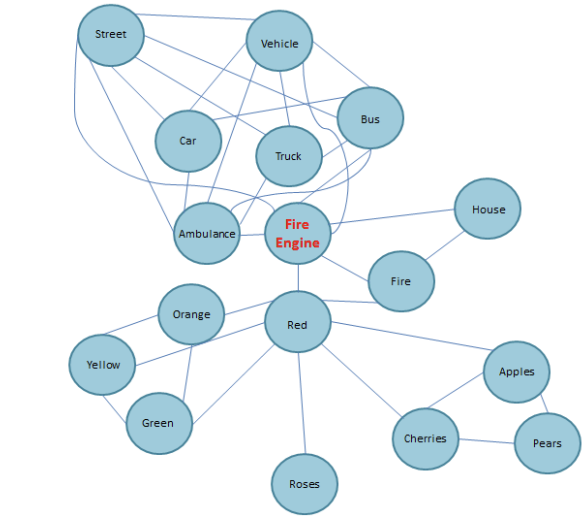
Semantic Activation Theory
Concepts act as nodes that are linked together based on conceptual relatedness. Distances between nodes represent relatedness, when a concept is activated or “primed”, related concepts are also activated
semantic priming effect
a cognitive phenomenon where exposure to a related word (the "prime") speeds up the recognition or processing of a subsequent word (the "target") In class: showed a list of items that were related to coffee (but not actually the word coffee) (e.g., mug, hot, mug, cream, mocha) then hid the list and asked if the words: stairs, coffee, brown were present, Very quicky said no to stairs but hesitated on coffee and brown because our coffee schema was activated!
Limitations of the Semantic Activation Model
Too simple: everything is represented as a single node
Too rigid: does not account for individual differences in semantic relatedness or temporal differences (things a true for us at different points of our lives)
Tri-Level Categorization Theory
3 levels of categorization exist: Superordinate (least detailed) (e.g., animal), Basic (e.g., dog), and Subordinate (most detailed) (e.g., Australian Sheppard)
Individuals default to the “basic” category level when given freedom to categorize information
Tradeoffs exist between time and accuracy, with the basic categorization scheme being a good “middle ground”
Tri-Level orginization short comings
Studies of semantic categorization often present stimuli without any context. When context is introduced, categorization becomes much more varied and context-dependent
Experts prefer subordinate categorization when assessing stimuli within their domains of expertise
Individuals with semantic dementia rely solely on superordinate information when recreating stimuli
Concepts are Not Likely Stored in Our Brain as they Would be in an Encyclopedia
Conceptual knowledge is context-dependent
Conceptual knowledge is not stable within individuals
Conceptual knowledge is not stable across individuals
Grounded Cognition Theory
Grounded Cognition Theory posits that Concepts are not processed in Isolation. Identification of objects is significantly improved when they are shown in-context. Argues that goals influence conceptual representations
Grounded Cognition Theory challanges what other theory
spreading activation
Grounded Cognition Theory is Supported by the Existence of
Embodied cognition, it posits that conceptual processing uses the same neural resources as those for perception/action
Congruent movement/color pairs are more rapidly processed (doorbell and point, vs doorbell and grasp)
The Hub and Spoke Model
The anterior temporal lobe acts as a hub, connected to various sensory ”spokes”
Damage to the hub should impair semantic memory across modalities
Seen with semantic dementi
What Supports the Existence of Hub and Spoke Model?
Directly Activating Hub and Spoke Areas using Transcranial direct current stimulation (tDCS), tDCS focusing on the Anterior Temporal Lobe boosts semantic processes across all modalities, tDCS focusing on specific spoke areas boosts semantic processing in a modality-specific manner
Schemas Represent A Distinct Form Of Semantic information from
concepts, schemas are broad and abstract and contain semantic memory
Schemas must have
Associative structure (based on multiple experiences of one thing)
Basis in multiple episodes
Lack of unit detail (no specific details because we incorporate a large number of items into a schemas)
Adaptability
What areas of the brain process concept related processing vs schema related processing?
ATL vs pre frontal cortex
Do patients with semantic dementia have worse concept or scripts (schemas)
concepts
Do patients with PFC damage have worse concept or script
scripts
4 Types of Schemas
script, frame, stereotype, spatial
Processing of stereotypes is associated with
activation of unique frontal areas
what brain areas uniquely light up when thinking about unique social categoy judgments vs social stereotypes
Left inferior frontal gyrus and inferotemporal cortex, advanced frontal areas
Low scores on indexes measuring social prejudice are associated with increased recruitment o
frontal brain areas like the anterior cingulate cortex (ACC), and dorsolateral PFC → inhibitory actions towards midbrain to areas such as amygdala
Being aware of social stereotypes activates the frontal areas that "shuts up" our midbrain areas that are related to course emotional processing
Positive and Negative effects of schematic memory performance
Participants recall more schema-consistent stimuli and highly salient, schema-inconsistent information is also more likely to be recalled
BUT participants are also more likely to incorrectly recall the presence of schema-consistent items that were not present in a scene
Social media algorithms and schemas
Social media algorithm reinforces our schemas and therefore we do not attended schema incongruent information