Project Management (Finals)
 Studied by 3 people
 Call Kai
 Learn
Learn Practice Test
 Spaced Repetition
 Match
Match Flashcards
 Knowt Play
1/388

There's no tags or description
Looks like no tags are added yet.
Name | Mastery | Learn | Test | Matching | Spaced |
|---|
No study sessions yet.
389 Terms
Project
an endeavor to produce/accomplish the following below through a unique set of interrelated tasks and an effective utilization of resources.
begins when a need, problem, or opportunity is identified.
ends when the project objectives has been achieved.
Threat Environment
Refers to the external and internal conditions, factors, and entities that could pose potential risks or dangers to an individual, organization, or system. It includes the various threats, vulnerabilities, and hazards that could affect security, operations, and safety.
Product
can either be a component of another item or an end item itself
A capability perform a service
business function supporting a production or distribution
Result
Refers to an output from performing project management processes and activities
Overview of a Project
It has a unique purpose.
It is temporary.
It is developed using progressive elaboration.
It requires resources that are often from various areas.
It should have a primary customer or sponsor.
It involves uncertainty.
Triple Constraints
SCOPE - “ What work should be done?”
TIME - “ How long will it take to complete?”
COST - “How much does it cost?
Project Management
Includes the knowledge, skills, methods, techniques, and tools needed in planning and managing project work.
9 Knowledge Areas
Scope Management
Time Management
Cost Management
Quality Management
Project Integration Management
Human Resource Management
Communications Management
Risk Management
Procurement Management
Stakeholders
involved in or affected by project activities
include project sponsor, project team, support staff, customers, users, suppliers, and opponents of the project
their needs and expectations are necessary in the beginning and all through the life of a project
Project Management Knowledge Areas
specify the key competencies that must be developed by project managers
four core knowledge areas that can lead to specific project objectives are identified as project scope, time, cost, and quality management
four facilitating knowledge areas through which the project objectives are achieved include human resource, communications, risk, and procurement management
Project Management Tools and Techniques
aid project managers and their teams in implementing the nine knowledge areas
examples of tools and techniques used in time management include Gantt charts, project network diagrams, and critical path analysis
Project Success Criteria
project met scope, time, and cost goals
project satisfied the customer/sponsor
results of the project met its main objectives
Project Success Factors
Executive support
User involvement
Experienced project manager
Clear business objectives
Minimized scope
Standard software infrastructure
Firm basic requirements
Formal methodology
Reliable estimates
Other criteria, such as small
milestones, proper planning,
competent staff, and ownership
Portfolio
Is a collection of projects or programs and other works that are grouped together to facilitate an effective management of that work to meet strategic business objectives.
Portfolio Management
the centralized management of one or more portfolios that includes identifying, prioritizing, authorizing, managing, and controlling projects, programs, and other work-related in order to achieve specific strategic business objectives
ensures that projects and programs are reviewed to prioritize the allocation of resources, and that the management of portfolio is consistent with and aligned to the strategies of the organization
Program
Refers to a group of related projects that is managed in a coordinated way to acquire benefits not available from managing them individually
It can contain elements of related work that is outside the distinct projects’ scope in the program
Common Programs in IT field
Infrastructure
Applications development
User Support
Infrastructure
includes projects that provide wireless Internet access, hardware and
software upgrade, and develop and manage corporate IT standards
Applications development
includes projects such as ERP system update, purchase of a new off-the-shelf
billing system, or additional feature for a customer relationship management system
User Support
includes projects that provide better e-mail system or develop technical
Program Management
the centralized coordinated management of a program to attain its strategic objectives and benefits
focuses on the project interdependencies and it aids in determining the best approach for them to be managed
Resolving resource constraints and/or conflicts affecting multiple project within the program
Aligning organizational/strategic direction affecting project and program goals and objectives
Resolving issues and change management within a shared governance structure
History of Project Management
The Manhattan Project was the 1st project that used modern project management techniques.
The Gantt chart, network diagram, and critical path analysis were the project scheduling tools developed in the early 1900s.
Today, project management is used in some form in virtually all organizations and disciplines, and project management software is making specialized project management techniques easier to use
Project Manager
in charge of managing a specific project, and is expected to meet the approved objectives of a project, including project scope, cost, and time
has the overall responsibility for planning, organizing, integrating, managing, leading, decision making, communicating, and building supportive environment for the project
Leads the project by establishing direction, aligning people and motivating, and inspiring
Balances quality, availability of resources, and risk management
Schedule appropriate feasibility reviews to ensure that the project is realistic, necessary, and well defined
Determines the schedules, resource plans, and budgets needed to achieve project objectives
Skills of Project Manager
Project Management Skills
People Skills
Integration Skills
Technical Skills
Knowledge of the organization
Project Management Skills
should have an understanding of the many facets of the business aspect of running a project and expertise in the areas of organization, communication, finance, and human resources
People Skills
formal authority and persuasion skills
must be able to address and solve problems within the team, as well as those that occur outside the team
must be able to motivate and sustain people
Integration Skills
integrate the phases of the project, such as planning, execution, reporting, and management
the more complex the project, the greater need for integration
Technical Skills
technical expertise is necessary to identify possible problems
must focus on managing the project and allowing the team members do the technical work
if lack of these skills, training is one option; being mentored or coached by a more experienced individual is another
Knowledge of the organization
should understand the company’s culture, policies, politics, and personalities
must also know the personalities, needs, and desires of the people in the organization
Project Life Cycle
Collection of project phases
Project Phases
collection of logically-related project activities, usually culminating in the completion of a major deliverable
completed in sequential manner, but can overlap depending on the situation of the project
vary by project or industry
concept, development, implementation and close-out
A project should successfully pass through each of the project phases before continuing to the next.
Because the organization usually commits more money as a project continues, a management review should occur after each phase to evaluate progress, likely success, and continued compatibility with organizational goals.
Project Feasibility
Concept
Development
Project Acquisition
Implementation
Close-out
Concept Phase
managers describe the project briefly — they create a summary plan for the project
preliminary cost estimate (or rough cost estimate) is developed, and an overview of the work involved is created
project work is usually defined in a work breakdown structure (WBS)
Development Phase
more detailed project plan
more accurate cost estimate
more thorough WBS
Implementation Phase
creates definitive or very accurate cost estimate
delivers the required work
provides performance reports to stakeholders
Close-out Phase
all of the work is completed
there should be customer acceptance of the entire project
project team should document their experiences on the project in a lessons-learned report
Systems Development Life Cycle (SDLC)
framework for describing the phases involved in developing and maintaining information systems
include waterfall model, spiral model, incremental build model, the Rapid Application Development (RAD) model, and prototyping model
Predictive Life Cycle
the scope of the project can be clearly communicated and the schedule and cost can be predicted
Adaptive Software Development (ASD) Life Cycle
presumes that software development follows an adaptive approach since the requirements cannot be predicted early in the life cycle
includes attributes such as:
Mission driven and component-based projects
Use of time-based cycles to meet target dates
Use of iterative approach in developing requirements
Risk-driven development
Organization Frames
Political Frame
Symbolic Frame
Political Frame
attends to the organizational and personal politics which take in the form of competition among groups or individuals
assumes that organizations are coalitions composed of mixed individuals and interest groups
key issues are conflict and power
emphasize on tactics and strategies
Symbolic Frame
focuses on symbols and meanings related to events
issues related are the meaning of work in high technology environments and the image of IT workers as being either key patterns in the business or a necessary cost
Organization Structures
Functional Organization
Project Organization
Matrix Organization
Functional Organization
used for routine work functions and maintenance of quality and work standards
main criticism is the lack of built-in employee recognition, measurement, and reward for project performance
Project Organization
designed for executing projects
specifically customized to meet the demands of complex projects through isolating unique work and maintaining a strong focus on completing the project
main criticisms are its inefficiency in technology and use of resources
Matrix Organization
represents the middle ground between functional and project structures
used when there are multiple projects being coordinated at once
Cultures and styles are referred to as cultural norms
common knowledge on how to approach the work that needs to be done, what ways are acceptable to get the work done, and who has influence in facilitating the work getting done
The unique cultures that manifest in most organizations in various ways include, but not limited to the following:
Shared visions, values, norms, beliefs, and expectations
Policies, methods, and procedures
View of authority relationships
Work ethic and work hours
Project Integration Management
refers to the processes required to ensure that the various elements of the project are properly coordinated. In short, itis the tying together of all of the other aspects involved in a project to make it a success.
Strategic Planning and Project Selection
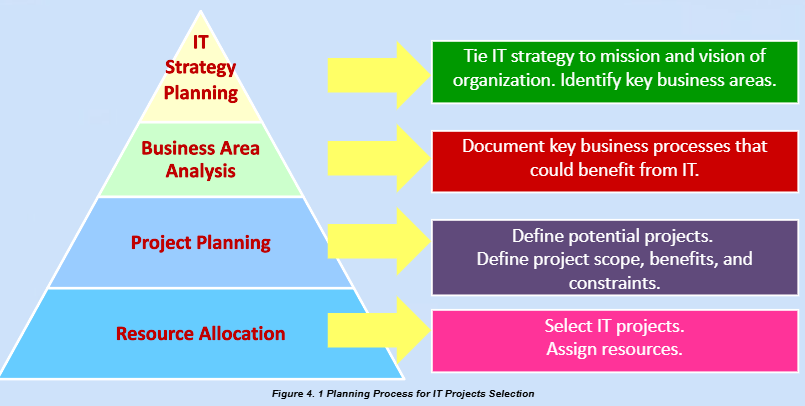
Identifying long-term objectives through the following:
analyzing the organization’s strengths and weaknesses;
studying opportunities and threats in the business environment;
predicting future trends; and
projecting the need for new products and services.
SWOT Analysis
Strengths, Weaknesses, Opportunities, and Threats
used as aid in strategic planning
Business Area Analysis
outlines documents the business processes that are vital to achieving strategic goals, sand aids in discovering which ones could most benefit from IT
Methods for Selecting Projects
Focusing on broad organizational needs
Categorizing IT projects
Performing NPV or other financial analyses
Using weighted scoring model
Implementing balanced scorecard
Focusing on broad organization needs
Top managers need to focus on achieving the various needs of the organization when deciding what projects to undertake, when to undertake them, and to what level.
One method for project selection based on broad organizational needs is determining whether they meet the first three important criteria: need, funding, and will.
Categorizing IT Projects
Problems
Opportunities
Directives
Problems
These are unwanted situations that prevent an organization from achieving its goals.
Opportunities
These are chances to improve the organization.
Directives
These are new requirements imposed by management, government, or some external influence.
Net Present Value
the method of calculating the expected net monetary gain or loss from a project by discounting all expected future cash inflows and outflows to the Net Present Value (NPV) present point in time
A positive NPV means the return from a project exceeds the cost of capital - the return available by investing the capital elsewhere.
Determine the cash inflows and outflows for the project.
Determine the discount rate.
A discount rate is the minimum acceptable rate of return on an investment. It is also referred to as the capitalization rate or opportunity cost of capital.
Calculate the NPV.
The mathematical formula for NPV is: NPV = Σt=0…n At / (1+r)t where t =year of the cash flows, A = amount of cash flow each year, and r =discount rate.
Return of Investment (ROI)
income divided by investment
required rate of return for projects
the minimum acceptable rate of return on an investment
based on the return that the organization could expect to receive else where for an investment of comparable risk
formulas for calculating financial ROI for an IT project or any other investment
Payback Period
Is the amount of time it will take to recoup the net amount invested in a project in the form of net cash inflows.
Payback Analysis
Determines how much time will lapse before accrued benefits overtake accrued costs.
When does Payback occurs?
It occurs when the net discounted cumulative benefits and costs reach zero.
Weighted Scoring Model
Is a tool that provides a systematic process for selecting projects based on various criteria:
Meeting broad organizational needs;
Addressing problems, opportunities, or directives;
The amount of time it will take to complete the project;
The overall priority of the project; and
The projected financial performance of the project.
These are needed to identify the criteria required to the project selection process:
Support for key business objectives
Has strong internal sponsor
Has strong customer support
Uses realistic level of technology
Can be implemented in one year or less
Provides a positive net present value
Has low risk in meeting scope, time, and cost objectives
Weights
Indicate how much you value each criterion or how important each criterion is.
Who developed a methodology called balanced scorecard?
Drs. Robert Kaplan and David Norton
Balanced Scorecard
Aids in the selection and management of projects in alignment with the business strategy.
It is used to convert an organization’s value drivers, such as , innovation, operational efficiency, and financial performance, into a series of defined metrics.
Metrics
were analyzed and recorded by the organizations to determine how well the projects have helped them in achieving strategic goals
Project Charter: INPUTS
Project statement of work
Business case
Contract
Enterprise environmental factors
Organizational process
Project Charter: TOOLS & TECHNIQUES
Expert Judgement
Project Charter: OUTPUT
Project Charter
Statement of Work (SOW)
Is a narrative description of products and services to be delivered by the project.
References the business need, product scope description and strategic plan
Business Case
Is a document that provides the required information from a business perspective to determine whether or not the project is worth investing for.
Contract
Specifies if the project is being done for an external customer.
The enterprise environmental factors that can influence the development of project charter include, but are not limited to:
Government or industry standards
Organization infrastructure
Marketplace conditions
The organizational process assets that can influence the development of project charter include, but are not limited to:
Organizational standard processes, policies, and standardized process definitions to be used in the organization
Project charters templates
Historical information and lessons learned knowledge base
Expert Judgement
Is used to evaluate the inputs that are used to develop the project charter.
Project Charter
Formally recognizes the existence of a project and provides direction on the project’s objectives and management
Allows a project manager to use the organizational resources to complete the project
Should be signed by key project stakeholders to acknowledge agreement on the need for and the intent of the project
Inputs, tools and techniques, and outputs
It specifies the following:
business needs;
current understanding of the customer’s needs; and
the new product, service, or result
Project Management Plan
It is a formal document used to coordinate all project planning documents and help guide a project’s execution and control.
It documents project planning assumptions and decisions regarding choices, facilitate communication among stakeholders, define the content, extent, and timing of key management reviews, and provide a baseline for progress measurement and project control
It is dynamic, flexible, and subject to change when the environment or project changes
It assist the project manager in leading the project team and assessing the project status
Its common elements are:
introduction or overview of the project
description of how the project is organized
management and technical processes used on the project
sections describing the work to be done, schedule, and budget information
Stakeholder Analysis
Documents information such as key stakeholder’s names and organizations, their roles on the project, unique facts about each stakeholder, their level of interest in the project, their influence on the project, and suggestions for managing relationships with each stakeholder.
Project Execution
Involves managing and performing the work described in the project management plan
Project manager and the project management team direct of the planned project activities, and manage the various technical and organizational interfaces that exist within the project
The main function of creating project plans is to guide project execution.
Having a good plan would result to good products and it should document the good work results included in it.
o improve the coordination between project plan development and execution, follow the rule: Those who will do the work should plan the work.
Tools and Techniques in Project Execution
Project management methodology
Project management information systems
Project management methodology
It follows a methodology describing not only what to do in managing a project, but how to do it
Project management information systems
Various organizations are using powerful enterprise project management systems that can be accessed via the internet
Monitoring and Controlling Project Work
It involves the following to determine what process improvements can be made:
collecting, measuring, and disseminating
performance information;
assessing measurements; and
analyzing trends
Project Performance
Should be monitored continuously by the project team to assess the overall condition of the project and to identify the areas that require special attention.
Tools and Techniques for Monitoring and Controlling Projects
Project management methodology
Project management information systems
Expert judgment
Earned value management
Inputs necessary to monitor and control project work:
Project management plan
Work performance information
Performance reports
Change requests
Outputs in Monitoring and Controlling Project Work:
Corrective actions
Preventive actions
Integrated Change Control
It identifies, evaluates, and manages changes throughout the project life cycle
Objectives of Integrated Change Control
Influencing the factors that create changes to ensure that changes are beneficial
Determining that a change has occurred
Managing actual changes as they occur
Inputs of Integrated Change Control
Project management plan
Work performance information (in a form of performance reports)
Requested changes
Recommended preventive and corrective actions
Recommended defect repair
Deliverables
Outputs of Integrated Change Control
Approved and rejected change requests
Approved corrective and preventive actions
Approved and validated defect repair
Deliverables
Updates to the project management plan
Change Control System
Refers to a formal, documented process that describes when and how the official project documents may be changed
It describes the people who are authorized to make changes, the for the change, and any automated or manual tracking systems that will be used by the project
Control Board (CCB)
It is a formal group of people who are responsible for approving or rejecting changes on a project.
It provides guidelines for the following:
preparing change requests
evaluating change requests
managing the implementation of approved changes
It consumes time in making decisions on proposed changes because they often meet only once a week or once a month and may not be able to make decisions in one meeting.