Interfaces and Cables
 Call Kai
 Learn
Learn Practice Test
 Spaced Repetition
 Match
Match Flashcards
 Knowt Play
1/19

There's no tags or description
Looks like no tags are added yet.
Name | Mastery | Learn | Test | Matching | Spaced | Call with Kai |
|---|
No analytics yet
Send a link to your students to track their progress
20 Terms
Bits and bytes
● 1 kilobytes (kb) = 1, 000 bits
● 1 megabits (mb) = 1,000,000 bits
● 1 gigbits (gb) = 1,000,000,000 bits
● 1 terabit (tb) = 1,000,000,000,000 bits
Ethernet Standards
● Defined in the IEEE 802.3 standard in 1983.
● IEEE = Institute of Electrical and Electronics Engineers
802.3i
Speed: 10 mbps
Common name: Ethernet
Informal name: 10base-t
Max Length: 100 m
Pairs: 2 pairs ( 4 wires)
802.3u
Speed: 100
Common name: Fast Ethernet
Informal Name: 100base-T
Max lenght: 100m
Pairs: 2 pairs ( 8 wires)
802.3ab
Speed: 1 gbps
Common name: Gigabit Ethernet
Informal name: 1000base-T
Max lenght: 100m
Pairs: 4 pairs (8 wires)
802.3an
Speed: 10 gbps
Common name: 10 Gig ethernet
Informal name: 10gbase-T
Max lenght: 100m
Pairs: 4 pairs ( 8 wires)
UTP
Unshielded Twisted Pair: It protects against EMI (Electromsgnetic Interference)
UTP Cables (10base- T , 100base-T)
Straight-through cable
Transmit (Tx) on pin 1 and 2 ( PC , Router) Switch Receive on those pin
Receive (Rx) on pin 3 and 6 (PC, Router) switches Transmit on those pins
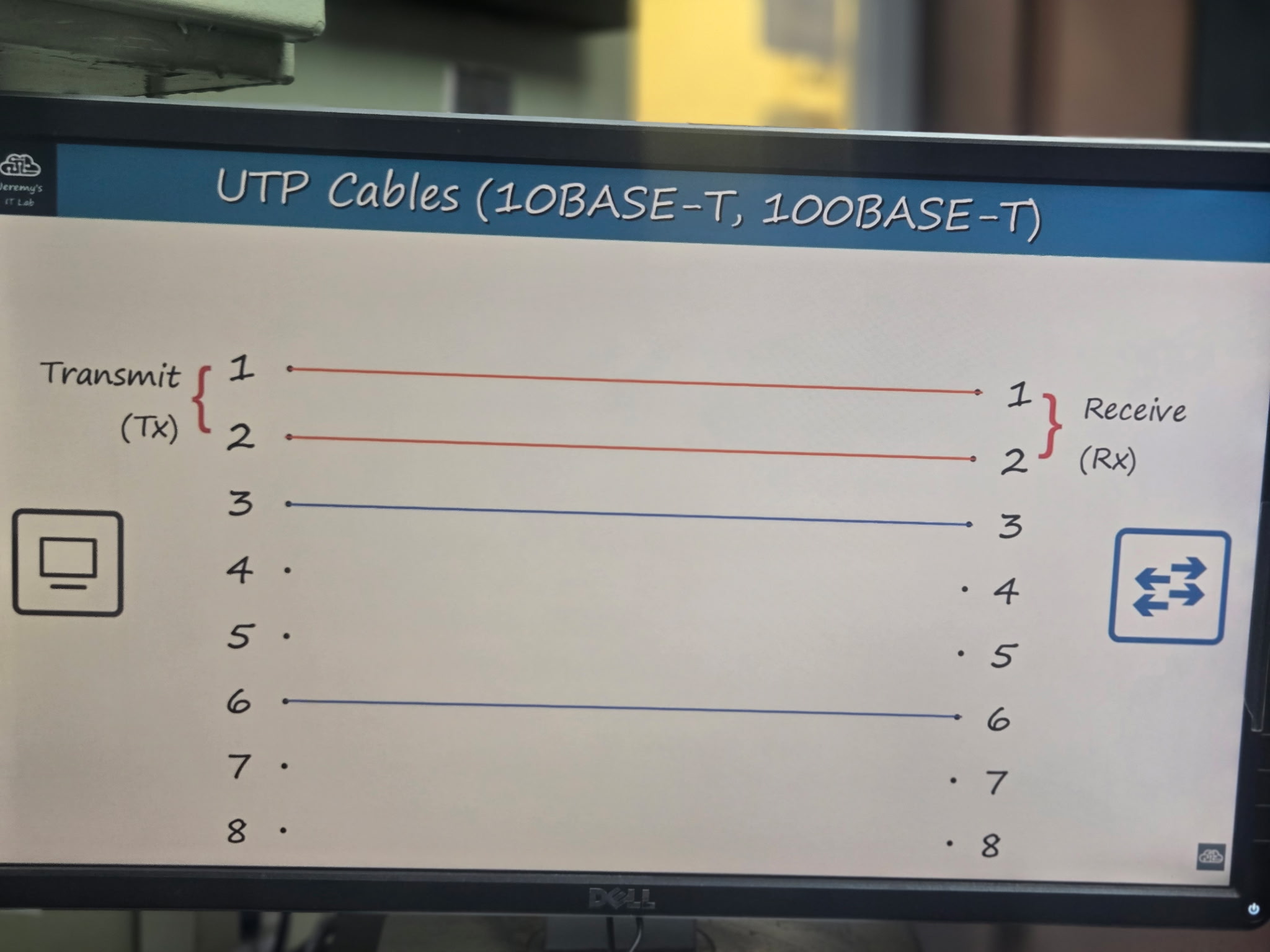
UTP Cables (10base- T , 100base-T) Crossover cable
Crossover cable
Transmit (Tx) on pin 1 to 3, 2 and 6 when connect two switches(Routers/PC)
Receive (Rx) on pin 3 to 1, 6 to 1, when connect two switches(Routers/PC)
When use switches with auto MDI-X
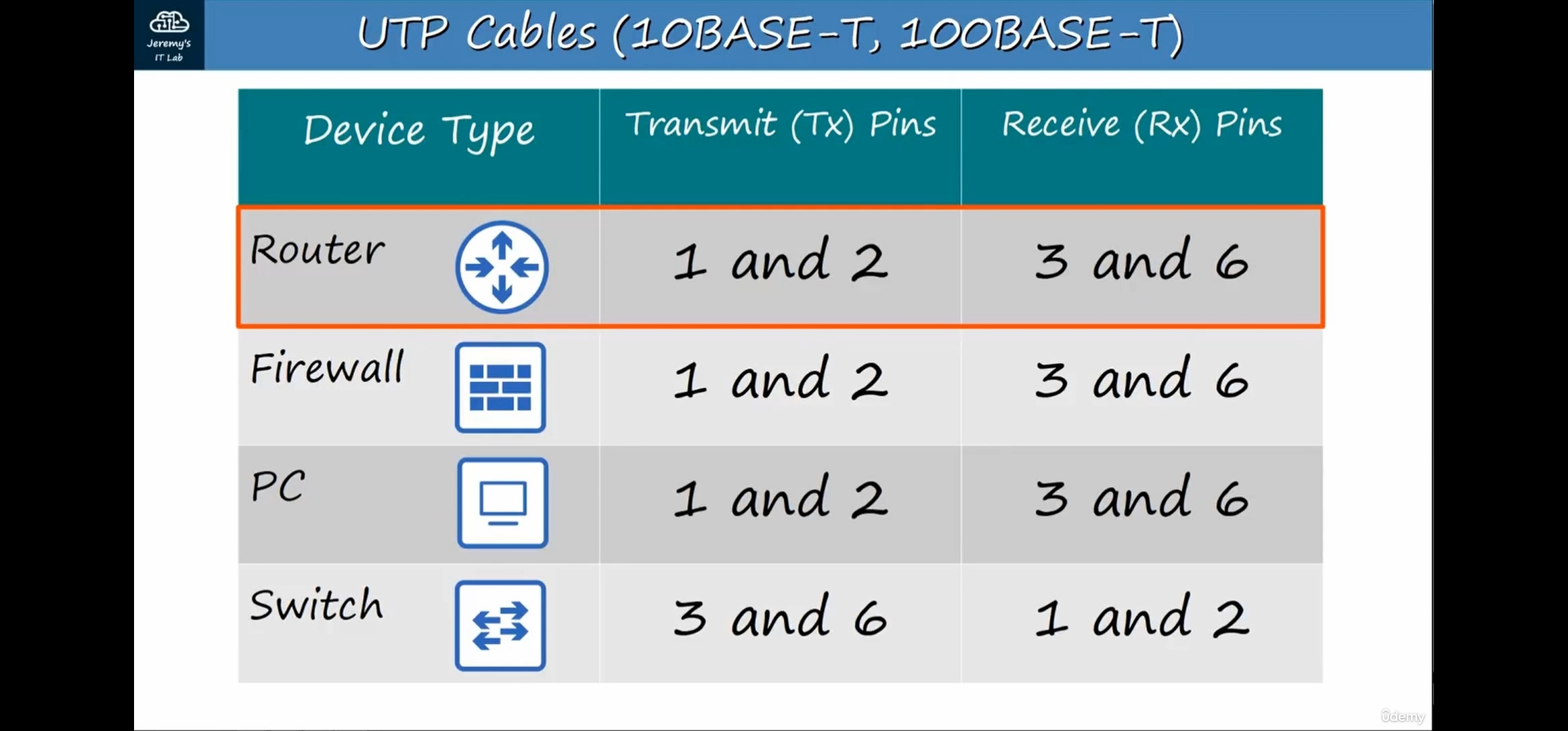
UTP cables pin tables (10Base-T, 100Base-T)
Device: Router uses pin 1&2(tx), 3&6(rx)
Device: Firewall same as Router
Device: PC. Same as Router
Device: Switch pin 3&6(tx), 1&2(rx)
SFP transceiver
Small form-facter pluggable
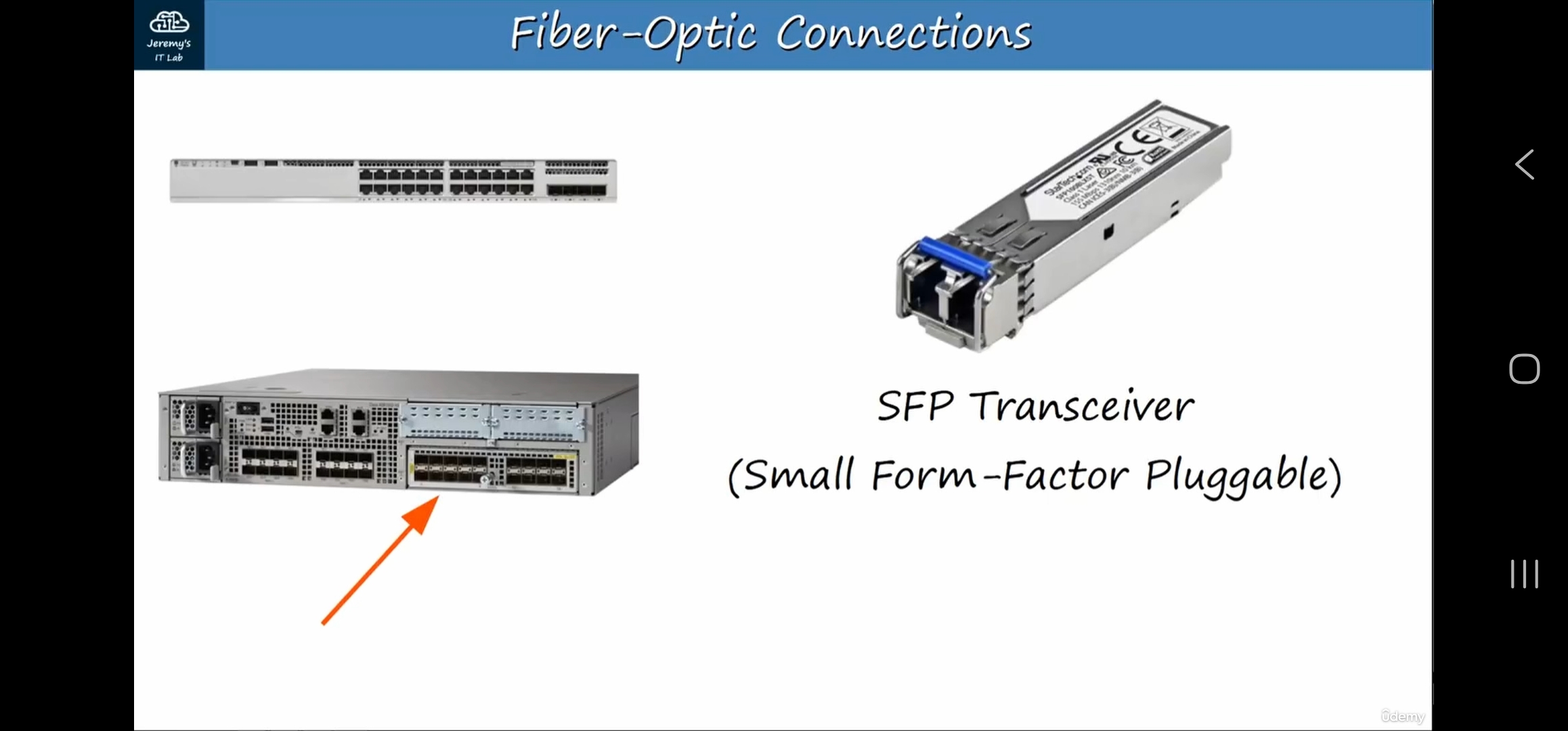
Fiber-Optic Connection
1: the fiberglass core itself
2: cladding that reflects light
3: a protective buffer
4: the outer jacket of the cable
Multimode Fiber
● Core diameter is wilder than single-mode fiber.
● Allows multiple angles (modes) of light waves to enter the fiberglass core.
● Allows longer cables that UTP, but shorter cables than single-mode fiber.
● Cheaper than single-mode fiber (due to cheaper LED-based SFP tranmitters)
Single-mode fiber
● Core diameter is narrower that multimode fiber.
● Light enters at a single angle (mode) from a laser-base transmitter.
● Allows longer cables that both UTP and multimode fiber.
● More expensive than multimode fiber ( due to more expensive laser-based SFP transmitters)
1000Base-LX
Stardard: 802.3z
Speed: 1 Gbps
Type: Multimode or Singlemode
Max length: 550m (MM) and 5km (SM)
10GBase-SR
Standard: 802.3ae
Speed: 10Gbps
Type: Multimode
Max length: 400m
10GBase-LR
Standard: 802.3
Speed: 10 Gbps
Cable type: Single-mode
Max lenght: 10 km
10GBase-ER
Standard: 802.3ae
Type: Single mode
Speed: 10 Gbps
Max lenght: 30 km
UTP cost
● Lower cost than fiber-optic
● Shorter maximum distance than fiber-optic (~100m).
● Can be vulnerable to EMI ( Eletromagnetic interference)
● RJ45 ports used with UTP are cheaper than SFP ports.
● Emit (leak) a faint signal outside of the cable, which can be copied (-security risk)
Fiber-Optice
● Higher cost that UTP
● Longer maximum distancecthat UTP
● No vulnerability to EMI.
● SFP ports are more expensive that RJ45 ports ( single-mode is more expensive than multimode)
● Does not emit any signal outside of the cable (=no security risks).