atomic theory and structure 1-4
 Studied by 0 people
 Call Kai
 Learn
Learn Practice Test
 Spaced Repetition
 Match
Match Flashcards
 Knowt Play
1/39

Earn XP
Description and Tags
fuh naw
Name | Mastery | Learn | Test | Matching | Spaced |
|---|
No study sessions yet.
40 Terms
wavelength variable & units
variable: λ
units: m, nm (10^-9m), Å (angstrom 10^-10m)
frequency variable and units
variable: 𝜈
units: hz, sec^-1, cycles/sec
higher frequencies lead to
high nrg
unit c
speed of light
2.998 × 10^8 m/s
relationship between wavelength, frequency and speed of light
λ * 𝜈 = c
order of light
LOW → HIGH
gamma, xray, UV, visible, IR, micro, radio
low energy → λ & 𝜈
long wavelength, low frequency, low nrg & vice versa
gamma
10^-12
xray
10^-10
ultraviolet
10^-8
visible
4×10^-7 → 7×10^-7
purple → red
400 nm → 700 nm
infared
10^-4
microwave
10^-2
radio
10²
Newton’s conclusion
light is a particle
pattern seen from the double slit experiment
light is a wave that can interfere with itself
Young’s conclusion
light is a wave
constructive interference

destructive interference
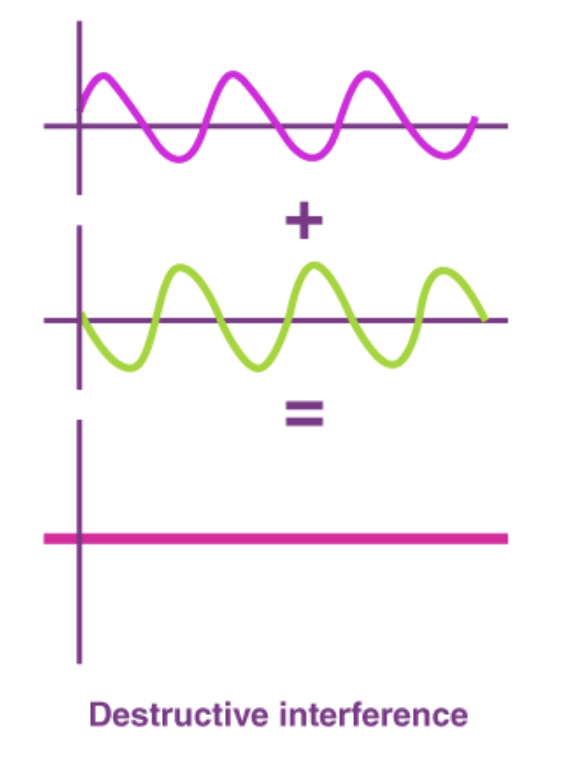
name of “packets” of energy
quanta
Planck's formula & constant
Formula: E = h𝜈 or ΔE = nh𝜈
h (constant) = 6.626 × 10^-34 Js
on formula sheet
energy of a wavelength of purple light
400 nm (4×10^-7) → (h*c)/𝜈
planck’s conclusion
light (& nrg) is a quanta
what happens when you shoot lower wavelengths at sodium metal
electrons are removed with higher velocity (?)
particles of light (einstein)
photons
when a high nrg photon hits an electron, what happens to the ecess nrg after the electron has left the metal?
excess nrg is converted to KE so the electron moves faster
ionization effect
left → right nrg increases making it harder to remove electrons
einstein’s conclusion
light is a particle
De Broglie’s equation
λ = h/p = h/mv
p = momentum
m = kg
v = m/s
NOT on constant sheet
radius of the nucleus
10^-15 m
electrons don’t exist in the nucleus
bond distance
10^-10 m
de Broglie’s conclusion of matter
matter is a wave
Rydberg equation
1/λ = R(1/n21 - 1/n22)
Rydberg constant (R)
1.096776×10^7 m^-1
What is the value of n1 for the Balmer & Rydberg equations
n1 = 2
Bohr Laws (?)
electrons can only exist in certain states of levels. each is associated with a value of “n”
the states with higher n are higher in nrg
an electron can be promoted to a higher state by absorbing a photon whose energy equals the difference between the two states
an electron dropping to a lower state emits a photon whose energy equals the difference between the two states
energy of an electron
-2.178×10^-18 J * (Z2/n2)
Z = nuclear charge (atomic #)
simplified Balmer formula (Bohr)
ΔE = h𝜈 = -2.178×10^-18J(Z2/n2f - Z2/n2f)
how many nrg levels are in an atom
infinite
When an electron is at the highest possible nrg level, or the highest value of n, what is its nrg? what does this mean for the electron
E = 0; the electron has been removed from the atom
 Note
Note  Flashcards (21)