RADAR Countermeasures
 Call Kai
 Learn
Learn Practice Test
 Spaced Repetition
 Match
Match Flashcards
 Knowt Play
1/11

There's no tags or description
Looks like no tags are added yet.
Name | Mastery | Learn | Test | Matching | Spaced | Call with Kai |
|---|
No analytics yet
Send a link to your students to track their progress
12 Terms
Electronic Warfare (EW)
Three branches
Electronic Support Measures (ESM) → Electronic Support (ES)
Electronic Counter Measures (ECM) → Electronic Attack (EA)
Electronic Counter-Counter Measures (ECCM) → Electronic Protection (EP
Electronic Support Measures
Search the radio spectrum for emissions and analyse the results, identifying friendly, neutral, and enemy electronic emissions
Provides warning of potential attack, knowledge of enemy capabilities and an indication of enemy use of active countermeasures.
Requirements of an ESM receiver
Wide spectrum surveillance - typically 30kHz to 50GHz
Wide dynamic range
Angle-of-Arrival measurement
Signal Analysis capability - Pulse width, PRF, scan rate, side-band characteristics, and modulation
Display
Recording System - save and analyse data
Electronic Counter Measures
Jamming and deception
Can be used against enemy sensors - we concentrate on ECM against RADAR
The basic purpose of ECM is to interfere with the operation of an enemy RADAR system
Cause confusion, corrupt information, provide deceptive information
Three basic ways to implement ECM
Radiate active signals to interfere with the RADAR - jamming
Change the electrical properties of the medium between the target and the RADAR - chaff
Change the RCS of the target - stealth
ECM - Jamming
Illuminate the enemy radar with a false signal. This may be in the form of random noise or be a more sophisticated signal designed to provide false information on target parameters such as range and RCS.
The power of the jammer is crucial. In order to be effective, the ECM transmitter must be capable of emitting enough power in the bandwidth of the victim receiver to mask (jam) its intended signal or to realistically simulate a deceptive signal.
When an ECM transmitter is used against only one missile, one radar, or one communications device the transmitter can concentrate its available power output into a narrow spectrum.
If the ECM transmitter operates against several devices separated in frequency, it must spread its available power output over a correspondingly increased spectrum.
Jamming Burnthrough
The range at which its signal is equal to the target return (signal-to-jam ratio = 1)
Important Notes:
RJ2 vs R4 is a big advantage for the jammer
G vs G(θ) is usually a big disadvantage for the jammer. Low sidelobe radar antennas reduce jammer effectiveness.
Given the geometry, the only parameter that the jammer has control of is the ERP (PJGJ)
The RADAR knows it is being jammed. The jammer can be countered using waveform selection and signal processing techniques.

Noise Jamming
A high-power continuous noise signal is transmitted to mask radar echoes.
The jammer requires large average power – ok on ships but takes up space and weight on aircraft.
When the radar antenna is pointed toward the jammer, the radar sees signals at all ranges.
The effect on a PPI scope is to create a solid line at the azimuth of the jammer.
This line, called a strobe, indicates to the operator that a jammer is present and gives its azimuth, but he does not know the range of the jammer.
Thus, jamming has the bad effect that it can highlight the target's presence and direction and serve to identify it as hostile, but it has the good effect of denying the radar operator the range of the target.
Spot Jamming
All the power output of the jammer is concentrated in a very narrow bandwidth, ideally identical to that of the radar. Need good ESM to identify operating frequency of radar.
Barrage and Sweep Jamming
Spread their energy over a bandwidth much wider than that of the radar signal.
Used against a number of radars operating at different frequencies
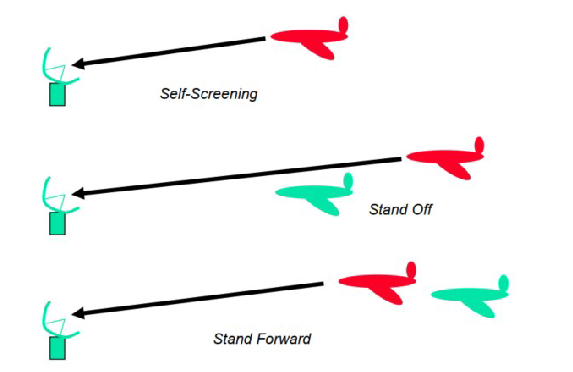
Jamming Tactics
Self-screening jammers (SSJ).
In this situation a unit carries jamming equipment for its own protection.
This results in a trade-off between weight and space reserved for ECM equipment and that reserved for sensors, weapons, and fuel.
The trade-off is most critical in aircraft and least critical in ships.
Stand-off jammers (SOJ).
Jamming unit remains just outside the range of enemy weapons, providing screening for attacking units that penetrate enemy defences.
The advantage of SOJ is that the jammer is safe from enemy home-on jamming (HOJ) weapons.
The disadvantage is that burn through occurs earlier on the attack units because the jammer must remain at very long range, while the attack units close the enemy to very short range.
Stand-forward jammers (SFJ).
The jamming unit is placed between enemy sensors and the attack units.
This situation is most dangerous for the jamming unit because it is a prime target for weapons systems - Home-on-Jam (HOJ) and Anti Radiation (ARM) weapons.
Often unmanned drones are used as SFJ