Case 3: Cognitive development
 Call Kai
 Learn
Learn Practice Test
 Spaced Repetition
 Match
Match Flashcards
 Knowt Play
1/20

There's no tags or description
Looks like no tags are added yet.
Name | Mastery | Learn | Test | Matching | Spaced | Call with Kai |
|---|
No analytics yet
Send a link to your students to track their progress
21 Terms
Adaptation
it includes two theories:
assimilation and accomodation
Assimilation
new experiences are reinterpreted so that they fit into old ideas
Accomodation
refining old ideas so that they accomodate the new experiences
Sensorimotor stage (birth - 2 years)
the world is explored through sensory functions and motor contact
object permanence develops, the child recognises that objects continue to exist even when they are no longer present
Sensorimotor intelligence stages 1 and 2
Primary circular reactions
involves the infant’s own body
reflexes, senses motion and noise
Sensorimotor intelligence stages 3 and 4
Secondary Circular Reactions
involves the infant with an object or another person
Sensorimotor intelligence stages 5 and 6
Tertiary Circular Reactions
actively discover properties of people or objects
Pre operational (2-6 years)
symbolic thought develops, the child can think, speak, and act in relation to objects that are not physically present
thinking is still illogical and egocentric (egocentrism) - the child believes that the world revolves around them and cannot yet see others’ perspectives
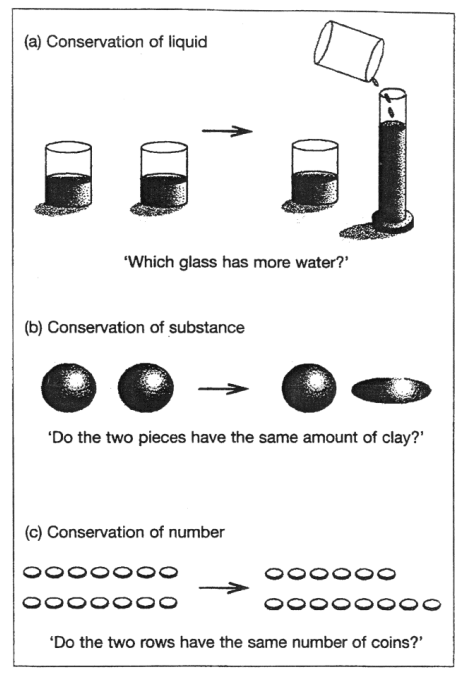
Preoperational thought: Conservation
children do not understand conservation
Conservation = characteristics remain unchanged regardless of other changes
conservation of liquid or volume
conservation of substance or matter
conservation of number
conservation of length
Pre-operational thought: Centration
the child focuses on one aspect of a situation to the exclusion of all others
EXAMPLES:
daddy is a father but cannot be a brother
cats are cats but lions and tigers cannot be cats
Pre-operational thought: Focus on Apperance
The child ignores all attributes except appearance
Daddy shaves his beard and baby does not understand
Girl cutting her hair short thinks that she has turned into a boy
Pre-operational Thought: Static Reasoning
The child assumes that the world is unchanging: Always in the state in which the child currently encounters it.
A child is shocked to see his preschool teacher buying groceries
A boy watching TV leaves the room and believes that he will commence watching his program exactly where he left off when he returns
Pre-operational Thought: Irreversibility
The child fails to recognise that reversing a process can sometimesrestore whatever existed before the transformation occurred.
Children cannot see that if you pour the liquid from the tall container back into the original one, it will remain the same quantity.
Concrete operational (6-11 years)
logical thinking about concrete objects develops
conservation develops; the ability to add and subtract
egocentrism diminishes
Logical principles of Concrete Operational Thought:
Classification: Process of organizing things into groups, categories or classes according to some property they have in common
Concrete operational thought: Identity
Certain characteristics of an object remain the same even if other characteristics change
Concrete operational thought: Reversibility
Sometimes a thing that has been changed can be returned to its original state by reversing the process by which it has been changed
Formal Operational (11 years - adolescence)
abstract reasoning and hypothesising develops
Hypothetical though
formulate hypotheses and test them logically
Inductive Reasoning
Specific Principles/Particulars then to gain a general conclusion
she is nurturing, caring and has children = she is a mother
Deductive Reasoning
general statement, premise or principle and then deduce a specific conclusion/conclusions
if she is a mother = she is nurturing, caring and has children