Fashion Analytics Final
 Studied by 0 people
 Call Kai
 Learn
Learn Practice Test
 Spaced Repetition
 Match
Match Flashcards
 Knowt Play
1/30

There's no tags or description
Looks like no tags are added yet.
Name | Mastery | Learn | Test | Matching | Spaced |
|---|
No study sessions yet.
31 Terms
Understand the main differences between pick and price insight vs rate and rank and ask and answer
- In a rate and rank, the outputs are style score and sentiment, no pricing involved and it ranks creative concepts, messaging, mood boards. Helps you figure out trends and the sentiment. Does not tell you how successful an item will be
- Pick and price gives you predictive pricing and allows you to build an assortment that is optimized, what products will be most successful on the floor
Gives you Value score, sentiment, model price, comments
Protects your margins and helps you know which items are winners and losers
- Ask and answer is more of a survey where you can understand concepts
What are reference items
Item you have previously sold that were best or worst sellers. Used to identify game respondents who
know the most about the products and target the consumer whose feedback you want
What is the model price
a consensus on what people will believe the market is willing to pay
for an item. It incorporates weighted and filtered pricing responses along with
sentiment responses. In essence, it can be viewed as a predictor of the AUR over the
life of product
What is sentiment
a direct representation of all consumer responses
What is the ticket price
designated/assigned price of the garment
What are attributes
details about the test items like the color, material, silhouette, etc
Up to how many test items can you have
15 test items
Understand what the value score means
multi-variate algorithm that is a composite of a number of factors
including price, sentiment, and the shape of the price response curve. It is similar to
your credit score
strongest measure of how an item is going to perform when it
hits the market.
• Total Value Scores range from 1 – 10, with 10 indicating the highest potential value, and 1 indicating the lowest potential value.
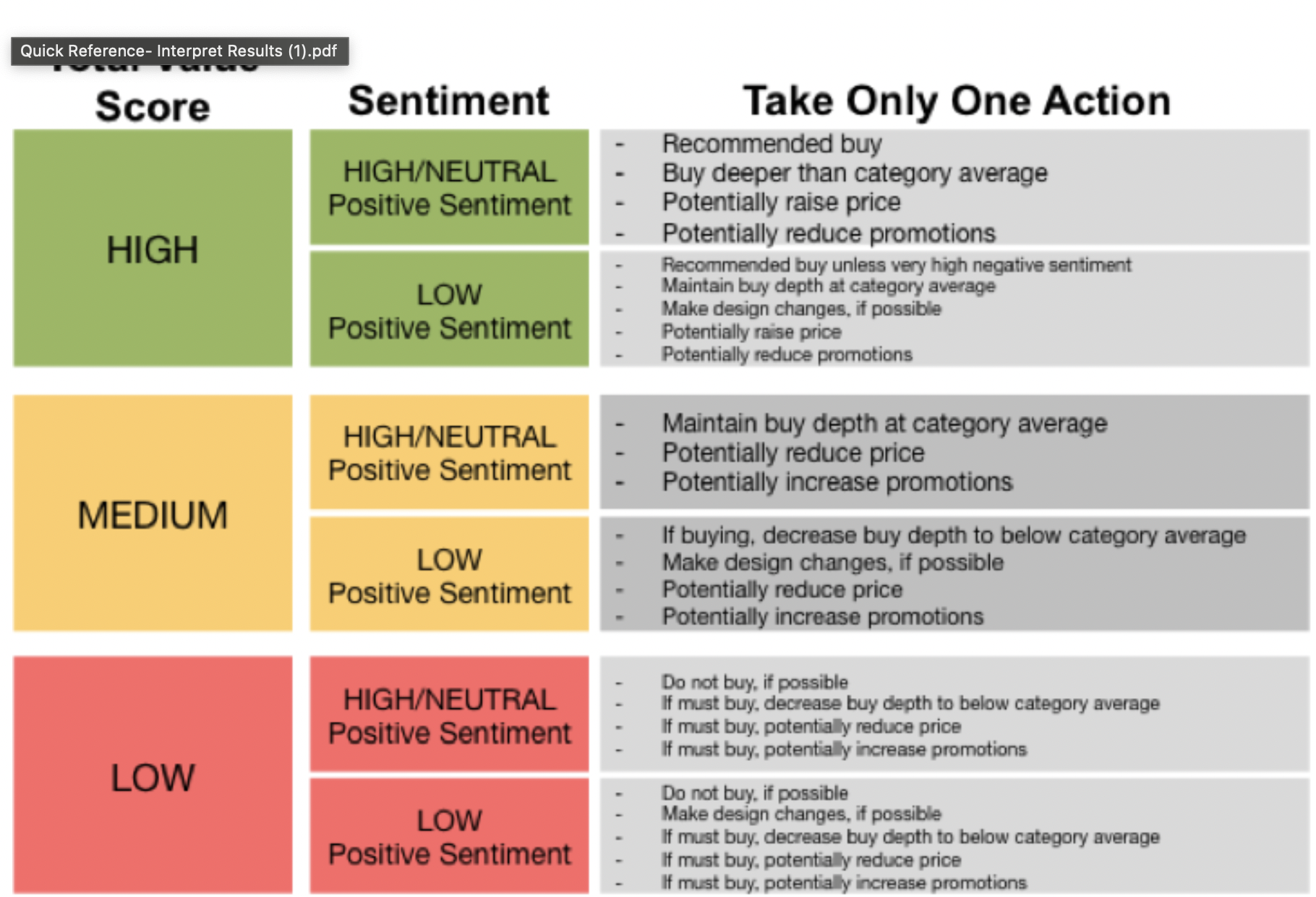
Understand how to interpret the results (Gives a chart to analyze)
The higher the Total Value score, the more likely an item is to perform well when it is brought to market.
Why do new products fail
Changing consumer preferences, long product introduction cycles, inaccurate store testing results and over and under pricing
What is the demand curve
illustrates the distribution of desirability for your item at various price points. The highest point tells you the price at which you are likely to sell the most units of the item. Different shapes indicate different sale and discount patterns
What is an example of a good objective
Determine which back pocket detail consumers like best for jeans: “Which pocket detail do consumers like best for
jeans?”
This objective is good because:
• It’s specific. It clearly identifies the one thing you want to learn (which pocket detail consumers like best).
• It tests for one variable. It clearly identifies the specific variable (pocket detail) on one type of item (jeans) that’s being tested.
• It’s actionable. After you review the results, you’ll have information to help you choose the right pocket detail. You’ll have an answer to the question, “Which pocket detail do consumers like best for jeans?
Understand what the colors mean when running an insight (pick and price)
RED: not enough responses to end the
Insight.Yellow: a fair number of responses to end
the insight, if you have time, you can wait for
more responses before ending the Insight.GREEN: enough responses to end the
insight
What are the 5 steps to building a pick and price insight
set objective
select items
engage respondents
apply analytics
gain insight
What is the product failure rate
over 50%
Image files should be no bigger than 10 mb and resolution should be 300 MG/MI
Image files should be no bigger than 10 mb and resolution should be 300 MG/MI
Review global vs local settings
Test items need to be in certain price range from each other
Item prices should be within a range of 1x - 1.5x of each other.
What are the various types of survey questions you can ask
single selection, multi selection, text (freeform), image choice selection, ranking
How many should you include to prevent respondent fatigue
3 to 5 questions
Understand what is insight strategy and planning
consumer trend and insights
Understand item trends and consumer trends over time
Analyze brand or portfolio health
Assess competitive positioning
forecasting
forecast financial results
access regional forecasts
strategic insights
macroeconomic, social, and cultural trends
whitespace and brand opportunities
What is insight design merchandising and sourcing
Concept Research, Ideation & Sourcing
Explore concept attributes
Gauge consumer trends
Test mood boards and design themes
Plan fabric and country of origin
product design
identify valued attributes
Decide licensing and logo
Test whitespace concepts and items
assortment building
Maximize product success
Identify winning assortments by region or country
Assess sourcing
Analyze competition
assortment rationalization
optimize SKU rationalization
optimize reach/basket
What is insight pricing
Price Optimization
Optimize pricing strategy
Determine initial pricing
Align promotion strategy
Align markdown planning
Margin Optimization
Model margin forecasts
Strategize cost-engineered items
Assess key item price sensitivity
What is insight supply chain planning
Plan and Inventory optimization
Determine initial buy depth
Allocation Optimization
Maximize initial allocation: region or demographics
Assess reach/basket per region, country, or channel
In season optimization
Assess replenishment depths
Revise allocations
Revise pricing
What is insight marketing and selling
Brand & Wholesale Sales
Increase sell-in
Perform competitive analysis
Enhance retail channel offerings
Market Research
Target profiles and personas
Gauge brand health and perception
Engage influencers / social media
Creative & Messaging
Optimize ad, web, catalog layouts, models and items
Improve store layouts and displays
Align wording and packaging with target segments
Campaigns & Targeting
Target segments with optimal materials
Incentivize and convert sales thru engagements
Improve CRM records
First insight platform boosts sales and gross margins by how much
4-10%
Insight suite pricing reduces markdowns by what percent
up to 25%
First insight reduces sample costs by how much
20-30%
Manufacturers can cut up to what percentage on product development time by using first night
30-40%
First insight delivers value in many ways. For example it allows you to buy deeper in winning items, which leads up to what percentage of improvement of what product offering
50-80% improvement in new product success rates
Francesca’s Webinar notes
tested logos for their new tween brand, Franki