StemUp: AQA A level Physics 3.4.1 Force, energy and momentum
 Call Kai
 Learn
Learn Practice Test
 Spaced Repetition
 Match
Match Flashcards
 Knowt Play
1/132

There's no tags or description
Looks like no tags are added yet.
Name | Mastery | Learn | Test | Matching | Spaced | Call with Kai |
|---|
No analytics yet
Send a link to your students to track their progress
133 Terms
What is a scalar quantity? (1)
A scalar has magnitude only and no direction.
What is a vector quantity? (1)
A vector has both magnitude and direction.
What are some examples of scalar quantities? (5)
- Mass.
- Temperature.
- Speed.
- Distance.
- Energy.
What are some examples of vector quantities? (5)
- Force/weight.
- Acceleration.
- Velocity.
- Displacement.
- Momentum.
How do you calculate the resultant of two perpendicular vectors? (2)
- To calculate the resultant of two perpendicular vectors, use Pythagoras' theorem.
- Square both magnitudes, add, then take the square root.
How do you find the direction of a resultant vector? (2)
- To find the direction of a resultant vector, use trigonometry.
- tanθ = opposite / adjacent.
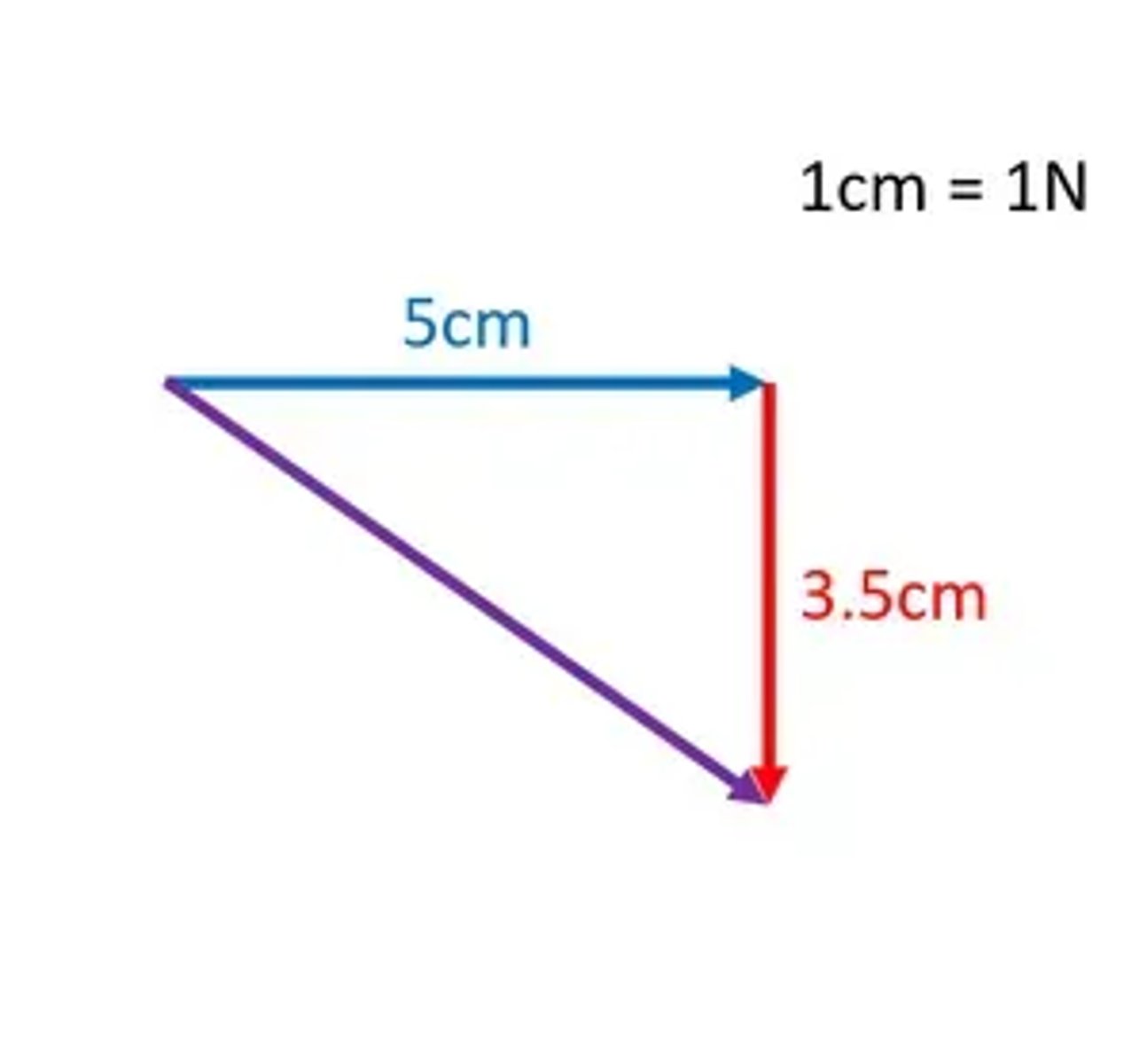
How are scale diagrams drawn to add non-perpendicular vectors? (1)
Draw each vector to scale and direction using a ruler and protractor.
How do you find the resultant vector using a scale diagram? (2)
- To find the resultant vector using a scale diagram, complete a triangle or parallelogram.
- Then measure the magnitude and angle of the resultant.
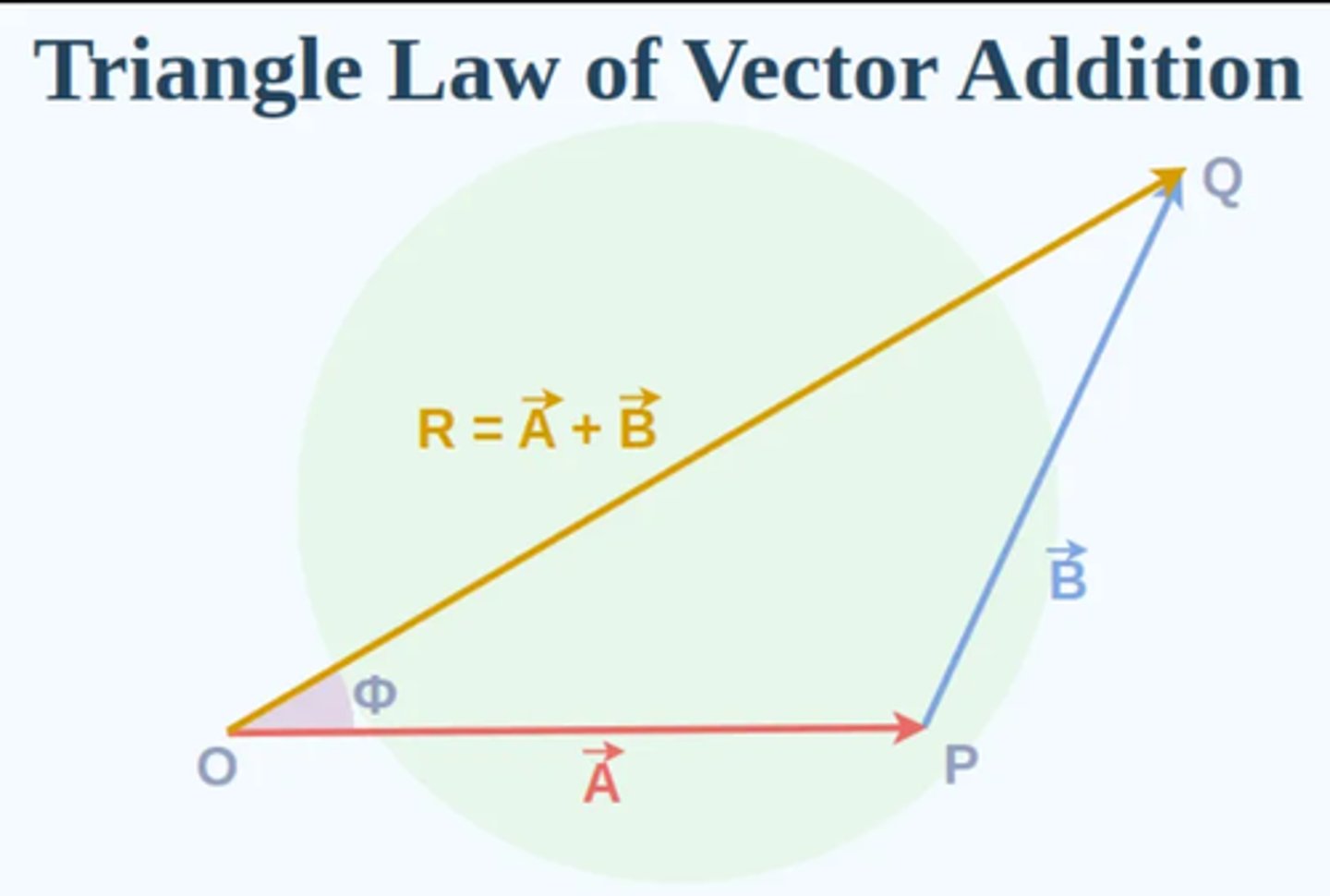
How can two vectors be added graphically using the triangle rule? (2)
- Place vectors tip to tail in correct direction and complete the triangle.
- The third side from start to end point is the resultant.
What does the triangle rule for vectors look like? (2)
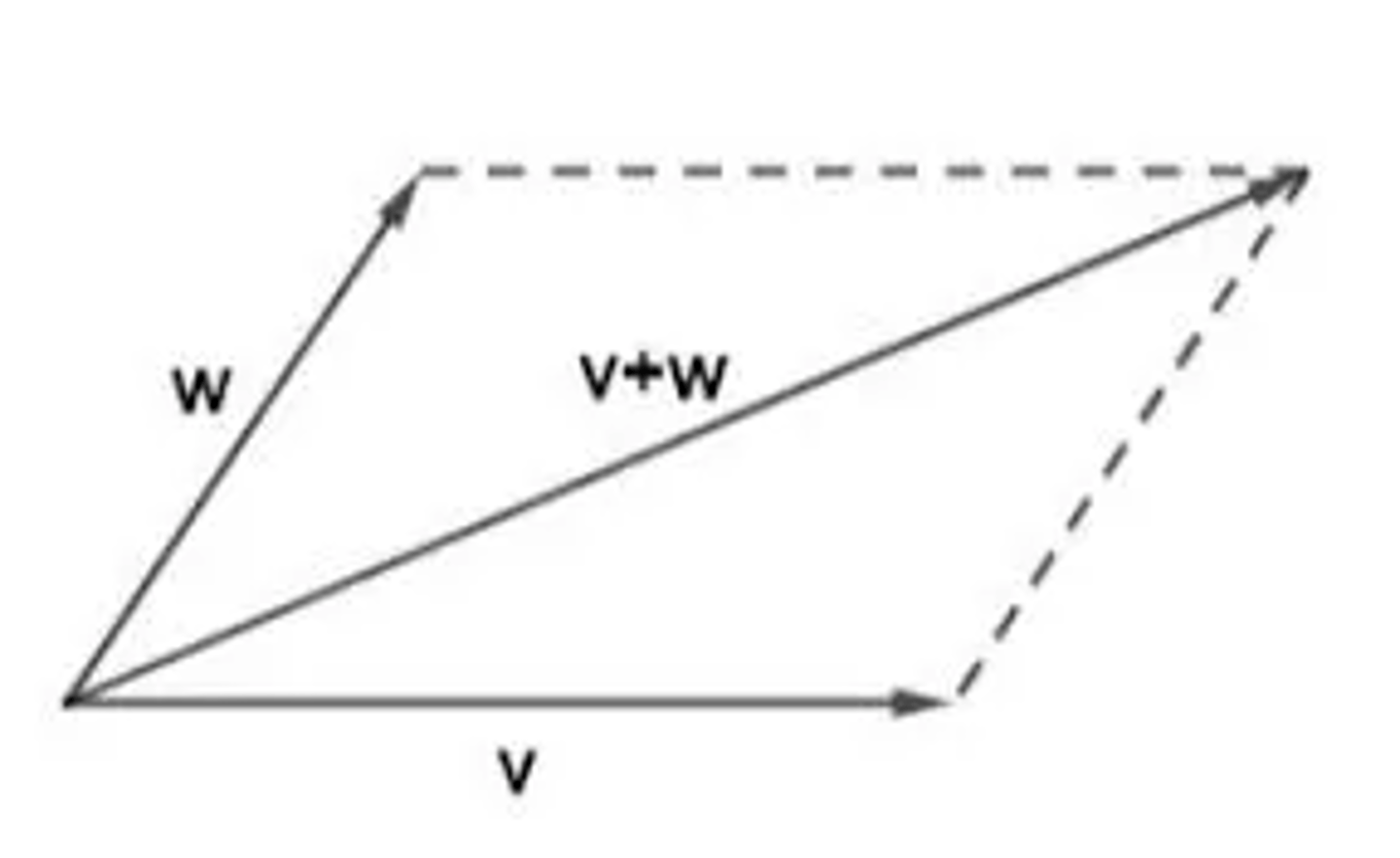
How can two vectors be added graphically using the parallelogram rule? (2)
- Place both vectors tail-to-tail and draw a parallelogram.
- The diagonal from the origin is the resultant vector.
What does the parallelogram rule for vectors look like? (2)
What do scale diagrams used to find a resultant vector look like? (3)
How do you resolve a vector into components? (4)
- Split the vector into horizontal and vertical parts using trigonometry.
- Horizontal: x = V cosθ.
- Vertical: y = V sinθ.
- Where V is the magnitude of the vector and θ is the angle measured anticlockwise from the horizontal to the vector.
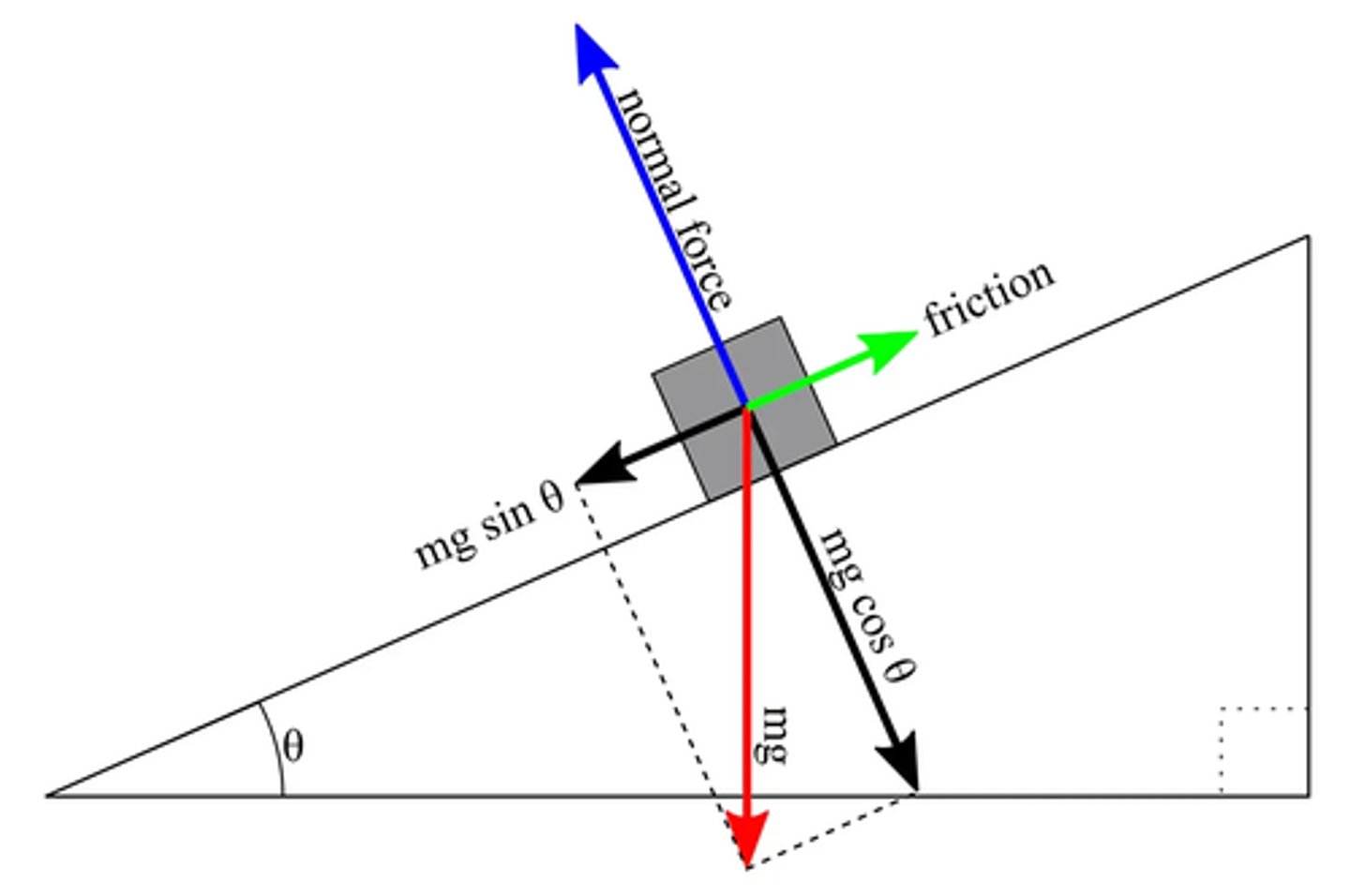
What is the force along an inclined plane? (1)
The force along an inclined plane is the component of weight parallel to the slope.
What is the force perpendicular to an inclined plane? (1)
The force perpendicular to an inclined plane is the component of weight acting normal to the slope's surface.
How do you use a diagram to find components on an incline? (2)
Draw the weight vector and resolve it into parts parallel and perpendicular to the slope.
What are the conditions for equilibrium of an object? (3)
- All forces acting on the object must cancel.
- The sum of anticlockwise moments about a point must be equal to the sum of clockwise moments around that same point.
- So, there is no resultant force or moment acting on the object.
What does equilibrium mean in terms of motion? (2)
- Equilibrium refers to the state of an object being either stationary or moving at constant velocity.
- As per Newton's first law.
How can you check equilibrium using force components? (2)
- Add all horizontal and vertical force components.
- If both sums equal to zero, it is in equilibrium.
How can a scale diagram show equilibrium? (2)
- Three forces must form a closed triangle on a scale diagram.
- Then, the object is in equilibrium.
How are forces at angles resolved in equilibrium problems? (2)
- Resolve each force into horizontal and vertical components.
- Then set the total in each direction to zero for equilibrium.
What is meant by weight? (1)
Weight is the force acting vertically downwards on an object due to gravity.
What is the equation for weight? (2)
- The equation is weight = mg.
- Where m is the mass of the object (kg) and g is the gravitational field strength on Earth's surface (9.81 ms^-2).
What is meant by a moment? (2)
- A moment is the turning effect of a force around a point.
- This depends on how far the force is from that point.
What is the equation for calculating a moment? (1)
The equation is moment = force × perpendicular distance from the point to the line of action of the force.
What do moments acting on an object look like? (2)
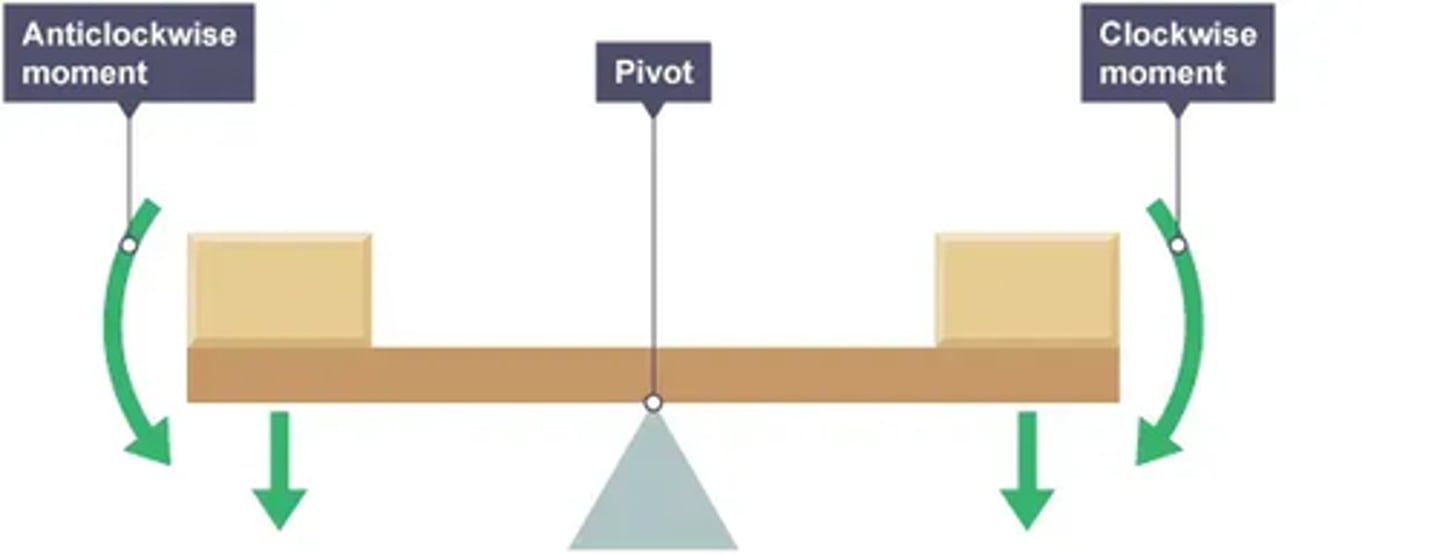
What is a couple? (2)
- A couple is two equal forces that act in opposite directions.
- In the same plane (coplanar) , but not along the same line.
How do you calculate the moment of a couple? (1)
To calculate the moment of a couple use moment = one of the forces × perpendicular distance between the lines of action of the forces.
What is the principle of moments? (2)
- The principle of moments regards an object in equilibrium.
- The total clockwise moment about any pivot must equal the total anticlockwise moment.
How do you use the principle of moments to find an unknown force? (3)
- Choose a pivot point and calculate moments about it.
- Do this by multiplying each force by its perpendicular distance to the pivot point.
- Set clockwise and anticlockwise moments equal, then solve the equation for the unknown force.
What is the centre of mass of an object? (1)
Centre of mass is the point where the entire weight of the object appears to act.
Where is the centre of mass in a uniform object? (1)
In a uniform object, the centre of mass is located at its geometric centre.
How do you find the centre of mass geometrically? (2)
- The centre of mass is at the centre of an object where the lines of symmetry of the object cross.
- The centre of mass is halfway through the thickness of the object where the lines of symmetry meet.
How do you find the centre of mass experimentally? (2)
- Hang an object freely from a point and draw a line downwards from that point.
- Repeat this for a different point and where the lines cross is where the centre of mass is.
How is the centre of mass related to the stability of objects? (2)
- An object will be stable if it has a low centre of mass and a wide base area.
- The higher the centre of mass and wider the base, the less stable an object is.
What is speed? (2)
- Speed is a scalar quantity that tells how fast an object is moving.
- Speed does not consider the object's direction.
What is displacement? (1)
Displacement is a vector quantity that shows the overall distance moved, from a starting point, in a particular direction.
What is velocity? (1)
Velocity is the rate of change of displacement, including both magnitude and direction, making it a vector quantity.
What is the equation for velocity? (2)
- The equation is v = Δs / Δt.
- Where Δs is change in displacement (m) and Δt is change in time (s).
What is acceleration? (1)
Acceleration is a vector quantity that shows the rate of change of velocity over time.
What is the equation for acceleration? (2)
- a = Δv / Δt.
- Where Δv is change in velocity (m/s) and Δt is change in time (s).
What is instantaneous velocity? (1)
Instantaneous velocity is the speed and direction of an object at a specific moment in time.
How is instantaneous velocity found using a graph? (1)
Instantaneous velocity is found from the gradient of a tangent to the curve on a displacement-time graph.
What is average velocity? (1)
Average velocity is the total displacement divided by the total time taken.
What is uniform acceleration? (1)
Uniform acceleration refers to when an object's acceleration stays constant over time.
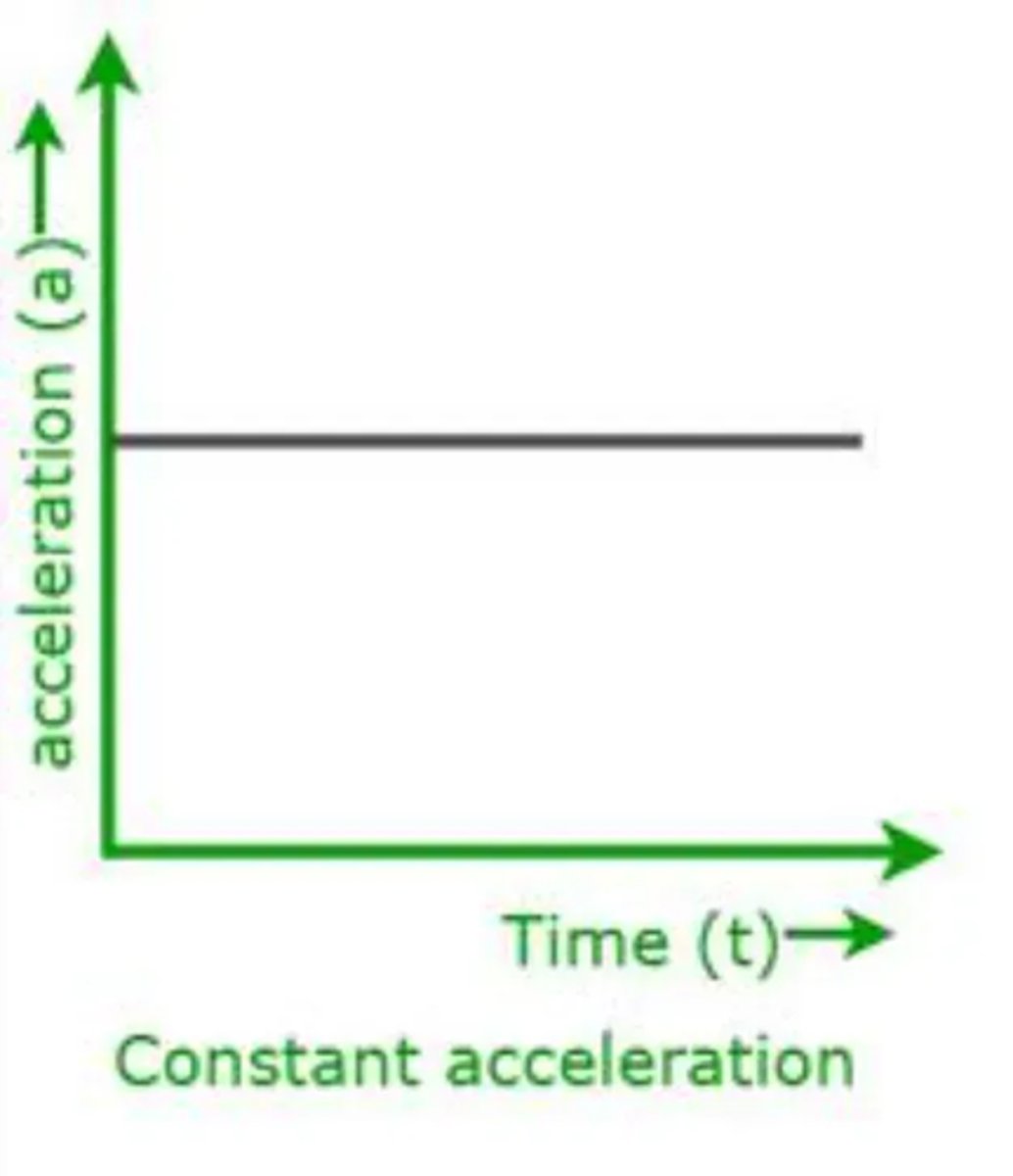
How is uniform acceleration shown on an acceleration-time graph? (1)
Uniform acceleration appears as a horizontal straight line on the graph.
What is non-uniform acceleration? (1)
Non-uniform acceleration refers to when an object's acceleration changes with time.
How is non-uniform acceleration shown on an acceleration-time graph? (1)
Non-uniform acceleration appears as a line with a constant or changing gradient.
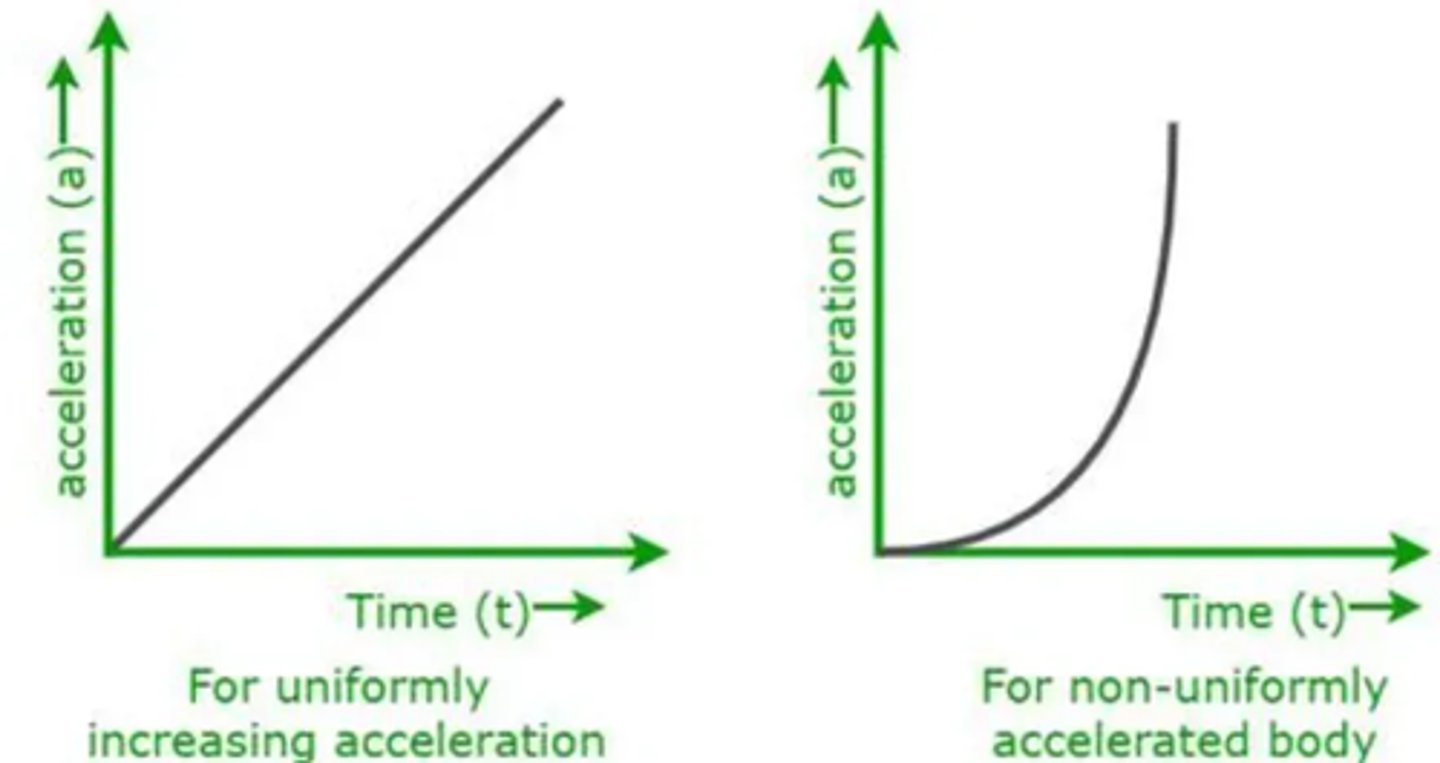
What does a velocity time graph look like for uniform and non-uniform acceleration? (2)
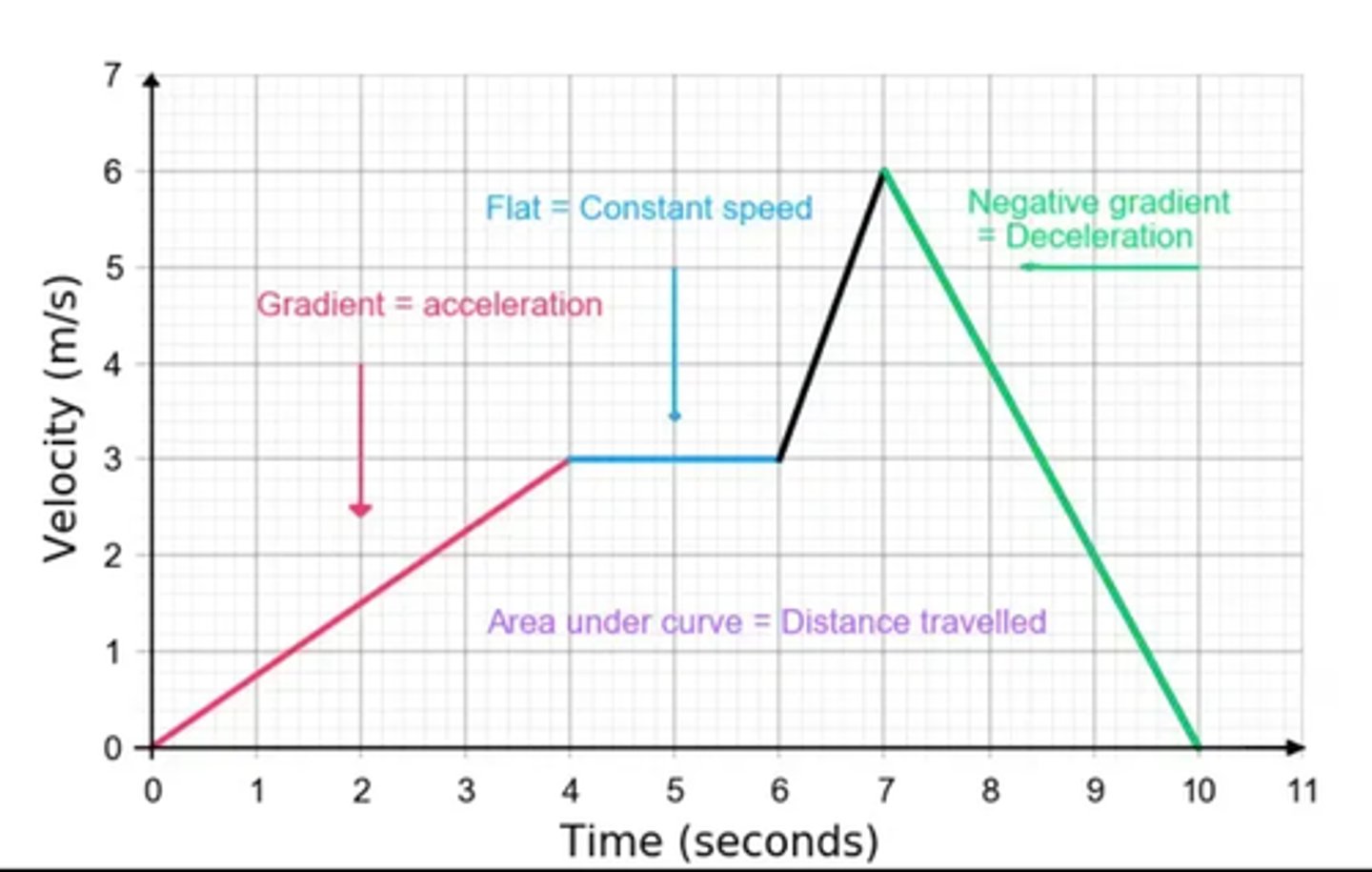
What does the gradient of a velocity-time graph represent? (1)
The gradient of a velocity-time graph represents the object's acceleration.
What does the area under a velocity-time graph represent? (1)
The area under the curve gives the object's displacement.
What does a displacement-time graph look like for uniform and non-uniform velocity? (2)
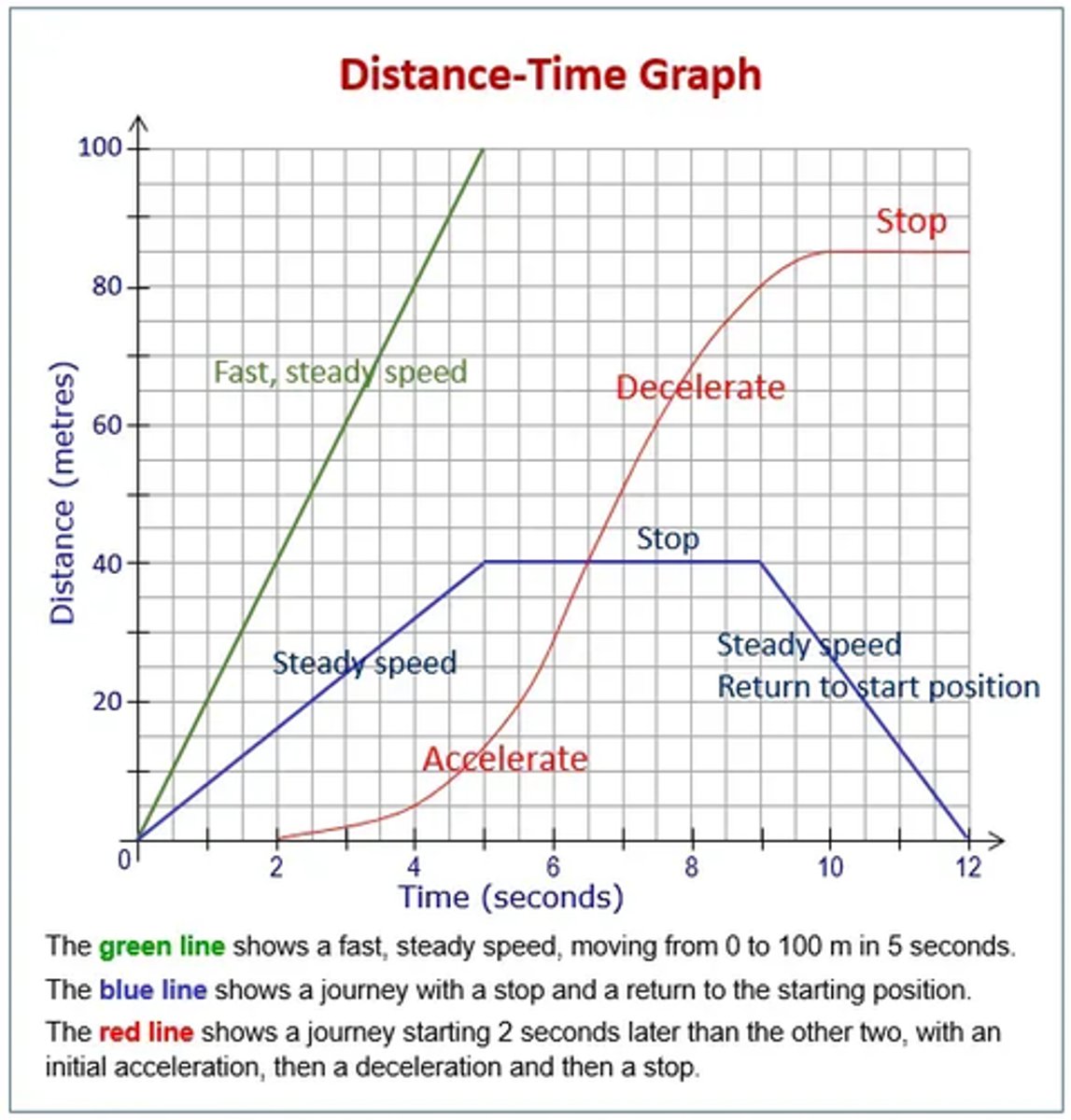
What is the shape of a displacement-time graph for an accelerating object? (2)
- The graph will be an upwards curve.
- It will have a constant gradient if the acceleration is constant.
What is the shape of a displacement-time graph for an decelerating object? (2)
- The graph will be an downwards curve.
- It will have a constant gradient if the acceleration is constant.
What does the gradient of a displacement-time graph represent? (1)
The gradient of a displacement-time graph gives the object's velocity.
How can displacement-time and velocity-time graphs be drawn using technology? (2)
- A data-logger can be connected to a computer with graph-drawing software.
- Displacement-time and velocity-time graphs can then be drawn in real time.
What are the equations of motion for constant acceleration? (5)
- v = u + at.
- s = ut + ½at².
- v² = u² + 2as.
- s = (u + v)t / 2.
- Where s is displacement (m), u is initial velocity (m/s), v is final velocity (m/s), a is acceleration (m/s^2), and t is time (s).
When can you use the equations of motion?
The equations of motion can be used only when the object's acceleration is constant.
What is the value of acceleration due to gravity? (1)
The value is 9.81 m/s² when gravity is the only force acting.
What is the acceleration of a body with the only force acting on it being weight? (1)
The acceleration is equal to the acceleration due to free fall, which is 9.81 m/s².
How do all objects accelerate in free fall? (1)
All objects accelerate at the same rate (at the value of g (9.81 m/s^2)).
Why can the horizontal and vertical motions of a projectile be treated separately? (1)
The horizontal and vertical components of a projectile's motion are independent of each other.
How does the angle of the projectile to the horizontal affects its motion? (2)
- As the angle to the horizontal increases, the initial vertical velocity increases.
- At the same time, the initial horizontal velocity decreases.
Why is it possible to analyse vertical projectile motion using constant acceleration equations? (2)
- The only acceleration acting on a projectile vertically is due to gravity, which is constant.
- Therefore, the equations of motion for constant acceleration can be applied specifically to the vertical component of the motion.
What is the symmetry of motion in a projectile path? (2)
- The time taken to reach the maximum height is equal to the time taken to fall from it.
- If the projectile lands at the same height from which it was launched, the final velocity has the same magnitude as the initial velocity.
What is the first step in projectile problems? (1)
If the projectile starts at an angle, the velocity must be resolved into vertical and horizontal components.
How is vertical motion calculated in projectile problems? (2)
- Vertical motion is calculated using the equations of motion for constant acceleration.
- The acceleration used is g.
How is horizontal motion calculated in projectile problems? (2)
- Use the equation s = vt.
- Where s is displacement (m), v is velocity (m/s), and t is time (s).
What is the equation for the horizontal range of a projectile in a vacuum? (2)
- R= (u² × sin2θ) / g.
- Where u is the launch speed (m/s), θ is the launch angle, and g is the acceleration due to gravity (m/s^2).
What does projectile motion look like visually? (2)
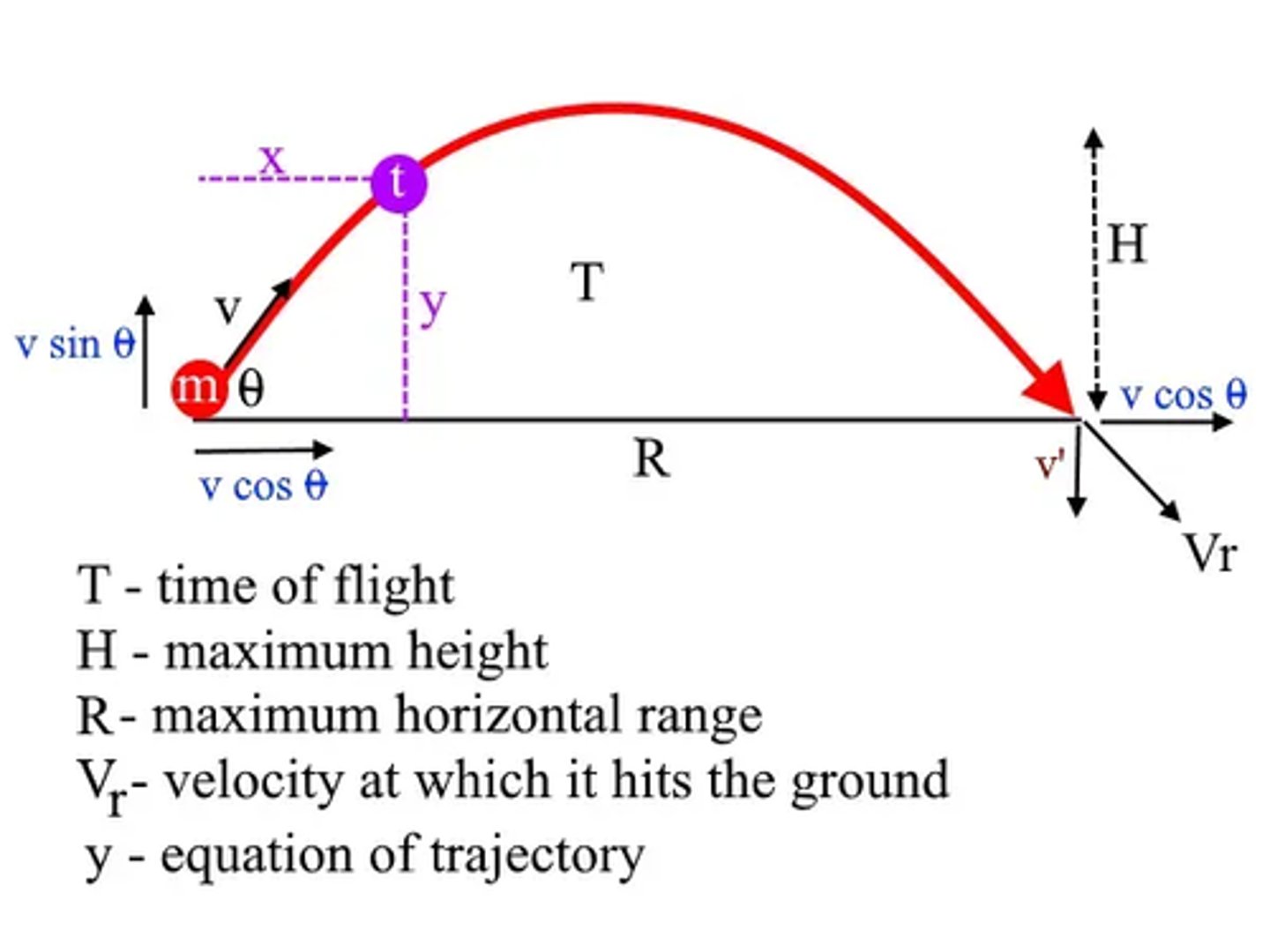
What is free fall? (2)
- Free fall is when an object accelerates under gravity alone.
- This happens when no other forces are acting on the object.
What is friction? (1)
Friction is a force that opposes motion and converts kinetic energy into heat or sound.
What is air resistance? (2)
- Air resistance is a type of friction acting on objects moving through air.
- Air resistance increases with speed.
What is drag? (1)
Drag is a form of friction that acts in a fluid (it is the same as air resistance).
What is meant by a fluid? (1)
A fluid is something which flows, such as a liquid or a gas.
What does the magnitude of drag depend on? (3)
- The force depends on the thickness (viscosity) of a fluid.
- The force also depends on the shape of the object (more aerodynamic shapes experience less drag).
- Drag increases as the speed increases (it is directly proportional).
What is lift? (1)
Lift is an upward force that acts on an object moving through a fluid.
What causes lift to act on an object? (2)
- Lift is caused by a change in the direction of fluid flow.
- It acts perpendicular to that flow.
What is terminal speed? (2)
- Terminal speed is when resistive forces balance the driving forces.
- So the object moves at a constant speed.
Why does an object stop accelerating at terminal speed? (2)
- There is no resultant force once resistance balances weight.
- So acceleration becomes zero and the velocity remains constant.
How does a skydiver reach terminal velocity? (3)
- A skydiver starts accelerating because weight is larger than air resistance.
- As speed increases, air resistance grows until it balances weight.
- This causes terminal speed.
How is terminal velocity shown on a velocity-time graph? (2)
- The graph starts with increasing velocity and curves to a horizontal line.
- Where drag equals weight and acceleration becomes zero.
How does air resistance affect the horizontal motion of a projectile? (1)
Air resistance reduces horizontal speed and shortens the range of the projectile.
How does air resistance affect the vertical motion of a projectile? (1)
Air resistance lowers the maximum height reached and causes a steeper descent.
What factors affect the maximum speed of a projectile? (2)
- Air resistance determines the maximum speed of a projectile.
- The strength of other forces acting on the projectile are another factor which determines its maximum speed.
How does air resistance limit the speed a projectile can reach? (1)
Greater air resistance results in a lower maximum speed because it increases with velocity.
What would happen to a projectile's speed in the absence of air resistance? (1)
In a vacuum, the projectile could continue to accelerate under gravity without limit.
What is Newton's first law of motion? (1)
An object will remain stationary or continue moving at constant velocity, unless acted upon by a resultant force.
What does Newton's second law of motion state? (2)
- The acceleration of an object is directly proportional to the resultant force acting on it.
- The acceleration of an object is inversely proportional to its mass.
What is the equation for Newton's second law? (2)
- The equation is F = ma, where mass is constant.
- Where F is the resultant force (N), m is the mass (kg), and a is the acceleration (m/s²).
How does the force affect the acceleration of an object? (2)
- The larger the force acting on an object, the larger the acceleration.
- They are directly proportional.
How does the mass affect the acceleration of an object? (2)
- The larger the mass of an objects, the smaller the acceleration.
- They are inversely proportional.
What is Newton's third law of motion? (1)
If an object (A) exerts a force on another object (B), object B will exert an equal but opposite force on object A.
What do the terms equal and opposite mean in Newton's third law of motion? (1)
It means an equal magnitude force but in the opposite direction.
What must the force pair obey in Newton's third law? (1)
The forces must be the same type (e.g both must be gravity, or both must be push/pull contact forces).
What is a free-body diagram? (2)
- A free-body diagram shows all the forces acting on a single object.
- The diagram uses arrows that indicate the direction and size of each force.
What does a free-body diagram help identify? (2)
- The diagram helps determine whether the forces are balanced or unbalanced.
- This suggests whether the object will accelerate, stay stationary, or move at constant velocity.
What does a free-body diagram look like? (2)
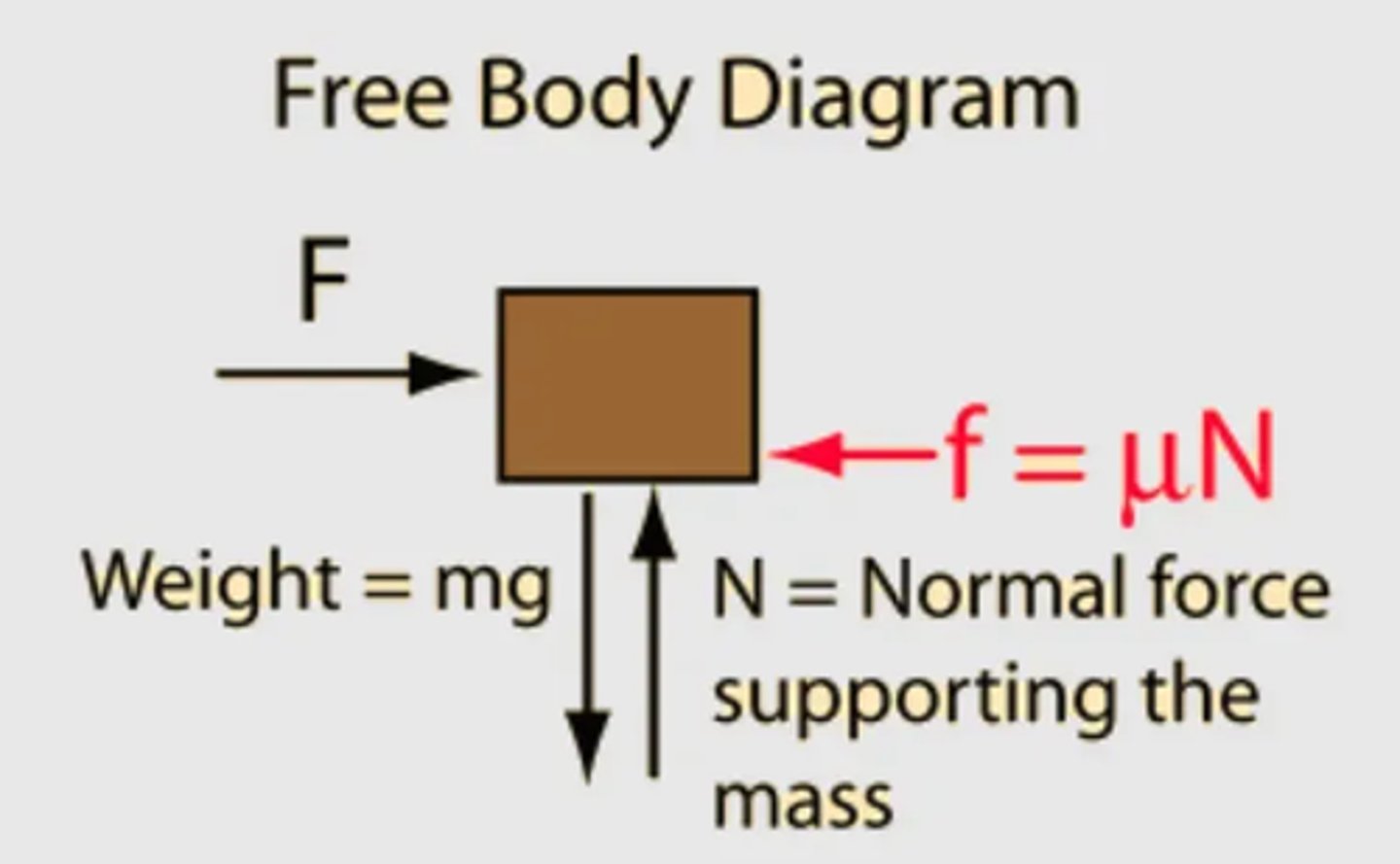
What is the equation for momentum? (1)
Momentum = mass × velocity.