Com 318 Unit 2
 Call Kai
 Learn
Learn Practice Test
 Spaced Repetition
 Match
Match Flashcards
 Knowt Play
1/86

There's no tags or description
Looks like no tags are added yet.
Name | Mastery | Learn | Test | Matching | Spaced | Call with Kai |
|---|
No analytics yet
Send a link to your students to track their progress
87 Terms
Individual Differences
Things about you that make you unique and interesting
Individual differences variables
Age
Gender
Race/ethnicity
Culture
Education level
Political Identity (party and ideology)
Predispositions and established attitudes
Traits
enduring characteristics presumed to be relatively stable across time
Demographics (but only some)
Personality characteristics
States
Temporary behaviors or feelings that depend on a person's situation or motives at a particular time
Examples of Traits
Age
Gender
Culture
Intelligence
Personality
Traits - Age
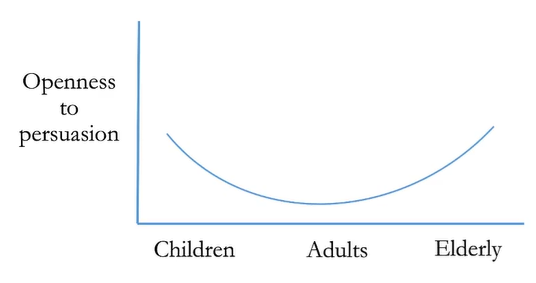
Life stage hypothesis - openness to persuasion
Children and elderly are more persuadable
Age - Children
Very susceptible to persuasion
Aren't as cognitively developed
Can't evaluate message as effectively
Don't realize when others are trying to persuade them
Less adept at resisting advertising
Education helps lessen effects of ads
Age - Elderly
Some seniors experience cognitive decline
Some scammers target elderly folks
Loneliness: Eager for human interaction
Savings: Nest-egg is a tempting target
Fixed incomes: looking for extra money
Traits - Gender
Generally, gender is not a significant predictor of persuasion
Men are perceived as being more persuasive
Double-bind for women
Women who are direct, assertive, or forceful may be perceived negatively
Women are less persuasive when they use aggressive and assertive tactics than when they use more stereotype-consistent tactics
Traits - Culture
One's identification with and acceptance into a group that shares symbols, meanings, experiences, and behaviors
Hofstede’s Five dimensions
Lecture discussed Individualism and Collectivism
Hofstede’s Five dimensions
Long-term orientation
Power distance
Uncertainty avoidance
Masculinity/Feminity
Individualism and Collectivism
Individualism
"I" perspective: the individual is the more important entity. "What's in it for me?"
Stresses independence
Members reward successes and achievements
Uniqueness is valued
Low context - say what you mean
Use direct persuasive strategies
United States and Australia
Collectivism
"We" perspective: Group needs supersede individuals
Behavior is guided by duty and not pleasure
Self is defined in relation to others, not as distinct from others
Focus on cooperation, not competition
High context because value harmony over clarity/directness - meaning is implied
Use indirect persuasive strategies
China
Individualism or Collectivism: “the art of being unique”
Individualistic
Individualism or Collectivism: “We have a way of bringing people closer together”
Collectivist
Traits - Intelligence
Cognitive complexity - one's ability for nuanced thinking
Nuanced thinking is when we are thinking about how many constructs a person can use to describe or understand an idea or belief
Construct: Perceptual category (ex. Good/bad, popular/unpopular, strong/weak) that we use to evaluate things
In general, less intelligent people are more easily persuaded than more intelligent people
Cognitive Complexity
one's ability for nuanced thinking
Nuanced thinking is when we are thinking about how many constructs a person can use to describe or understand an idea or belief
Construct: Perceptual category (ex. Good/bad, popular/unpopular, strong/weak) that we use to evaluate things
Individuals with lower intelligence and lower cognitive complexity:
May not comprehend the message
May rely more heuristic cues (peripheral route processing)
Individuals with higher intelligence and higher cognitive complexity:
Have higher tolerance for messages that are inconsistent with their preexisting beliefs/cognitions
Pay closer attentions to messages and evaluate those messages
Are less influenced by the source of the message
Rely more on central route processing
Traits - Personality
Self-esteem
Self-Monitoring
Self-esteem
People with moderate levels of self-esteem are more likely to be persuaded (when compared to people with high or low self-esteem)
High - may notice the message but not be persuaded by it
Low - may assume the message is not geared toward them and not pay attention to it
Self-Monitoring
How much people observe and regulate their behaviors in social contexts
Research shows that some people work harder to manage their public image than others do
High self-monitors
Responsive to social cues
Acceptance, social cues
More likely to adjust appearances and behaviors
More likely to conform to social norms
More responsive to image-based advertising
Where better name, packaging, and branding matters
Low self-monitors
Less responsive to social cues
Can come across as unaware or insensitive
Less likely to do something because it looks good to others
Are more attentive to message content
Rely more on their own judgement
Ego Involvement
The strength of your attitude and how committed you are to that
Knowing a person's attitudes and ego involvement will help in designing a message that persuades them
People make evaluations about content of messages based on their anchors, or stances, on a particular topic messages
The strength of someone's attitudes influences how they process messages related to that attitude
Social Judgement Theory
People don't just consider a persuasive message on its merits (contents) alone
They consider how it fits within their own perceptions
Their perceptions serve as a filter for new information
Evaluations of persuasive arguments under SJT
Latitude of acceptance
Latitudes of Noncommitment
Latitudes of Rejection
Latitude of Acceptance
Statements and ideas with which the listener agrees
Latitude of Noncommitment
Statements and ideas with which the listener neither agree or disagrees
Latitudes of Rejection
Statements and ideas with which the listener judges as objectionable or unacceptable
Influences latitude of acceptance and rejection
Their ego involvement with an issue
High personal relevance = High degree of ego involvement
High Ego involvement
How much a person will be open to change
How likely a person will be to accept the opinions of others
Anchor position in Social Judgement Theory
This is the most preferred position (your preexisting attitude is)
More ego involvement
Larger latitude of rejection
If you are highly committed to an idea, you are more likely to reject anything that questions it or tried to change it
Smaller latitude of noncommitment
The more important an issue is to you, the more you will have thought about it and the less persuadable you will be
Less ego involvement
Larger latitude of noncommitment
Increased possibility of shifting to latitude of acceptance
Contrast Effect in SJT
When a message is perceived as farther from the person's original position (anchor) than it really is
Rejects new information
Assimilation effect in SJT
When individual minimizes the difference between the two positions
Accepts new information
Moral Foundation Theory
Proposed new way to think about persuasion and politics
Instead of thinking about just liberal or conservative ideologies, we can think about what might inform those ideologies
The 5 moral foundation
Care
Fairness
Loyalty
Authority
Purity
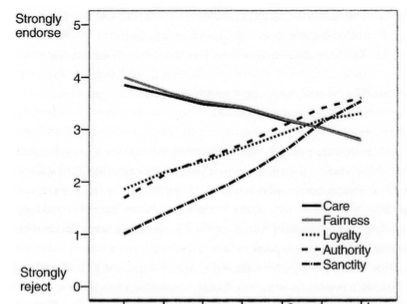
MFT and Persuasion
How might you use these different more foundations to persuade someone?
We can use language to emphasize the different moral foundations
Care: Empathy, Safe, Benefit, Compassion
Fairness: Equal, Justice, Rights, Tolerant
Loyalty: Together, Family, Patriot, Group
Authority: Obey, Respect, Duty, Leader
Purity: Clean, Innocent, Chaste, Modest
How to persuade
Adapt your persuasive message to your receiver's frame of reference
Adject your message based on the receiver's age, gender, culture, intelligence, etc.
Tailor the message based on the receiver's preexisting attitudes and beliefs
Consider the receiver's personality when designing the message
Conformity
Adhering to or observing standards, rules, or laws
Behaviors in accordance with socially accepted conventions or standards
Rules may not be clearly stated but you learn to follow them in order to be part of the group
Norms
Expectations held by a group of people about what behaviors or opinions are right or wrong, good or bad, acceptable or unacceptable, appropriate or inappropriate
Formal and Explicit Norms
No cheating on tests - written in the syllabus and said
Informal and implicit Norms
Not picking your nose during class
Norms may not be apparent until violated
Texting during class - the teacher doesn't say anything possibly until someone actually does it
May have to learn as you go
Variables that influence group conformity
Group size
Number of dissenters
Difficulty joining the group
Reference groups
Communicator characteristics
Stages of indoctrination into cults
softening-up stage (often targeted with vulnerable, “love bombing”)
Compliance stage - recruits experiment with some of the behaviors of the cult
Internalization stage - recruit it considering some of the demands and beliefs
Consolidation stage - they become loyal
Ostracism
the act of excluding and ignoring others
Decision in group settings, people are motivated by…
Informational influence
Normative influence
If others are expressing dissent
Informational Influence
Wanting to be right/correct
We conform to the group because we think the group is correct and we want to be correct
This type of response is stronger when you response in private (instead of in front of the group)
Normative influence
Wanting to be liked and accepted
We conform to the group because we want others to like us or make us feel included
If there is something they are doing but we might have slight objections we may do it anyways so that the group will accept us
This type of response is stronger if you have to respond in front of the group
If others are expressing dissent
Difficult for a lone dissenter to hold out
If a second dissenter emerges, conformity decreases by 80%
This means that if one other person says they disagree, others are more likely to say they disagree, too
Dissent
People who question the authority figure saying maybe we should double check that.
Indoctrination
a way group influence can go wrong
Individuals have stronger conformity in groups if they experience severe/challenging indoctrination
If it's hard to get in, we value the group more
If we value the group more, we are likely to conform to the rituals and practices
Hazing
Identification
Includes experiencing shared meaning and goals
For persuasion to occur, one party must "identify" with another
That is, the one who becomes persuaded sees that one party is like the other in some way
The more we identify with a group, the greater the group's power to influence behavior
Identification through media occurs when…
You form an imaginary interpersonal relationship with an individual in the media
You feel like you are the individual in the media
I am so much like so and so and we really understand each other
You feel a lot like the individual in the media
The way they reacted is similar to how I would have reacted
Identification through media
You form an imaginary interpersonal relationship with an individual in the media
When we feel like we're engaged in a social relationship with the individual (not merely watching them through media)
They don't always reciprocate such as celebrities, athletes, actors, characters on a show
How identification through media occurs
Cognitive --> I wonder is ____ was similar to me
Affective --> Sometimes I really loved ___ for what he/she did
Behavioral --> Occasionally, I said something to ____
Reference Group
A group that has the power to influence us through the process of identification
Groups we respect, admire, identify with
Social Identity Theory
Explains how we categorize ourselves and other people into desirable and undesirable groups
In-group
Out-group
In-group
the group we want to be a part of or are already part of
"we"
We perceive our in-group - the groups of people we associate ourselves with - to be most similar to us
Out-group
the group we do not want to be part of
"they"
We see the out-group as negative and hurting our self-esteem and self-identity
Social Identity Theory - Comparing ourselves with other
We see a small social distance between ourselves and our friends, family, etc.
This social distance increases as the degree of separation increases
We try to associate ourselves with the in-group and distance ourselves from the out-group
Negative consequences to identification
Ethnocentrism
Groupthink
Strong culture (book)
Ethnocentrism
Assuming one's culture is the standard for judging other cultures
can lead to hatred, discrimination, and violence toward members of another culture
Groupthink
tendency to engage in consensus seeking
Failure to question or challenge the group's opinions
Need for someone to play devil's advocate
too concerned with everyone getting along and agreeing
Groupthink and Strong culture involve
Involve collective of people who are all thinking in the same way and are notorious for bad decision making
Strong culture
in organizational communication contexts, too much identification can lead to this.
Employees may identify so much with their organization that they conform to the organization’s values and actions
How to prevent the negatives of identification
Encourage group members to "kick the problem around" before focusing on a solution
Encourage disagreement when brainstorming
Establish a norm of critical evaluation
Promote expression of disagreement
Assign a devil's advocate (to find issues with suggestions)
Leader must be open to having ideas scrutinized
Social Cognitive theory
How we learn from other people's actions and decide what actions we are going to take ourselves
Social Cognitive Theory - Learning
Is cognitive and behavioral
Can take place by observing a behavior and its consequences
Can translate into acting out the learned behavior
Interacts with cognition, behavior, and background characteristics
Simply put, social learning involves observational learning (monkey see, monkey do)
Social learning and consequences
We evaluate what we see and whether we're willing to take the same chance…
… with the possibility of the same outcome
Consequence of social learning materialize in 2 ways
External concerns: Fear of punishment
Internal concerns: Questions of morality
In order for social learning to take place these things must occur
Attention - you have to see it happen
Retention - you have to remember it occurred
Reproduction
Motivation
Example of Social Cognitive Theory and media
An example in college students
A student swinging on a wrecking ball on their campus imitating Miley Cyrus in her music video
Started with the Miley Cyrus video and then the students wanted to imitate that behavior
Unintended effects of Social Cognitive Theory
Usually negative
TV viewing and smoking among youth
Reading women's magazines and the desire to be thin
No the intention of the magazine but people were seeing these thin women in the magazine and wanted to imitate that
Teens watching sexually explicit TV content and intentions to have sex
But also more knowledge about safe sex practices and fewer negative ideas about sex
Intended Effects of Social Cognitive Theory
Usually positive
Entertainment-educations about various topics, including AIDS preventions, condom use, and gender equality
Health campaigns to encourage healthy behavior change (sunscreen use)
Social Proof
Tendency to view behaviors as more appropriate or correct when a lot of other people are doing it
Others' behaviors is used as a yardstick for how to behave
Includes viral marketing
Social proof via online reviews
Explains fads, trends, jumping on the bandwagon, etc.
According to Social Proof which one worked best?Researchers placed fliers on doors of San Diego residents once a week for a month. Residents were given only one of these messages:
A majority of your neighbors regularly try to conserve energy
Social Loafing
Reducing one’s efforts when working in a group
Explanations of Social Loafing
Colletive effort model
Free ride effect
Sucker effect
On the other end - Diligent isolates
Collective effort model
We get lazy if we don't think our efforts are valued or will be useful
Argues that we tend to get lazy if we don’t expect our efforts to lead to personally valued outcomes or if we don’t think our effects will be instrumental in obtaining those outcomes (Book)
Free ride effect
We'll do less if we can get away with it
suggest that when they can get away with it people try to benefit from the efforts of others (book)
Sucker effect
When others are slacking, some will do less to match the level of the other slackers
occurs when people suspect that others may be taking a free ride
Diligent isolates
People who increase their efforts and work to rescue group projects
To counter social loafing
Monitor individual performance
Set individual goals
Social facilitation
the tendency to perform better when other people are around