RADR 2209 Chapter 6
 Call Kai
 Learn
Learn Practice Test
 Spaced Repetition
 Match
Match Flashcards
 Knowt Play
1/42

There's no tags or description
Looks like no tags are added yet.
Name | Mastery | Learn | Test | Matching | Spaced | Call with Kai |
|---|
No analytics yet
Send a link to your students to track their progress
43 Terms
A filament electron interacts with an outer shell electron of a tungsten but does not remove it. Which of the following is produced?
a. 50 keV photon
b. 70 keV photon
c. heat
d. brems photon
C. Heat
At what point in the interaction chain of events is a characteristic photon produced?
Outer shell electron filling inner shell vacancy.
A filament electron enters a tungsten target atom with an energy of 70 kVp. It interacts with an L-shell electron, then with a K-shell electron. Which of the following are produced?
1. K-characteristic x-ray photon
2. L-characteristic x-ray photon
3. Heat
2 and 3 only
What is the energy of an x-ray photon produced when an O-shell electron fills a K-shell vacancy?
69.42 KeV
What is the energy of an x-ray photon produced when an L-shell electron fills a K-shell vacancy?
57.4 KeV
What is the energy of an x-ray photon produced when a M-shell electron fills an L-shell vacancy?
9.28 KeV
What is the energy of an x-ray photon produced when an O-shell electron fills an L-shell vacancy?
12.02 KeV
Beam Quality
The penetrating power of the x-ray beam.
Beam Quantity
The total number of x-ray photons.
Bremsstrahlung Interactions
An interaction in which a filament electron is attracted to the nucleus, causing it to slow down and change direction. The energy loss is emitted as a bremsstrahlung photon.
Characteristic Cascade
The process of outer-shell electrons filling inner shell vacancies, creating a cascading.
Characteristic Interactions
An interaction in which a filament electron removes an orbital electron from an atom; to regain stability, an outer-shell electron fills the vacancy, giving up its excess energy as a characteristic x-ray photon.
Continuous Emission Spectrum
A graphic representation of bremsstrahlung x-ray production.
Discrete Emission Spectrum
A graphic representation of characteristic x-ray production.
Filtration
The use of a material, usually aluminum or aluminum equivalent, to absorb the lower-energyphotons from the x-ray beam.
Half-Value Layer (HVL)
The thickness of absorbing material (aluminum) necessary to reduce the energy of the x-ray beam to one-half its original intensity.
Inverse Square Law
The intensity of a source of radiation is inversely proportional to the square of the distance.
Penetration
Those x-ray photons that are transmitted through the body and reach the image receptor.
Primary Beam
The x-ray beam upon exiting the collimator and exposing the patient.
Remnant Beam
The x-ray beam that remains after interaction with the patient and is exiting the patient to expose the image receptor.
X-ray Emission Spectrum
A graphic representation of the x-ray beam as a whole, combining the relevant parts of the discrete and continuous emission spectra.
X-rays are produced when ________________ from the cathode interact with
___________ in the anode.
electrons, tungsten atoms
Image of Characteristic Interactions
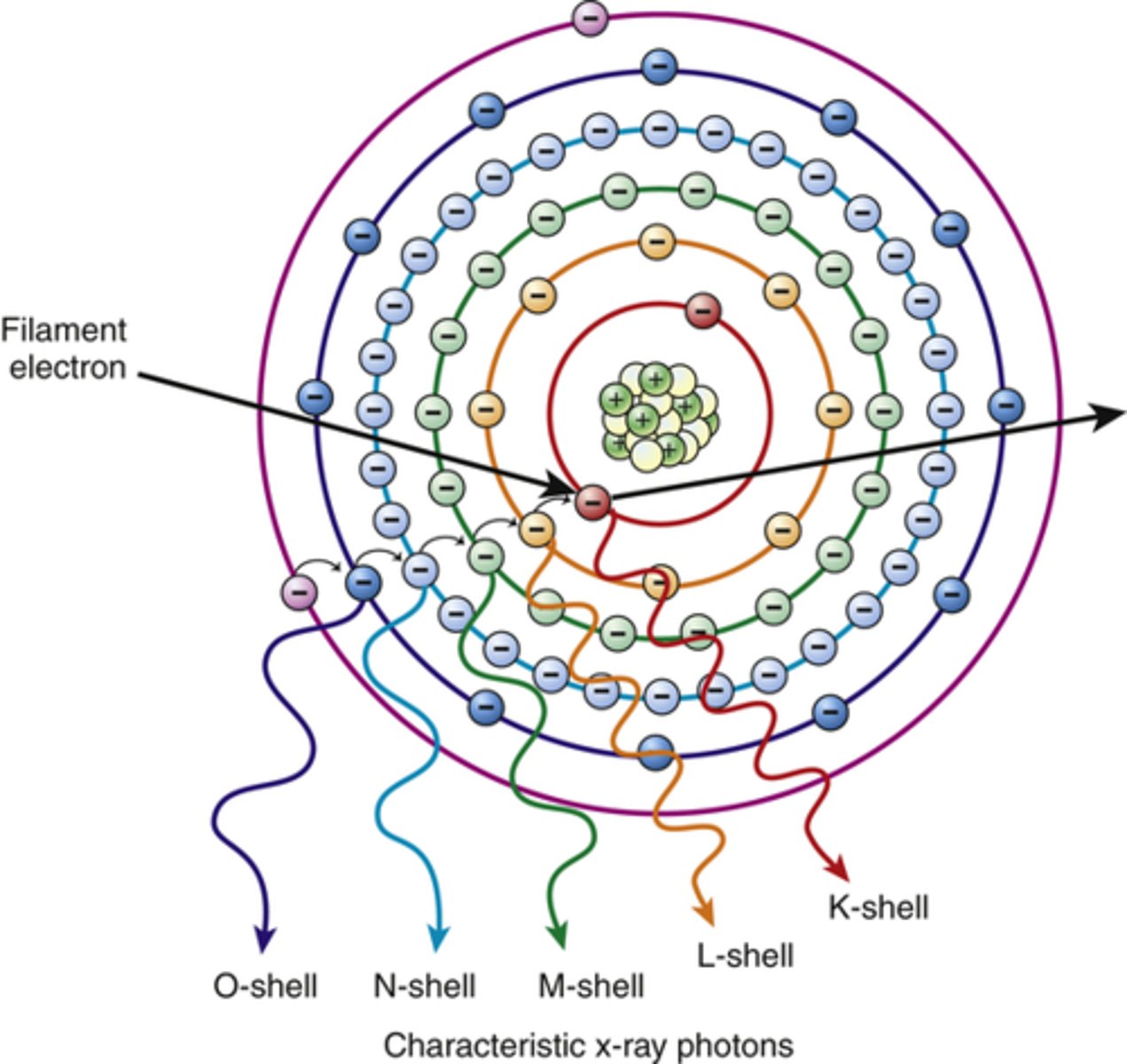
Describe what is happening to the filament electron during a characteristic interaction and then the subsequent shell electrons.
The filament electron enters the atom and strikes an orbital electron. If the energy is greater than the binding energy, it is removed from orbit. Then outer shell electrons drop to fill the inner vacancies.
Image of Bremsstrahlung Interaction
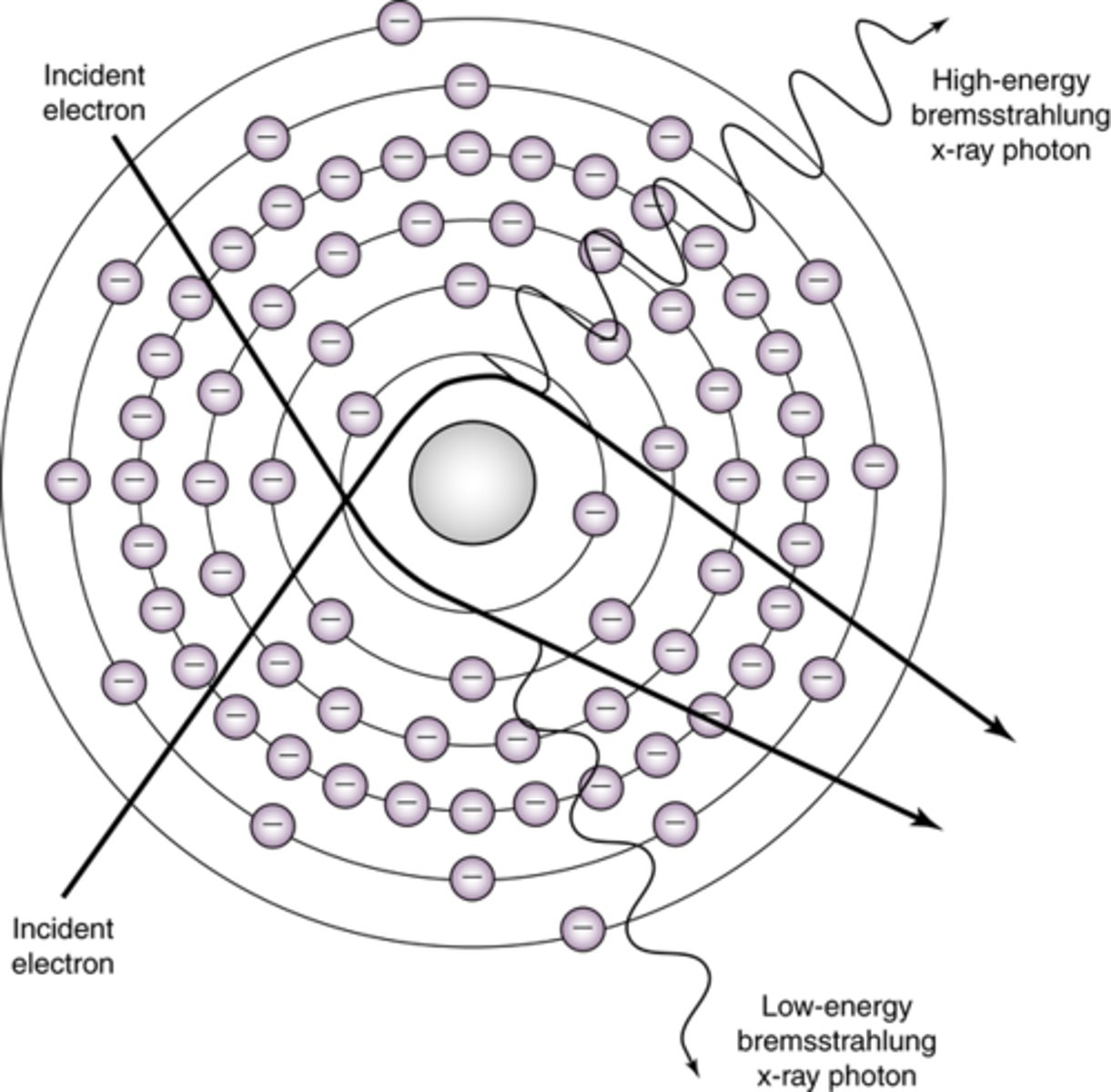
Describe what is happening to the filament electron during a Bremsstrahlung interaction.
The filament electron misses all the orbital electrons and interacts with the nucleus of the target atom. The attraction of the filament electron to the nucleus causes it to slow down and change direction. The resultant loss of energy is given off as a brems photon.
If the technologist sets the kVp at 65, why are all of the photons considered Brems photons?
It is not strong enough to produce a characteristic photon, since the K-shell binding energy for tungsten is 69.5 keV.
If mA increases, what happens to the emission spectrum?
Quantity increases
If kVp increases, what happens to the emission spectrum?
Quantity and quality increase
If filtration is added to the tube, what happens to the emission spectrum?
Quantity decreases and quality increases
If you move from a 3-phase 6-pulse generator to a high frequency generator and use the same amount of electricity, what happens to the emission spectrum?
amplitude increases, shift to the right
If the atomic number of the target material goes down, what happens to the emission spectrum?
The average energy and quantity of x-rays go down, and the discrete line moves to the left.
What type of interaction happens when tube circuit electrons interact with target electrons?
Characteristic
Which of the following filament electron energies has the potential to make a Characteristic interaction occur?
a. 69.5 keV
b. 74 keV
c. 100 keV
d. All of the above
d. All of the above
In the target material, when an outer shell electron fills an inner shell vacancy, what happens?
a. X-rays are produced
b. Characteristic cascade
c. The electron loses potential energy
d. All of the above
d. All of the above
What happens when a filament electron passes very close to the nucleus of a target atom?
a. The filament electron knocks an electron out of the target atom.
b. The electron speeds up.
c. The electron slows down.
d. Any of the above are possible.
c. The electron slows down.
Which of the following will affect beam quantity?
a. mAs
b. kVp
c. Distance
d. All of the above
d. All of the above
An increase in beam quantity will increase:
a. Patient dose
b. The penetrating power of the beam
c. The hardness of the beam
d. All of the above
a. Patient dose
Which of the following controls penetration of the x-ray beam?
a. mA
b. mAs
c. Time
d. kVp
e. All of the above
d. kVp
Which of the following will affect beam quality?
1. Filtration
2. kVp
3. mAs
1 and 2
Why is characteristic radiation production reflected as a discrete emission spectrum?
a. It only occurs at low energy levels
b. It is considered insignificant
c. It produces many photon energy levels
d. It produces limited photon energy levels
d. It produces limited photon energy levels
What factor will cause an emission spectrum shift to the right?
a. Increase kVp
b. Decrease kVp
c. Increase mAs
d. Decrease mAs
e. A and C
f. B and D
a. Increase kVp
Which of the following will increase the amplitude of the emission spectrum?
1. mA
2. kVp
3. Filtration
4. Using 3 phase generator instead of high frequency
5. Using a tungsten target instead of molybdenum
1, 2, 5