Oxidising Power of Halogens
 Studied by 0 people
 Call Kai
 Learn
Learn Practice Test
 Spaced Repetition
 Match
Match Flashcards
 Knowt Play
1/3

There's no tags or description
Looks like no tags are added yet.
Name | Mastery | Learn | Test | Matching | Spaced |
|---|
No study sessions yet.
4 Terms
Table showing the standard electrode potentials of chlorine, bromine and iodine.
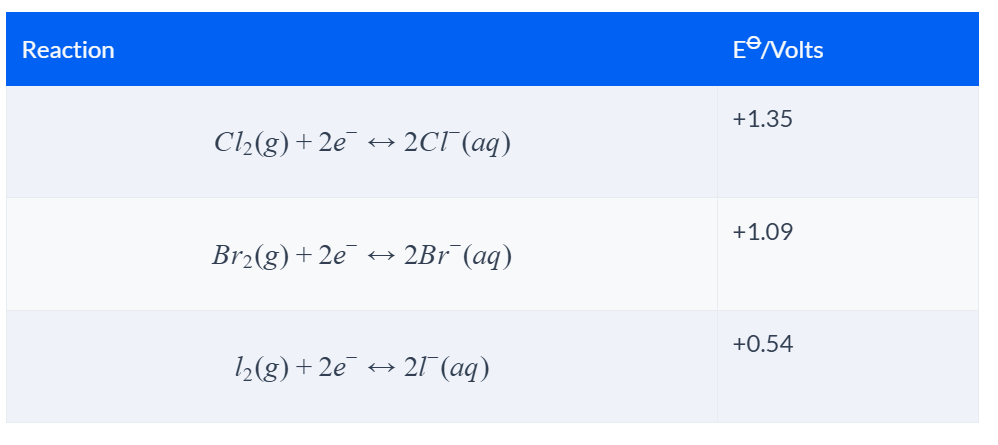
From the table, which halogen is most oxidising and which is least? Give a reason why.
Chlorine is most oxidising, as it has the most positive electrode potential, whilst iodine is the least oxidising.
This shows that the -1 oxidation state of chlorine is more stable than the -1 oxidation state of bromine and iodine.
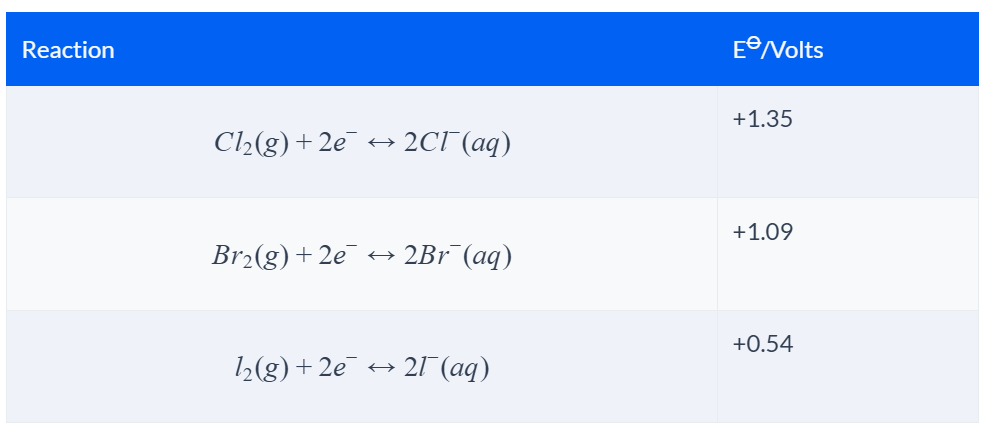
What is the trend in the oxidising power of the halogens as you move down the group?
The oxidising power decreases down the group.
How is the oxidising power of the halogens linked to the displacement reactions learnt previously?
A more reactive halogen oxidises the ions of a less reactive one.
In terms of the electrode potentials, chloride has a more positive value than bromide; chlorine is a more stronger oxidising agent and will oxidise (‘displace’) bromide to bromine.