PubPob pt. 6 - Policy Problem and Agenda Setting
 Call Kai
 Learn
Learn Practice Test
 Spaced Repetition
 Match
Match Flashcards
 Knowt Play
1/44

There's no tags or description
Looks like no tags are added yet.
Name | Mastery | Learn | Test | Matching | Spaced | Call with Kai |
|---|
No analytics yet
Send a link to your students to track their progress
45 Terms
Unless the problem is identified and brought before the attention of the government, the different policy makers would not be able to gain ground and develop the best possible solution to the issue that is affecting the society.
The definition of alternative issues, problems, and solutions is crucial because it establishes which issues, problems, and solutions will gain the attention of the public and decision makers, which, in turn, are most likely to gain broader attention.
Policy Problem
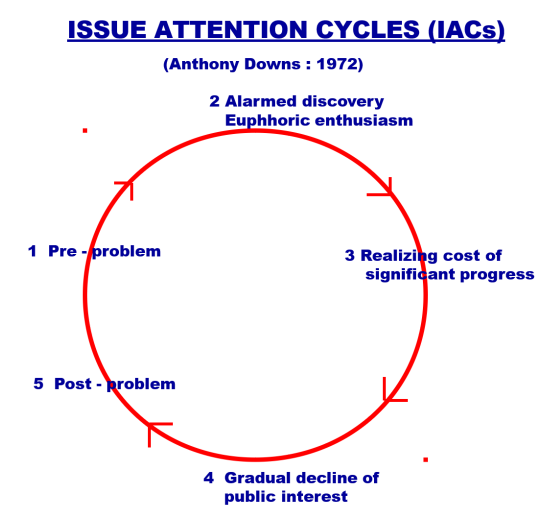
The process by which problems and alternative solutions gain or lose public and elite attention.
Agenda Setting
This is a collection of problems, understandings of causes, symbols, solutions, and other elements of public problems that come to the attention of members of the public and their governmental officials.
They may be concrete as bills that are before the legislature, but also includes a series of beliefs about the existence and magnitude of problems and how they should be addressed by government, the private sector, non-profit organizations, or through joint action by some or all these institutions.
Agenda
Issue Attention Cycle
List of items explicitly up for the active and serious consideration of authoritative decision makers
Institution Agenda
Consists of all issues that are commonly perceived by members of the political community as meriting public attention and as involving matters within the legitimate jurisdiction of existing governmental authority.
Systematic Agenda
This contains items that are about to be acted upon by a governmental body. Bills, once they are introduced and heard in committee, are relatively low on the decision agenda until they are reported to the whole body for a vote
Decision Agenda
Prominent space in Agenda setting
While the carrying capacity of the agenda may change, the agenda carrying capacity of any institution ultimately has a maximum bound, which means that interests must compete with each other to get their issues and their preferred interpretations of these issues on the agenda.
Even when a problem is on the agenda, there may be a considerable amount of controversy and competition over how to define the problem, including the causes of the problem and the policies that would most likely solve the problem.
Policy problems are possible when human beings make judgments about desirability of altering some problematic situation. Policy problems are products of subjective human judgment… and also come to be accepted as legitimate definitions of objective social conditions… and are therefore socially constructed, maintained, and changed.
Artificial
Policy problem in one area frequently affect policy problems in other areas. In reality, policy problems are not independent entities; they are parts of whole systems of problems.
Interdependent
There are many different solutions for a given problem as there are definitions of that problem. Problem and solutions are in constant flux, hence problems do not stay solved.
Dynamic
The external conditions that give rise to a problem are selectively defined, classified, explained and evaluated. Although there is a sense in which problems are objective , but they are typically interpreted in markedly different ways. Policy problems are mental artifacts that come about by transforming experience through human judgment.
Subjective
Political or programmatic. Political in a sense that there are several political actors that are repeatedly engaged within the policy and programmatic in a sense that it has technical content and multiple causation in its complexities.
Complexity
Whether the given policy issue can be converted into monetary terms or not.
Monetarization
Considers the identification of the policy issue into a single policy domain
Interdependence (Guy Peters)
There are two factors to consider whether the policy has an issue that possesses a definable solution or whether it has a chronic element which means that it is likely to appear from time to time.
Solubility
The magnitude and the range of effects that the policy issue creates. This is also the disaggregation of the problem into smaller components
Question of Scale
Pertains to the nature of goods that is required to solve the policy problem. Extent on how costs and benefits are concentrated or diffused in the society.
Divisibility
The ability of actor A to cause actor B to do things—is ______. The other face is the ability to keep a person from doing what he or she wants to do; the second face is a _______
Coercive power
Blocking power
Blocking Power fact
The blocking moves of the more powerful interests are not simply a function of A having superior resources to B, although this does play a substantial role. In essence, we should not think of the competition between actor A and actor B as a sporting event on a field, with even rules, between two teams, one vastly more powerful than the other. Rather, the power imbalance is as much a function of the nature and rules of the policy process as it is a function of the particular attributes of the groups or interests themselves.
All forms of political organization have a bias in favor of the exploitation of some kinds of conflict and the suppression of others because _______________. Some issues are organized into politics while others are organized out.
organization is the mobilization of bias
In the third face of power, social relationships and political ideology are structured over the long term in such a way that the mining company, remains dominant and the miners cannot conceive of a situation in which they can begin to participate in the decisions that directly affect their lives. When the miners show some signs of rebelling against the unfair system, the dominant interests are able to ignore pressure for change. In the long run, people may stop fighting as they become and remain alienated from politics; _______ is the result.
Quiescence
________ is the ability to change the actions of other people in general ways by changing their criteria of satisfaction and therefore improving their performance and productivity. Influence is the outcome of exercising power. It is expressed by other’s behavioral response to your exercise of power.
_________ is the right of directing others and asking them to do things that they would not naturally want to do, but it is legitimate and can be only exercised during the working hours of organizations
Influence
Authority
The ability to influence or outright control the behavior of people; It is an ability of the person to produce intended effects on others.
Power
Sources of Power
Formal and Personal Power
Uses rewards, perks, new projects or training opportunities, better roles and monetary benefits to influence people.
REWARD POWER
Such leaders rely on threats, bullying, and “or-else” language to “motivate” those that are beneath them. This type of behavior often leads to fear, dissatisfaction, and resentment.
COERCIVE POWER
This power emanates from an official position held by someone, be it an organization, bureaucracy or government and etc. This is the typical “command and control” structure that is employed by the Military world. And it acts as a formalized way of ensuring that there is someone to make a decision (good or bad) and that someone is responsible
LEGITIMATE POWER
This is a personal kind of power which owes its genesis to the skills and expertise possessed by an individual, which is higher quality and not easily available
EXPERT POWER
Extension of referent power stemming from individual’s personality and interpersonal style
CHARISMATIC POWER
A power of an individual over the team or followers, based on a high level of identification with, admiration of, or respect for the power holder/leader.
REFERENT POWER
The power of having information that another does not have, or, the distribution of information as a means of effecting change.
INFORMATIONAL POWER
POWER GAMES
Positional Power
Resources and Rewards
Knowledge and Expertise
Personal Influence
Networks and Gossip
Energy and Stamina
The problem of control is important in all organizations including schools, and the essence of organizational control is power. Further, politics begets power, which is a fact of organizational life. Regardless of level or position, virtually everyone in the organization is a player in the game of politics. Thus, we turn to a set of political tactics that employees at all levels can use to enhance their influence and power. T or F?
FALSE - power begets politics
Tactic process of forming relationships with influential people. Policymakers who have close, friendly relations with union representative or the secretary usually have access to important information. Likewise, employees who have contacts with the spouse of the policymakers or who have an indirect link to the superintendent are also likely to gain valuable inside information.
Networking
A simple tactic that almost everyone uses from time to time to create a favorable image. The tactic includes dressing (dress for success) and behaving appropriately, underscoring one’s accomplishments, claiming credit whenever possible, and creating the appearance of being important, if not indispensable.
The key is to get valuable information and build an image such that others see you as knowledgeable, powerful, articulate, sensible, sensitive, and socially adept.
Managing Impressions
Blaming and attacking others when things go wrong or badly. Policymakers often try to blame their constituents when the policy goes south. Finding a scapegoat can allow politically astute individuals an opportunity to shift attention and “get off the hook” by finding someone else to take the fall. Although this tactic is negative and carries risk, it is a frequently used tool.
Scapegoating
A tactic of using high praise and adulation to make a person feel good, important, and appreciated. Evidence suggests that even if the person being flattered believes the comments are hyperbole, people like to hear nice things about themselves. Administrators welcome kind words and flattery. Anything can be overdone, but flattery holds up well even if it comes across as fawning and a little obsequious—much better to flatter than to criticize.
Flattering
Yet another tactic to gain power and influence. Good ideas need to be heard by the right people if they are to bring acclaim and reward. There is a fine line between bragging and getting attention, but the content and style of one’s behavior are important, for example, Innovative suggestions, volunteering for to perform activities that others avoid, initiating novel actions to solve problems, and list goes on.
Getting the Attention of Superiors (GASing)
A tactic by which individuals or units make themselves necessary to the organization. Crafty administrators often develop specialized skills or units that make them important and essential in the operation of the organization. Such individuals are increasingly called upon to solve problems, and their successful solutions further enhance their status and value
Increasing indispensability
The process of individuals uniting to achieve common goals. People often join forces to oppose a proposed policy, to resist a proposed change, or to initiate change. A change in the policy is successful depending on which coalitions support or oppose it. Individuals alone are much less effective at influencing than groups; and relatively powerless groups become stronger if they can act together in concert. Those who are effective at organizing internal coalitions are often the political power players.
Building Coalitions
A tactic used to gain the goodwill of another by doing favors, being attentive, and showing deference. The tactic is based the universal “norm of reciprocity,”
Ingratiating
Groups go public with a problem by using symbols and images to induce greater media and public sympathy for their cause.
Groups that lose in the third stage of a political conflict can appeal to a lower decision-making level, such as when losing parties appeal to state and then federal institutions for an opportunity to be heard, hoping that in the process they will attract others who agree with them and their cause.
Statement A is CORRECT
Statement B is INCORRECT - should be First stage; Higher decision-making level
Policy communities use agreed-upon symbols to construct their visions of problems, causes, and solutions. If these images and symbols are maintained throughout society, or remain largely invisible and unquestioned, agenda access for groups that do not share these images is likely to be difficult; change is less likely until the less powerful group’s construction of the problem becomes more prevalent.
If alternative selection is central to the projection of political power, an important corollary is that powerful groups retain power by working to keep the public and out-groups unaware of underlying problems, alternative constructions of problems, or alternatives to their resolution.
Policy Monopolies