SJSU MICR20 CHAPTER 24
 Call Kai
 Learn
Learn Practice Test
 Spaced Repetition
 Match
Match Flashcards
 Knowt Play
1/55

There's no tags or description
Looks like no tags are added yet.
Name | Mastery | Learn | Test | Matching | Spaced | Call with Kai |
|---|
No analytics yet
Send a link to your students to track their progress
56 Terms
viruses in human infections & disease
- smallest parasites w/ simplest biological structure
- DNA or RNA molecules surrounded by protein coat
- obligate parasites enter cell, instruct its genetic & molecular machinery to produce & release new viruses
- all DNA viruses are double-stranded except parvovirus
- all RNA viruses are single stranded except for reoviruses
medical considerations in viral disease
- viruses limited to particular host or cell type
- most DNA virus are budded off the nucleus
- most RNA virus multiply in & are released from cytplasm
- viral infections range from asymptomatic to mild to life-threatening
- many virus strictly human in origin, others are zoonoses transmitted by vectors
course of viral disease
- invasion at portal of entry & primary infection
- some viruses replicate locally
- others enter circulation & infect other tissue
common manifestations
- rashes
- fever
- muscle aches
- respiratory involvement
- swollen lymph nodes
body defenses
combined action of interferon, antibodies, and cytotoxic T cells
viral infections
- many viral infections have rapid course; lytic cycle
- some establish long-term persistent infections
2 types of persistent infections
- chronic infections
- latent infections
chronic infections
- virus detectable in tissue samples
- multiplying at a slow rate
- symptoms mild or absent
latent infections
- after a lytic cycle, virus enters dormant phase
- generally not detectable
- can reactivate & result in recurrent infections
animal virus
- categorized according to nucleic acid (DNA/RNA), capsid, & presence or absence of envelope
DNA viruses causing human disease
- enveloped DNA virus
- nonenveloped DNA virus
- nonenveloped ssDNA virus
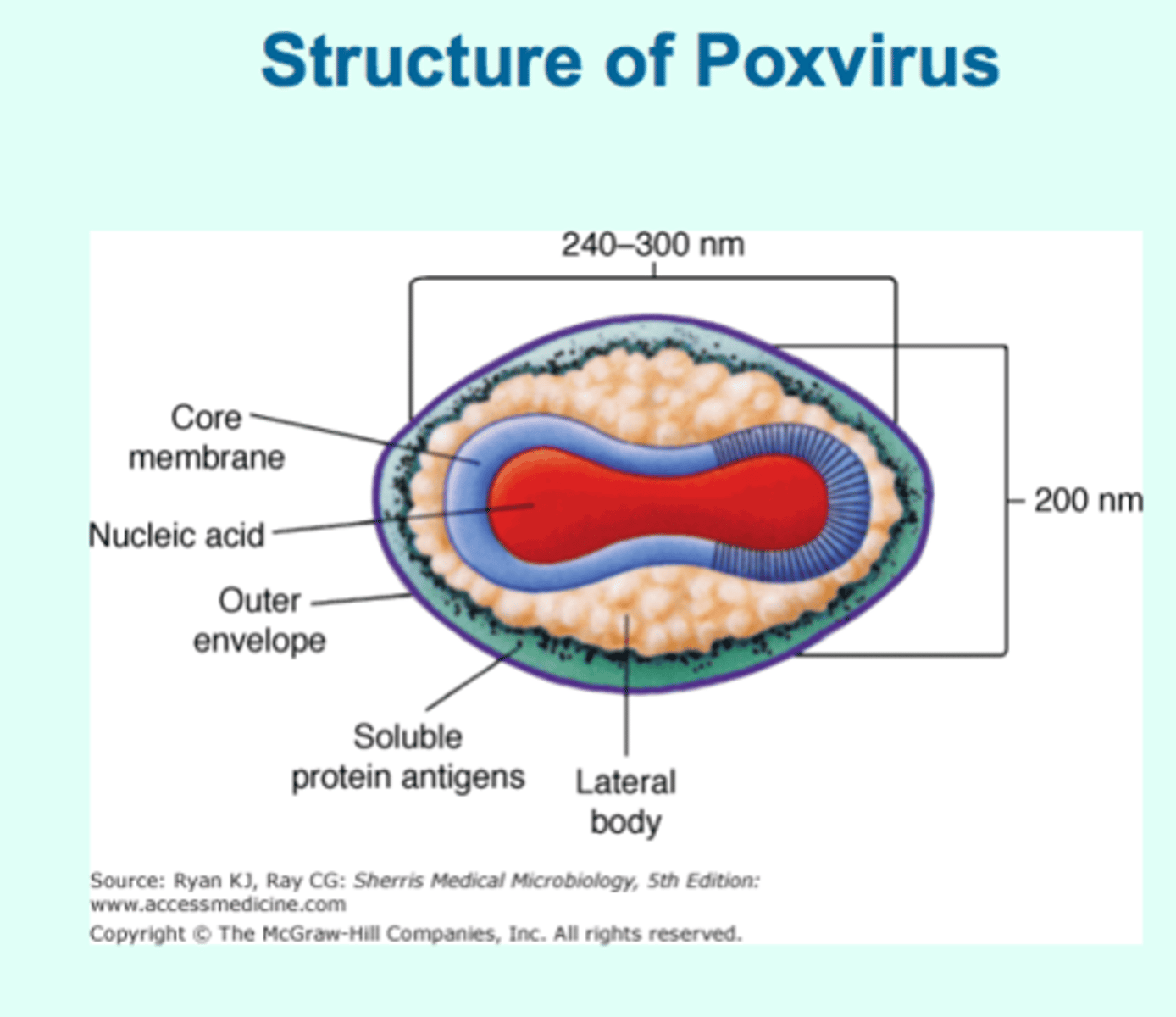
poxvirus
- enveloped
- produce eruptive skin pustules that leave scars
- largest & most complex animal virus
- have largest genome of all viruses
- dsDNA
- multiply in cytoplasm of epidermal cells & subcutaneous connective tissues
smallpox
- first disease to be eliminated by vaccination
- exposure through inhalation or skin contact
- fever, malaise, prostration, rash
- variola major & variola minor
variola major
- highly virulent
- cause toxemia, shock, & intravascular coagulation
variola minor
less virulent
smallpox vaccination
- uses single drop of vaccinia virus punctured into skin w/ double-pronged needle
- routine vaccination ended in US in 1972
- vaccine reintroduced in 2002 for military & medical personnel
herpesviruses
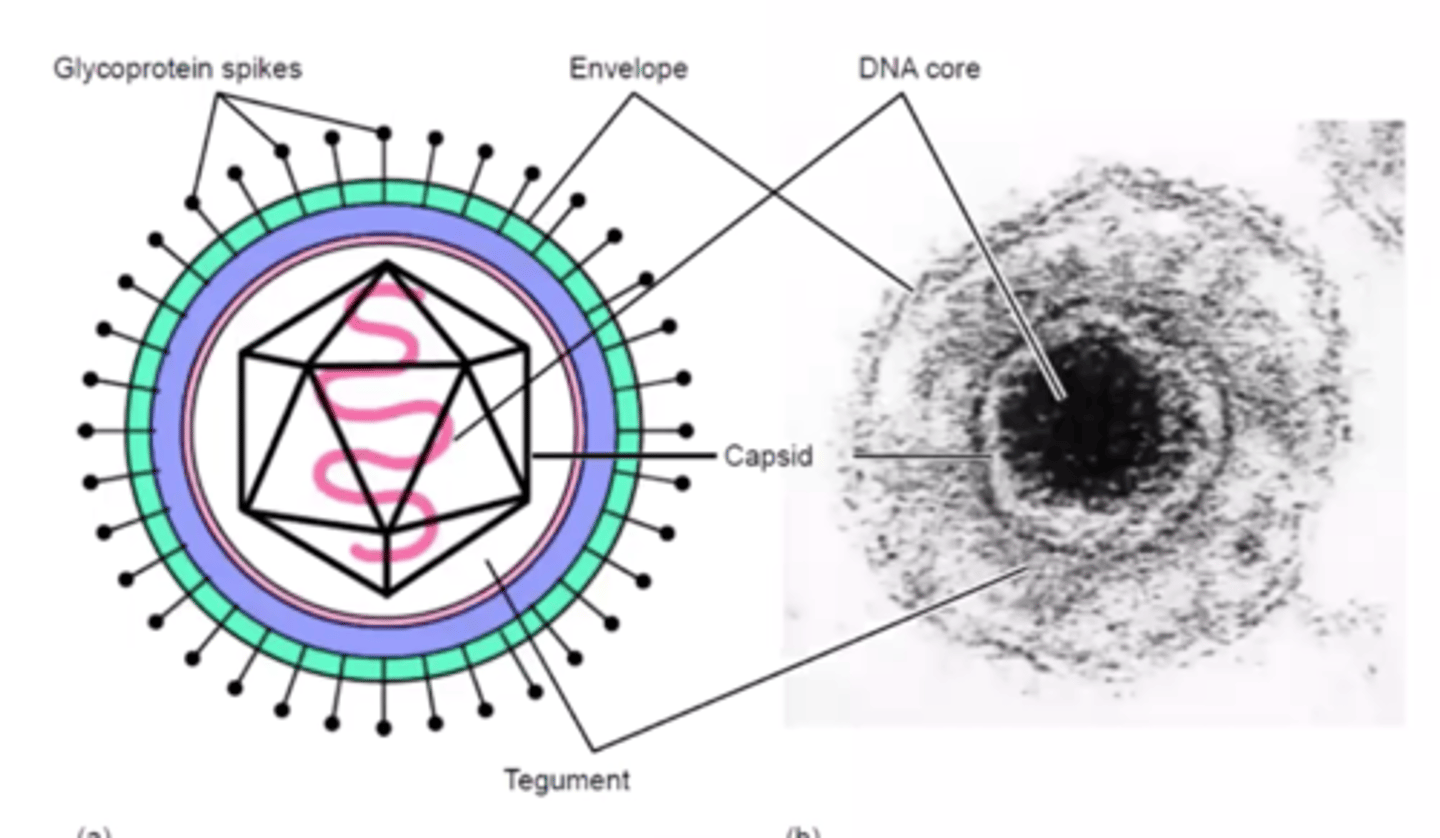
- enveloped DNA
- show latency & cause recurrent infection
- viral DNA forms episome
- clinical complications of latency & recurrent infections become more severe w/ advancing age, cancer, chemotherapy, or other conditions that compromise the immune defenses
- common & serious opportunists among AIDS patients
- humans susceptible to 2 varieties: HSV-1 & HSV-2
episome
- type of genetic element (such as DNA)
- can exist and replicate in the cytoplasm of a cell
- or can integrate into the host chromosome
herpesvirus structure
- large enveloped icosahedral double stranded DNA
- replicated within nucleus
HSV-1
- usually lesions on oropharynx, cold sores, fever blisters
- close contact, usually face
- occurs trigeminal ganglion
- enters 5th cranial nerve
HSV-2
- lesions on genitalia, possibly oral
- sexual or intimate contact
- occurs primarily in sacral ganglia
- enters lumbosacral spinal nerve trunk ganglia
transmission of Herpes Simplex
- by direct exposure to secretions containing the virus
- active lesions are most significant source
- genital herpes can be transmitted in absence of lesions
- HSV multiplies in sensory neurons, moves to ganglia
Herpes Simplex infection
- recurrent infection is triggered by various stimuli - fever, UV radiation, stress, mechanical injury
- newly formed viruses migrate to body surface, producing a local skin or membrane lesion
HSV-1 in children & adults
- Herpes labialis
- herpetic gingivostomatitis especially in young children
Herpetic keratitis
Herpes labialis
- fever blisters or cold sores
- most common recurrent HSV-1 infection
Herpetic gingiviostomatitis
- especially in young children
- inflammation of oral mucosa (gums, tongue, soft palate, & lips)
Herpetic keratitis
- ocular herpes
- inflammation of eye
- latent virus travels into ophthalmic rather than mandibular branch of trigeminal nerve
- gritty feeling in eye, conjunctivitis, sharp pain, & sensitivity to light
Type 2 Herpes infections
- genital herpes
- recurrent bouts usually less severe, triggered by menstruation, stress, & concurrent bacterial infections
genital herpes
- herpes genitalia
- starts with malaise, anorexia, fever, & bilaterial swelling & tenderness in groin
- clusters of sensitive vesicles on genitalia, perineum, & butt
- urethritis, painful urination, cervicitis, itching
- vesicles ulcerate
Herpes of newborn
- HSV-1 & HSV-2 infections potentially fatal in neonate & fetus
- infant contaminated by mother before or during birth; hand transmission by mother to infant
- infection of mouth, skin, eyes, CNS
- preventative screening of pregnant women; delivery of C-section if outbreak at time of birth
diagnosis of Herpes Simplex
- vesicles & exudate are typical diagnostic symptoms
- scrapings from base of lesions showing giant cells
- culture & specific tests for diagnosing severe or disseminate HSV; direct fluorescent antibody tests
treatment of HSV
- acyclovir: inhibit viral DNA synthesis
- famciclovir: inhibit viral DNA synthesis
- valacyclovir: inhibit viral DNA synthesis
Varicella-Zoster Virus
- humans are only natural host
- transmitted by respiratory droplets & contact
- primary infection: varicella (chickenpox)
- reactivation of virus: Herpes zoster (shingles)
chickenpox
- primary infection of varicella-zoster virus
- vesicles
- virus enters neurons & remains latent
Herpes zoster
- reactivation after chickenpox
- dermatomes
- more common in older patients
diagnosis of VZV infection
- cutaneous manifestations of varicella & shingles are sufficiently characteristic for ready clinical recognition
- shingles can be confirmed form multinucleate giant cells in stained smears prepared from vesicle scrapings
- unequivocal shingles identification w/ fluorescent antibody detection of viral antigen in skin lesions, DNA typings, or culture
viral agents of Hepatitis
- DNA virus: Hepadnaviruses (major group) & Hepatitis B Virus
- RNA viruses: Hep. A, Hep. C, Hep. E, & Hep. D
Hepatitis B Virus (HBV)
- produces hepatitis in humans
- multiplies exclusively in liver, which continuously seeds blood w/ viruses (chronic)
- 107 virions/mL blood
- blood products can transmit infection; sexually transmitted
- high incidence among homosexuals & drug addicts
- increase risk of liver cancer (hepatocellular carcinoma)
Hepatitis A virus (HAV)
- from contaminated food
- least virulent
Hepatitis C virus (HCV)
- from fecally contaminated food
- newly identified
- causes disease similar to HAV
Hepatitis D virus (HDV)
- defective RNA virus
- only infects cells already infected w/ HBV
pathogenesis of Hep. B virus
- virus enters break in skin or mucous membrane or by injection into bloodstream
- reaches liver cells, multiplies, & releases viruses into blood
- avg. 7 week incubation
- most exhibit few overt symptoms & eventually develop HBV immunity
- some experience malaise, fever, chills, anorexia, abdominal discomfort, & diarrhea
- fever, jaundice, rash, arthritis (severe case)
- small # of patients develop chronic liver disease - necrosis & cirrhosis
Adenovirus
- nonenveloped, dsDNA
- 30 types associated w/ human disease (oncogenic only in animals)
- infect lymphoid tissue, respiratory, & intestinal epithelia
- spread by respiratory & ocular secretions
- cause cold, pharyngitis, conjunctivitis, keratoconjunctivitis, acute hemorrhagic cystitis
- severe cases treat w/ interferon
- inactivated polyvalent vaccine
Parvovirus
- nonenveloped, ssDNA
- small diameter & genome size
- cause distemper in cats, enteric disease in dogs, fatal cardiac infection in puppies
- few cause infection in humans
human parvovirus
- B19 cause of erythema infectiosum (5th disease); rash of childhood
- children may have fever & rash on cheeks
- severe fatal anemia can result if pregnant woman transmit virus to fetus
- adeno-associated virus (AAV) is defective virus; cannot replicated in host cell without adenovirus
Epstein-Barr virus
- member of Herpesviridae family
- one of most common viruses in humans
- primarily transmit through saliva (kissing disease); can transmit through other bodily fluids
- cause infectious mononucleosis
- latent infection in B lymphocytes; virus can reactivate
- treatment: only relievement
- no vaccine
Cytomegalovirus
- member of Herpesviridae
- common virus - can infect all ages
- primarily transmit through bodily fluids & sexual contact
- can transmit through mother to child during pregnancy, childbirth, or breastfeeding
- flu-like symptoms
- can remain dormant, reactivate later
- congenital infections - lead to hearing loss, developmental delays
Herpetic whitlows
- painful infection caused by HSV that affects fingers or thumbs
- usually transmitted through direct contract w/ infected area, such as oral or genital lesions
symptoms of Herpetic whitlows
- initial symptoms: localized pain, itching, or burning at site of infection
- swelling & redness
- painful blisters/vesicles
Syncytium
- multinucleated cell that forms from fusion of multiple individual cells
- caused by HIV, RSV & herpesviruses
- can facilitate spread of virus b/w cells while evading immune response
Giant cells
- specialized, large cells that can form from fusion of macrophages or other immune cells
- can be multinucleated & seen in inflammatory responses
- types of giant cells: Langhans Giant Cells & Foreign Body Giant Cells
- indicative of chronic inflammation
- play role in body's immune response to persistent infections or foreign substances
Langhans Giant Cell
- characterized by horseshoe arrangement of nuclei
- typically associated w/ granulomatous inflammation
- ex. tuberculosis
Foreign Body Giant Cells
formed in response to foreign materials
infectious mononucleosis
- primarily caused by Epstein-Barr virus
- fatigue, fever, sore throat, swollen lymph nodes, enlarged spleen
Burkitt's Lymphoma
- type of aggressive non-Hodgkin lymphoma
- characterized by rapid proliferation of B lymphocytes
- associated w/ Epstein-Barr Virus
- most common in children
- rapidly growing tumors in abdomen, jaw, or lymph nodes
Human papillomavirus (HPV)
- nonenveloped
- 55nm
- common in human carriers
- virulence factor: ability to persist in epithelial cells of genitalia
-can insert in genome & cause oncogenesis
- common warts, plantar warts, genital warts
-