classics 20 image ID
 Call Kai
 Learn
Learn Practice Test
 Spaced Repetition
 Match
Match Flashcards
 Knowt Play
1/42

There's no tags or description
Looks like no tags are added yet.
Name | Mastery | Learn | Test | Matching | Spaced | Call with Kai |
|---|
No analytics yet
Send a link to your students to track their progress
43 Terms
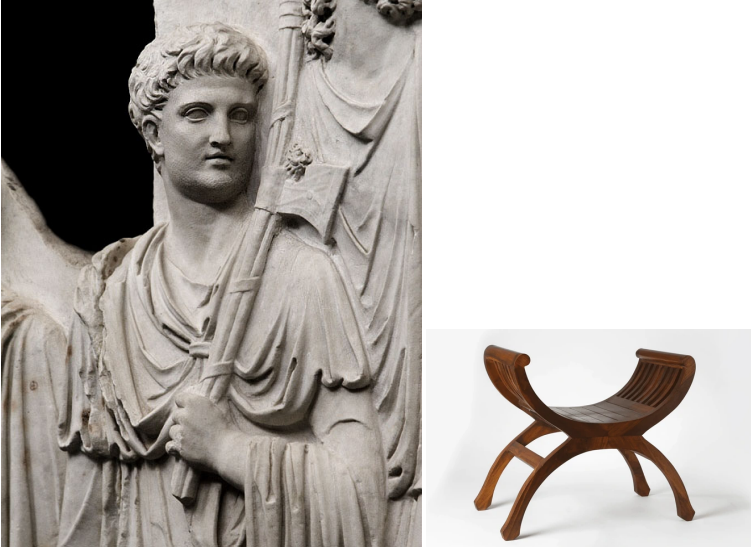
Curule Insignia: Fasces
Curules are senior magistrates who get to wear special insignia, called fasces. They symbolize authority and power. An example of this is the curule chair, which represents political authority. Only powerful magistrates could sit in one.
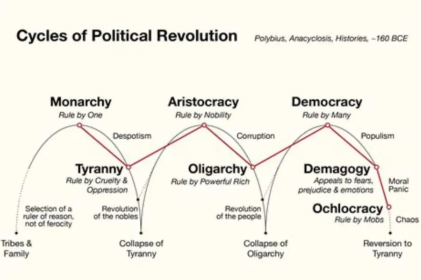
Polybius on Anacyclosis and the Mixed Constitution
This image shows the cycle of political revolution; however, the Roman Empire did not succumb to this. The reason was because of its mixed constitution, combining monarchy (consuls), aristocracy (senate), and democracy (the people).
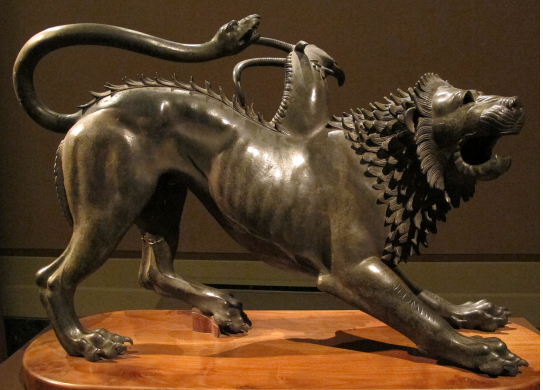
Etruscans: Chimera statue
The Etruscans were an advanced civilization in Italy that dominated the land before the Roman Empire. They had a good trade system and laid the foundation for the culture and politics of Rome.
The Chimera of Arezzo statue demonstrates that the Etruscans had contact with the Greeks, as the chimera is part of Greek mythology. It shows that the civilization was very advanced and their culture was influenced by other nearby cultures.
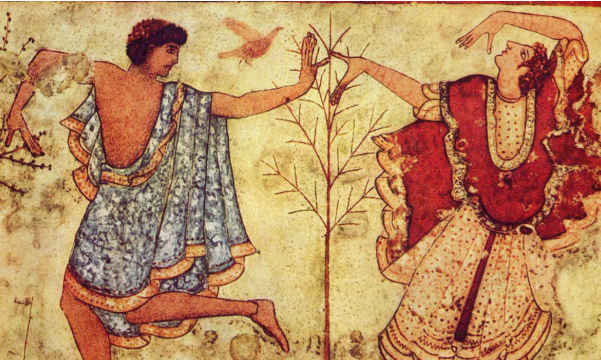
Etruscans: Tomb of the Triclinium
This tomb is a famous underground tomb known for having frescoes preserving Etrsucan art. This art depicts a woman dressed in fine clothes, demonstrating that women might be on more equal footing with men in Etruscan society than in Roman society.
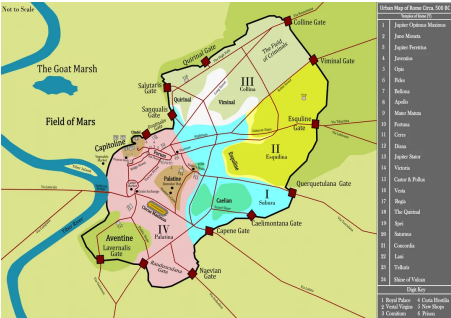
Map of Rome c. 500 BCE
This map depicts the Temples around Rome as well as the city gates, demonstrating how the different areas of the city were organized.
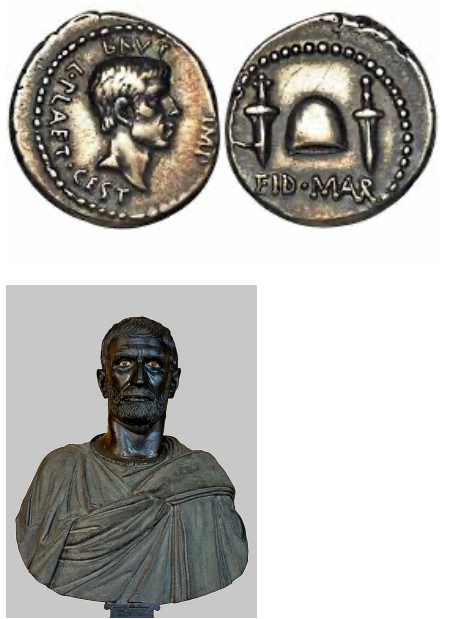
This statue depicts Lucius Iunius Brutus (died c. 500 BCE), semi-legendary founder of Roman Republic, one of two first consuls, ancestor of the gens Iunia.
The coins depict Marcus Iunius Brutus, descendent of the above, a Roman politician, orator, and one of the leading assassins of Julius Caesar. The knives represent his assassination attempt while the cap is the Polaneus Cap given to a freed slave.
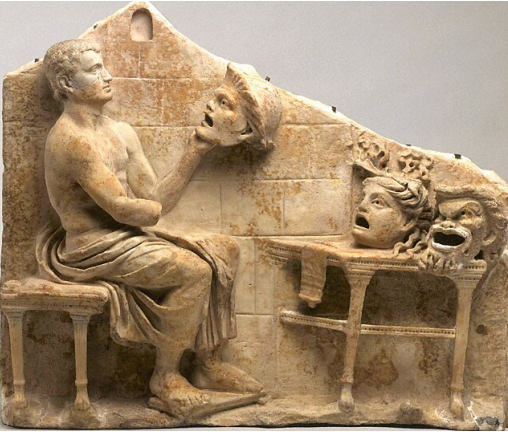
Hellenization: New Comedy
Menander is a Greek playwright who wrote what became known as “new comedy.” These plays bled into Roman culture, leading to plays that typically focused on young men main characters, with additions of archetypes like the clever slave and helpless woman, focusing on issues of mixed identity as well as civic and romantic problems.
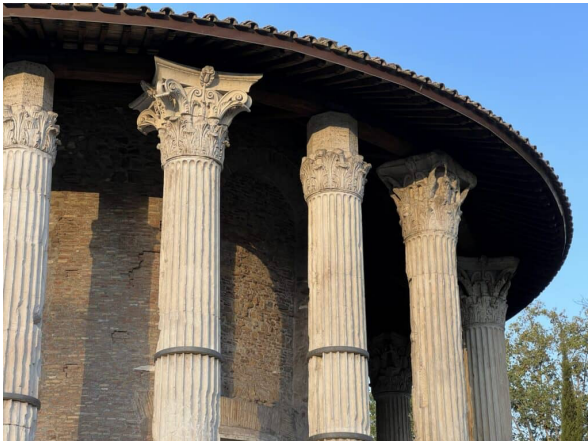
Temple of Hercules
The Corinthian columns and colonnade of this temple demonstrate influence of Greek architecture
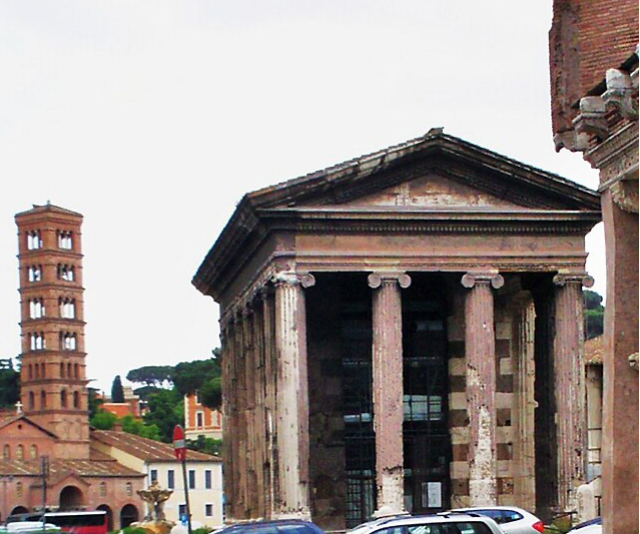
Temple of Portunus
Ionic columns, pediment, and pronaos (empty space in front of cellar) all betray the influence of Greek architecture.
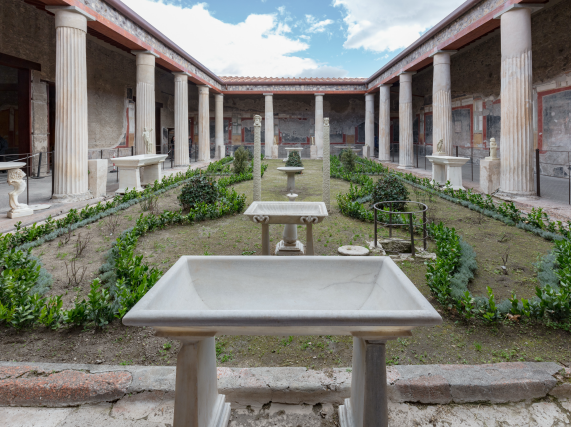
Colonnade in House of Vettii
The lavish colonnaded courtyard was designed to impress clients at the wealth of the two freedmen who lived in the House.
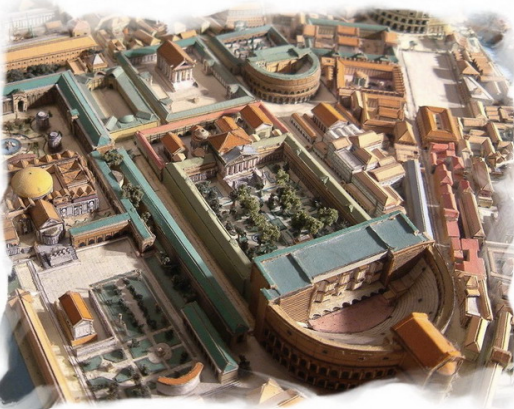
Theatre of Pompey
Pompey was able to get around the rules about building permanent structures within the city of Rome by orienting his theater just outside the sacred boundary. He also incorporated Temples of Venus into its design.
Other political figures used the theater to further their agendas: Caesar celebrated his triumph over Pompey’s forces in Africa there, and Julius Caesar was assassinated in the curia Pompey had incorporated in its design.
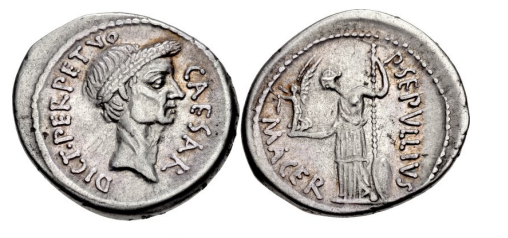
Julius Caesar: Dictator for Life
It was unusual for Roman emperors to be dictators for life- they typically held office for 10 years. This coin demonstrates the unusualness of this demand as it was custom for no living person to put themselves on a coin.
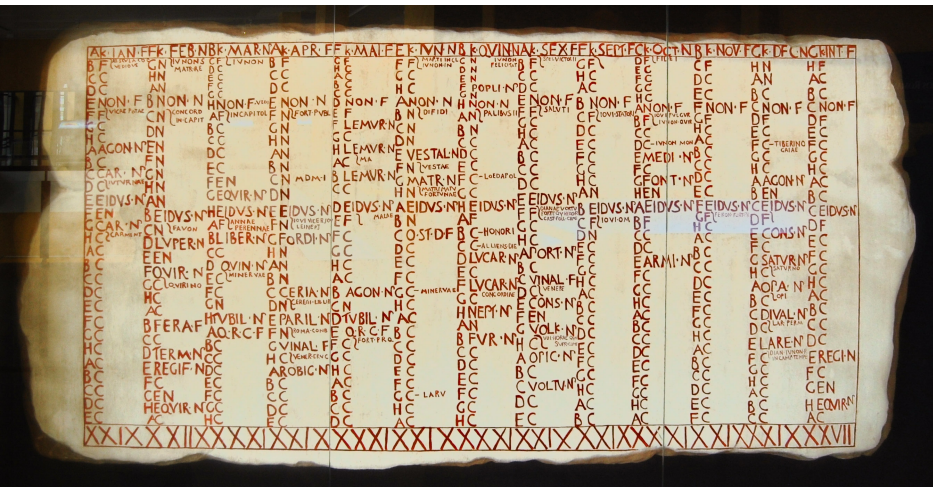
Roman Calendar Before Julian Reforms
Our only surviving example of a pre-Julian calendar; Julius Caesar named the 5th month, Quintilius, after himself, which then became July. He also created the 365 day solar year and created the leap year.
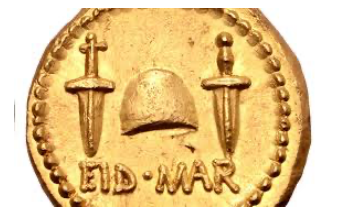
Tyrannicide
This coin depicts the assassination of Julius Caesar by Brutus (knives demonstrating his assassination, Polaenous Cap demonstrating that Brutus and Cassius had “freed” Rome from the tyrannical rule of Julius Caesar
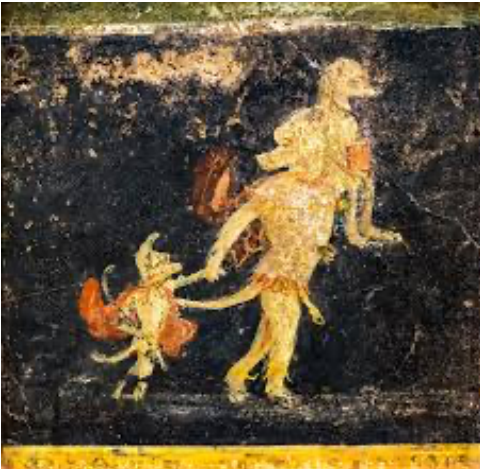
The Aeneid: An Instant Classic
This image depicts Aeneas, Anchises, and Iulus/Ascanius + the Penates (their household gods). They fled Troy to Italy after the Siege of Troy, where Aeneas’ fate was to travel to Italy and found the city that would eventually become Rome.
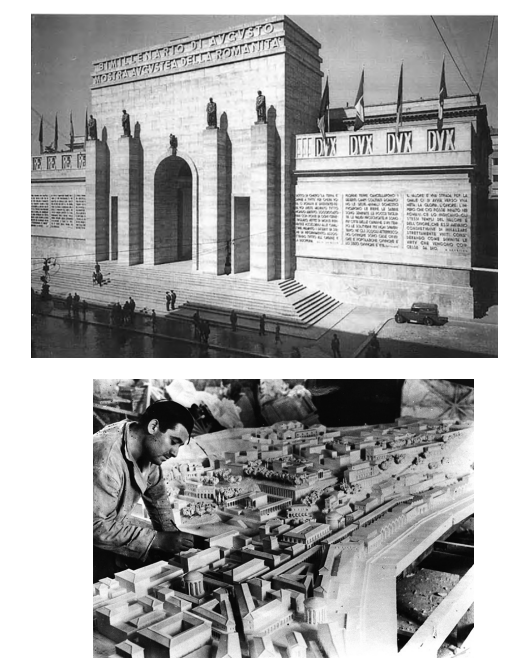
Augustus and Mussolini
Augustus was the pontifex maximus, or chief priest. He used monuments to detail all of his achievements, similar to Mussolini. Both attempted to appear as peacekeepers through physical monuments (Mussolini sponsored archaeological restorations to present himself as the modern heir to Roman emperors).
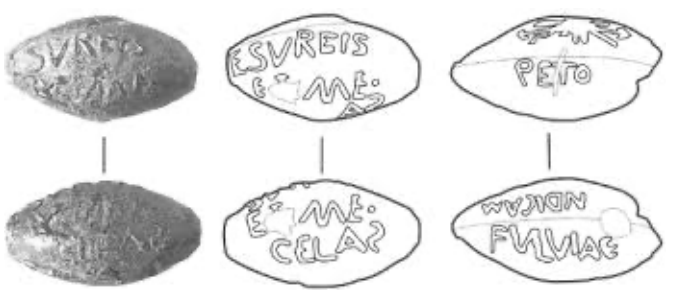
Fulvia and the Siege of Perugia
Fulvia, the wife of Mark Antony, was out east during the conflict between Lucius Antonius and Octavian, so Fulvia led his troops in Perugia, representing his interest in the war. The sling bullets depicted have vulgar insults written on them, showing that women were not well-respected as leaders in the Roman Empire.
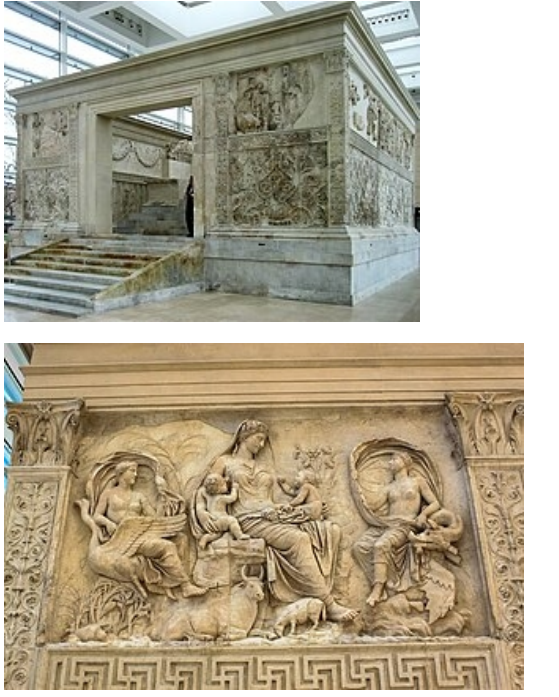
The Ara Pacis
“The Altar of Peace” a massive altar commissioned by the Roman Senate, honors the Emperor Augustus returning from his campaigns in Hispania and Gaul. It was a religious monument, but tied religion to political propaganda as it legitimized Emperor Augustus’ rule.
Fruits and animals on the walls reminded the Roman people that Augustus restored agricultural wealth. Roma, the personification of Rome, sits atop war spoils to advertise Augustus’ military triumphs.
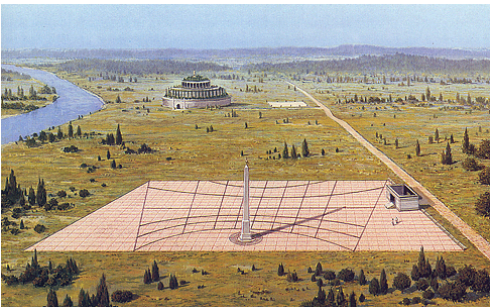
Horologium Augusti
A monumental solar instrument constructed by Emperor Augustus celebrating Rome’ conquest of Egypt. It was designed to symbolically align with the Ara Pacis.
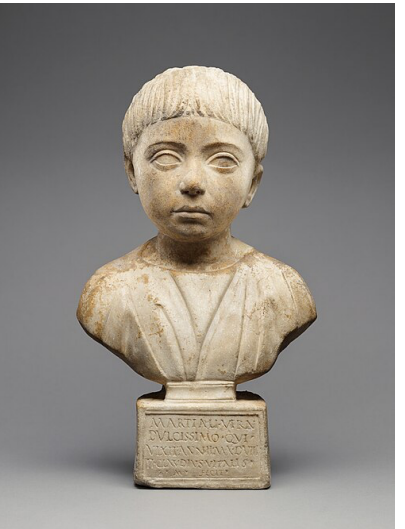
Martial, verna of Tiberius Claudius Vitalis
Martial was a house-born slave of Tiberius Vitalis, who made this monument for him after he died at two years old. This demonstrates that Roman slaves could be very young, and any slave children were born into slavery as well. Additionally, Martial could have been Tiberius’ son, which drove him to memorialize him.
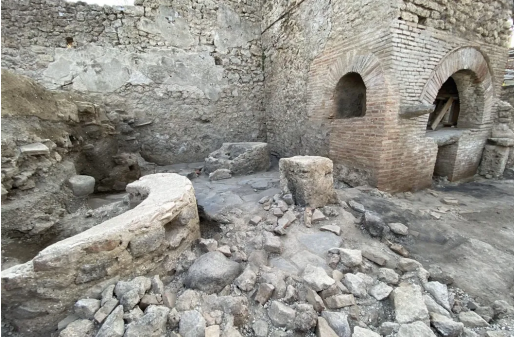
Slave labor: The Prison Bakery
This image depicts a bakery in Pompeii where slaves worked and lived, as their living quarters were within the structure. They lived in very poor conditions, in filth and squalor, and there was no separation between work and life. There was no light and slaves also lived with donkeys.
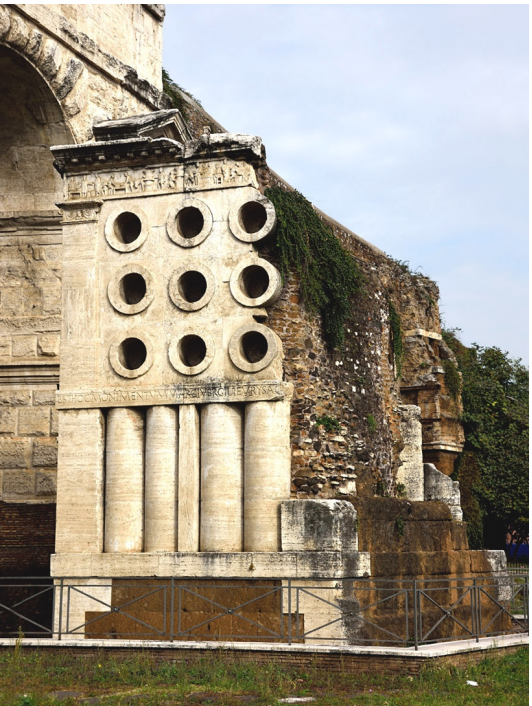
Eurysaces the Baker
This is the tomb of Eurysaces the Baker, a freedman (former slave) who rose to economic wealth and status through his work as a baker. It is shaped like a baker’s oven and depicts the bread-making process on the sides. We know this is a freedman’s tomb because freeborn Roman citizens would not have work/mercantile duties depicted on the sides. Instead, Eurysaces’ financial gain was a source of pride.
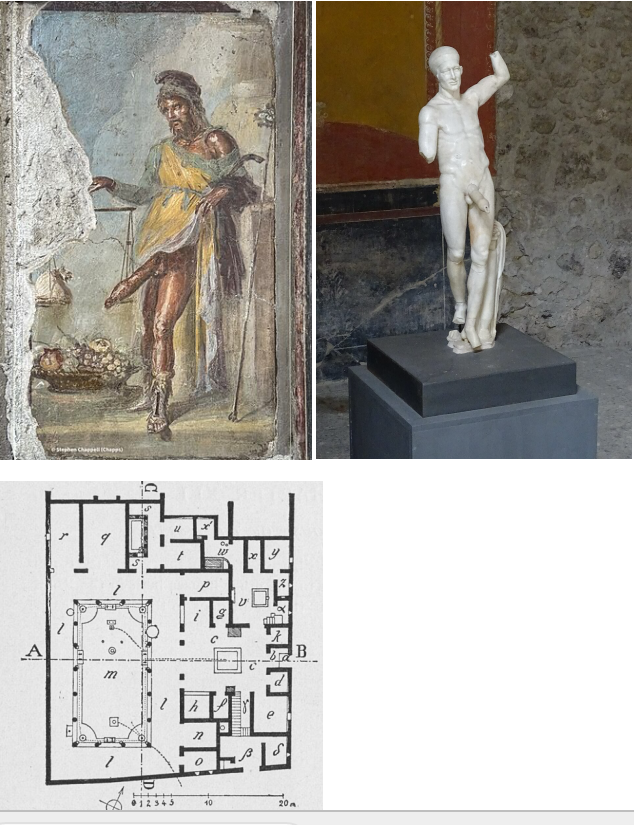
this also includes the mercantile cupids image
House of the Vettii
A house of a freedman in Pompeii that contained several depictions of Priapus, the god of wealth, who has a very large phallus. It symbolizes fertility and wealth. They also had images of Cupids performing mercantile activities, demonstrating that this was the house of freedmen and not freeborn men.
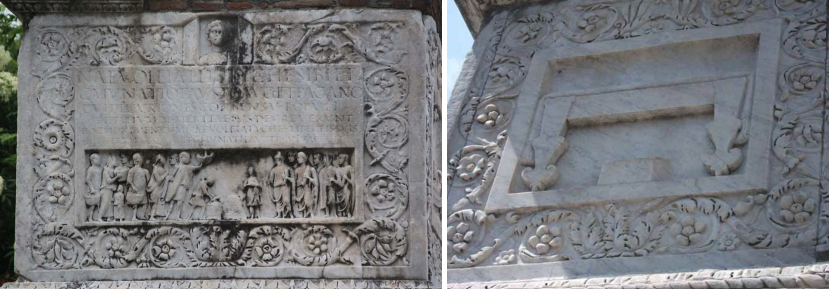
Freedmen’s Tombs at Pompeii
The tomb of Naevolia Tyche, a freedwoman, showcases the wealth, ambition, and social climbing of freedwoman in Roman society. She commissioned this structure with her husband while she was still alive to commemorate the lives of other freed men and women. It also had a seat of double width for Gaius Faustus for his civic benefactions and community service.
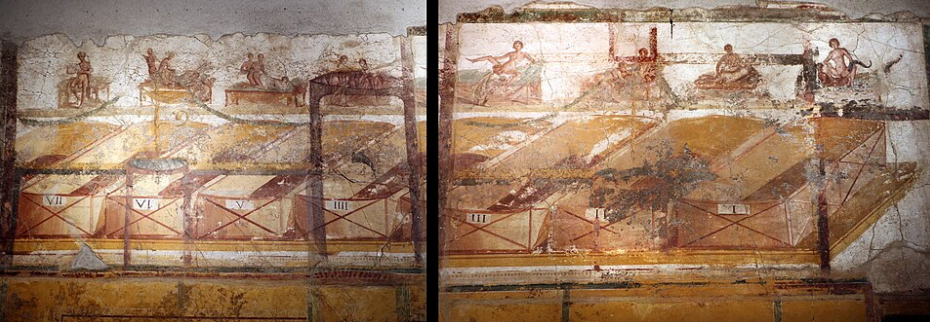
Roman Sexualities
These images from the suburban baths at Pompeii tell us that Roman sexualities were a big part of Roman life that were not taboo to be depicted in art. They also show that homosexuality was not widely accepted, though Roman sexual acts were described more through “active” and “passive” roles than gendered roles. These images could have merely been used to help patrons of the bath remember where they placed their clothes.
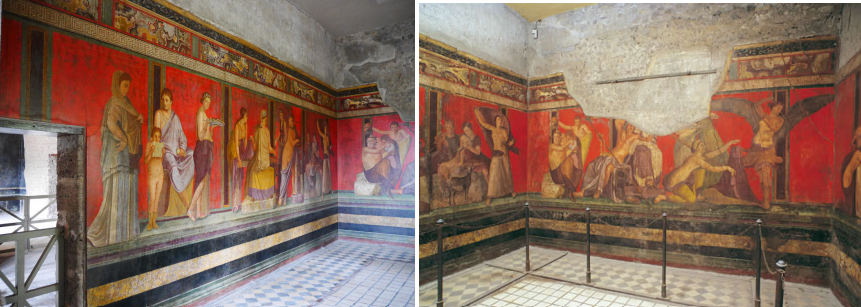
Second Style Pompeian Wall Painting in the Villa of the Mysteries
Figures are life size and it feels like you can enter into the paintings, drawing viewers in; a big part of Second Style is visual illusionism.
First Style
“Incsrustation”: imitation of marble blocks, using stucco to create realistic images
Some architectural elements, e.g. pilasters
Second Style
Architectural features are used to lend perspective & illusionism
Openings in architecture, masks, landscapes, mythological scenes
Third Style
Illusionism and 3 dimensional worlds disappear; walls are flatter, vertical zones separated by columns
Mythological “sacred” landscapes
Fourth Style
Wall is a mosaic of framed pictures, figures are statue-like
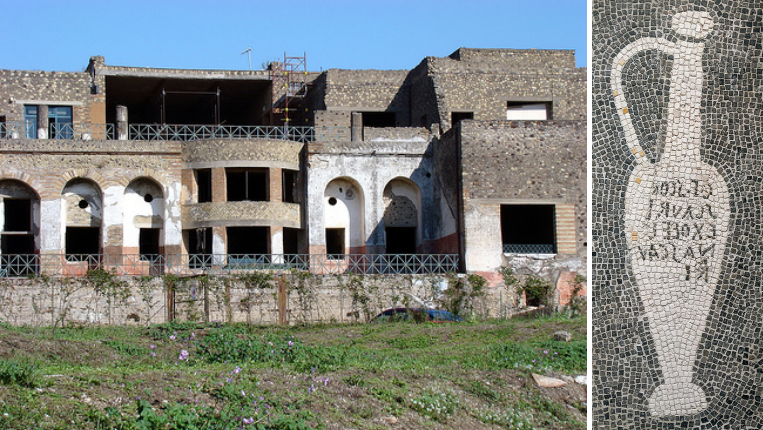
Aulus Umbricius Scaurus, the Garum-maker
Aulus Umbricius Scaurus was a Pompeiian manufacturer-merchant known for making garum, a popular fermented fish sauce. He became very wealthy because of the high demand of his products, and is considered the “father of advertising” because he turned his home into a direct advertisement of his fish sauce jars by putting mosaics of them on his walls.
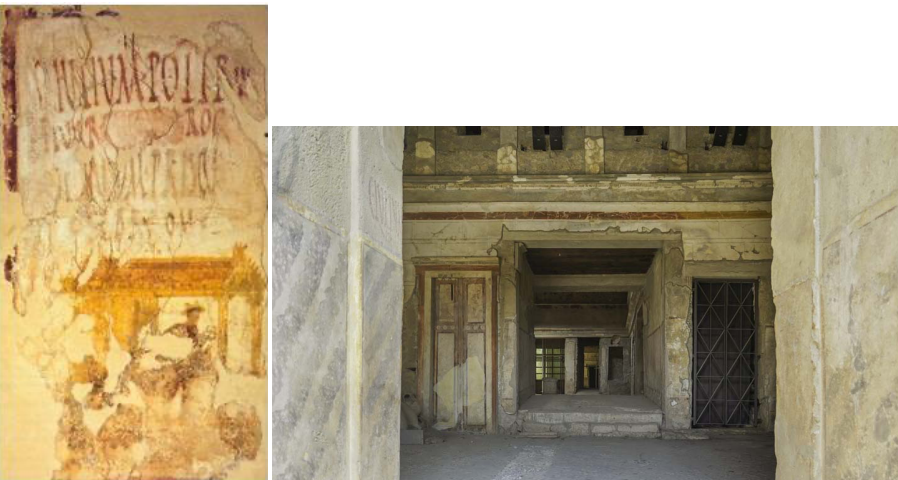
C. Iulius Polybius
Polybius was heavily involved in Pompeian local politics, and his house had numerous inscriptions on his house’s exterior promoting his bid for duumvirate. He was very influential and wealthy; “Caius Julis Polybius for duumvir. Cuculla begs it.”
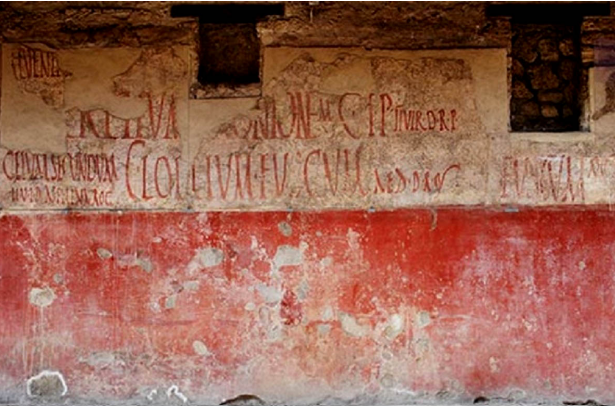
Pompeii: Low Life
Programmata, inscriptions about political candidates on the side of a tavern
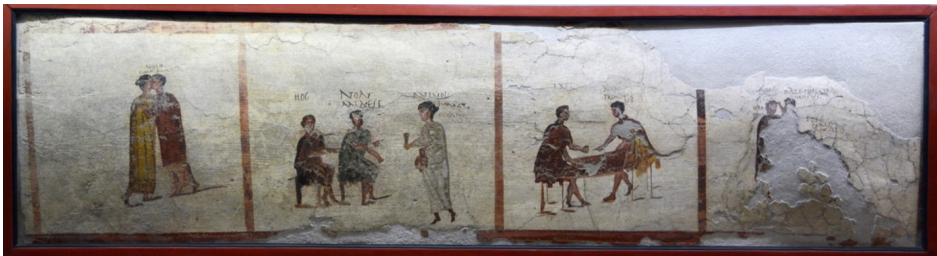
Bar
This fresco depicts scenes from daily tavern life, including gambling, drinking, a kissing couple, and a game of dice. The lower classes typically engaged in this behavior.
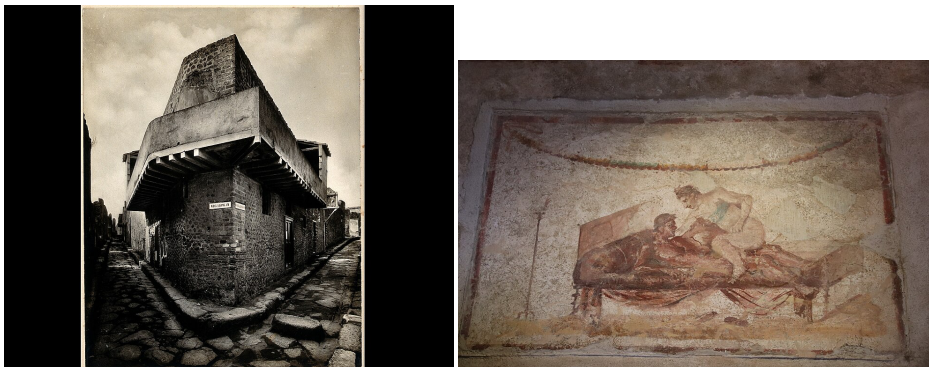
Brothel
This is an image of the Lupanar Brothel, the official brothel of Pompeii. Prostitution was legal in Rome and this brothel was very large, with 10 rooms. Brothels were decorated with murals depicting erotic scenes.
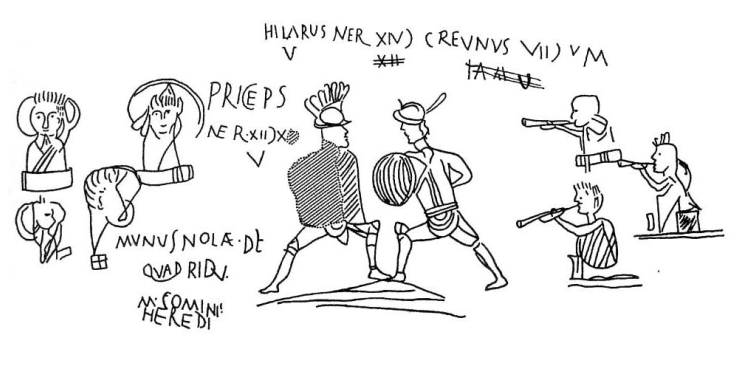
Gladiator Drawing
This drawing is graffiti from Pompeii, specifically a record of a gladiatorial match drawn on the wall. Around the gladiators, musicians play traditional instruments for musical accompaniment during the games/festival
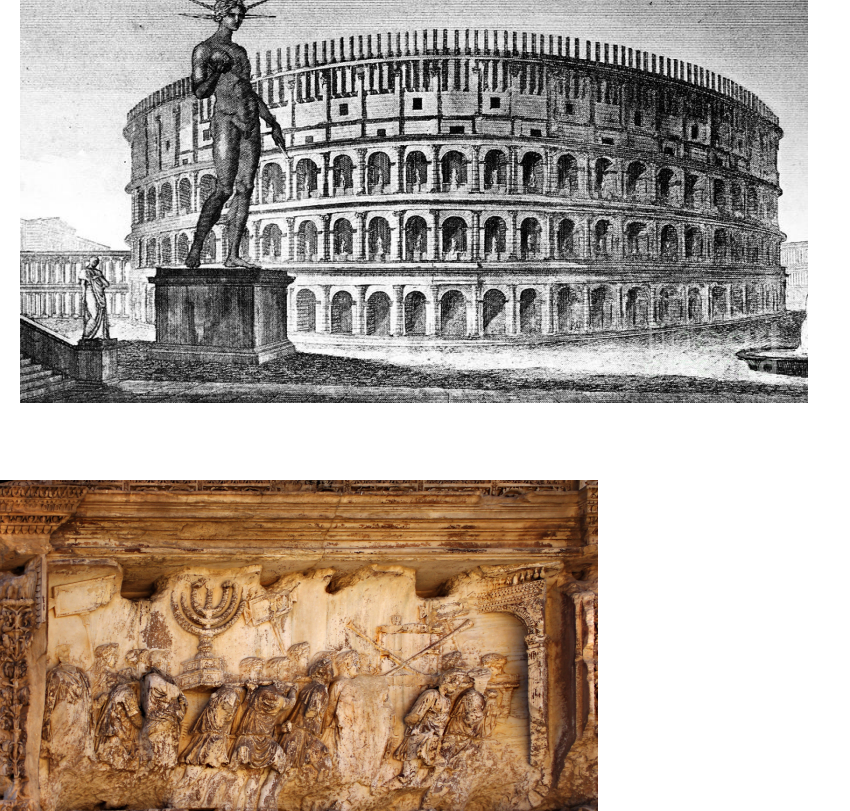
What do the images below tell us about the construction of the Colosseum?
The Colosseum was built on the space where Nero’s Golden House used to lay, next to Palatine Hill. A Colossus of Nero stands outside of the Colosseum near the entrance, and might have given it its name. Images on the walls depicted a Menorah being taken as a war spoil after the defeat of the Jews, demonstrating that the spoils from Jerusalem paid for the construction of the Colosseum.
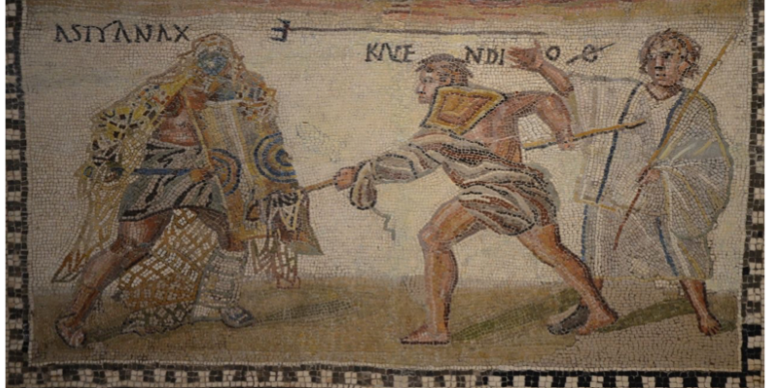
Retiarius vs. Secutor
This image is a mosaic depicting a gladiator fight. A retarius, or net fighter, fights a secutor named Astynax to the death.
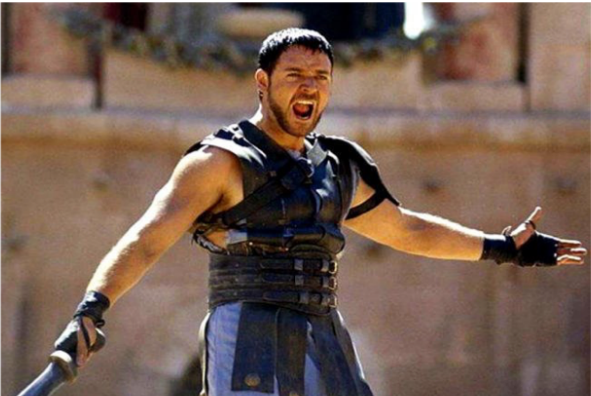
Are you not entertained?
Gladiator follows a former general, Maximus Decimus Meridius, in his quest for revenge against the corrupt emperor who obliterated his entire family and turned him into a slave. After Maximus defeats his opponents in the arena, he asks the crowd, “Are you not entertained?” as he is disgusted by the spectacle, and throws his sword. He holds contempt for the system and cycle of violence.
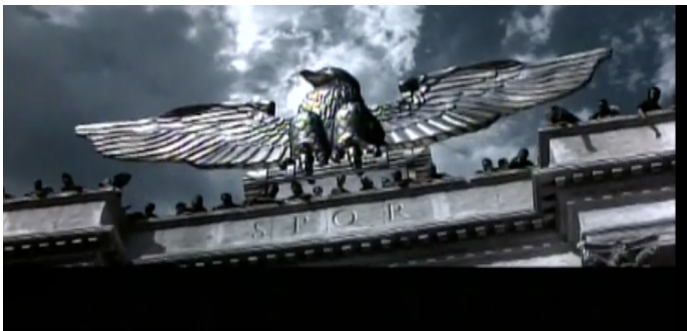
SPQR
What use does Gladiator make of fascist iconography like this?
SPQR = The Senate and People of Rome
Visually frames Rome as a brutal, oppressive police state, positioning it opposite to Maximus’ moral heroism.
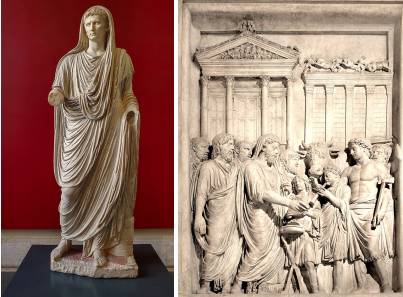
Religion: Pontifex Maximus
In what role do we see the emperors Augustus and Marcus Aurelius in the images below?
This statue depicts the Emperor Augstus with his head veiled for a religious sacrifice, as emperors are both political leaders and chief religious authority of the Roman Empire.
This is a bas-relief panel depicting Emperor Marcus Aurelius performing a sacrifice, highlighting the emperor as both a political and religious leader
How important was this role to Roman emperors in the first two centuries CE?
Emperors were vital as religious leaders because religious legitimacy was a vital tool to unify the empire across regions; it allowed all of the conquered lands to worship the Emperor through religious practices, altars, and temples. Claiming divine favor also helped legitimize the monarchy.
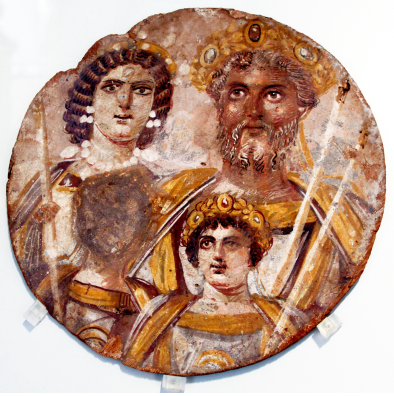
Severan Dynasty and Damnatio Memoriae
This artwork shows Emperor Severus and his wife, Julia Domna, and two sons Caracalla and Geta. Severus left Caracalla and Geta as joint heirs to rule Rome together, but they soon grew bitter. Caracalla had his brother Geta assassinated and then completed damnatio memoriae, or the “condemnation of memory.” Caracalla had Geta’s name chiseled out of inscriptions and face blackened in artwork and murdered his supporters.
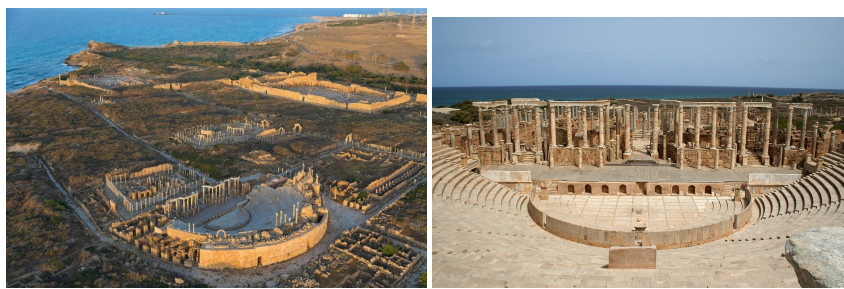
Leptis Magna
A very wealthy, prominent city of the empire in North Africa. Because it was the Emperor Severus’ hometown, he poured vast imperial wealth into the building of the city, creating basilicas, arches, theaters, and a bustling port. It has a lot of surviving architecture we study today.
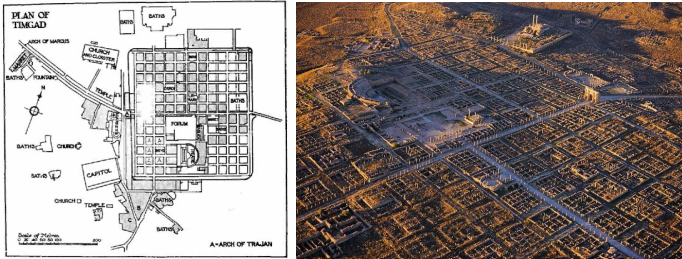
Timgad
The Roman colony of Timgad in modern day Algeria displays typical features of Roman town planning in the provinces–how?
Perfectly walled square measuring 355 x 355 meters, divided into a rigid grid of blocks (20 x 20) connected by perpendicular streets. It also prominently features the two main intersecting streets that characterize many Roman cities, the Decumanus Maximus (east-west road) and the Cardo Maximus (north-south road).
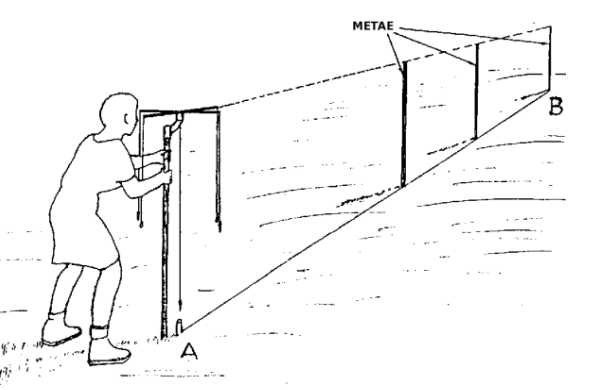
Centuriation
Land-surveyors (gromatici)
Centuriation is the procedure for tracing a grid with an instrument called a groma
Grid axes:
Decumanus maximus (main east-west road)
Cardo maximus (north-south road)
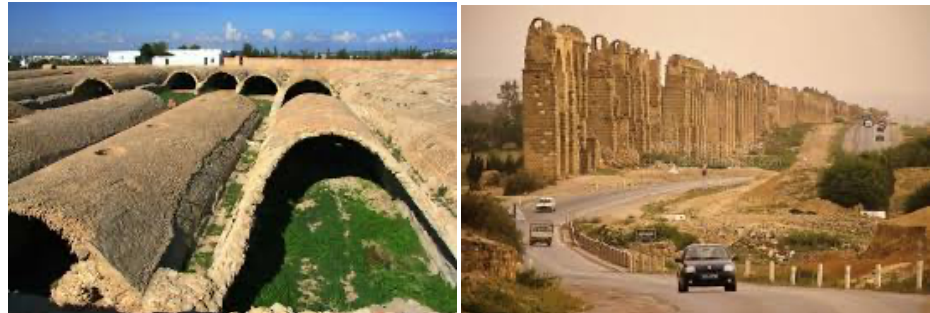
Water Supply
Cisterns at Malga (Carthage), where water was brought from the Zaghouan Aqueduct, Tunisia
Held 60,000 cubic meters of water
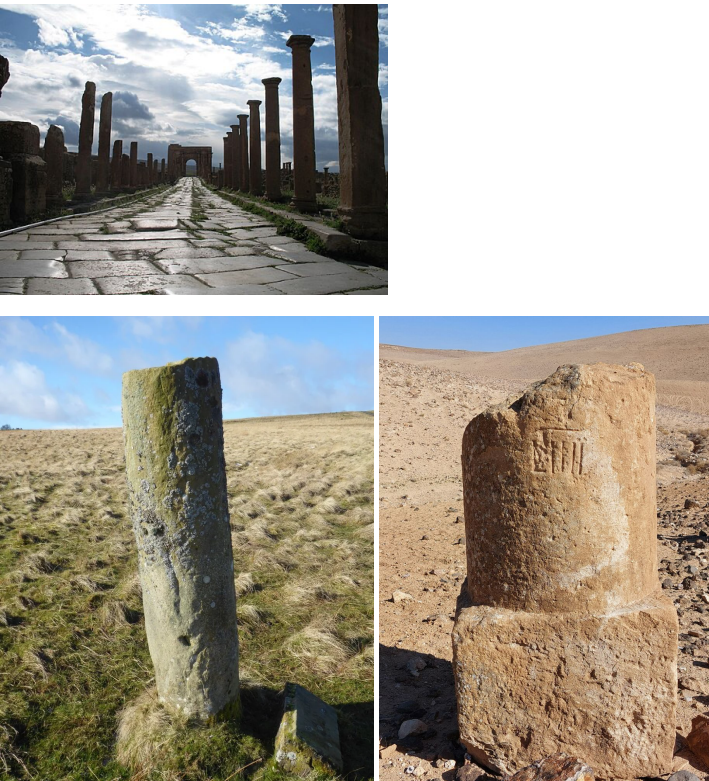
Roads & Milestones
Roman roads were revolutionary and spanned nearly 250,000 miles. They connected the empire for military, trade, and communication and were built to be extremely durable using four layers.
Romans used these stone pillars to mark when around a mile had passed (1,000 paces). These were like an ancient GPS that could tell passerby the distance to the nearest city of Rome and the name of the emperor who commissioned the road.