Intro to motor learning
 Studied by 0 people
 Call Kai
 Learn
Learn Practice Test
 Spaced Repetition
 Match
Match Flashcards
 Knowt Play
1/40

There's no tags or description
Looks like no tags are added yet.
Name | Mastery | Learn | Test | Matching | Spaced |
|---|
No study sessions yet.
41 Terms
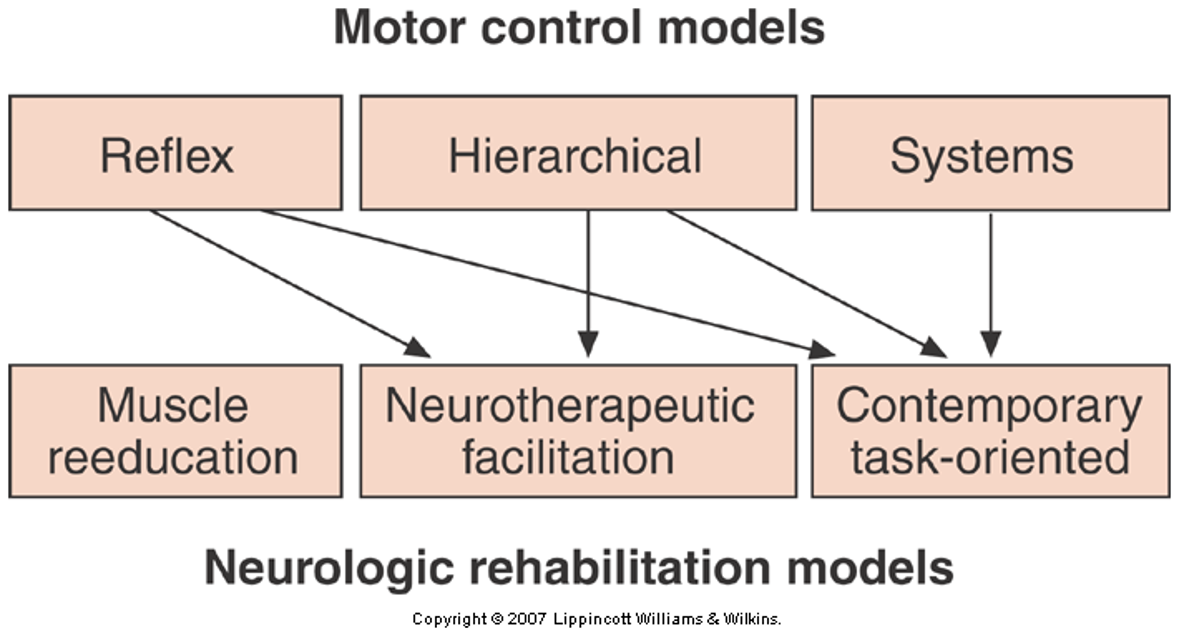
How motor control models (reflex, hierarchical, and systems) correlate with neurological rehab facilitation models (muscle reeducation, neuropathic facilitation, contemporary task-oriented)
Motor learning defined
-The study of the aquisition and/or modification of skilled action
-Set of processes associated with practice or experience leading to relatively permanent changes in the capability for producing skilled action
Motor learning involves more than motor process…
-emerges from a complex interplay of perception-cognition-acition processes
Task solution emerges from interaction of the ___ with the ___ and the ___
individual; task; environment
Recovery of function entails the reorganization of both perception and action systems in relation to how individuals are solving ___ ___ in ___ ___
-functional tasks; specific environments
Performance
-temporary change in motor behavior seen during practice sessions; complex interaction among many variables
Learning
-set of processes associated with practice or experience leading to relatively permanent changes in motor behavior/skilles action assessed during retention or transfer tests
Practice design 2 phases
-Acquisition phase
-Transfer phaseA
Acquisition phase
-initial practice of task; performance evident
Transfer phase
-Test of task performance given with sufficient rest or lay-off so any tempory effects are allowed to dissipate
Goals for practice (4 points)
1) Improvement of performance during practice session
2) Generalizability to similar
3) Success in altered contexts
4) Retention
Training for motor learning - Sufficient evidence now exists that the acquisition of a new motor skill requires:
-progressive challenge
-intensity
-problem-solving
-sufficent motivation and focused attention
especially in the early stages of learning
Training for motor learning - skill-based learning involves ___ ___ and requires a certain degree of ___ ___ ___
-active participation; voluntary neuromotor capability
Organization of practice (2 types)
-Blocked practive
-Random practice
Blocked practice
- repetition of the same task prior to changing tasks
Random practice
-repition of various tasks in random order
Random practice promotes ___ ___ ____ and ___-___ by the learner, rather than rote reproduction as with blocked practice
-depth or processing; problem-solving
implementation of blocked vs random practice will vary based on what?
-Will vary based on pathology/diagnostic group
Practice to promote acquisition
-requiring specific movements
-reproduction of movements
-consistency of movements
-part practice
-blocked practice
-using manual guidance for cueing
Practice To promote retention:
-promote accomplishment of actions
-Generation of action problem solutions
-Diversity of movements with actions
-Practice within context of actual task
-Random practice
-Reducing manual guidance and cueing
Feedback (2 types)
-Intrinsic feedback
-Extrinsic feedback
Intrinsic feedback definition
-performance information generated internally by the performer
Extrinsic feedback definition
-Supplemental information provided to the performer; augmented (e.g. VCs, manual guidance, visual cues)
Extrinsic feedback
-knowledge of results (KR) augmented, post-response, “verbalize” extrinsic information about success in meeting the environmental goal; outcome fedback
-Knowledge of performance (KP) - extrinsic information about the pattern of actions that lef to the achievement (or not) of the environmental goal; kinematic feedback
Extrinsic feedback to promote acquisition
-high quantity
-high frequency
-given concurrent with task
-given to the patient from the therapist
-much manual guidance and cueing
Extrinsic feedback to promot retention
-lower quantity
-lower frequency
-given following the task or after a delay
-coordinated with patient’s intrinsic information
-less manual guidance and cueing
Specificity of motor learning
-what you learn depends largely on what you practice
-practicing in a particular environment or workspace leads to better performance, mainly in the same context
-sensory feedback resulting from performance during specific types of practice becomes part of the learned representation for skill
Instructive Motor leanring
-defined as a change in motor behavior achieved through the use of an intentional movement strategy
-learner is provided specific extrinsic feedback about a movement error or performance relative to a task goal (ie. knowledge of performance) that promotes the development of an intentional error-reducing movement strategy (extrinsic feedback - auditory, visual, tactile)
-Strategy can be explicity (consciously) described by the learner and reproduced in the future; also commonly termed explicit or strategy-based motor learning
-Involves multiple cognitive processes (comprehension of instructions, performance monitoring); high cognitive burden of instructive learning mediated primarily in prefontal cortex
-occurs on a relatively fast timescale when cognition is intact
Reinforcement Motor learning
-Defined as an improvement in motor behavior that is driven by outcome-based feedback
-Depends on external feedback about the success or failure of the movement relative to a task goal (knowledge of results/KR)
-Potentially mediated by reward-based dopamine signaling, where activity of dopaminergic neurons in the basal ganglia increases in response to task success during early stages of practice
-Cognitive processes are unclear; traditionally, considered an implicit or automatic process → currently, intentional exploration of different movements in search of the successful behavior may be critical - may require more cognitive processing than originally proposed; Moderate cognitive burden
-Slower rate of reinforcement learning associated with longer retention of aquired movements; may be coupled with other ML mechanisms
Use-dependent motor learning
-Defined as a change in motor behavior that is driven by repeated task-specific practice
-Repeated massed practice of a new task causes future repitions to be more similar to the practiced behavior
-Primary behavioral driver is the amount of practice completed by the learner; researchers have also identified a number of practice parameters that can be manipulated to optimize use-dependent learning (task-specificity, aerobic intensity, etc.)
-Requires some cognitive engagement (problem solving); extensive practice reduced cognitive load (automaticity); mediated primarily in the motor cortex and spinal cord
-Occurs over a long timescale; lasting improvements in motor behavior are slow to accumulate (weeks/months) and the generalization from training to real-world improvement can be quite small
→More immediate changes in motor behavior may occur if combined in parallel with instructive motor learning, which occurs on a much faster timescale
Sensorimotor adaptation
-Defined as a change in motor behavior that is driven by sensory errors
-Most often occurs when unexpected task demands or changes in the environment (perturbations) require modifications to the executed motor program
-Primarily dependent on the cerebellum, mapping of outgoing motor commands to the predicted sensory feedback from that movement (actual vs intended); Allows error detection and correction
-Low cognitive burden -though to occur automatically and implicitly, independent of intentional, voluntary modifications to movements; often occurs in parallel with instructive/strategy-based motor learning
-Occurs on a very rapid timescale, generally resulting in a change in motor behavior over minutes; allows impressive flexibility of movement in the context of many different task demands
→Not simply transient changes in movement performance - newly learned movement must actively be unlearned (aftereffect)
→Re-exposure to perturbation results in (1) smaller movement errors initially and (2) relearning of new movement faster (“recall” and “savings”, respectively)
Neural plasticity definition
-the ability to show modification, in the case neural modifiability
Neural plasticity incliudes
-short-term changes (efficiency or strength of synaptic connections)
-long-term structural changes (organization and # of connections among neurons)
Plasticity occurs at many levels, including:
-Brain level - glial and vascular support
-Netowrk level- changes in patterns of neural activation and cortical re-mapping
-Intercellular level - changes between neurons at synaptic level, including sprouting
-Intracellular level - mitochondrial and ribosomal function
-Biochemical level - protein conformation, enzyme mobilization
-Genetic level - transcription, translation, and post-translation modifications
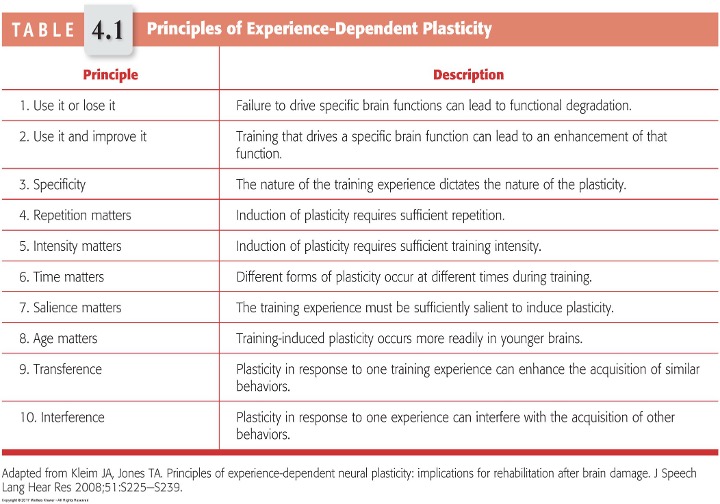
Principles of experience-dependent plasticity
Why does High Intensity Training matter?
-Intensity - increased workload (HR, RPE) promotes neuroplasticity
-Specificity - the task itself impacts brain activity and neuroplastic changes
-Repetition - higher number of trials (massed practice) includes neuroplastic changes
4 key subcomponents and criteria of gait:
stance control
limb advancement
propulsion
postural stability
what is stance control and common movement problems
-absence of vertical limb or trunk collapse during stance
-Problems: knee buckling, severe hyperextension thrust, saggital plane hip collapse, uncontrolles ankle equinovarus
What is limb advancement, and common movement problems
-adequate foot clearance and a positive step length bilaterally
-Problems: inability/difficulty to initiate swing, insufficient toe/foot clearance, negative step lengthW
What is propulsion, and common movement problems
-ability to move COM in a specific direction (forward, backward, etc) during stance, separate from limb advancement
-Problems: slow walking speed, negative step length
What is postural stability, and common movement problems
-maintaining upright in sagittal and frontal planes, keeping COM within base of support'
-Problems: inability to remain upright without UE use or other physical assistance