Sperry
 Call Kai
 Learn
Learn Practice Test
 Spaced Repetition
 Match
Match Flashcards
 Knowt Play
1/18

Earn XP
Description and Tags
Name | Mastery | Learn | Test | Matching | Spaced | Call with Kai |
|---|
No analytics yet
Send a link to your students to track their progress
19 Terms
What was the background to this study?
Focused on epilepsy. In the 1940s a treatment was developed called ‘split brain surgery’ (commissurotomy) that included the corpus callosum being cut so that the abnormal electrical impulses could not spread throughout the brain. Sperry thought patients who’d undergone this surgery were perfect to study what each hemisphere of the brain does.
Define lateralisation of function
One side of the brain has a different role from the other.
Define corpus callosum
Fibres that carry the majority if information between the two hemispheres of the brain.
Define contralateral control
The idea that each side of your body is controlled by the other side of your brain.
Define commissurotomy
Surgical operations to sever the corpus callosum.
What was the overall aim?
To study the functions of separated and independent hemispheres.
Describe the sample used in the study
Epileptic- 11 patients (male and female) who had undergone a commissurotomy as a treatment for their epilepsy. They were obtained from a surgery within America.
Non epileptic- group of people who had not undergone surgery.
What are some strengths and weaknesses of the sample?
Strengths
Able to test the hemispheres independently as they were separated in the surgery
Weaknesses
Small sample size
2 people had the surgery 4-5 years ago so may have recovered
Perhaps the cause of results was epilepsy
How was the tachistoscope used?
It’s a piece of equipment that allows researchers to show participants images to only one of the visual fields in each eye. The images are presented for 0.1 seconds.
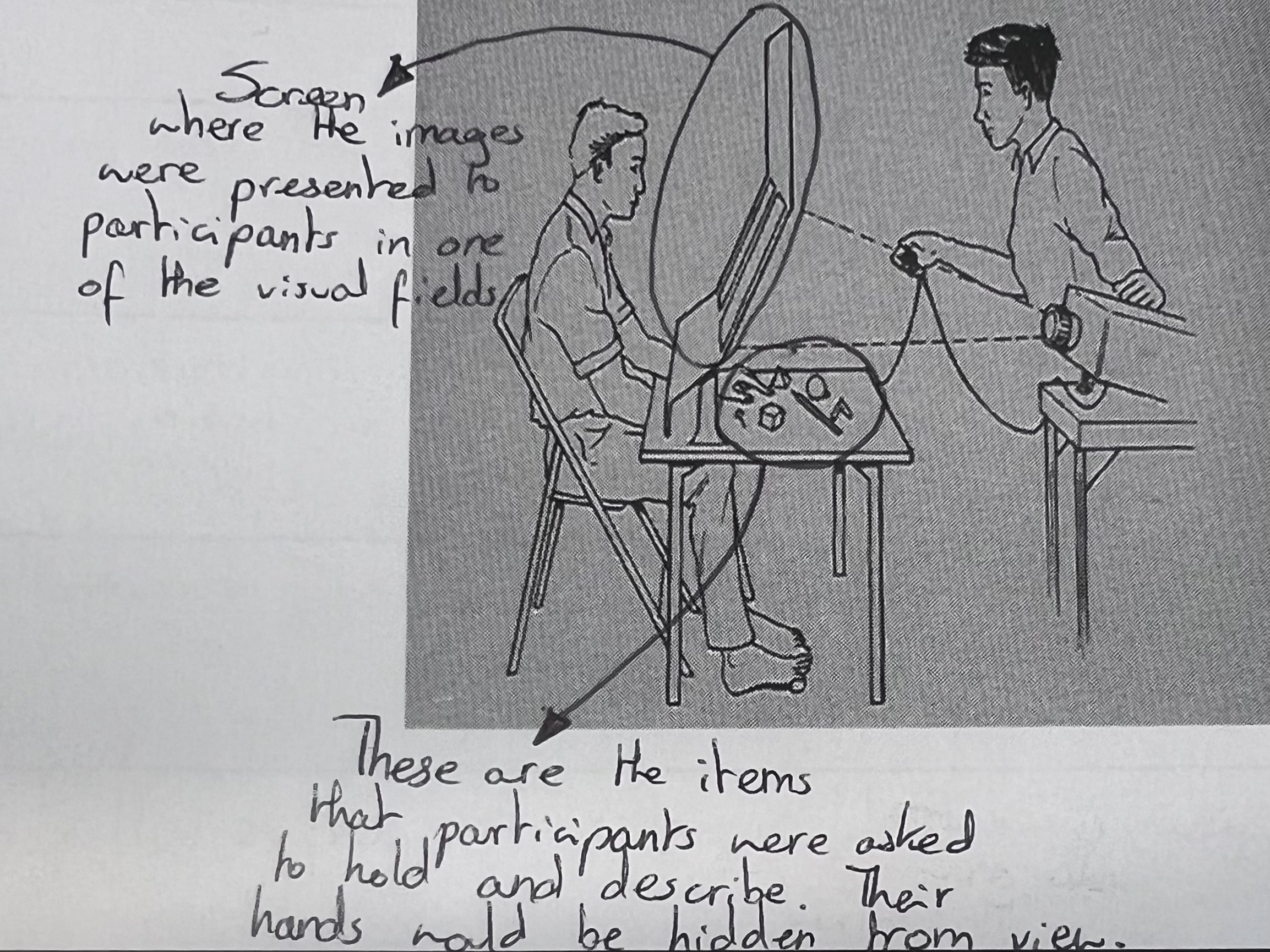
What controls were used?
The items
The images/lasted same time
The fixation point
Hands out of view
Symbols displayed
One eye covered
Set up of tachistoscope
Describe 2 things Sperry found during the visual tasks
Objects were flashed to the right visual field-went to the left hemisphere-participant COULD name the object verbally
Objects were flashed to the left visual field-went to the right hemisphere-participant COULD draw or point to object with left hand-participant COULD NOT say what they’d seen
Describe what Sperry found during the tactile tasks
Objects were felt by the right hand (unseen)-went to left hemisphere-participant COULD name what they’d felt or write it
Objects were felt by the left hand (unseen)-went to right hemisphere-participant COULD find/point to object with left hand-participant COULD NOT say what they’d held
What did Sperry conclude about the left hemisphere?
It has language ability (both written and verbal) and controls the right hand side of your body.
What did Sperry conclude about the right hemisphere?
It can only communicate non-verbally and controls the left hand side of your body.
What ethical guidelines were upheld and broken?
Upheld
Confidentiality
Informed consent
Deception
Broke
Protection from harm- upsetting/embarrassing to not have full capabilities or understanding present
Debrief- not clear if they had one
Evaluate the ethnocentrism
Quite ethnocentric because it’s only participants from America but since it’s linked to the brain it’s global + applicable.
Evaluate the reliability
Internal reliability
Very standardised as many things were controlled and each participant likely had the same experience e.g. images shown for 0.1 seconds
External reliability
Only 11 people who had epilepsy so small sample, no consistent effect
Evaluate the validity
Construct validity
Epilepsy could’ve effected the results
Population validity
All Americans
Both genders
Specific to epileptic people who have had split brain surgery
Ecological validity
Visual tasks- not normal to be flashed images through a tachistoscope + for only 0.1 seconds
Tactile tasks- normal to touch objects daily without seeing hands e.g. in the dark
Which debates does this study link to and why?
Nature vs nurture- your brain is biological and there’s no influence from environment
Reductionism vs holism- only looking at hemisphere of brain/biological reasons
Usefulness of research- useful since it shows how each hemisphere of the brain works and can be used in medicine for potential brain injuries and peoples’ capabilities + support needed