Chapter 10 - Photosynthesis
 Call Kai
 Learn
Learn Practice Test
 Spaced Repetition
 Match
Match Flashcards
 Knowt Play
1/13

There's no tags or description
Looks like no tags are added yet.
Name | Mastery | Learn | Test | Matching | Spaced | Call with Kai |
|---|
No analytics yet
Send a link to your students to track their progress
14 Terms
Photosynthesis
Series of energy-requiring redox reactions where light energy is converted into chemical energy stored in carbohydrates
CO2 is reduced to form energy-rich C–C and C–H bonds and H2O is oxidized to produce O2 gas
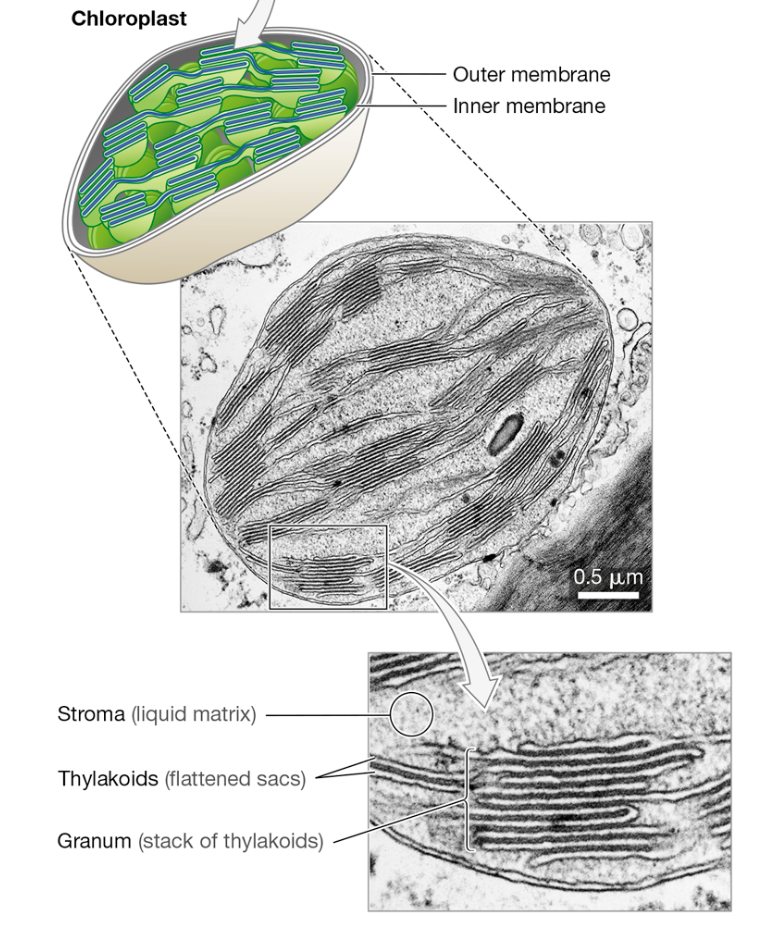
Occurs in chloroplasts
Light-capturing rxns = thylakoid membrane
Calvin cycle = stroma
Primary energy source for ecosystems and produces atmospheric oxygen required for aerobic respiration
Light Reactions vs. Calvin Cycle
Light reactions capture energy from sunlight to produce ATP and NADPH by exciting electrons in pigment molecules
Occur in the thylakoid membranes
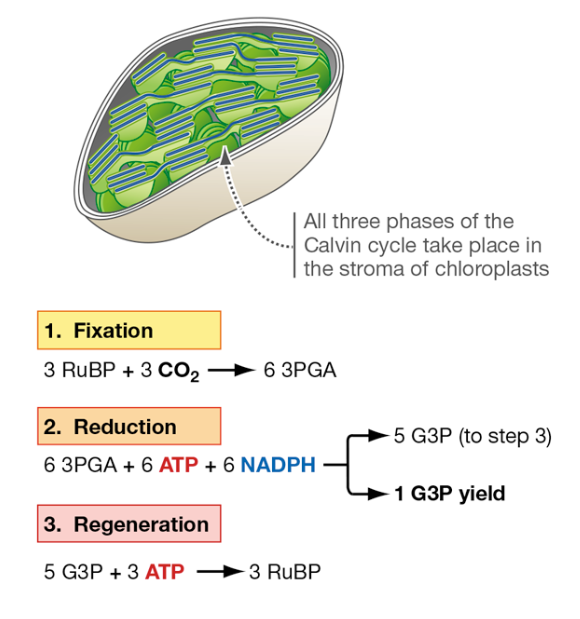
The Calvin cycle uses ATP and NADPH to reduce CO2 into glyceraldehyde-3-phosphate (G3P), a precursor to glucose
Occurs in the stroma of chloroplasts
Stages are linked: Calvin cycle depends on ATP and NADPH and regenerates ADP, and NADP+, etc. for reuse
Without light reactions supplying energy and electrons, the Calvin cycle cannot proceed
Chloroplast Structure
Surrounded by a double membrane that regulates transport of molecules
Thylakoid membranes contain chlorophyll + other pigments and ETC for light reactions
Arranged in stacks (grana) which increases SA available for light absorption
Stroma contains enzymes (including Rubisco) necessary for the Calvin cycle
Compartmentalization allows separation of light reactions and carbon fixation for efficiency
Why CO2 Diffusion Can Be Challenging
Trade-off between water conservation and carbon fixation
The cuticle of plants reduces water loss but also limits gas exchange
CO2 enters through stomata, which must open for diffusion, but opening the stomata increases risk of water loss
Closing stomata reduces CO2 availability, limiting photosynthesis
Rubisco
The most abundant enzyme in nature; large but slow with 16 subunits and 8 active sites
Catalyzes CO2 fixation in the Calvin cycle (RuBP + CO2 → 3PGA)
It can bind O2 instead of CO2, leading to photorespiration
Plants produce large amounts of Rubisco to compensate for inefficiency
Photorespiration
Occurs when Rubisco binds O2 instead of CO2
Produces 2-phosphoglycolate, which must be recycled using ATP
Consumes energy without producing sugars (reduces efficiency)
Releases CO2, undoing carbon fixation
More common in hot, dry conditions when stomata are closed
C3 Pathway
Standard Calvin cycle pathway used by most plants
CO2 is fixed directly by Rubisco into 3PGA
Occurs in mesophyll cells
Efficient in cool, moist environments
Prone to photorespiration under low CO2 conditions
C4 Pathway
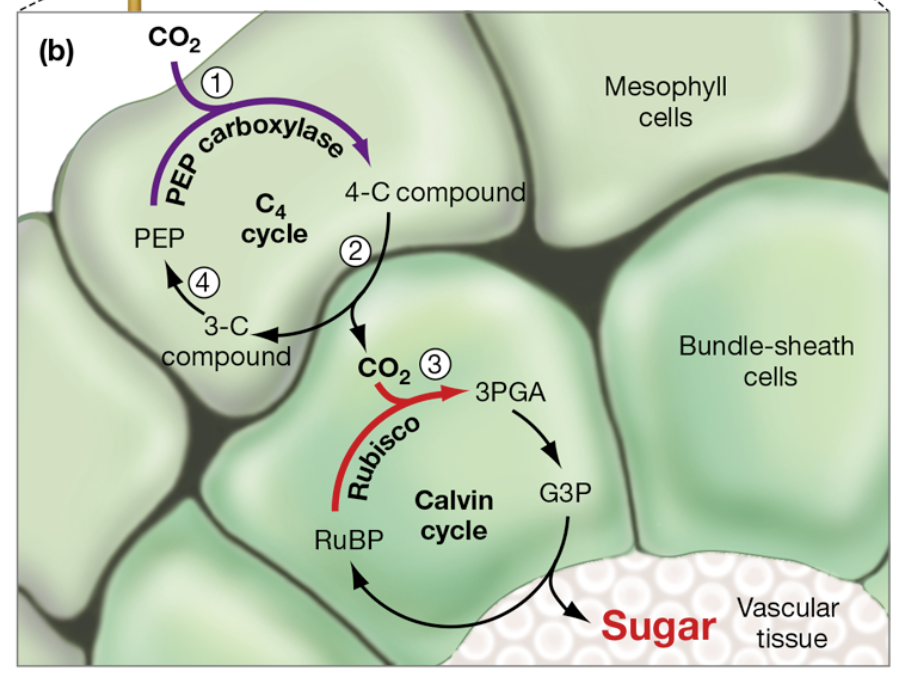
CO2 is first fixed by PEP carboxylase into a 4-carbon compound in mesophyll cells
The compound is transported to bundle-sheath cells
Less permeable to gases so CO2 [ ]s rise and promote carbon fixation by rubisco to make 3PGA
Also reduces photorespiration (so much CO2 around that O2 is less likely to bind to rubisco)
CO2 is released and enters the Calvin cycle near Rubisco
Increased efficiency of photosynthesis in conditions where stomata is mainly closed (hot environments; preventing dehydration
CAM Pathway
CO2 is fixed at night when stomata are open, reducing water loss
CO2 is stored as organic acids in vacuoles
During the day, CO2 is released for the Calvin cycle while stomata are closed
Separates carbon fixation and Calvin cycle in time
Adaptation for arid environments
Calvin Cycle: Overview
Occurs in the stroma of chloroplasts
Reduces CO2 into carbohydrates using ATP and NADPH
Produces G3P, a 3-carbon sugar used to form glucose
Requires continuous input of energy from light reactions
Central process of carbon fixation in plants
Calvin Cycle: Fixation Phase
CO2 combines with RuBP (5-carbon molecule)
Forms unstable 6-carbon that immediately splits into two molecules of 3PGA
Reaction catalyzed by Rubisco and does not require ATP directly
Calvin Cycle: Reduction Phase
3PGA is phosphorylated by ATP
Consumes energy from the light reactions
Reduced by NADPH to form G3P
G3P contains high-energy electrons; used to regenerate RuBP in the next phase
Some G3P exits cycle to form sugars
Calvin Cycle: Regeneration Phase
Remaining G3P is used to regenerate RuBP
Requires ATP
Ensures cycle can continue fixing CO2
Maintains supply of starting molecule
Completes the cycle
Use of Sugars from Photosynthesis
G3P is used to synthesize glucose via gluconeogenesis
Glucose can be converted into sucrose for transport
Sucrose is used in respiration and growth
Excess glucose is stored as starch
Starch is broken down at night for energy supply