3 - culture and society
 Studied by 0 people
 Call Kai
 Learn
Learn Practice Test
 Spaced Repetition
 Match
Match Flashcards
 Knowt Play
1/34

There's no tags or description
Looks like no tags are added yet.
Name | Mastery | Learn | Test | Matching | Spaced |
|---|
No study sessions yet.
35 Terms
Changes to the economy in the 1930s
Led to massive social change in the USSR , as well as modernising the USSR stalin set out to create a socialist society
Discuss religion
Similarly to Lenin,Stalin set out to eradicate religion from his socialist society - the once dominant orthodox church was shut down - all its churches and monasteries so by the outbreak of war only 1% of churches survived - many mosques and synagogues were destroyed and many religious figures became victims of terror
moved closer toward socialism
Women
Stalin reversed many of the progressive changes brought in by Lenin - following the revolution women became more liberated easier divorces,legalised abortion and expected to take on full time work roles
1917 - New divorce law (making divorce easier)
1920- abortion allowed under medical supervision
However - by 1930 the USSR had the highest rate of divorces and a decline in population when more workers were needed - this ultimately pushed Stalin to reverse policies
new law - The great retreat
May 1936
Made abortion illegal (due to the declining birth rate) and divorce more difficult by raising up to 50 roubles for the first divorce
regressive toward women
contraception was only permitted on medical grounds
Mothers with six or more children received tax exemptions and 2000 roubles per year
It pushed women back into traditional domestic roles by restricting reproductive rights increasing state control over private life and encouraging higher birth rates through financial incentives.
Birth rate
it did increase from 25 per 1000 in 1933
to 31 per 1000 in 1940
exemplified success of the Great Retreat
Women during the great patriotic war
measures were taken to increase women to have children - those that had more than two were labelled “Heroines of the Soviet Union”
The organisation to represent views of women in the party lapsed in 1930 as demands of the economy grew in the 1940s and the dual expectations of women working and being mothers strained
Education
experienced great changes due to demands of the economy
Lenin emphasised education to indoctrinate young people whereas Stalin saw education as vital so young people played a part in modernising the USSR
Education data
literacy rate leaped from 51% in 1926 to 88% in 1939
exemplified growing education
Komosol -
created 1926 geared to 10-28 year olds and by 1939 had over 10 million members
used for propaganda purposes
Stalin and religion
He had a more direct attack on religion
religious schools were closed down , the teaching of religious creeds forbidden church were destroyed
between 1929 and 1940 the holy day of sunday was removed
some slowdown but reinstated as the terror was extended
discuss places of worship
despite persecutions and measures to remove the power of the orthodox church,jewish synagogues and mosque byt 1941 nearly 40,000 Christian churches and 25,000 muslim mosques were closed down and converted into schools,cinemas clubs etc
religion data
by 1937 census over half a million soviet citizens declared themselves religious - the real number of believers was certainly much higher
Lenin attitude to marriage
traditional bourgeois marriage akin to slavery - it was economic and sexual exploitation . The bolsheviks set the socialist dream for women but this soon conflicted with the economic realities of life in the Soviet state in the 1930s
Divorce
By 1919 the USSR had the highest marriage rate and by the mid 1920s the highest divorce rate - this did not work in womens favour as many young women were abandoned once pregnant.
survey from the end of the 1920s - indicated that 70% of marriages were initiated by men and only 7% by mutual consent
by 1927 two thirds of marriages in moscow ended in divorce
The government could not afford to fund creches as by 1922 it would of costed more than the entire budget
orphans
1920s - seven and nine million orphans under the age of thirteen
The reality for many was that there was no socialist kindergarten but a life of struggle to due war and civil war
women in employment
During the first world war the percentage of women in the urban workforce doubled; by 1917 it was 47%
how did women in employment suffer
unemployment in the NEP - women were forced from skilled to unskilled work and then to unemployment and prostitution . there were all women gangs and 39% of proletarian men used prostitutes
the result of this that all women in industrial labour in 1929 was practically the same as it had been in 1913
Women in the communist party
1917 - women were 10% of the party membership
by 1928 it was 12.8%
limited progress
Zhenotdel
Zhenotdel was established in 1919 asa womens department for the party to make women active defenders of the revolution. However it focused on practical help such as scoial services
it was abolished in 1930 suddenly on the grounds it was no longer necessary
exposed the regime’s retreat from women’s equality, leaving growing gender inequalities unaddressed just as social and economic pressures intensified.
failures of education
in the 1920s it was a disaster - the vast majority of teachers were not communist (3.1% in primary schools and 5.5% in secondary)
matters did not improve under the NEP ,many children left school by 1923 the number of schools and pupils were barely half of the total of two years earlier
negativity toward communism
a failure to indoctrinate - a survey in 1927 revealed children aged 11-15 had become increasingly negative toward communist values as they grew older and nearly 50% believed in God
discuss the differences between culture and society
culture - education, propaganda “the socialist man” , religion
Society - women,young children,urban workers
Evidence the socialist man still had some way to go
Private housing was never fully eliminated,even in 1938 privatley owned mud huts still made up 17.5% of living space in Magnitogorsk. In the
Bolsheviks and religion
The Bolsheviks were aggressively atheistic
Karl Marx - “Religion is the opium of the people”
Lenin declared that the party's aim was to destroy the ties between “Exploiting the and the organisation of religious propaganda” and replace it with scientific education .
Lenin forecast that the “Peasant will pray to electricity”
This attitude brought the Bolsheviks into direct conflict with the orthodox church
decree on the separation of the state
January 1918 - The bolsheviks issued the decree on the Separation of the Church and State which declared the church could not own property
Priests and servants and clerics were declared “servants of the bourgeoise”
the Bolsheviks undermined the Church’s authority and aligned religion with the old oppressive regime, helping to consolidate Bolshevik control.
establishment of union of the militant godless
1921 as a state-supported organisation dedicated to promoting atheism and eradicating religion from Soviet society. Peasants were even taken for rides in planes to see there was no god in the sky
institutionalised the Bolsheviks’ anti-religious policy, promoting atheism through propaganda and education while undermining the Church’s authority
anti-clerical propaganda
after 1921 Lenin used the Volga famine 1921-1922 to demand the church surrender its valuables for famine relief, there was bitter resistance and over 8000 people were executed or killed in 1922 in the anti-church campaign , including the metropolitan of Petrograd ( 28 bishops and 1215 priests)
consolidated political control and weakened the Church’s institutional power but also provoked fear and resentment among believers, highlighting the social and political costs of enforcing state atheism.
The working man
The working men hoped the industrialisation of the USSR would raise their living standards and improve employment opportunities
Those who did the best were skilled workers , with the spread of technical and more opportunities for training - introduction of wage differentials and the stakhanovite movement determined and loyal workers found ways to improve themselves, acute skills shortage suffered in the 1930s meant the
Cultural revolution impact on religion
Soviet government stressed the link between Kulaks and church goers - priests were hounded out of villages churches were raided , the state imposed heavy taxation on churches and their priests . peasants resisted , especially women but by the end of 1930 80% of the country’s village churches were closed
only one in 4 churches was functioning by the end of the 1930s , the number of active orthodox priests fell from around 60,000 in the 1920s to only 5665 by 1941 , more priests,mullahs and rabbis were killed during this period than during the civil war .
Juvenile behaviour
was perceived as an increasing problem
April 1935 decree made violent crimes committed by adolescents punishable in the same way for adults
growing state control
the ideal new man
New soviet man would embody the morality , values and characteristics that a good soviet citizen should possess, he would be a willing servant of the state with the right attitudes far removed from the backward tsarist peasant. creating citizens like this was the objective of proletarization - the changes were aimed mainly at the youth through the education system
Discuss the new man in magnitogorsk
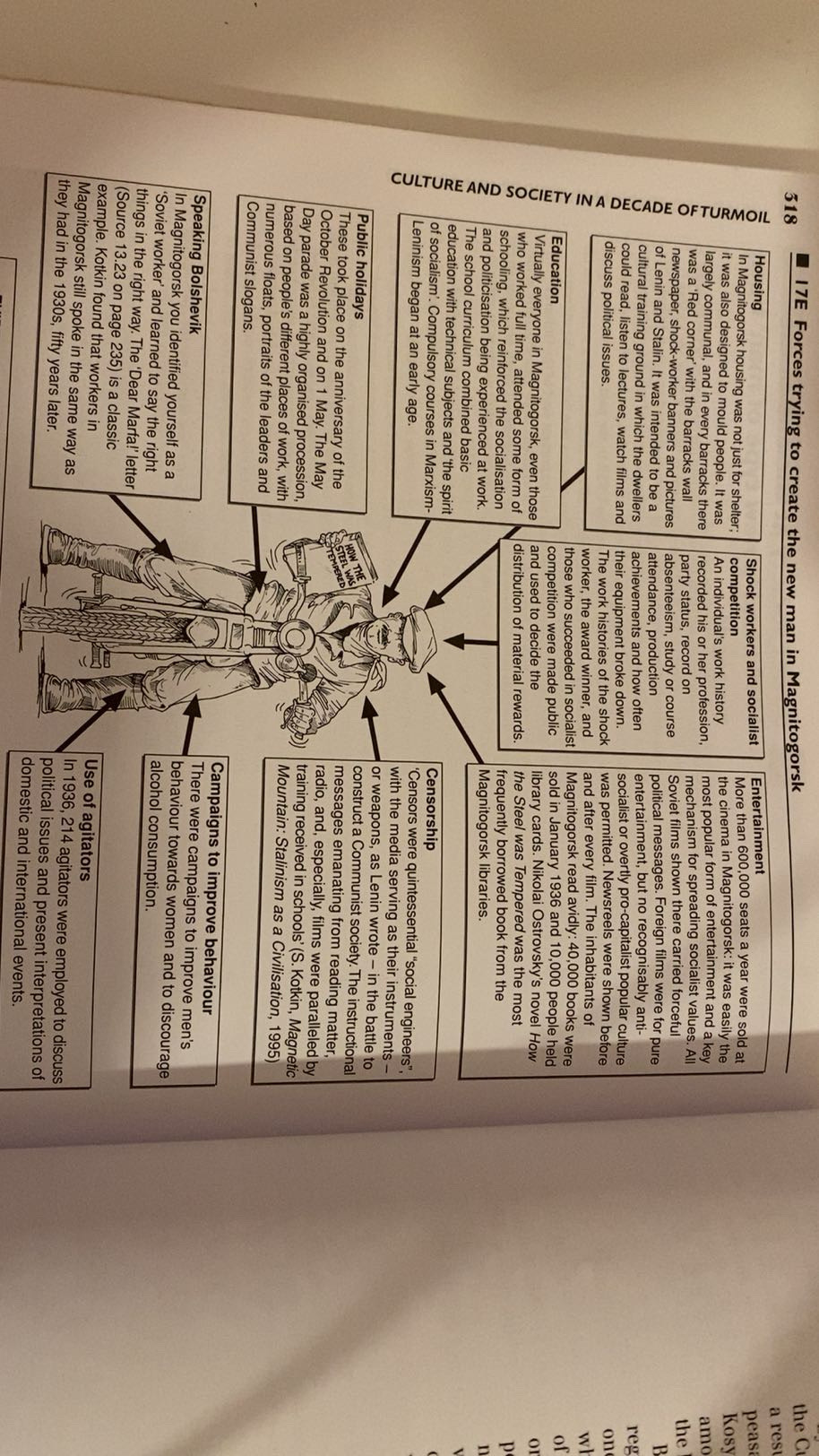
social mobility
By 1939, the combination of technical education opportunities granted by the revolution and opportunities for upward social mobility as a result of industrialisation meant that a working class/peasant governing elite had been virtually achieved. 150,000 workers and communists entered higher education during the first five year plan
did the mass of people transform
the attitude of the people to the regime is one way of assessing this. an estimated one-fifth of all workers supported the regime and its politics while another minority opposed, but not overtly. this left the great mass of workers who were neither supporters nor opponents they accepted the regime for its social welfare policies. NKVD soundings of the popular opinion in the 1930s indicate the regime was relatively unpopular in towns but more in the villiages. Stalin was compared unfavourably with lenin mainly as living standards had dropped . the arbitary nature of terror and rewards encouraged passivity in the population
Socialist man who emerges in the 1930s may or may not be a new man but had to be a survivor