Biology - Gas exchange
 Call Kai
 Learn
Learn Practice Test
 Spaced Repetition
 Match
Match Flashcards
 Knowt Play
1/87

There's no tags or description
Looks like no tags are added yet.
Name | Mastery | Learn | Test | Matching | Spaced | Call with Kai |
|---|
No analytics yet
Send a link to your students to track their progress
88 Terms
What is diffusion?
Diffusion is the movement of particles from a region of higher concentration to a region of lower concentration, down a concentration gradient
Why is diffusion important for living organisms?
Diffusion is important because it allows substances to move into and out of cells down a concentration gradient. Oxygen diffuses into cells for respiration, and carbon dioxide diffuses out as a waste product. In plants, carbon dioxide diffuses into leaves for photosynthesis and oxygen diffuses out.
What is gas exchange?
Gas exchange refers to the exchange of the gases oxygen (O₂) and carbon dioxide (CO₂) between a cell/organism and its environment
Why can single-celled organisms depend only on diffusion, whereas multicellular organisms need exchange surfaces and organ systems?
Single-celled organisms can depend on diffusion because they are very small, so substances only have a short distance to travel. They also have a large surface area compared with their volume, which makes diffusion efficient. Multicellular organisms are much larger, so diffusion alone would be too slow to supply all their cells. They therefore need exchange surfaces and organ systems to increase the surface area for diffusion, keep the diffusion distance short, and maintain steep concentration gradients.
How do gas exchange organs increase the efficiency of exchange? [5]
Gas exchange organs increase the efficiency of exchange by having a large surface area, so more gas can diffuse at the same time. They also have a short diffusion distance because the exchange surface is thin, often only one cell thick. In animals, these surfaces are well ventilated, which keeps the concentration of oxygen and carbon dioxide different on each side of the surface. This maintains a steep concentration gradient, so diffusion happens faster. In addition, a good blood supply helps maintain the concentration gradient for diffusion.
Which proceesses depend on gas exchange?
respiration and photosynthesis
Explain gas exchange during respiration in a leaf. [5]
During respiration, plant cells use oxygen and produce carbon dioxide. Respiration happens all the time, both day and night. At night, when there is no photosynthesis, oxygen diffuses into the leaf from a higher concentration outside to a lower concentration inside. This is because the respiring cells use up oxygen, so its concentration stays low inside the leaf. Carbon dioxide diffuses out of the leaf from a higher concentration inside to a lower concentration outside. This is because carbon dioxide is produced by respiration and builds up inside the leaf.
Aerobic respiration requires ______ and produces ______ ________.
oxygen, carbon dioxide
Respiration occurs in plant cells both during the ___ and at _____.
day and at night
During the night when there is no light no _____________ occurs, but _________ will still be occuring.
photosyntehsis, respiration
Plant cells with chloroplasts can photosynthesise when there is enough _______
Plants ____ ____ conduct photosysnthesis at night.
do not
Photosynthesis requires ______ ________ and releases ______
carbon dioxide and releases oxygen
Explain gas exchange in leafs during photosysnthesis.
During photosynthesis, plant cells with chloroplasts use carbon dioxide and release oxygen. Carbon dioxide diffuses into the leaf from a higher concentration outside to a lower concentration inside. This is because the photosynthesising cells use up carbon dioxide, so its concentration stays low inside the leaf. Oxygen diffuses out of the leaf from a higher concentration inside to a lower concentration outside. This is because oxygen is produced during photosynthesis, so its concentration becomes high inside the leaf. Gas exchange happens by diffusion down concentration gradients through the stomata.
What are some examples of gas exchange organs in animals?
Gills and lungs
What are some examples of gas exchange organs in plants?
leaf and roots
Explain adaptions of leaf for gas exchange.
The leaf is thin, so gases have a short diffusion distance.
The leaf is flat, giving it a large surface area for diffusion.
There are many stomata in the lower epidermis, allowing gases to move in and out.
The stomata can open and close to control gas exchange and reduce water loss.
The spongy mesophyll has large air spaces, which let gases move around the leaf easily.
The mesophyll cells are loosely packed, increasing the space for gas exchange.
The mesophyll cell walls are thin, so gases can diffuse into the cells quickly.
The cell walls are moist, so gases dissolve before diffusing.
The close contact between mesophyll cells and air spaces makes gas exchange efficient.
The palisade mesophyll is near the upper surface, where it can receive lots of light for photosynthesis, which helps maintain a diffusion gradient for carbon dioxide.
What is stomata?
Stomata are tiny pores found mainly in the lower epidermis of a leaf, surrounded by two guard cells. They open and close to control gas exchange and water loss.
How do stomata help reduce water loss?
When water availability is low, the guard cells lose water by osmosis and become flaccid. This causes the stomata to close. Closing the stomata reduces the diffusion of water vapour out of the leaf, so less water is lost.
Describe how stomata open and close.
Stomata are openings between two guard cells.
When water enters the guard cells by osmosis, they become turgid.
The guard cells curve apart, so the stomatal pore opens.
When water leaves the guard cells by osmosis, they become flaccid.
The guard cells close together, so the stomatal pore closes.
State two conditions that cause stomata to open.
Plenty of water
Sunlight
State two conditions that cause stomata to close.
Low water availability
Low sunlight
Explain why stomata are mainly found in the lower epidermis.
he lower epidermis is less exposed to direct sunlight and wind.
This helps reduce water loss by evaporation.
Stomata in the lower epidermis still allow gas exchange.
Having them mainly underneath protects the leaf from excessive transpiration.
So the plant can balance gas exchange with water conservation.
Plants can only photosynthesise when they have __________ _____.
sufficient light
The cells of plants respire ____ ___ ____.
all the time
During the day plants both __________ and _______________.
respire and photosynthesise
During the day, The rate of photosynthesis tends to be _______ than the rate of respiration
higher
During the night, plants only _______.
respire
At low light intensities, the rate of photosynthesis is _____ to the rate of respiration
equal
Describe gas exchange in a plant during the day when light intensity is high.
During the day, when light intensity is high, the rate photosynthesis happens faster than respiration. As a result, there is a net diffusion of carbon dioxide into the plant and a net diffusion of oxygen out of the plant.
Describe gas exchange in a plant during the night.
During the night, plants only respire. This means that there is a net movement of oxygen into the plant and a net diffusion of carbon dioxide out of the plant during the nighttime
Describe gas exchange in a plant at low light intensity.
At low light intensities, the rate of photosynthesis is equal to the rate of respirationThis means that there is no net movement of oxygen or carbon dioxide in either direction
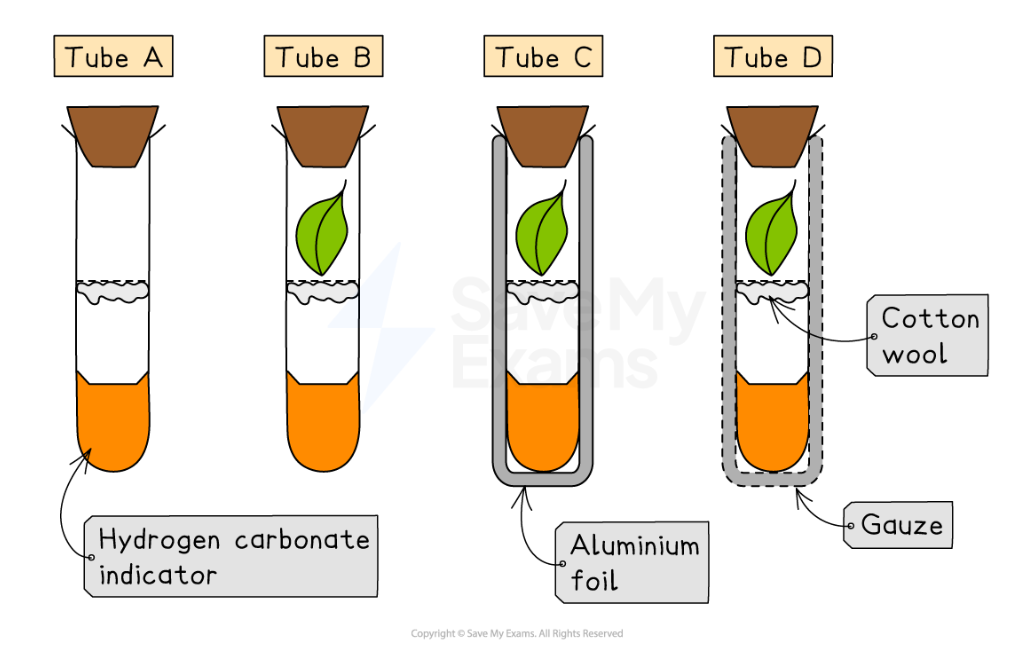
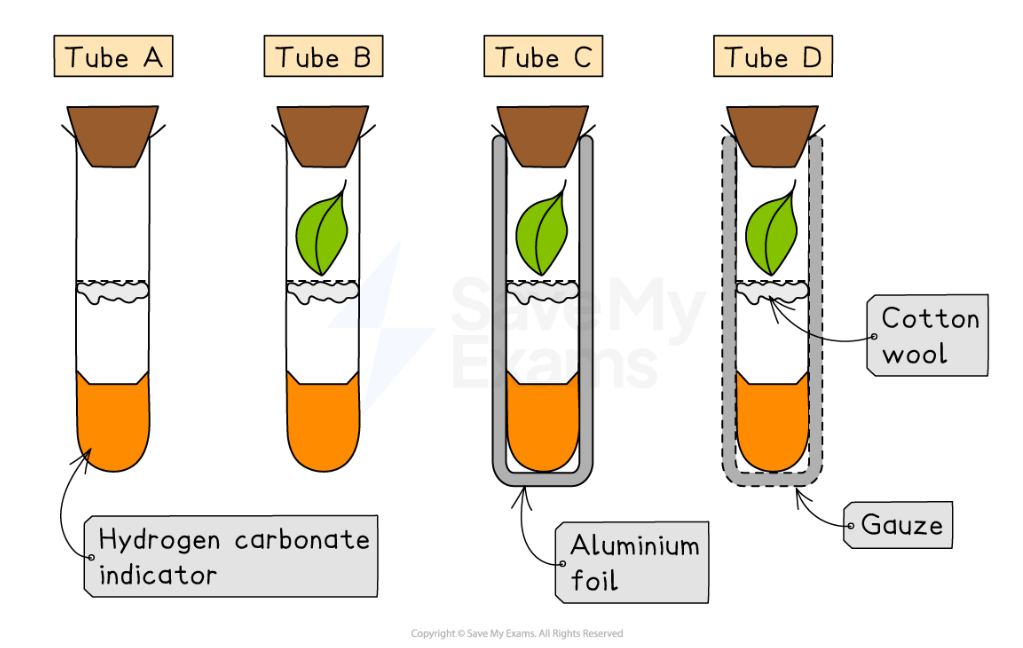
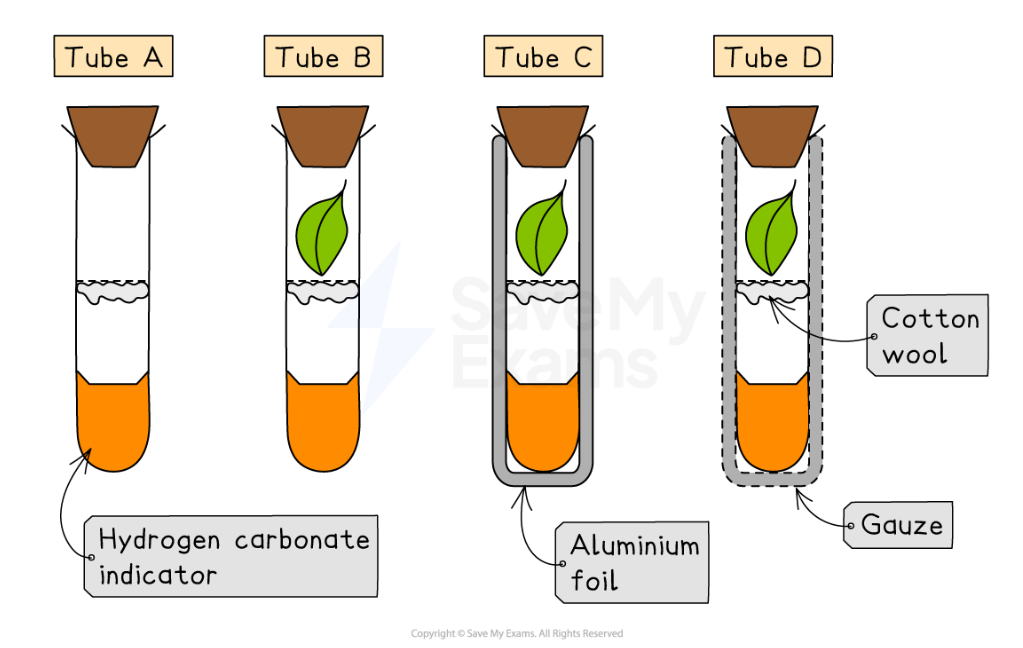
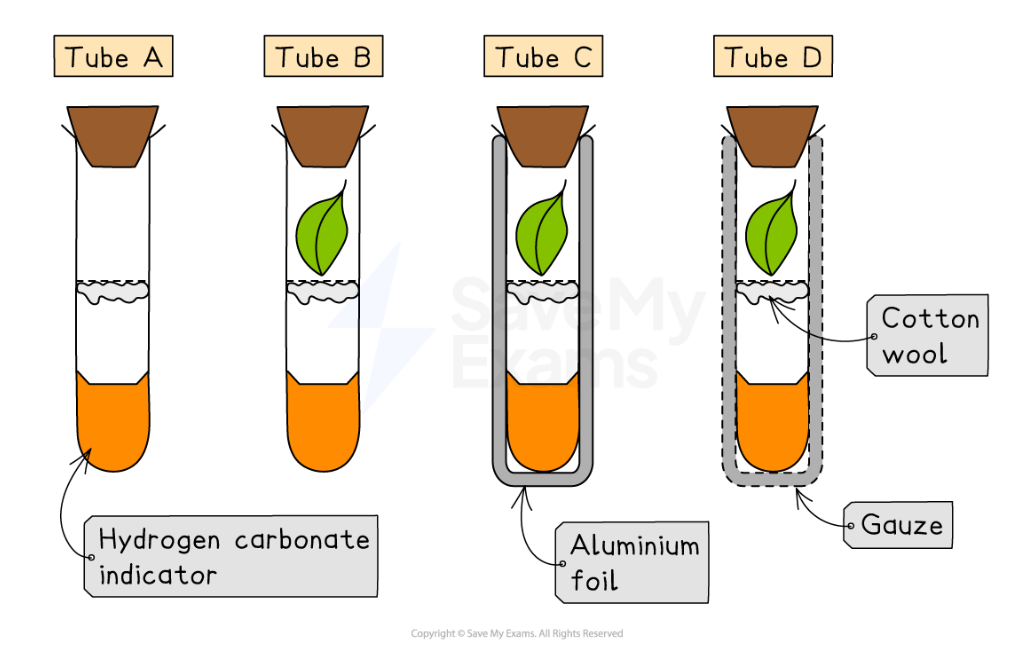
Practical: The Effect of Light on Gas Exchange in Plants :- What is the apparatus required?
Boiling tubes
Cotton wool
Aluminium foil
Muslin (thin cotton cloth)
Rubber bungs
Hydrogen-carbonate indicator
Leaves
Hydrogen-carbonate indicator changes colour depending on the ______ _______ concentration:
carbon dioxide.
What does yellow Hydrogen-carbonate indicator indicate?
high CO₂ (more acidic)
What does Orange/red Hydrogen-carbonate indicator indicate?
normal CO₂
What does Purple Hydrogen-carbonate indicator indicate?
low CO₂ (less acidic)
What is the method for this experiment?
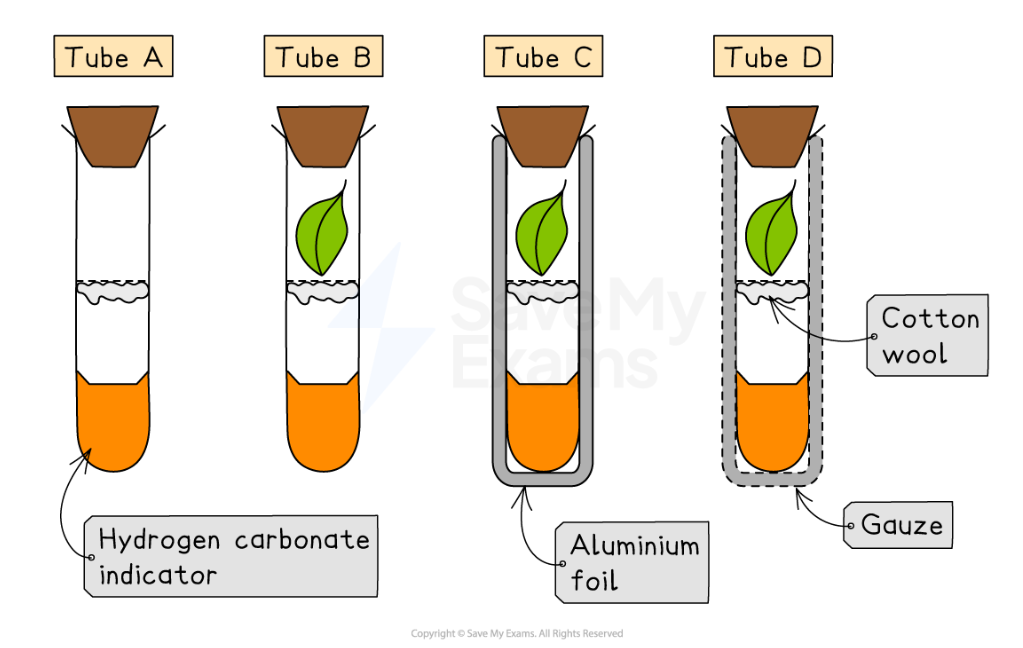
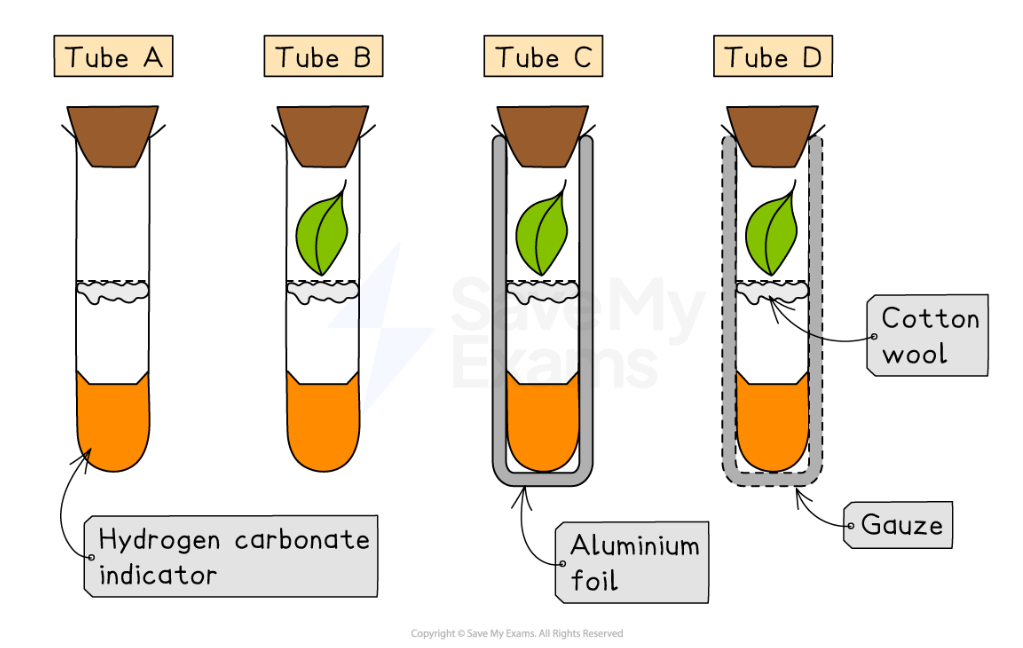
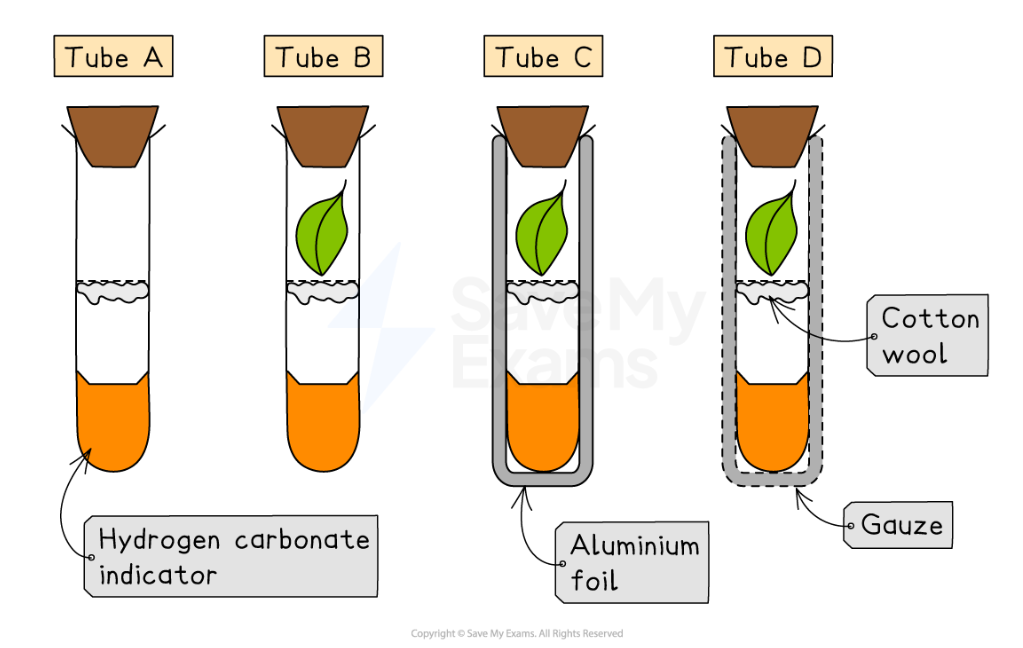
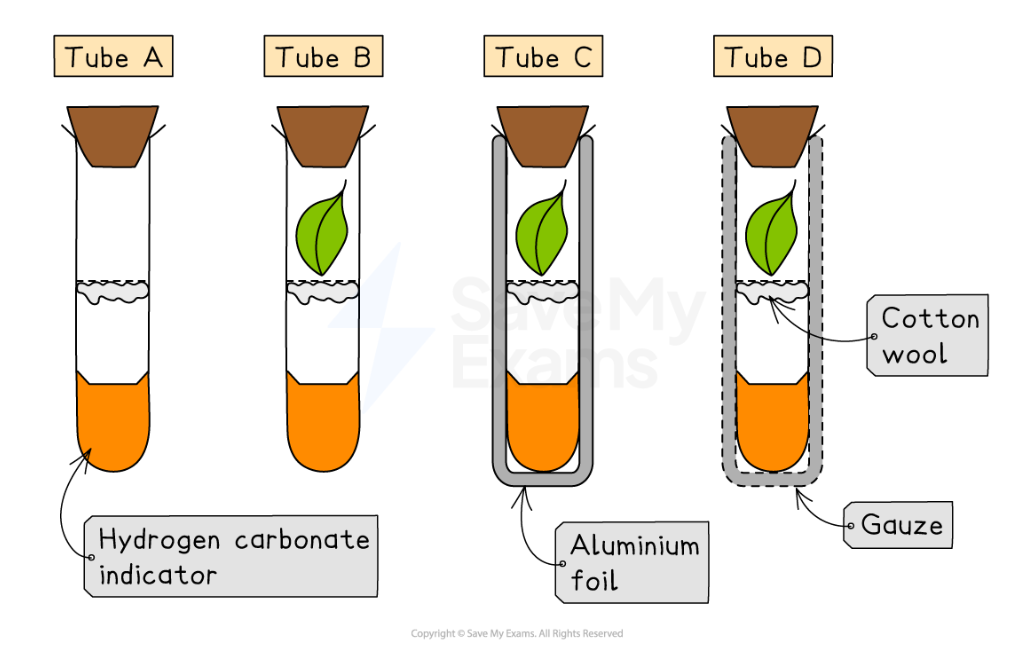
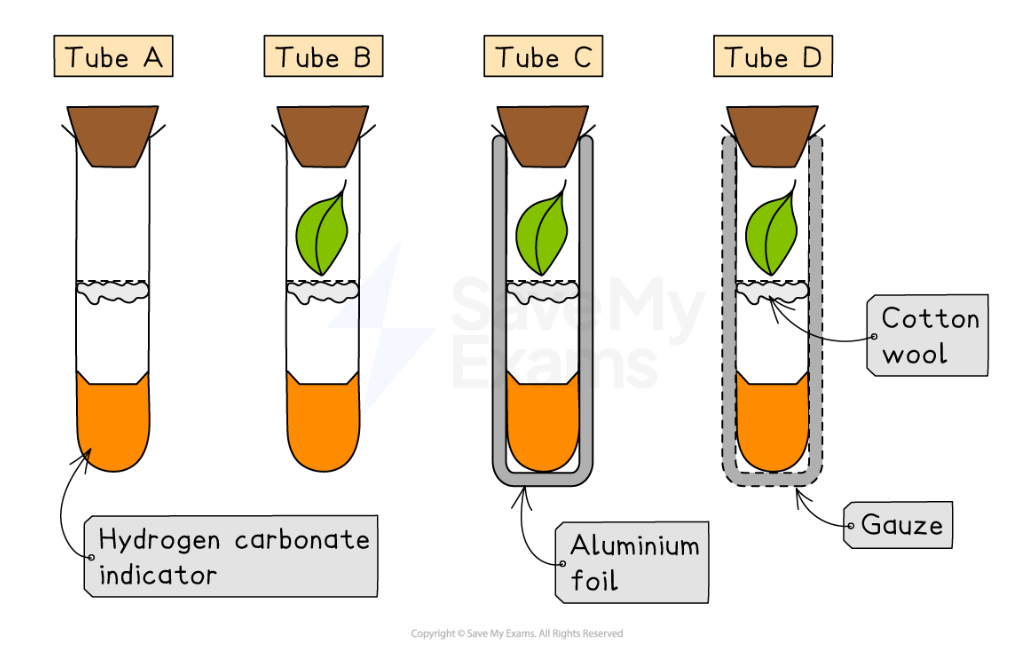
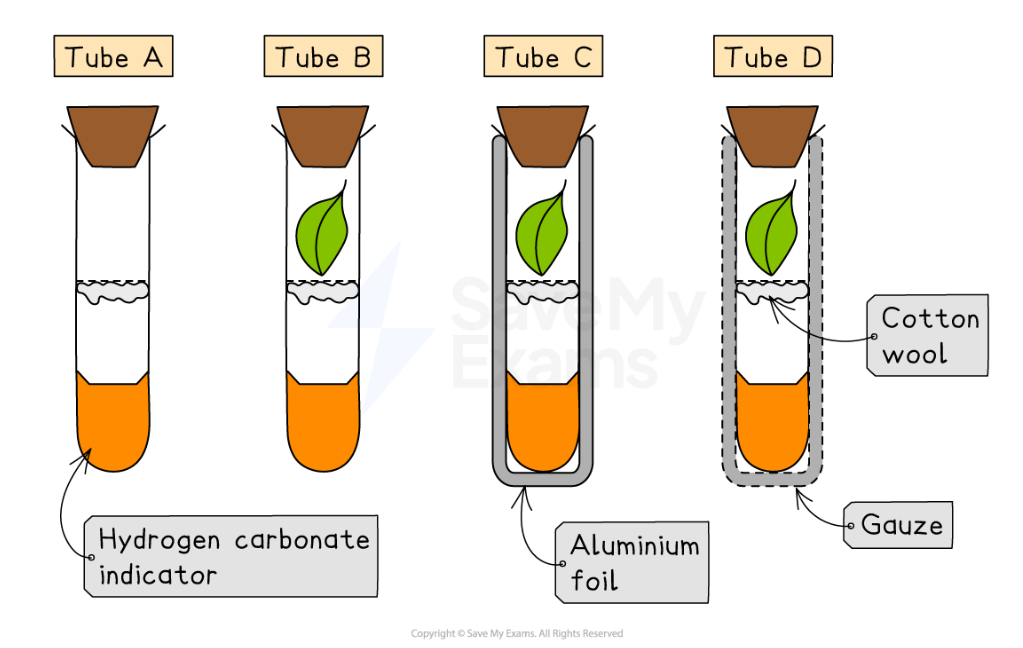
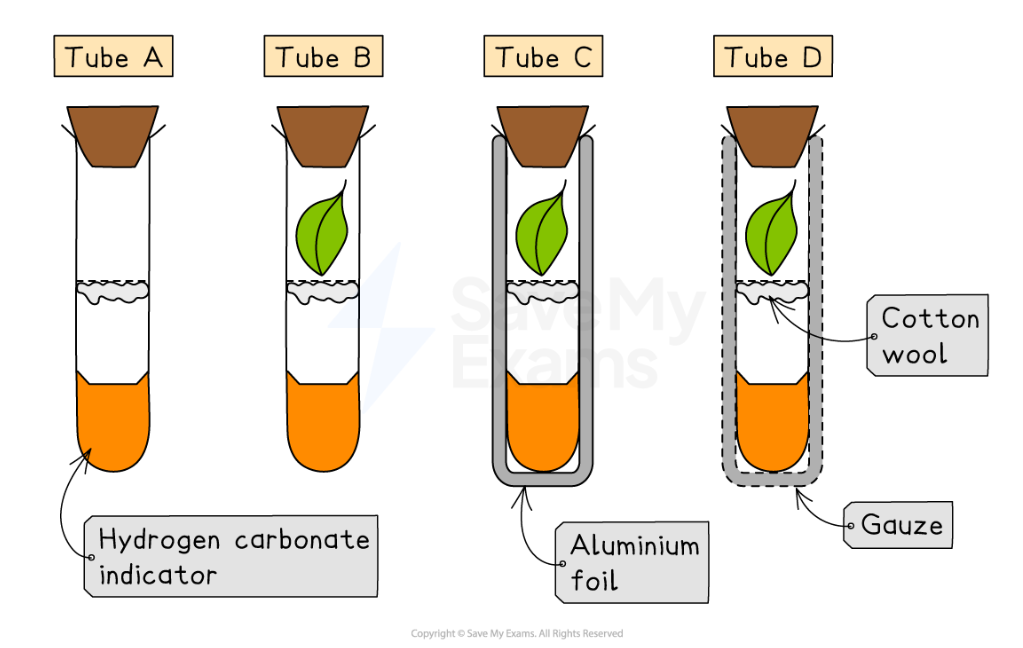
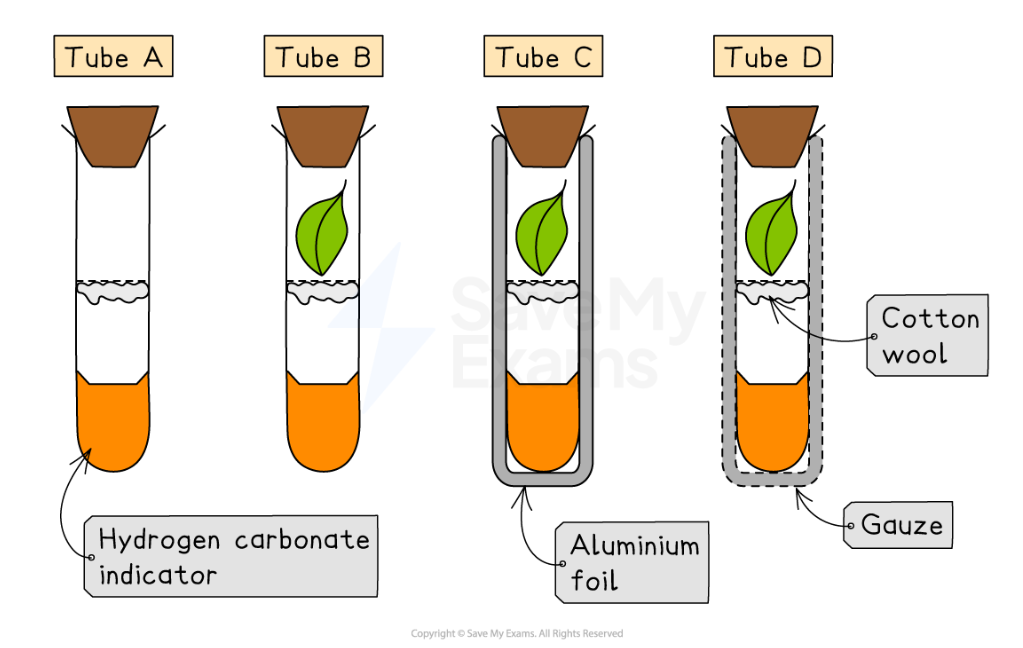
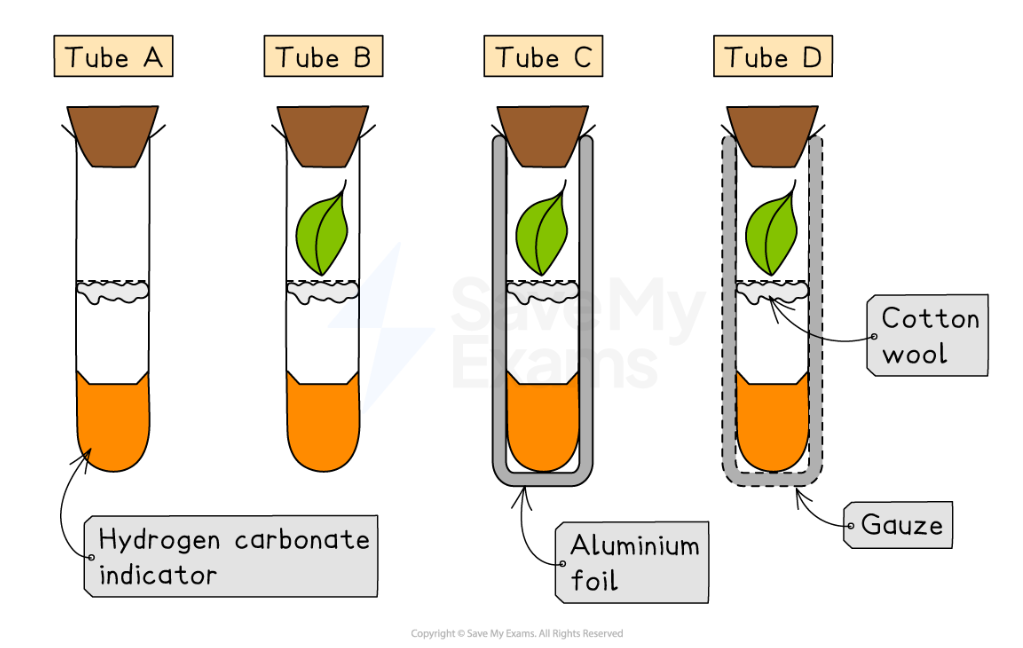
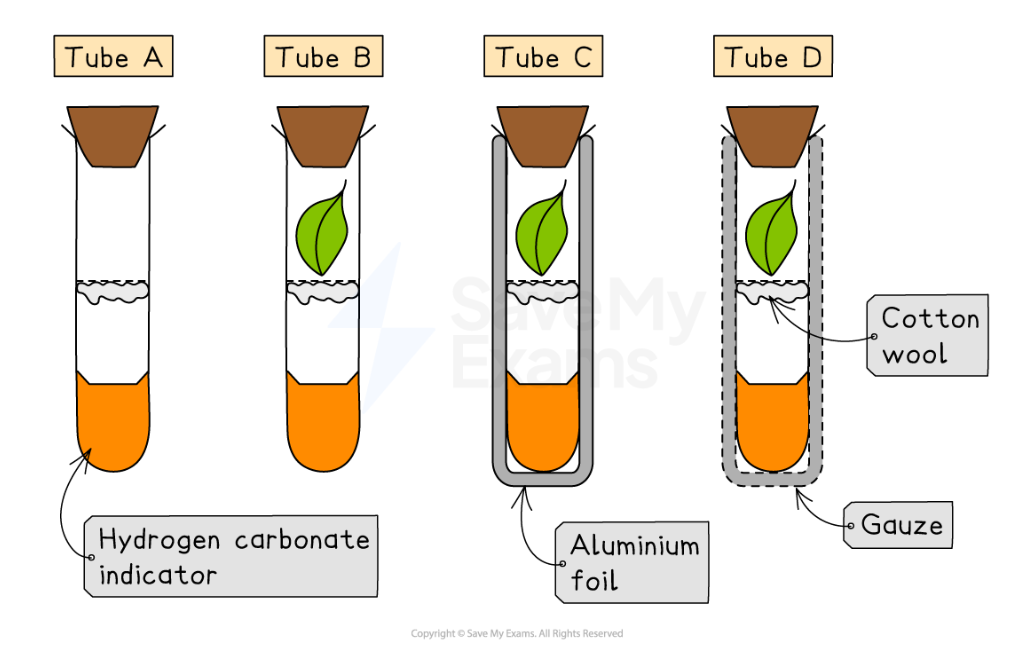
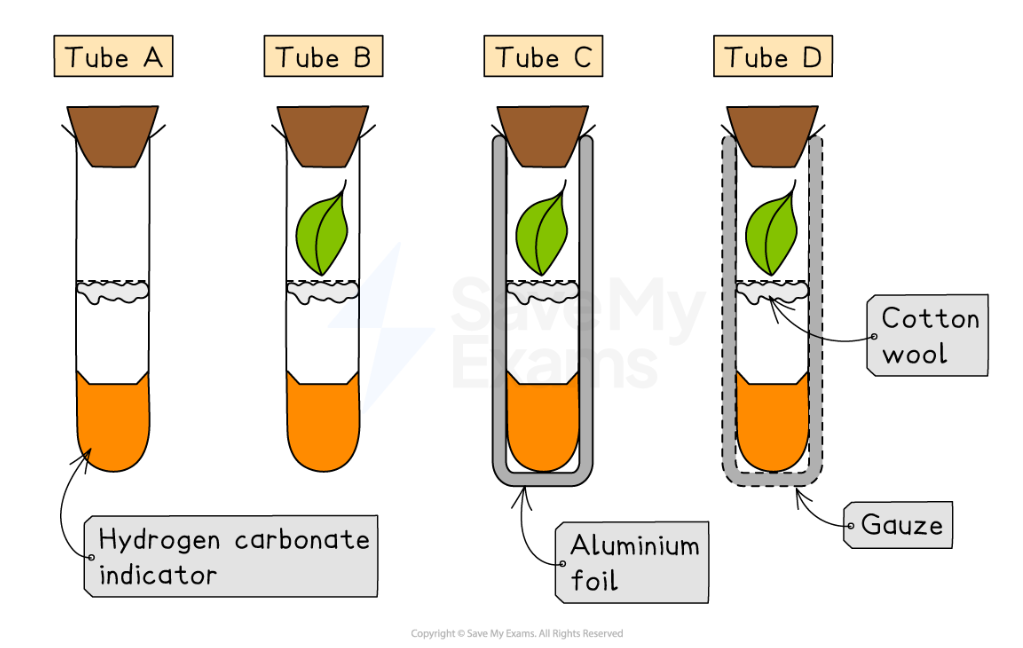
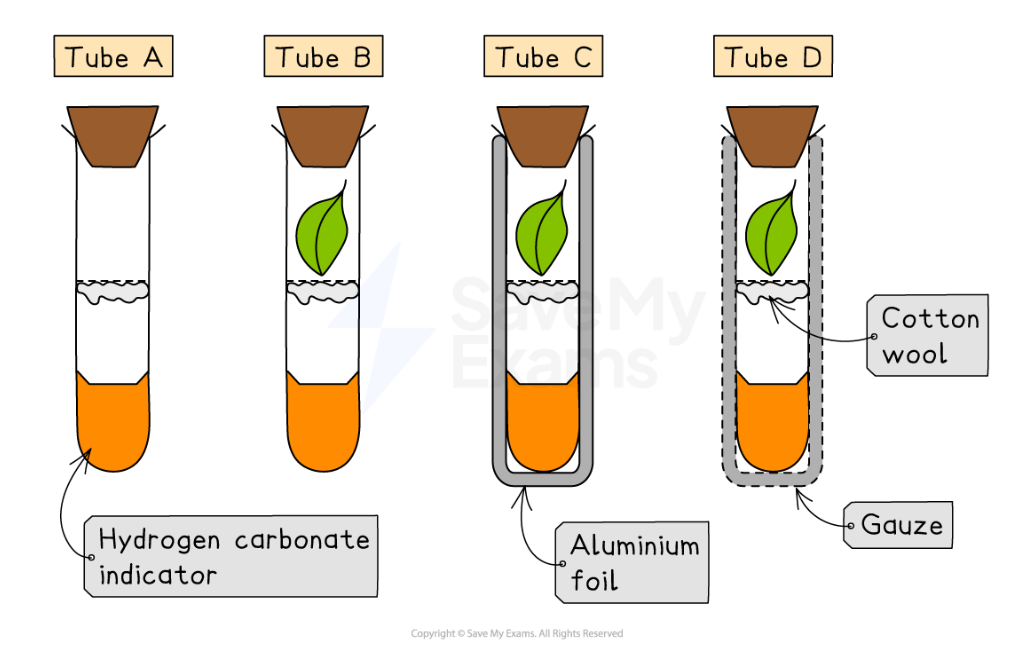
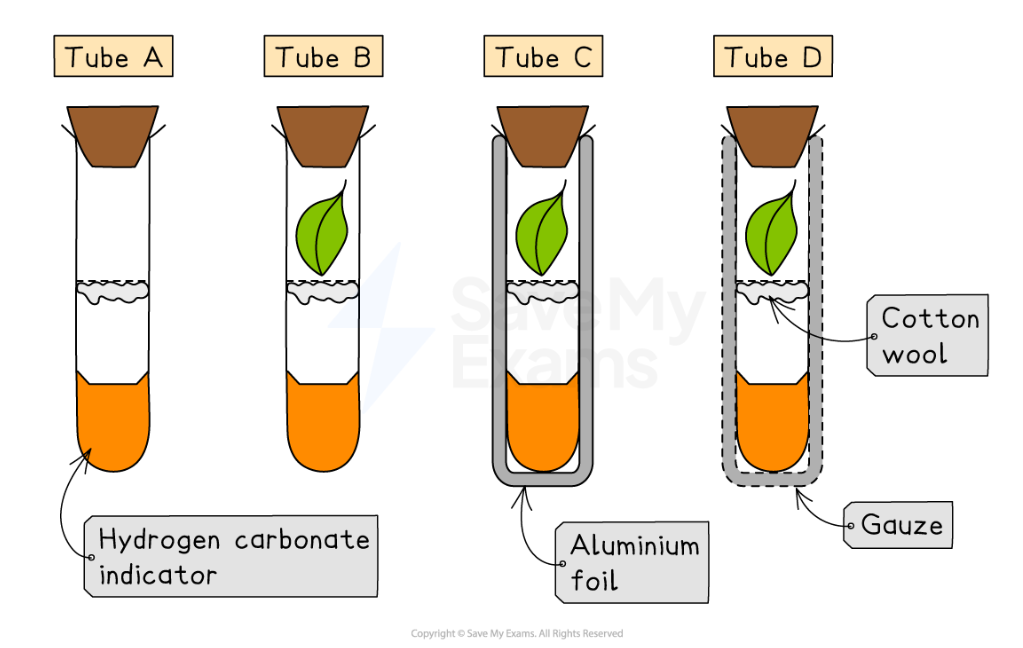
Measure out 20 cm3 hydrogen-carbonate indicator into each of 4 boiling tubes
Put some cotton wool into each boiling tube
Label the boiling tubes A-D and set them up as follows:
Tube A - No leaf (control tube) left in bright light
Tube B - Place a leaf in the tube and leave in bright light
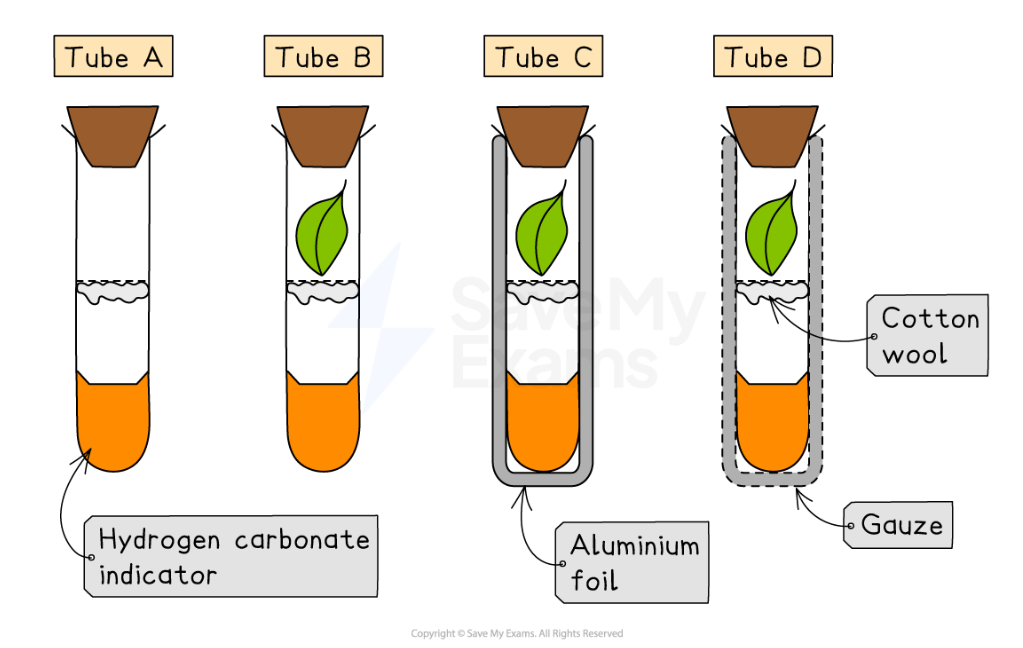
Tube C - Place a leaf in the tube and wrap the tube in aluminium foil to block out light (leaf will be in the dark)
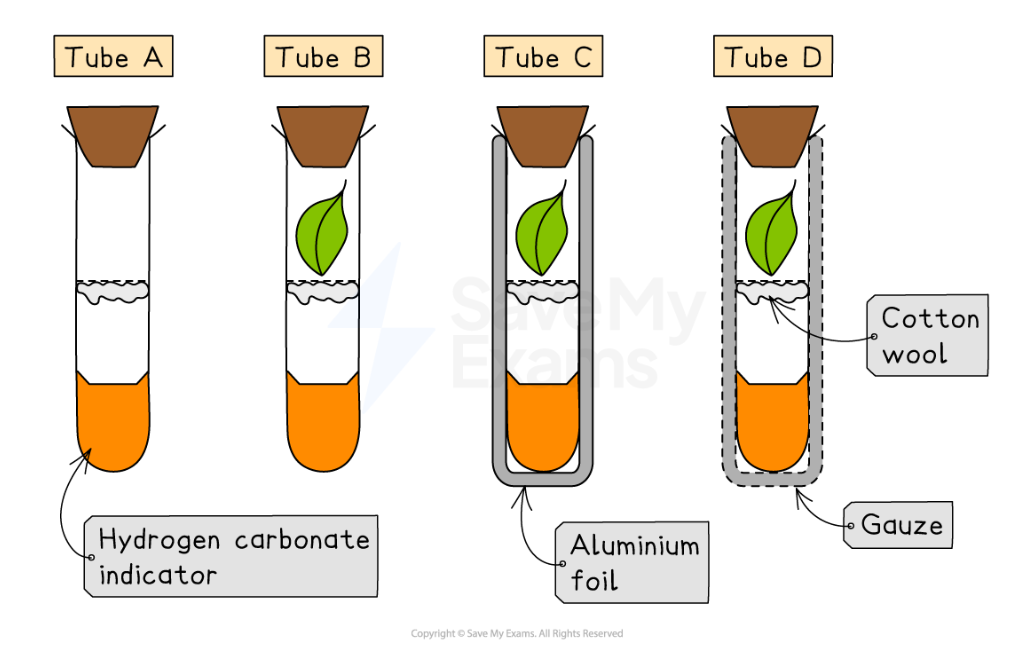
Tube D - Place a leaf in the tube and wrap it in muslin (thin cotton cloth) to allow some light through
Put a bung into the top of each tube
Leave all 4 tubes in the light for several hours/overnight
Observe any colour changes in the hydrogen-carbonate indicator
Results
After several hours/overnight, we would expect the following results:
Tube A - The control tube should remain an orange colour to show that the carbon dioxide is at atmospheric levels
There has been no net movement of carbon dioxide
Tube B - This tube was placed in the light with a leaf which is photosynthesising and respiring
Because the rate of photosynthesis is greater than the rate of respiration, the hydrogen-carbonate indicator will turn purple as there is less carbon dioxide than atmospheric levels
Tube C - This tube had a leaf inside, but was wrapped in aluminium foil meaning that no sunlight could reach the leaf
No light means that this leaf will not photosynthesise but will still be respiring, producing carbon dioxide. The indicator will turn yellow as carbon dioxide levels increase above atmospheric levels
Tube D - This tube had a leaf inside and was wrapped in muslin (cotton cloth) allowing some light through
This means that the rate of photosynthesis is roughly balanced with the rate of respiration, although usually the rate of photosynthesis is slightly greater so there may be a very small net change in carbon dioxide levels and the indicator either remains orange, but it could turn slightly purple.
Any colour change will be much less dramatic than the tube in bright light
Use CORMS to explain this experiment.
Change - change the availability of light for each boiling tube (not wrapped, wrapped in foil, wrapped in muslin)
Organisms - the leaves should be from the same species/age of the plant, they should be approximately the same size
Repeat - repeat the investigation several times to ensure results are reliable
Measurement 1 - observe the change in the hydrogen-carbonate indicator
Measurement 2 - after several hours/overnight
Same - control the volume of hydrogen-carbonate indicator, the number of leaves, the temperature of the environment
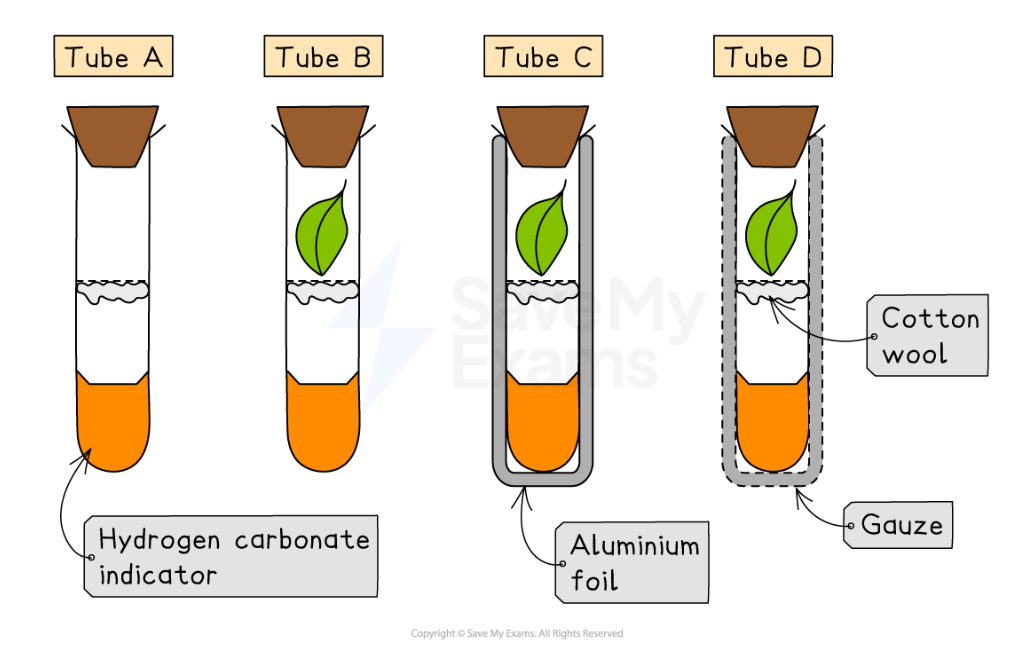
What would be the final colour of hydrogen-carbonate indicator and explanation in Tube A?
Orange | No respiration or photosynthesis so no net movement of CO2 |
What would be the final colour of hydrogen-carbonate indicator and explanation in Tube B?
Purple | Photosynthesis > respiration. There is a net intake of CO2 . The level of CO2 decreases. |
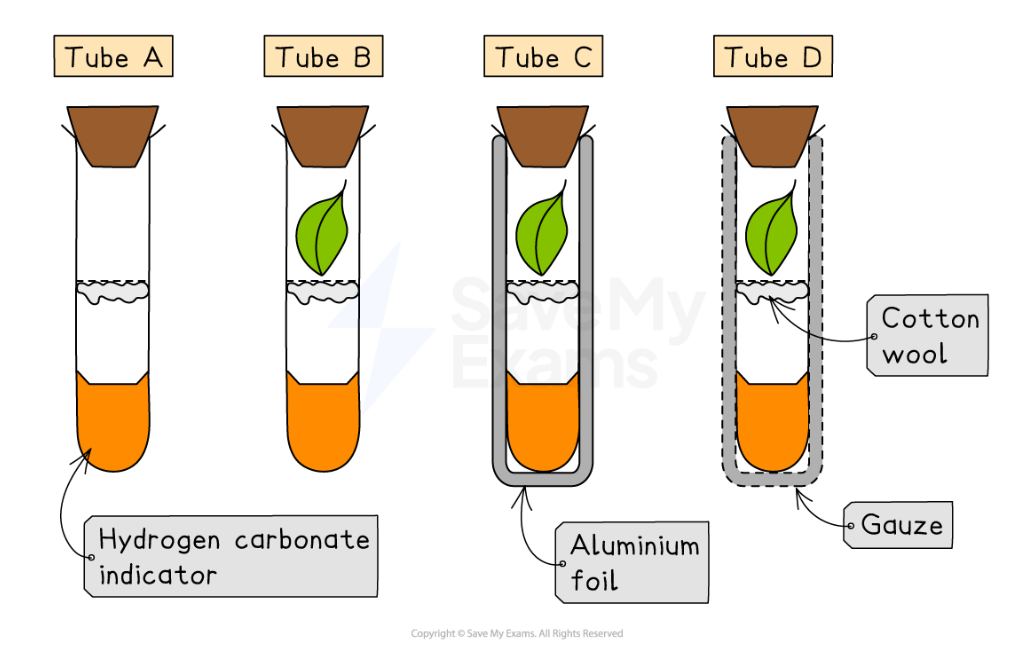
What would be the final colour of hydrogen-carbonate indicator and explanation in Tube C?
Yellow | No photosynthesis due to lack of light, only respiration occurs. |
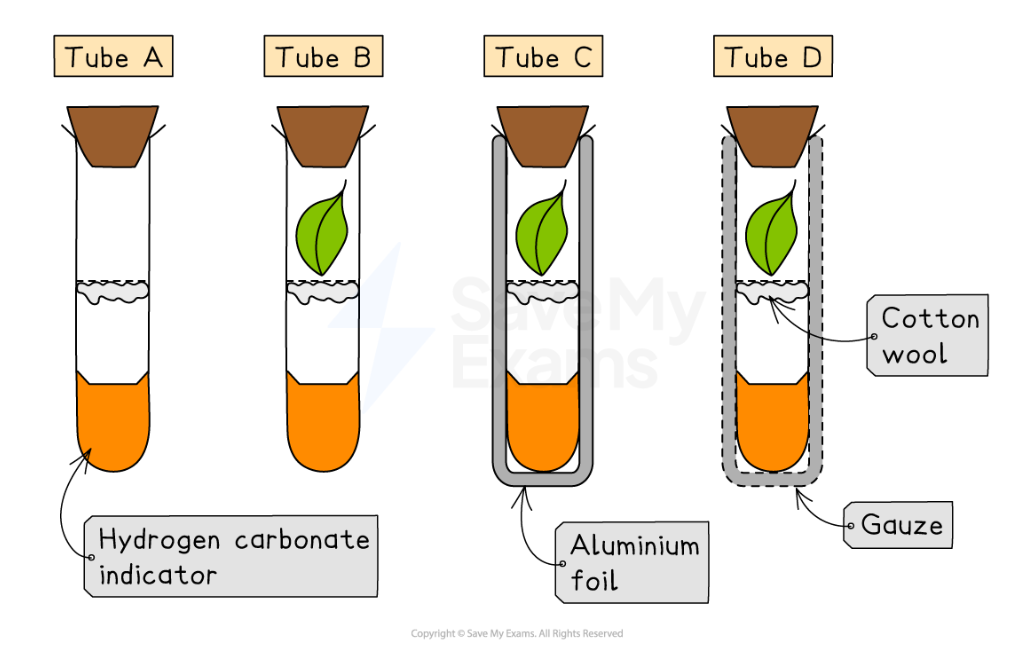
What would be the final colour of hydrogen-carbonate indicator and explanation in Tube D?
Orange/slightly purple | Photosynthesis and respiration are relatively balanced. Net exchange of gas is small, although photosynthesis may exceed respiration so a small net update of CO2 may happen (level of CO2 decreases) |
The human respiratory system is located in the ______.
thorax
The thorax is the chest cavity in humans. It contains:
the ribs
the intercostal muscles
the diaphragm
the trachea
the lungs, which contain:
the bronchi
the bronchioles
the alveoli
the pleural membranes
What are the adpatation of the human respiratory system?
Large surface area - provided by many alveoli, increasing the area over which gases can be exchanged by diffusion between air in the lungs and blood in the capillaries
The walls of the alveoli and capillaries supplying blood to them are one cell thick, keeping the distance over which gases are exchanged as short as possible
Good ventilation with air - movement of air in and out of the lungs maintains a high concentration gradient for oxygen and carbon dioxide between the air in the lungs and blood in the capillaries
Good blood supply - maintains a high concentration gradient by carrying blood with a high concentration of oxygen away from the alveoli
Description of ribs.
Bone structure that protects internal organs (eg. the lungs)
Description of Intercostal muscle.
Muscles between the ribs which control their movement causing inhalation and exhalation
Description of Diaphragm.
Sheet of connective tissue and muscle at the bottom of the thorax that helps change the volume of the thorax to allow inhalation and exhalation
Description of Trachea.
Windpipe that connects the mouth and nose to the lungs
Description of Bronchi
Large tubes branching off the trachea that connect to the bronchioles. The human lungs contain two bronchi, each tube is known as a bronchus:
Bronchi (plural)
Bronchus (singular)
Description of Bronchioles.
Smaller tubes that connect the bronchi to the alveoli
Description of Alveoli.
Tiny, balloon-like air sacs found at the ends of the bronchioles in the lungs. The alveoli are the specialised gas exchange surfaces where oxygen diffuses into the blood and carbon dioxide diffuses out.
Alveoli (plural)
Alveolus (singular)
Description of Pleural membranes
Thin layers of tissue that surround the lungs and line the inside of the thorax.
What do muscles do to bones?
Muscles can only pull on bones, not push them.
Why are there two sets of intercostal muscles?
Muscles can only pull on bones, not push them. They work antagonistically to help breathing.
Where are the external intercostal muscles found?
On the outside of the rib cage.
Where are the internal intercostal muscles found?
On the inside of the rib cage.
What do external intercostal muscles do during inhalation?
They contract and pull the ribs up and out.
What do internal intercostal muscles do during forced exhalation?
They contract and pull the ribs down and in.
What is the diaphragm?
A thin sheet of muscle separating the chest cavity from the abdomen.
What happens to the diaphragm during inhalation?
It contracts and becomes flat.
What happens to the diaphragm during exhalation?
It relaxes and becomes domed.
What happens to the rib cage during inhalation?
It moves up and out.
What happens to the rib cage during normal exhalation?
It moves down and in.
What happens to the volume of the thorax during inhalation?
It increases.
What happens to the volume of the thorax during exhalation?
It decreases.
What happens to air pressure inside the lungs during inhalation?
It decreases.
What happens to air pressure inside the lungs during exhalation?
It increases.
Why does air move into the lungs during inhalation?
Because pressure inside the lungs is lower than outside.
Why does air move out of the lungs during exhalation?
Because pressure inside the lungs is higher than outside.
What is inhalation also called?
Inspiration.
What is exhalation also called?
Expiration.
What is normal exhalation?
Breathing air out at rest.
What is forced exhalation?
Breathing air out more quickly and forcefully.
When does forced exhalation happen?
During strenuous activity.
Why is forced exhalation needed during exercise?
To remove more carbon dioxide quickly.
What do the internal intercostal muscles do in forced exhalation?
They help decrease thorax volume further.
What is the pleural cavity for?
It contains fluid to reduce friction during breathing.
What happens in inhalation?
The diaphragm contracts and flattens
The external intercostal muscles contract to pull the ribs up and out
This increases the volume of the chest cavity, or thorax
There is a decrease in air pressure inside the lungs relative to outside the body
Air is drawn in
What happens in exhalation?
The diaphragm relaxes and moves upwards back into its domed shape
The external set of intercostal muscles relax so the ribs drop down and inwards
This decreases the volume of the chest cavity
There is an increase in air pressure inside the lungs relative to outside the body
Air is forced out
What happens in forced exhalation?
The external and internal intercostal muscles work as antagonistic pairs
When we need to increase the rate of gas exchange, e.g. during strenuous activity, the internal intercostal muscles will also work to pull the ribs down and in; this decreases the volume of the thorax further, forcing air out more quickly – this is called forced exhalation
There is a greater need to rid the body of increased levels of carbon dioxide produced during strenuous activity
This allows a greater volume of gases to be exchanged
How is alveoili adpated for gas exchange?
The alveoli are highly adapted and specialised for gas exchange
There are many rounded alveolar sacs which give a very large surface area to volume ratio
Alveoli (and the capillaries around them) have thin, single layers of cells to minimise diffusion distance
Ventilation maintains high levels of oxygen and low levels of carbon dioxide in the alveolar air space, meaning there is a steep concentration gradient for diffusion of gases
A good blood supply ensures a constant supply of blood high in carbon dioxide and low in oxygen, again to maintain concentration gradients for diffusion
A layer of moisture on the surface of the alveoli helps diffusion as gases dissolve
How does Tar affect human body?
Tar is a carcinogen, which means it increases the risk of cancer.
Tar stimulates goblet cells and mucus glands to enlarge, producing more mucus. It also destroys cilia, meaning mucus (containing dirt, bacteria and viruses) build up in the lungs, blocking bronchioles, causing lung infections, chronic bronchitis and pneumonia.
Smoker’s cough is the attempt to remove the mucus from the lungs
Tar also contributes to emphysema, which develops as a result of frequent infections. This damages the alveoli, reducing the surface area for gas exchange. This reduces volume of oxygen in the blood, as a result patients with emphysema become breathless and wheezy very easily, and often need a constant supply of oxygen to remain alive.
How does carbon monoxide affect the body?
Carbon monoxide binds irreversibly to hemoglobin, reducing the capacity of blood to carry oxygen.
This leads to shortness of breath and fatigue, as not enough oxygen is supplied to cells for respiration to release energy. So, breathing frequency and depth increases to maintain oxygen supply to cells.
It also increases heart rate to pump blood and oxygen around the body faster, this increases the risk of coronary heart disease and strokes
How is nicotine affect the body?
Nicotine is highly addictive.
Nicotine narrows blood vessels leading to an increased blood pressure. It also increases heart rate
These increases the risk of blood clots; this can block arteries leading to heart attack or stroke
Explain Chronic bronchitis
Tar stimulates goblet cells and mucus glands to enlarge and produce more mucus
Mucus builds up, blocking the smallest bronchioles and leading to infections
The build-up of mucus can result in damage to the cilia, preventing them from beating and removing the mucus
A smoker's cough is the attempt to move the mucus
Explain emphysema?
Emphysema is a result of frequent infection
Infections occur more frequently in smokers due to the build-up of mucus that occurs in the lungs
Emphysema develops as follows:
phagocytes that enter the lungs release elastase, an enzyme that breaks down the elastic fibres in the alveoli
the alveoli become less elastic and cannot stretch, so many burst
the breakdown of alveoli reduces the surface area for gas exchange
Emphysema patients become breathless and wheezy, and may need a constant supply of oxygen to stay alive