Lecture 5: Memory III: Semantic Memory
 Studied by 0 people
 Call Kai
 Learn
Learn Practice Test
 Spaced Repetition
 Match
Match Flashcards
 Knowt Play
1/102

Earn XP
Description and Tags
Name | Mastery | Learn | Test | Matching | Spaced |
|---|
No study sessions yet.
103 Terms
Semantic memory
general world knowledge, including objects, people, concepts, and words
What can semantic memory be described as?
a network
Categorisation
how we organise information, how we know what the categories are and what belongs to what
Semantic memory networks
spreading activation
hierarchical network model (Collins & Quillian, 1969)
network elements
nodes, paths, and features
basic, subordinate, and superordinate levels
associative network model (Collins & Luftus, 1975)
Theories of categorisation
classical theory (Aristotle vs Wittgenstein)
measuring categorisation
typicality ratings
exemplar production
membership verification
prototype theory (Rosh, 1975)
exemplar theory
explanation- based theory
Barsalou’s (1983) experiments
Categories, schemata, and scripts
predicting what happens next based on regularities in the world
Schema processes (Alba & Hasher, 1983)
selection (Bransford & Johnson, 1972)
abstraction (Carmichael et al., 1932)
interpretation (Johnson et al., 1973)
integration (Bransford et al., 1972)
reconstruction (Bartlett, 1932; Brewer & Treyens, 1981)
Semantic memory structure
representations and their relations stored in a more economical network
stored in some form of network structure
How are concepts accessed in the hierarchical network model?
access of concept representations through spreading activation between nodes via their connecting paths
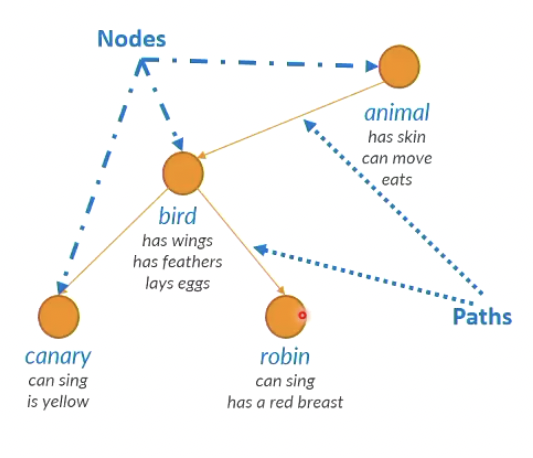
What are the levels in the hierarchical network model?
superordinate
basic
subordinate
Superordinate level
within hierarchical network model
very general, broad, high up concept
e.g. animal
Basic level
within hierarchical network model
broad concepts
e.g. birds
concepts belong to superordinate level
Subordinate level
within hierarchical network model
items belong to basic level
specific
e.g. canary, robins
Features
in the hierarchical network model, features are things separating nodes (items) from each other
Limitation of hierarchical organisation
does not account for semantic relatedness
retrieval of information not consistent with hierarchy
does not account for semantic spreading activation
so hierarchical structure not perfect
retrieval times DO NOT correlate to hierarchical structure
been replaced with semantic relatedness
Collins and Loftus’ (1975) associative network model
idea that our network of semantic information is stored based on semantic relatedness and spreading activation is facilitated through this relatedness
nodes connected through pathways based on their associations
much more flexible, more representative
Semantic dementia
losing ability to understand meaning
syndrome of progressive deterioration in semantic memory, leading to loss of knowledge about objects, people, concepts, words
Heirachical or associative network?
associate network
What do categories allow?
formation of concepts and knowledge of what belongs to a certain family
allow us to make expectations about the world based on previous knowledge and experiences
broad concepts to make predictions
What does semantic representation enable us to do w.r.t. categories?
enables us to form representations of categories based on regularities in the world
this allows us to make predictions about what will happen next and decisions on how to interact with the world
Classical theory of categorisation
Aristotle
categories defined by necessary and sufficient features
Aristotle’s definition of categorisation
categories are defined by necessary and sufficient features
When is it difficult to categorise using classical theory?
difficult when ambiguous
e.g. define a chair
easy to define an odd number, for example
hard to define something that is variable
subjective and difficult to identify necessary and sufficient features
problem with how we organise semantic memories
Criticisms of classical theory
Does not recognise idea of family resemblance: different members of a category can share different features
Does not account for central tendency: categories exhibit an average ideal
e.g. average/exemplar car, dog, etc
Does not account for graded membership: some members are more typical for a category than others
some ppl seem to be more typical or representative for category
e.g. penguins and ostriches are not as typical as pigeons
typicality depends on life experiences
Measuring categorisation
typicality ratings (measures graded membership)
exemplar production
category membership verification
Typicality ratings
rank items from best to worst example of a category
average Ps’ ratings
less about how they are ranked but more about the fact that Ps do rank- shows there is a variance in typicality
DV of typicality ratings
DV: average rank or rating
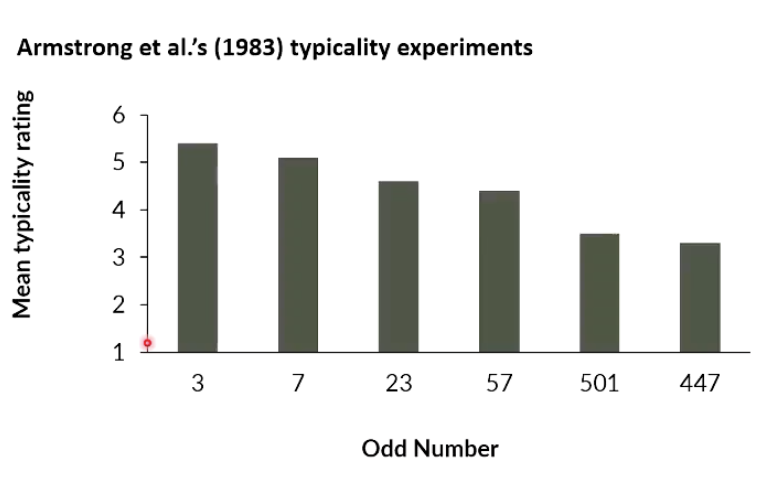
What did Armstrong et al., (1983) find regarding categorisation?
did typicality experiments
found graded membership exists even for odd numbers- even arbitrary things, we have idea of typicality
graph- mean typicality ratings (how odd is the odd number) X odd number
Exemplar production: process and detail
ask Ps to produce as many examples as they can of a category (e.g.: provide examples of furniture)
word cloud, biggest items are most popular → most common. (e.g.: see how many people say table)
gives idea of which items are most dominant in how we are processing and organising these categories/ elements and items of these categories
see what representations are counted, how many, how they are organised, popularity, examine commonalities
Exemplar production
Ps asked to recall as many items in a category as they can
e.g.: recall as many pieces of furniture as you can
DV(s) in exemplar production
DV(s): frequency of production and/or position in the production
Category membership verification
like the inverse of exemplar production
Ps asked: is [this item] an exemplar of [the category]?
e.g.: is carpet an exemplar of furniture?
DV(s) in category membership verification
DV(s): accuracy of responses and/or reaction times
What do modern theories of categorisation attempt to do?
attempt to overcome difficulties and deficits observable in classical theories
Modern theories of categorisation
Prototype Theory (Rosch, 1975)
Exemplar Theory (Nosofsky, 1986)
Rosch’s (1975) theory of categorisation?
Prototype Theory
Prototype Theory
modern theory of categorisation
categories are determined by a mental representation that is a weighted average of all category members
prototype may or may not be an actual entity
Prototype Theory: assumption
gather together all the representations of a theory and create one representation which is a weighted average of all the category members
representation of the ‘standard’
What type of features are identified in Prototype Theory? (+ e.g. in context of dogs)
distinctive features (e.g. barks, is omnivore)
common features (e.g. four legs, furry, tail)
Common vs distinctive features
common features are features that are also found in other, distinct categories
e.g. four legs, furry, tail are features of a dog but these are common features b/c apply to a lot of things: furniture, other animals
VS
distinctive features are features with more impact in distinguishing one category from another
e.g. barks, is omnivore helps distinguish dogs from other animals
Prototype Theory: interacting with the world
build prototype
when in the world, if encounter something can decide if it belongs to X category
e.g. if encounter dog, decide if it is a dog
do this by looking for common features and then distinctive features
if what you encounter matches your prototype, then encountered thing can be integrated into that category e.g. understand it is a dog
What do we use prototypes as?
use prototypes as a mental shortcut to access and understand whether something falls into a category or not
Criticisms of Prototype Theory
PT cannot explain how people can:
tell the sizes of categories
e.g.: many types of dogs, fewer types of elephants
can’t explain that sizes of categories are different and that sizes of categories are relevant to generation of a representation
add new members to a category
how decide whether or not to add smth to representation
how check unusual things count
how integrate unusual things into category
if addition changes what prototype is
What theory attempts to address issues with prototype theory?
Exemplar Theory
Exemplar Theory
categories consist of separate representations of the physical features of experienced examples of the category
What does Exemplar Theory suggest about representations?
we can have individual representations rather than only one representation of the whole category
exemplar like the prototype, but not the same
we have all the individual representations that formed the exemplar AS WELL AS the exemplar
What does the Exemplar Theory ‘fix’ w.r.t. Prototype Theory?
people can tell category sizes (b/c have individual representations)
people can add new members (b/c individual representations and an exemplar which is made up of all representations that we have)
What is the exemplar made up of? (Exemplar Theory)
exemplar made of all the stored representations that we have
Exemplar vs Prototype
exemplar: specific and good example of a category
prototype: idealised or average representation of a category
Criticisms of Exemplar Theory
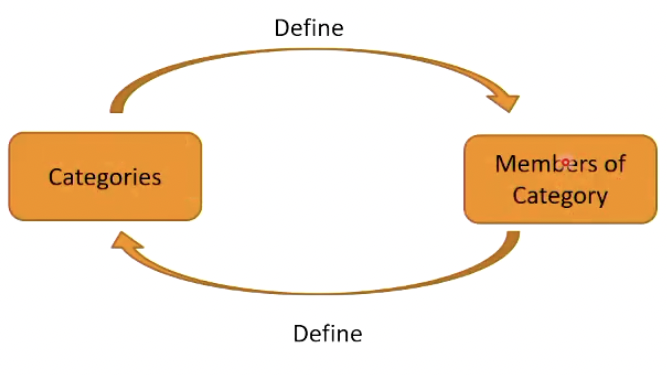
it cannot explain how people can retrieve all category members to define a category if retrieval is based on category membership
relies on assumption that:
need all members of category to be able to define the category
BUT
need the category to define members of a category
→ end up with issue of theoretical circularity
it cannot explain how people form abstract categories of things without physical features
e.g. types of social groups, ideologies of political parties, types of world events, ways to make friends
using exemplar of those things doesn’t really address more nuanced ways we categories
What theory attempts to address criticisms of Exemplar Theory?
Explanation-Based Theory
Explanation-Based Theory
categories are based on common causal characteristics rather than physical features
Explanation-Based Theory: assumptions
suggests there is an explanation for our basis of categorising things into different categories
states there must be reason, logic, and thought behind categorisation, rather than physical things
Previous accounts vs Explanation-based account: example, ‘waterfowl’
previous accounts:
waterfowl: animals with webbed feet (physical characteristic)
explanation-based account:
waterfowl: animals that swim (not based on physical characteristic, linking on smth that they do/smth related to them)
How can categories be created in Explanation-Based Theories?
ad hoc using world knowledge and explanations
way we use and define categories more align with how we organise them in the world- as and when we need them
categories lots of things based on their properties, rather than their physical features
can come up with categories on the fly, if asked even if never thought of before
Barsalou (1983): research question
do ad hoc categories have the same features as common categories?
What is ‘fruit’ an example of? (categorisation)
common category
(explanation-based theory)
What is ‘things with a distinctive smell’ an example of? (categorisation)
ad hoc category
(explanation-based theory)
What variables did Barsalou (1983) assess?
family resemblance
central tendency
graded membership
→ whether ad hoc explanation based theories hold up to theory of categorisation
Barsalou (1983): findings
high average agreement (70-80%) among participants regarding category membership, typicality of members, and production of exemplars
ad hoc categories are similar to common categories in that they exhibit family resemblance, central tendency, and graded membership
What do schemata and scripts help application of?
help apply semantic memory
understanding about rules, way world works + helps apply semantic knowledge to different situations
influences how we process information, both at encoding and retrieval
What does semantic memory enable us to form?
schemata
scripts
Schemata
ways in which we use our semantic memory to build useful things for us to work with in daily life (e.g.: “buying things”)
schemata encapsulates commonly encountered aspects of life
explanation-based event categories
representations for individual categories or rules for how things operate
captures the events
Scripts
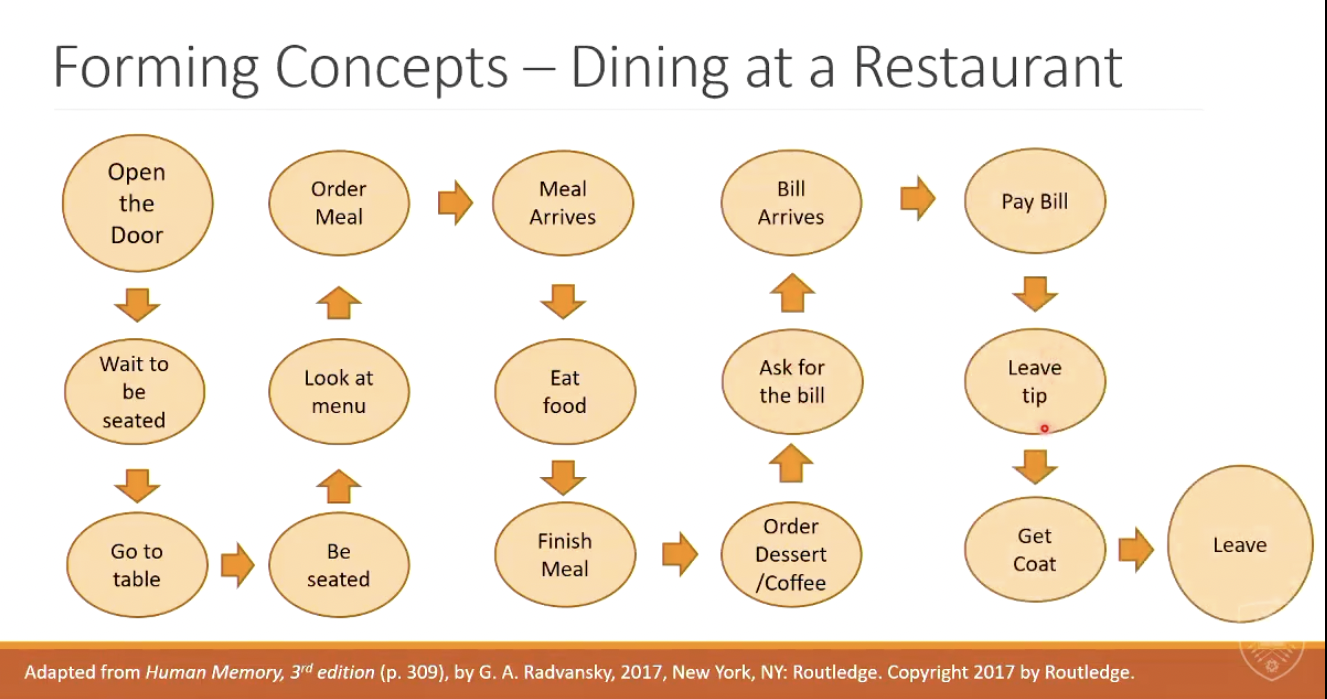
capture the order of events for common aspects of life
temporally ordered schemata
e.g.: “eat in a restaurant”
captures order of events and how they are going to go, not actually the events
instead of ordering manually and having each individual schemata, have a rough order in a script
Forming concepts: dining at a restaurant
based on past explanation of experiences, have an idea of events → schemata
based on past experiences, have an idea of order events are going to go in → scripts
What do scripts and schemata allow us to do?
allow us to make predictions about the world and the rules of the world around us
→ so we can interact with it effectively
→ without having to constantly go over and manually think of these things, consciously ‘playing out’ how they are going to go
just our expectations of how things work and so will work
What did Alba & Hasher (1983) identify?
five primary schema processes
What do the five primary schema processes influence?
how we encode information
how we retrieve information
perceive, receive, encode, store, retrieve
Five primary schema processes
selection
abstraction
interpretation
integration
reconstruction
Which primary schema process/es influence encoding?
selection
abstraction
interpretation
integration
Which primary schema process/es influence retrieval?
reconstruction
Selection
selection of information central to a schema
matching preferences against supply, quality, and price
when processing information, grab information that is relevant and helpful
select appropriate information, matching preferences
allows us to identify key information we are going to need
allows selection of centrally relevant information to a particular topic
one of five primary schema processes
Bransford & Johnson (1972): Schema: concept + procedure
demonstrated selection as a schema process
series of experiment
Ps presented with topic and asked to recall as much information as they could
3 conditions:
study text w/o being told topic
study text, given topic after
study text, given topic before
asked to free recall as much info abt text as possible
→ when we know the topic, can start organising information
organise into different groups, find relevant information
once understand topic, schema for selection allows you to pick out relevant information
Bransford & Johnson (1972): Schema: findings
schema activation benefits encoding of schema- relevant information
told topic after → worst recall
not told topic → slightly better recall
told topic before → over 2x as good recall
b/c able to use schema process of selection more readily
better equipped to encode schema relevant information
selection helps identify relevant concepts
Abstraction
able to abstract from a particular representation we are provided with, into a more general schema-consistent item/representation
one of five primary schema processes
What does Carmichael et al., (1932) demonstrate?
abstraction
Carmichael et al., (1932): Abstraction
present Ps with individual stimuli they have to encode
if provide Ps with a schema, or an item with some information which is going to lead them to think about that information in a particular way, it will change the way they recall that information at the point of encoding
Carmichael et al., (1932): procedure
2 groups of Ps
presented with 3 images (origin) that Ps had to encode
group 1: told shapes were: a) curtains in a window; b) seven; c) gun
group 2: told shapes were: a) diamond in a rectangle; b) four; c) broom
Ps later asked to recall information and draw representation of original shape
shows information told about shapes influenced encoding and thus recall- information been abstracted to be more consistent with schema representation given
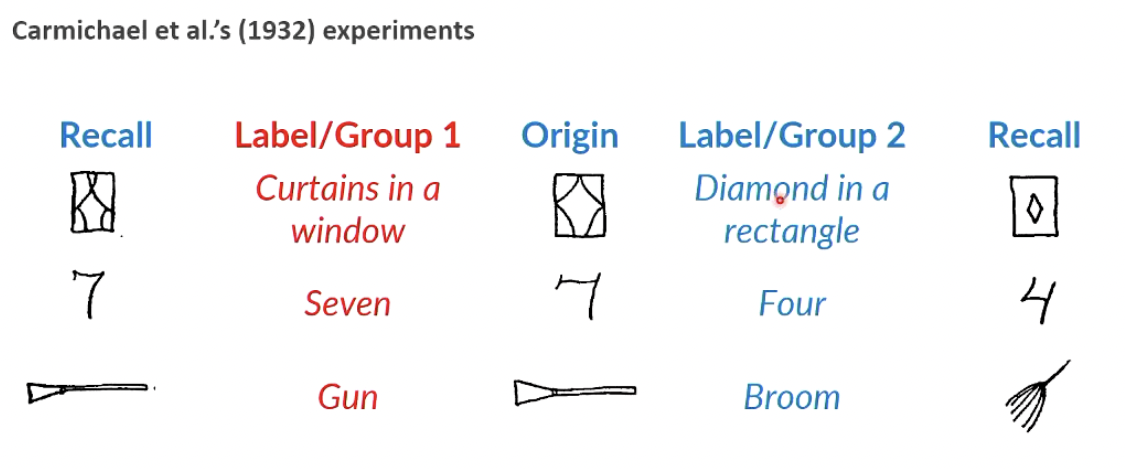
Carmichael et al., (1932): findings
Ps abstracted origin information to be more aligned with schematic representation given to them
group 1’s drawings looked more like a window, a seven, and a gun
group 2’s drawings changed to be a small diamond in a rectangle, and more like a four and a broom
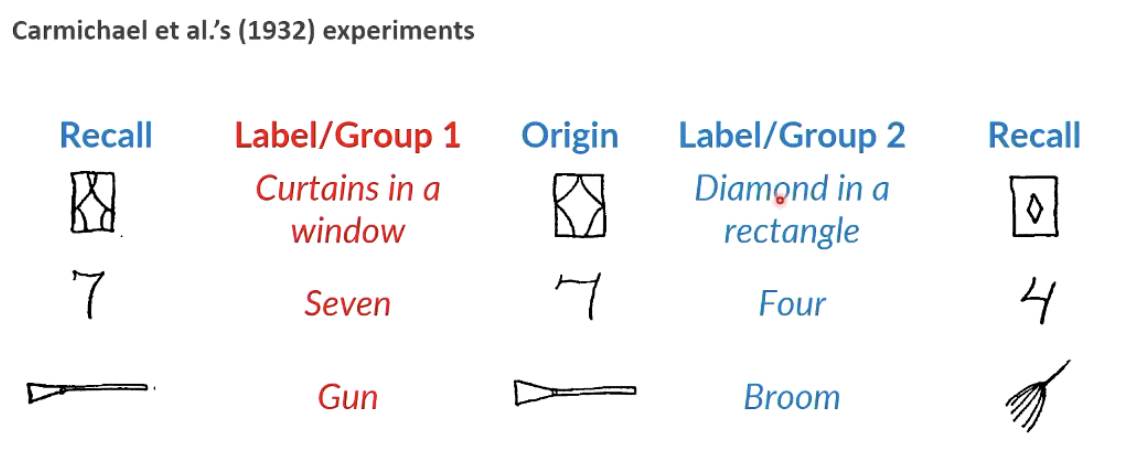
→ abstracted
recalling is different between group 1 and 2
closer to label than image presented with, much more consistent with schema presented with
abstraction abstracts representations actually presented with to be more in line with our schematic representations
affects how we encode information, thus influencing retrieval later.
Interpretation
dependent on level of information we have been given + ability to interpret possible outcomes based on what we have been presented with
one of five primary schema processes
What did Johnson et al., (1973) demonstrate?
interpretation
Johnson et al., (1973): Interpretation: Procedure
way we are provided information can affect what information and how that information is encoded
presented 2 groups with 2 different sentences
group 1: dropped delicate glass pitcher
group 2: just missed delicate glass pitcher
at no part in sentence were either groups told the pitcher had broken
Ps asked later if “broke the delicate glass pitcher when it fell on the floor” was exactly the sentence they heard
Johnson et al., (1973): Interpretation: Findings
60% of group 1- who had cause to believe glass pitcher was broken bc it dropped on floor- reported it was exactly the sentence they heard
only 20% of group 2- who did not have cause- reported it was exactly the sentence they heard
3x more with cause than without cause re schema activiation
Johnson et al., (1973): Interpretation: Conclusion
interpretation is used to ‘fill in the gaps’ in a story with schema-consistent information
Integration
process whereby we integrate representations into one schema consistent representation based on information that we have
one of five primary schema processes
Bransford et al., (1972) demonstrates?
integration
Bransford et al., (1972): Integration: Procedure
Ps gradually presented with pieces of information to integrate into a holistic representation
drip feeds of information
e.g. there is a tree w a box beside it
then: there is a chair on top of the box
then: the box is to the right of the tree
etc
→ building holistic representation based on information provided with, enabled by schematic integration
Ps then asked which sentence they heard
e.g.: Which sentence did you hear? a) the box is to the right of the tree; b) the chair is to the right of the tree; c) the box is to the left of the tree; d) the chair is to the left of the tree
Bransford et al., (1972): Findings
Ps would be able to ID that (a.) is the sentence they heard bc it is the same as the old one and in line with old information
they wld be able to ID that (c.) and (d.) are not the sentences they heard bc they are NEW: (c.)- relation change; (d.): relation change and subject change
(b) is a new, but permissible statement. possible for Ps to recall it based on inference. Ps do report this.
only reason think (b.) is bc know the box is right of the tree and chair is on top of the box and so therefore the chair is to the right of the tree
—> only reason know this is bc integration creates whole representation
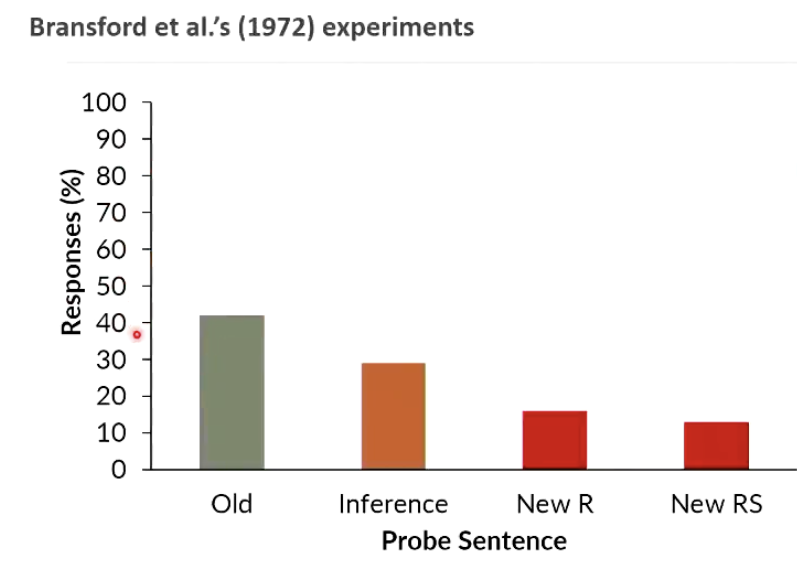
Bransford et al., (1972): Conclusion
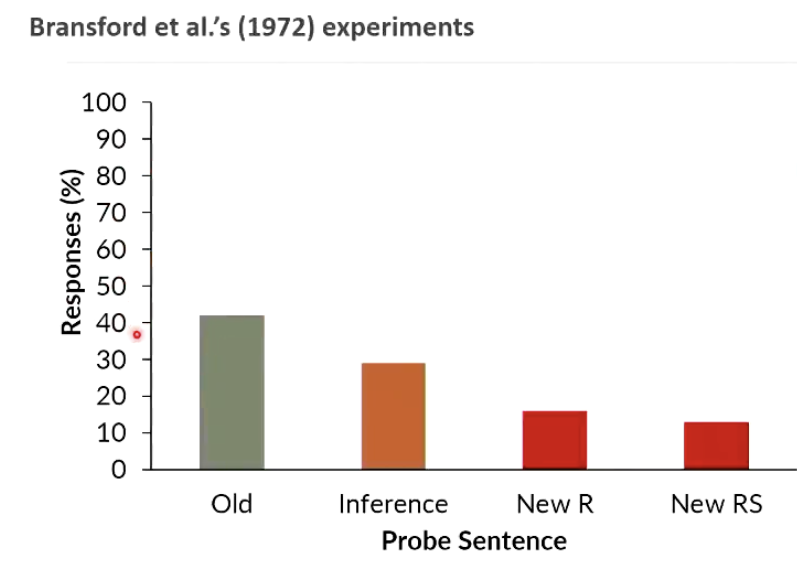
integration of information is used to form schema consistent holistic representations
Integration vs Inference
inference is filling in gaps based on schema consistent information, whilst, in integration, there is not necessarily a gap in that information- the information is there and present, it is integrated. not filling in gaps, just making connection between related information.
Reconstruction
influences retrieval stage of memory processes
retrieval of memories reconstructed to be schema consistent
alteration based on expectations and predictions of items that should be there, or based on own experiences
negative impact on recall of accurate information
one of five primary schema processes
What did Bartlett’s (1932) experiments demonstrate?
reconstruction
Bartlett (1932): Procedure
British students studied Native American tale The War of the Ghosts
they were asked to recall it after days, weeks, months, or years
Bartlett (1932): Findings 4mo later
recall skewed based on personal experience and information
main character becomes white European, rather than Native American b/c that is what person who encoded information has experience with
details were reconstructed to be simplified and fit cultural schema
canoes → boots
paddles → rowing
protagonist from “Egulac” → British warrior
reconstruction process during retrieval has been changed to fit what they already know
Brewer & Treyens (1981): what schema process did they demonstrate?
reconstruction
Brewer & Treyens (1981): Reconstruction: Procedure
Ps waiting in a graduate student office
later asked to recall everything they cld about the room
Brewer & Treyens (1981): Reconstruction: Findings
Ps recalled key items like chair, desk, poster, skull
Ps also recalled expected items like books, filing cabinet- which were not present
falsely recalled
Schema Theory
five primary schema processes
Alba & Hasher (1983)
schema processes affect encoding and retrieval of information
those effects can change our memories + so change their correctness
The phenomenon that people tend to recall stories in a schema consistent way is known as…
reconstruction
To ‘fill in the gaps’; in a story is an example of…
interpretation