RP 1: Investigation into the variation of the frequency of stationary waves on a string with length, tension and mass per unit length of the string.
 Call Kai
 Learn
Learn Practice Test
 Spaced Repetition
 Match
Match Flashcards
 Knowt Play
1/14

There's no tags or description
Looks like no tags are added yet.
Name | Mastery | Learn | Test | Matching | Spaced | Call with Kai |
|---|
No analytics yet
Send a link to your students to track their progress
15 Terms
What is the method used to investigate how the frequency of stationary waves on a string depends on the vibrating length? (7)
- Set up the apparatus so that the string passes from the vibration generator over a pulley with a 100 g mass, hanging vertically to provide tension.
- Clamp a wooden bridge to set the vibrating length of the string to exactly 1.000 m, using a metre ruler for accurate measurement.
- Adjust the frequency of the signal generator until the string produces a clear first harmonic and record the frequency.
- Reduce the vibrating length of the string by 0.100 m and again adjust the frequency to find the first harmonic, recording the new frequency.
- Repeat the process by reducing the length by 0.100 m each time down to 0.500 m, recording the frequency for each length.
- Perform the entire experiment two more times and calculate the mean frequency for each length.
- Measure the total mass of the 1.5 m string using a balance and calculate the mass per unit length by dividing the mass by 1.5.
What equipment is needed for the stationary waves on a string practical? (9)
- Signal generator.
- Vibration generator.
- Stand.
- Pulley.
- Wooden bridge.
- 100 g masses with
holder.
- Metre ruler.
- 1.5 m long string.
-Balance.
What does the setup for the stationary waves on a string practical look like? (3)

What graph is plotted in the stationary waves practical? (1)
A graph is plotted with the mean frequency on the y-axis and the reciprocal of the vibrating length (1/l) on the x-axis.
How is the wave speed determined from the graph in the stationary waves practical? (1)
The wave speed is found by calculating twice the gradient of the line of best fit, based on the equation f = v / 2l.
How can the experimental wave speed be compared to a theoretical value? (1)
The experimental wave speed can be compared to v = √(T / μ), where T is the tension (equal to the weight of the hanging mass), and μ is the mass per unit length of the string.
What does the graph used in the string frequency practical look like? (3)
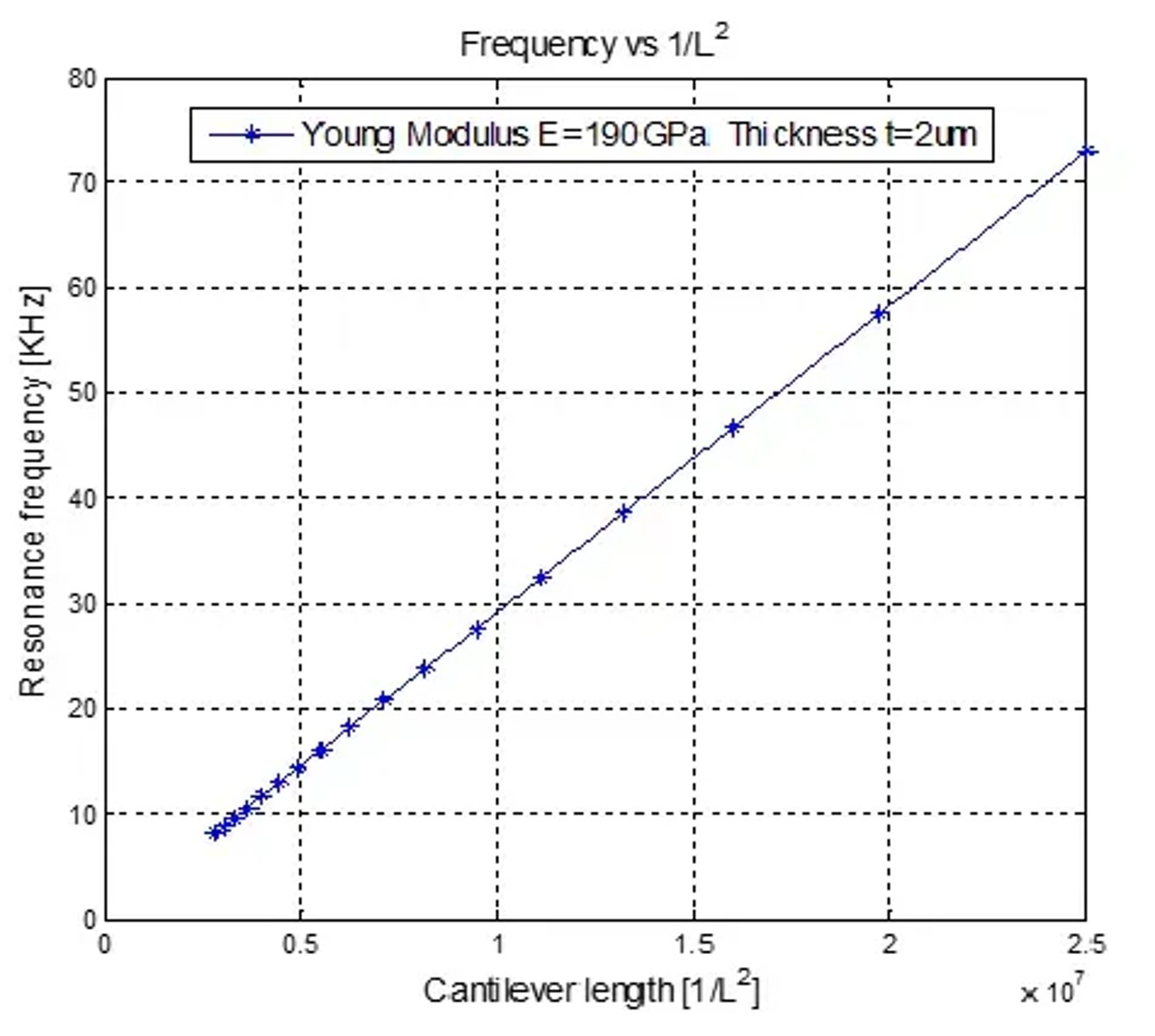
What is the independent variable in the string frequency practical? (1)
The independent variable is the vibrating length of the string.
What is the dependent variable in the string frequency practical? (1)
The dependent variable is the frequency at which the first harmonic occurs.
What are the controlled variables in the string frequency practical? (1)
The controlled variables include the tension in the string, the thickness and type of string and the room temperature.
What is one safety precaution for the stationary waves practical? (2)
- The stand could fall due to the string tension.
- A counterweight should be added to its base to make the setup more stable.
How could the effect of tension on frequency be investigated further? (1)
Different masses could be used to change the tension in the string and observe how this affects the frequency.
How could the effect of mass per unit length on frequency be investigated further? (1)
Strings of different thicknesses or materials could be used to study how the mass per unit length affects wave speed.
How could the frequency measurements be made more accurate? (1)
An oscilloscope could be connected to the signal generator to accurately confirm the frequency output.
Why should the signal generator be switched on before the practical begins? (1)
The generator should be left on for around 20 minutes before starting to allow it to stabilise.