Introduction to Intervention
 Call Kai
 Learn
Learn Practice Test
 Spaced Repetition
 Match
Match Flashcards
 Knowt Play
1/37

There's no tags or description
Looks like no tags are added yet.
Name | Mastery | Learn | Test | Matching | Spaced | Call with Kai |
|---|
No analytics yet
Send a link to your students to track their progress
38 Terms
Intervention
It refers to the entering in an ongoing system of relationships, to come between or among person, groups, or objects for the purpose of helping them
True
Interventions enter into the ordinary continuous stream of organizational life and are shaped by politics, workload, goals, environment, relationships, and history
True or False
Action Planning
It refers to one of the two core interrelated activities in intervention, which devises an appropriate intervention strategy to address organizational problems
Implementing
It refers to one of the two core interrelated activities in intervention, which structures chosen interventions to fit an individual, team, or organization.
Intervention Event
It refers to a single, discrete meeting, workshop, or milestone
Intervention Strategy
It refers to a deliberate, sequenced series of progressive steps/events combined into a coherent program to achieve an overall objective
Principle of Congruence
The _________ posits that change activities must be precisely matched with diagnostic data, the root causes of the problems, and the nature of the organizational units
Harrison’s Rule of Depth
__________ posits that a change agent must intervene no deeper than necessary to achieve the client’s objective since deeper levels involve higher emotional risk, personal anxiety, consultant dependency, and lower transferability
Maximize Diagnostic Data
It is the first among Beer’s sequence considerations, which runs data-generating events first to fine-tune subsequent steps
Maximize Effectiveness
It is the second among Beer’s sequence considerations, which builds early momentum and confidence to ease harder later phases.
Maximize Efficiency
It is the third among Beer’s sequence considerations, which systematically conserve time, energy, and financial resources
Maximize Speed
It is the fourth among Beer’s sequence considerations, which structures elements to align with the client’s desired pace of change.
Maximize Relevance
It is the fifth among Beer’s sequence considerations, which ensures the most pressing, primary problem is addressed first.
Minimize Strain
It is the sixth among Beer’s sequence considerations, which starts with safer, low-anxiety activities to protect organizational health.
Change Agent
Failed interventions systematically damage both parties. For instance, ________ suffers self-doubt and reputational loss.
Organizational Members
Failed interventions systematically damage both parties. For instance, ________ experience an increase in defensive behavior, decrese in appropriate coping skills, severe psychological burnout, and increased cynicism.
Readiness
It refers to the collective involvement, willingness, energy, capability, and motivation of the system to execute change
Persuasive Communication
__________ influences readiness by utilizing oral and written channels by leadership to explicitly highlight the urgency and necessity of change.
Active Participation
__________ influences readiness by involving members directly in diagnostic activities so they discover the need for change themselves.
Sharing External Information
__________ influences readiness by bolstering internal reports with credible external validation like industry data, news media, or academic research
Empirical-Rational
The ________ standard approach to change assumes people are rational and will change if provided logical data and programmatic justification
Normative-Reeducative
The ________ standard approach to change assumes change happens only when personal attitudes, values, skills, and group norms are actively transformed, having interventions as structured so content execution concurrently builds new behavioral norms.
Power-Coercive
The ________ standard approach to change is enforced via policy, legal frameworks, economic sanctions, or psychological compliance (guilt/embarrassment)
Creating Opportunities for Learning
One of the three foundational OD architecture is ________, which states that experiential exercises and reflective debriefs must be structured so members learn how to solve problems, and ensure long-term system competence
Giving Free Choice
One of the three foundational OD architecture is ________, ensuring explicit autonomy to participate and direct outcomes without institutional coercion or shame.
Providing Clear, Explicit Outcomes
One of the three foundational OD architecture is ________, which builds absolute authenticity and trust by being uprfront about risks, targets, and goals.
Facilitative
One of the five primary roles of a change agent is ________, which clarifies alternatives, pathways, and choices to help groups reach their own goals
Gatekeeping
One of the five primary roles of a change agent is ________, which spans boundaries and manages negotiations/feedbacks between teams or hierarchical tiers.
Diagnostic
One of the five primary roles of a change agent is ________, which mirrors observed data and behaviors to enhance collective self-awareness
Architectural
One of the five primary roles of a change agent is ________, which intentionally design sessions, environments, and structural agendas to prompt learning.
Mobilizing
One of the five primary roles of a change agent is ________, which explicitly advocates for a specific approach or systemic perspective
Misrepresentation of the Intervention
One of the four high-risk ethical issues is ________, which refers to the deliberate hiding of costs, difficulty, or over-promising outcomes to please a client
Misrepresentation of Skill Level
One of the four high-risk ethical issues is ________, which refers using a client as an experimental testing ground for an intervention method outside the practitioner’s competence.
Collusion with the Client
One of the four high-risk ethical issues is ________, which refers to agreeing to deploy a groundless intervention without diagnostic data, or becoming so embedded in the culture that objective perspective is lost.
Coercion/Manipulation
One of the four high-risk ethical issues is ________, which refers to depriving members of transparent information or genuine free choice regarding participation.
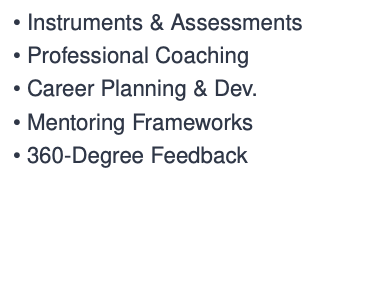
Individual Interventions
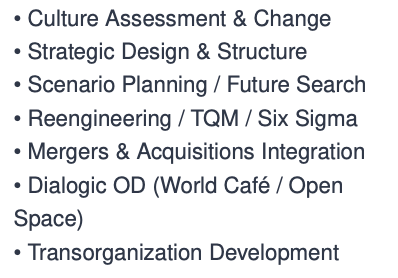
Interventions are strategically classified among three organizational domains. The following bullets from the image belongs to which category?
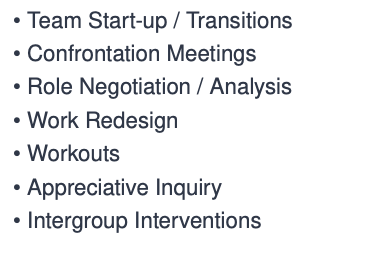
Team Interventions
Interventions are strategically classified among three organizational domains. The following bullets from the image belongs to which category?
Organizationwide Interventions
Interventions are strategically classified among three organizational domains. The following bullets from the image belongs to which category?