34. Models of Research
 Call Kai
 Learn
Learn Practice Test
 Spaced Repetition
 Match
Match Flashcards
 Knowt Play
1/120

There's no tags or description
Looks like no tags are added yet.
Name | Mastery | Learn | Test | Matching | Spaced | Call with Kai |
|---|
No analytics yet
Send a link to your students to track their progress
121 Terms
Type of model? Computer simulations and mathematical models?
in vitro
Type of model? anything in an animal (prokaryote, invertebrate, vertebrate)
in vivo
Coarnorhabditis elegans
Nematode
Drosophila melanogaster
Fruit fly
An animal model is meant to mimic or be a ______. it will not necessarily be identical to the disease being studies
surrogate
Analogous processes of an animal model does what?
relates one structure or process to another
Homologous process of an animal model does what?
reflects counterpart genetic sequence
Type of model: model generally demonstrate similar phenotype
one to one model
Examples of research using a one to one models
infectious dz or spontaneous/induced monogenetic dz
Type of model: looks at process in an organism or organisms, where each component feature is evaluated at several hierarchical levels
many to many modeling
Examples of research using many to many modeling
System, organ, tissue, cell, and subcellular levels (E.g. cancer, diabetes)
▪ high-throughput techniques (sequencing, transcriptomics, proteomics)
▪ Multiple systems: computer modeling, in vitro, in vivo, population-based studies
Type of model: A normal animal with phenotypic similarity to humans, or abnormal animal with random mutation
spontaneous model
Type of model: Normal animals which undergo surgical, chemical, genetic, or other manipulation which results in an abnormal physical condition (includes transgenic animals)
induced model
Type of model: disease or characteristic of interest only occurs in model of interest however a similar condition could naturally occur OR dz occurs naturally in non human species, but has not been described in humans
orphan model
Type of model: dz or characteristic of interest does not occur in model population
negative model
What are the 2 major limitations of chemical mutagenesis?
1. mutation occur randomly
2. Large scale mapping required - once PHENOTYPE is established, chromosomal mapping and sequencing is necessary to determine which GENE was mutated to produce the phenotype
Where does N-nitroso-N-ethylurea (ENU) induce mutations?
random mutation of a single base pair in germ cells of male mice
How is ENU used to induce a mutation?
Inject into male mice, creates single base pair mutations in germline, breed progeny and back to get homozygotes for mutated allele.
ENU can induce gain or loss of function mutations and can be used to mutate _____ cells?
embryonic stem cells - random mutation
When ENU is used in zebrafish, what is the genetic mutation average induction rate?
1 in 1000
What are the limitations for ENU genetic manipulation?
random mutations and chromosomal mapping is required
How does irradiation induce mutations?
Germline mutations - X-rays cause small chromosomal deletions in mouse spermatogonia, postmeiotoc germ cells, and oocytes
What are the limitations of irradiation mutation?
produce large mutations and low recovery rate of mutant mice
What is a major radiation induced mouse model?
beige mouse (bg)
How is chlorambucil used to induce mutations?
produces deletions in post-meiotic germ lines
What are limitations of chlorambucil induced mutations?
produces large deletions and difficult to obtain large numbers of mice
A _______ transgenic model produces a non-functional gene after targeted mutation
knock out
A ____ transgenic model produces a new functional gene
knock in
How does pronuclear injection cause mutation?
Direct insertion of cloned genetic material into pronucleus of fertilized mouse egg
How much DNA can be injected with pronuclear injection transgenesis?
no limits on size of DNA injected
What is a limitation of pronuclear injection mutation?
site of genetic integration is random
How is mutation achieved using ESC (embryonic stem cell) mutation?
1. Genes are inserted by homologous recombination into embryonic stem cells
2. Vectors contain positive and negative selection markers.
3. ESC with targeted mutation injected into mouse embryo and implant into a pseudopregnant mom.
What type of offspring are created using ESC (embryonic stem cell) mutation?
chimeras
Chimeras are founders with _______ expression of mutation
germline
What is the difference between a chimera and a mosaic animal?
Chimera - animal consisting of more than one genetically distinct cell population, derived from two or more zygotes (ES cells + the embryo they were injected into (8 cell blastocyst)).
Mosaic - animal consisting of more than one genetically distinct cell population, derived from one zygote (tissue specific distribution).
How are mosaic animals created?
result from a mutation during development which is propagated to only a subset of the adult cells.
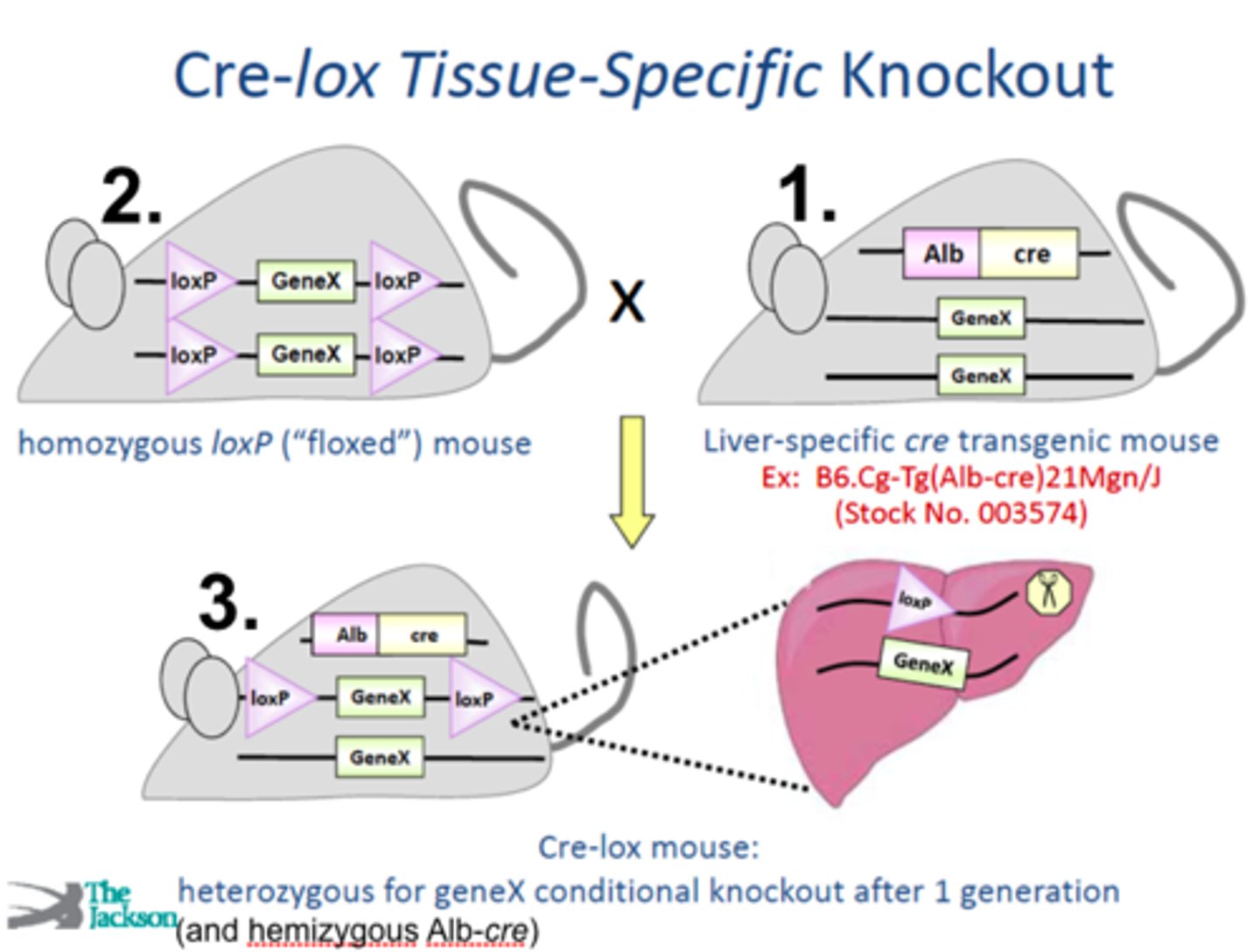
_____ is a tissue specific exon excision and ablation of gene function. It allows scientists to generate tissue specific knockouts
Cre-LoxP
How do you breed mice in order to get a cre-lox tissue specific knockout? Step 1
Breed mouse containing the liver specific cre transgene to a homozygous loxP floxed mouse
now you have a heterozygous mouse for GeneX conditional knockout mouse after 1 generation
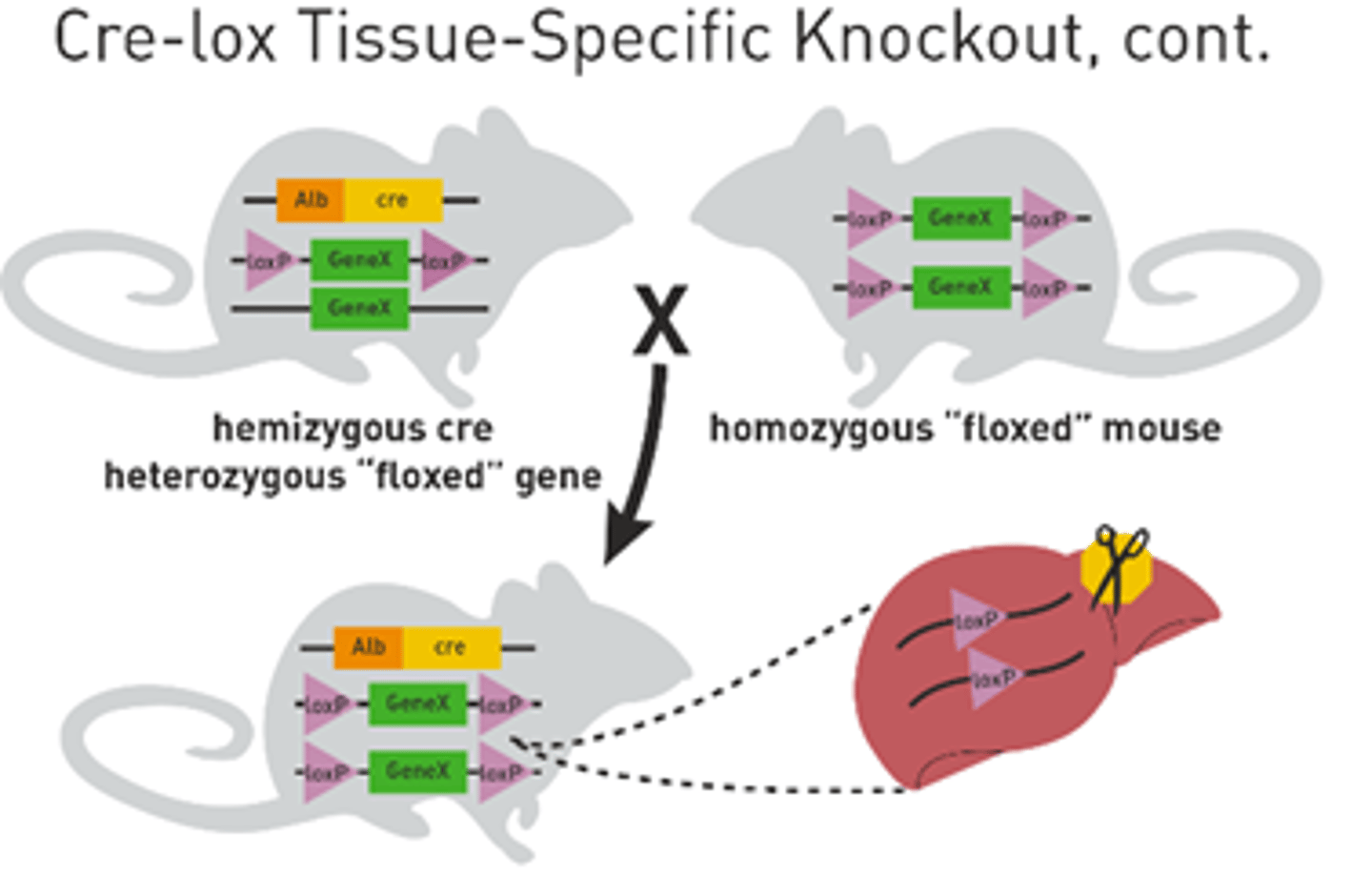
How do you breed mice in order to get a cre-lox tissue specific knockout? Step 2
Breed the hemizygous cre heterozygous floxed mouse to a homozygous floxed mouse
now you have a homozygous cre floxed mouse for GeneX
What can you incorporate in mice while breeding to regulate gene expression in the presence or absence of tetracycline?
upstream promoters (Tet on or Tet off)
______ used for microinjection of very large segments of human DNA; able to study higher levels of gene expression because includes more than one gene so genomic structure organization is not disrupted around the structural gene.
yeast artificial chormosomes (YACs)
______ used to deliver exogenous nucleic acid
Lentivirus-mediated transgenic manipulation
_____ targetable recombinases that can induce homologous recombination or removal of gene segment
ZFN (Zinc-finger nucleases)
_____ similar to ZFN as it relies on nuclease, but utilizes TALE elements
TALEN (transcription activator-life effector nuclease)
_____ similar to ZFN as it relies on clustered regularly interspaced short palindromic repeats
CRISPR
What are the 5 NRC criteria for appropriate animal models?
1. Model must be appropriate for its intended use.
2. Can be developed, maintained, and provided at a reasonable cost.
3. Is of value for more than one type of research
4. Is reproducible and reliable.
5. Is reasonably available and accessible.
Major clinical breakthroughs typically require a long history of _________ that often involve animal research
basic science discoveries
_______ provides transcriptional profile data similar to microarrays, but greater data discovery power
RNA sequencing
______ high throughput method to determine DNA:protein interactions in which cells are fixed to crosslink proteins to the chromosome, then immunoprecipitated with antibodies specific to the protein of interest
ChIP (chromatin immunoprecipitation sequencing)
In 1966 Flanagen discovered the ______ mouse through spontaneous mutation, they have developemental failure of thymic anlage, they have no circulating functional T cells
nude mouse
______ initial clustering of embryonic cells from which part or an organ develops
anlage
In 1983 Bosma discovered the ______ mouse. It has a mutation in the rag1 gene, failed to rearrange T cell receptor genes meaning they have combined T and B cell immunodeficiency
SCID mouse
In 1877 Louis Pasteur developed what?
vaccine against rabies
John lister discovered what?
antiseptic use prevented wound infection
in 1876 Robert Koch was able to do what?
grow bacteria outside of an animal
Emil Von Behring discovered what?
guinea pigs and rabbits vaccinated with diptheria or tetanus organisms developed immunity
Paul Ehrlich studied what?
antisera in guinea pigs and developed standardized test in 1897 to quantitate toxins and antitoxin
What cells mediate acute allograft rejection? Blocking these cell pathways prolongs graft survival.
CD4 and CD8 T cells
Atnigen presentation to host T cells primarily occurs by donor dendritic T cells. Dendritic cells are important for adaptive immune responses. Thus induction of ______ in donor dendritic cells is an effective strategy for prolonging graft survival?
tolerance
_____ ability to make a wholesale change in chromosomal makeup
genetic shift
_____ ability to undergo more minor point mutations within its own chromosomes
genetic drift
What 3 animal models are used to test safety and efficacy of influenza virus vaccines prior to human use?
Mice, ferrets, rhesus macaque
Immunogeneticity of the quadravalent vaccine against cervical cancer (HPV 6, HPV 11, and genetical warts) was tested in what 3 animal models?
mice, african green monkeys, and chimpanzees
Pattern recognition receptors (PRRs) promote asthma. Toll like receptors (TLRs) which recognize native molecular patterns and induce an immune response are most well known what 2 PRR spontaneous animal models?
C3H/HeJ, C57BL/10
Richet and Bovet discovered pathogenesis of early and late responses to asthma are characterized by biphasic reactions mediated by _____ immunoglobulin
IgE
What 5 animals have had their entire genome sequenced (excluding humans)?
mouse, rat, dog, chimpanzee, and zebrafish
_____ are genes which evolved from a common ancestral gene by speciation, usually have similar function
orthologs
____ are genes related by duplication within the genome, often acquire a new function
paralogs
What percent of mouse genes have a human ortholog?
99%
What percent of rat genes have a human ortholog?
89 to 90%
_____ are changes in a single nucleotide in the DNA sequence
SNP (single nucleotide polymorphism)
_____ are a pattern of SNPs on the same chromosome and are inherited as a block.
Haplotype
Agouti gene encodes protein that binds to melanocortin receptor, blocking melanin production and creating ____ mice
yellow (obese) mice
The agouti gene is turned on or off by ______
DNA methylation
If pregnant yellow obese mice are given a diet rich in ______ the DNA in the offspring is ______-lated and most of the offspring will be brown (agouti) and non-obese
methyl
______ and ______ are organizations that attempts to identify gene function in the mouse through genotpe driven targeted gene knock outs
1. International Knockout Mouse Consortium
2. International Mouse Phenotyping Consortium
The international knockout mouse consortium uses mostly _____ to produce targeted mutations
C57BL6/N ESC (embryonic stem cells)
The international mouse phenotyping consortium established ______ for every protein coding gene in the mouse genome
phenotype knockout
_____ form the core datasets to ID loci harboring genes associated with disease
QTL (Quantitative Trait Loci)
What animal model is widely used in metagenesis screening assays?
Zebrafish
_____ model is the best model for HIV vaccine testing due to orthologous genes encoding proteins regulation immunity including HLA proteins
Indian origin rhesus macaques
What similarities to humans do baboons have that make them a good animal model?
anatomic, physiologic, and genetic
_____ primate center has a major focus on mapping genes that affect risk factors for artherosclerosis, hypertension, osteoporsis, obesity, and diabetes
SWNPRC (South west national primate research center)
_____ share synteny for 89% of human genes and 93% mean sequence identity with the human egenome
Rhesus macaque
_____ gene sequences are phylogenetically conserved among bacteria?
16S rRNA
Children raised in households with dogs are protect from development of what?
allergies and asthma against dogs
What is the mouse model for Autism?
ASD mouse
By transplanting _____ bacteria ASD mice had corrected gut leakiness and the main behavioral symptoms of autism improved
Bacteriodes fragillus
_____ was present in the blood of ASD mice at 46X control concentrations. Injection of this into wild type mice produced autism like behaviors.
4-ethylphenylsuplphate (4EPS)
_____ bacteria was 50% lower and _____ bacteria was higher in the cecum of genetical obese mice
Bacteroidetes and Firmicutes
Germ free mice deficient in _____ were protected from diet induced insulin resistance
TLR2 (toll like receptor 2)
What is the primary parasite for malaria?
Plasmodium falciparum
What is the primary vector for malaria?
Anopheles gambiae
What law ensures that drugs and medical devices are first tested in nonhuman animals?
Nuremberg Code
Spontaneous animal model for hereditary hyperbilirubinemia
Gunn rat
Spontaneous animal model for Aganglionic megacolon
Piebald lethal / lethal spotting mice
Spontaneous animal model for Type I diabetes mellitus
NOD mouse, BB Wistar Rats
Spontaneous animal model for Autoimmune disease
NZB X NZW mice
Spontaneous animal model for DiGeorge syndrome
Nude mice
Spontaneous animal model for Severe combined immunodeficiency
SCID mice