SENSATION, PERCEPTION, ATTENTION BLOCK 2: PART 2.2
 Call Kai
 Learn
Learn Practice Test
 Spaced Repetition
 Match
Match Flashcards
 Knowt Play
1/39

There's no tags or description
Looks like no tags are added yet.
Name | Mastery | Learn | Test | Matching | Spaced | Call with Kai |
|---|
No analytics yet
Send a link to your students to track their progress
40 Terms
what does olfaction inform us about? 2 pts
approaching an external object
avoiding an external object
receptors: nose and olfactory muscosa? 5 pts
the mucosa is a small region located high in the nasal cavity containing the olfactory receptors found below the olfactory bulb
odarant molecules are carried into the nose in an air stream which brings these molecules in contact with the mucosa
the olfactory receptor neurons in the mucosa are dotted with olfactory receptors that are senstive to chemical odorants
there are 350 types of olfactory receptors each sensitive to a particular group of odorants
the large number of olfactory receptors is important because it is a reason we can identify 100,000+ different odors
nose and olfactory mucosa physiological basis of sensation? 6 pts
olfaction starts in the nose where the air particles are collected
odorant molecules enter in contact with the olfactory mucosa which contains olfactory receptors
olfactory receptor neurons (ORNs) in the mucosa are dotted with olfacatory receptors that are senstive to 350 types of chemical odorants
activation of receptors in the mucosa causes electrical signals in the ORNs that are distributed across the mucosa
the ORNs send signals to structures called glomeruli inthe olfactory bulb
the axons of the bipolar olfactory cells constitute the olfactory nerve that contains afferent nerve fibers of olfactory receptor neurons transmitting nerve impulses about odors to the central nervous system where they are perceived by the sense of smell
characteristics of the olfactory bulb? 3 pts
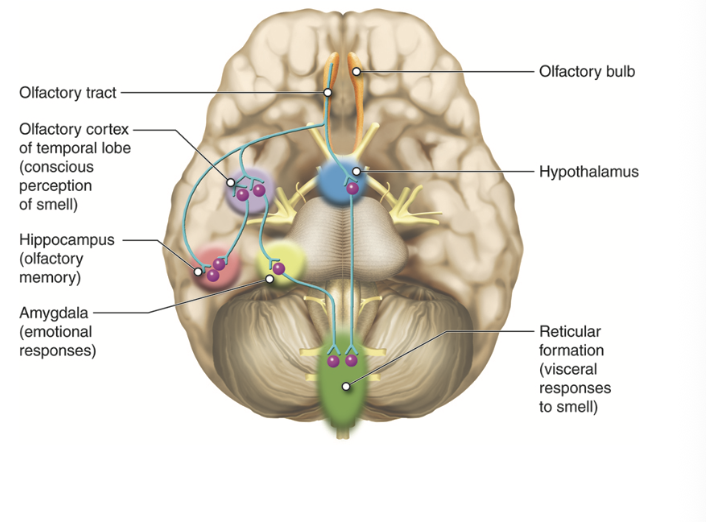
mitral cells are locared in the olfactory bulb in the brain whose axons transfer info to the areas in the brain including the piriform/primary olfactory cortex, the orbitofrontal cortex, and the amygdala
the olfactory system is the only human sense that bypasses the thalamus and connects directly to the forebrain
the amygdala is associated with emotions and plays a role in the emotional reactions that odors can elicit
how do taste and olfaction influence the perception of flavour? 1 pt
odorant molecules released by food in the oral cavity travel through the nasal pharynz to the olfactory mucosa in the nasal cavity resulting in the perception of the flavor of food (taste and smell)
five basic taste qualities? 5 pts
sweetness- associated with substances with nutritive value
bitterness-associated with potentially harmful subastances
saltiness- indicates the presence of sodium
sour
umami- described as a meaty, frothy, savory taste
receptors on the human tongue? 4 pts
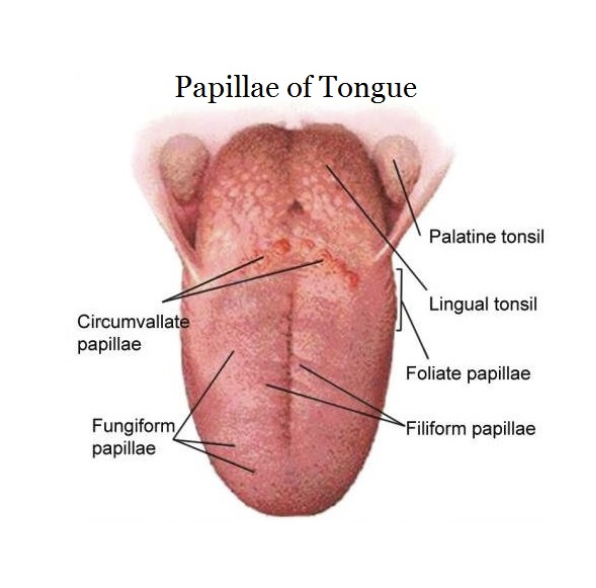
filiform- shaped like cones and are found over the entire surface of the tongue giving it its rough appearance
fungiform- shaped like mushrooms and are found around the tip and sides of the tongue
foliate- a series of folds along the bacl of the tongue on the sides
circumvallete- shaped like flat mounds surrounded by a trench and are found at the back of the tongue
how many taste buds are found on the tongue and where? 1 pt
there are about 10K tastebuds that each contain 50-100 taste cells that are found on all the papillae except the filiform meaning stimulation of the back or perimiter of the tongue rather than the central result in a broad range of taste sensations
what is transduction? 1 pt
occurs when chemicals contact receptor sites located on the tip of these taste cells resulting in the generation of electrical signals in the taste cells that are transmitted from the tongue in a number of different nerves
pathway from taste buds to the cortex? 4 pts
taste info will be transmitted to the nucleus of the solitary tract located in the medulla O via a 3 way or 3 cranial nerves (VII, IX, X)
facial nerve pathway (VII)- transmits info from the anterior part of the tongue
glossopharayngeal nerve pathways (IX)- transmits info from the back of the tongue
vagus nerve pathway (X)- transmits the info mrom the palate and the epiglottis
once this info reaches the nucleus of the solitary tract it projects to the posterior medial ventral nucleus (VMP) of the thalamus and from there the info will travel to the primary gustatory cortex located in the insulated and opercular frontal cortex
parts of the somatosensory system? 3 pts
cutaneous senses- responsible for the perceptions such as touch and pain that are caused by stimulation of the skin
proprioception- ability to sense the position of the body and limbs
kinaesthesia- ability to sense the movement of the body and limbs
types of stimuli: skin stimulations? 1 pt
external mechanical energy that in contact with the skin gives rise to sensations of touch (minimal force that generates a small distortion in skin), pressure, or vibration.
types of stimuli: proprioceptive and kinesthetic stimuli? 3 pts
internal mechanical energy that is generated by the position or movement of a part of the body
the position of the different parts of the body are indicated by the static force of joints, muscles, and tendons to maintain theis position against gravityy
the movement of a part of the body is indicated by dynamic changes in the force applied to muscles, tendons, and joints
types of stimuli: painful stimuli? 1 pt
internal or external mechanical energy that gets harmful to the tissue and can be triggered by the sensation of contact with a painful stimulus or as a result of inflammation of a tissue
what is skin? 5 pts
a sensory organ that serves a protective function and prevents the evaporation of organic fluids and is composed of two layers:
epidermis- surface epithelium of the skin overlying the dermis consisting of a layer of tough dead skin cells
dermis- thick layer of living tissue below the epidermis which forms the trus skin containing blood capillaries. nerve endings. sweat glands, hair follicles, and other structures
hypodermis- not considered a part of the skin and is the deepest later formed by connective tissue attached to the dermis and fat cells
mechanoreceptors that respond to mechanical stimulation are found in the epidermis and the dermis layers of the skin
types of touch receptors: mechanoreceptors? 3 pts
receptors sensitive to mechanical deformations of the skin (flexion, pressure, stretching) and to the temporal dimensions of these transformations
consists of the Meissner and Pacini corpuscles, Ruffini cylinders, Merkel receptors, and hair follicle receptors
they have different locations, receptive fields, and response times
types of touch receptors: nociceptors? 3 pts
free nerve endings located just below the epidermis
spread all over the body except in the brain
respond when damage (excessive pressure, excessive heat/cold, harmful chemicals) occurs in the tissues they are inserted in
types of touch receptors: thermoreceptors? 4 pts
free nerve endings near the epidermis
sensitive to temperature exchanges between the body and the outside
detect sudden changes and adapt over time
divided into heat detectors (30-45 degrees and above 45 degrees) and cold detectors (10-35 degrees)
types of touch receptors: proprioceptors? 3 pts
respond to changes produced by body movement
inform about the internal environment; the relative position of the differnt parts of the body and its movements
located in the muscles, tendons, and ligaments to respond to mechanical deformations of these tissues
mechanoreceptors: merkel receptor and meissner corpuscle? 2 pts
located close to the surface of the skin near the epidermis and respond to a pressure stimulus that is presented and then removed
merkel receptor- fires continously as long as the stimulus is on; senses fine detials (touch-mild pressure)
meissner corpuscle- fires only when the stimulus is first applied and when it is removed; senses controlling handgrip (touch-pressure)
mechanoreceptors: ruffini cylinder and pacinian corpuscle? 2 pts
located deeper in the skin and respond to pressure stimulus that is presented then removed
ruffini cylinder- responts continously to stimulation; senses stretching of the skin (touch-pressure-heat-pain)
pacinian corpuscle- responds when the stimulus is applied and removed; senses rapid vibrations and fine texture (touch-pressure-vibrations)
where are the bulbs of Krause (mechanoreceptors) located? 1 pt
between the skin and the mucous membrane
which receptors adapt quickly over time? 1 pt
meissner receptors and pacinian corpuscles react only to changes
which receptors adapt slowly over time? 1 pt
merkel receptors and ruffini cylinders fire APs as long as the stimulus continues
pathways from skin to cortex? 3 pts
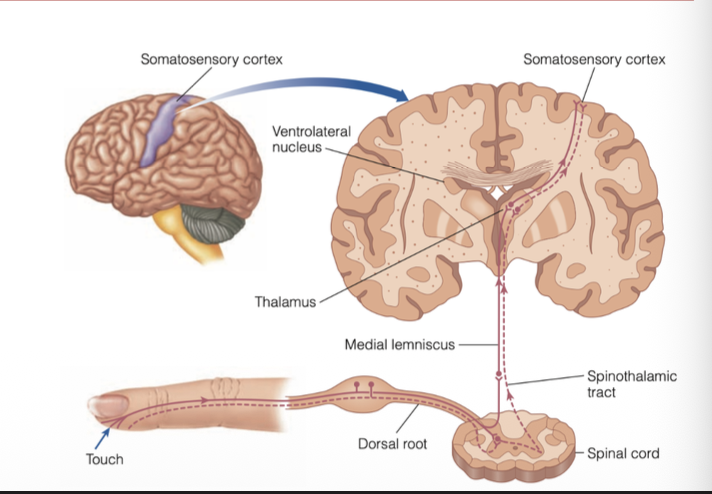
nerve fibers from receptors in the skin travel in bundles(prepheral nerves) that enter the spinal cord through the dorsal root
medial lemniscal pathway- has large fibers that carry signals related to sensing the positions of the limbs and perceiving touch
spinothalamic pathway- smaller fibers that transmit signals related to temperature and pain
fibers from both pathways cross ober to the other side of the body during their upward journey to the thalamus
must of these fibers synapse in the ventrolateral nucleus in the thalamus but some synapse in the other thalamic nuclei
because signals in the spinal cord cross over to the opposite side of the body on their way to the thalamus meaning signals originating from the left side of the body reach the thalamus in the right hemisphere of the brain and vice versa
maps of the body on the cortex? 3 pts
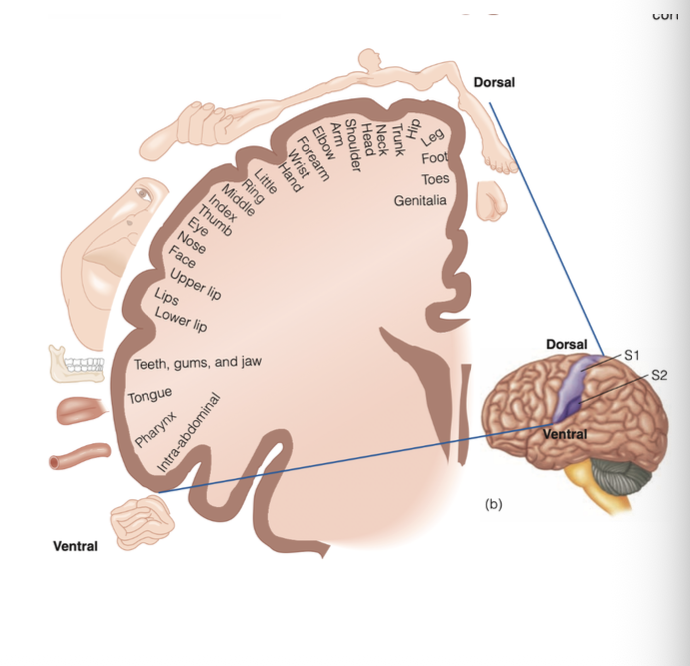
from the thalamus signals travel to the somatosensory receiving area (S1) in the parietal lobe of the cortex and possibly to the secondary somatosensory cortex (S2)
signals also travel between S1 and S2 and vice versa to additional somatosensory areas
the homunculus shows that some areas of the brain are represented by a disproportionately large area of the brain
sensory homunculus on the somatosensory cortex? 1 pt
parts of the body with the highest tactile acuity area represented by larger areas on the cortex
the somatosnesory cortex in the parietal lobe? 2 pts
S1 primary somatosensory area receives inputs from the ventrolateral nucleus of the thalamus
S2 secondary somatosensory area partially hidden behind the temporal lobe
what is experience dependent plasticity? 1 pt
when the cortical representation of a particular function becomes larger when that function is used often
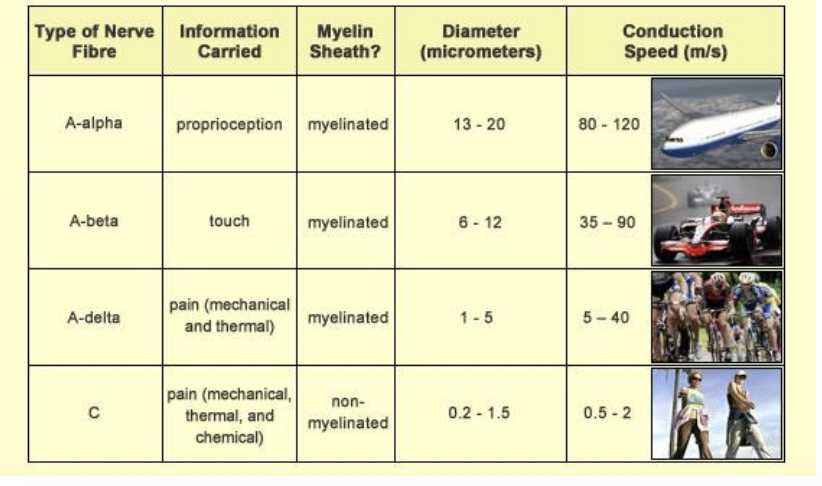
types of nerve fibers? 5 pts
A-fibers are large and myelinated so their conduction velocity is greater (spinal nerves)
A-alpha fibers- proprioceptive info
A-beta axons- touch sensations are transmitted
A-delta fibers - mechanical and thermal pain info
C-fibers are small and unmyelinated so they have a lower conduction velocity (50% of sensory fibers)
C fibers- mechanical, thermal, and chemical pain
three types of pain? 3 pts
nociceptive pain- caused by the activation of nocicpetors in the skin that respond to different stimuli (heat, chemical, severe pressure, cold)
inflammatory pain- caused by damage to tissues and inflammation to joints or by tumor cells
neuropathic pain- cuased by lesions or other damage to the nervous system e.g. capral tunnel syndrome caused by repetitive tasks, spinal cord injury, brain damage
what is the direct pathway model of pain? 1 pt
this theory states that pain is caused by signals sent directly from the skin to the brain; when pain occurs nocicpetors are sitmulated and send their signals to the brain
how does phantom limb pain occur? 1 pt
cutting nerves that used to transmit signals form the limb to the brain has been found not to eliminate pain meaning pain originates in the pain since signals are send from the remaining amputation/limb
two things that can affect pain? 2 pts
a person’s mental state
a person’s attention
gate model model? 5 pts
pain signals enter the spinal cord from the body and are then transmitted from the spinal cord to the brain
proposes that there are additional pathways that influence the signals sent from the spinal cord to the brain
signals from these additional pathways can act to open or close a gate located on the spinal cord that determines the strength of the signal leaving the spinal cord
this system consists of cells in the spinal cord called the substantia gelatinosa that are activated when pressure is applied to the area that hurts
input along the gate control system occurs along the S-fibers, L-fibers, and central control fibers
S-fibers? 4 pts
small diameter fibers associated with nociceptors
activity in S-fibers increase the activity of the transmission cel/T-cell
intensity of pain is determined by the amount of T-cell activity; more activity more pain
signals from S-fibers always excite T-cells and therefore increase pain
L-fibers? 4 pts
larger in diameter and carry info about non-painful tactile stimulation e.g. signals from rubbing the skim
activity in L-fibers can send inhibition to the T-cells
signals that pass through SG activate an inhibitory synapse
this closes the gate decreasing T-cell acitivty and subsequently decreases pain
central-control? 2 pts
contain info related to cognitive functions e.g. expectation, attention, distraction
as with L-fibers activity coming down from the brain also closes the gate and decreases T-cell activity and decreases pain
what determines the perception of pain? 1 pt
a balance between the input from the nociceptors in the skin and nociceptive activity from the skin and the brain
who proposed the gate control theory and why? 2 pts
melzack and wall (1965)
to describe a process of inhibitory pain modulation at the spinal cord level