05 - Iron-carbon phase diagram
 Call Kai
 Learn
Learn Practice Test
 Spaced Repetition
 Match
Match Flashcards
 Knowt Play
1/15

There's no tags or description
Looks like no tags are added yet.
Name | Mastery | Learn | Test | Matching | Spaced | Call with Kai |
|---|
No analytics yet
Send a link to your students to track their progress
16 Terms
What are ferrous metals?
Metals that contain iron as the main component
What happens when iron cools down from the liquid state?
How is this phenomenon called?
How is the iron qualified then?
Its crystal structure changes as it cools:
1536 - 1392°C:
delta → gamma (austenite)
BCC → FCC
1392 - 912°C:
gamma → alpha (ferrite)
FCC → BCC
→ allotropic transformation
→ polymorphous metal
What’s the polymorphism?
Ability of a solid material to exist in more that one crystal structure under different conditions
What does “allotropic” mean?
Transition of a material from one crystal structure to another at a given temperature
What can we say about pure iron?
It doesn’t exist in real world
What are the 2 main types of iron-carbon alloys called?
What’s their respective carbon concentration (& other main elements if specified)?
steel → carbon content < 2.06% by mass
Cast iron → carbon content > 2%, silicon content > 1.5%
What’s the difference between a metastable system and a stable system?
metastable system
→ not at the most stable thermodynamic state (not the lowest energy), but stable enough to stay so → it “wants” to transform into a more stable system but does it extremely slowly
stable system
→ is at its lowest energy state → doesn’t change over time unless extreme conditions changes
In iron-carbon alloy, which type of system is the most important and thus, represented in the phase diagram?
What’s actually the phase diagram represented then?
The metastable system
→ iron-cementite phase diagram (Fe-Fe3C)
Why does the iron-carbon diagram only goes up to 6.67% of carbon content?
Because above this carbon content, graphite forms and not cementite anymore
What’s a eutectic reaction?
Reaction where a liquid turns into 2 different solids (simultaneously)
L → S1 + S2
What’s a eutectoid reaction?
Reaction where a solid turns into 2 different solids
S1 → S2 + S3
What’s a peritectic reaction?
Reaction where a liquid and a solid turns into a single solid
L + S1 → S2
What’s a peritectoid reaction?
Reaction where 2 solids turn into a third different solid
S1 + S2 → S3
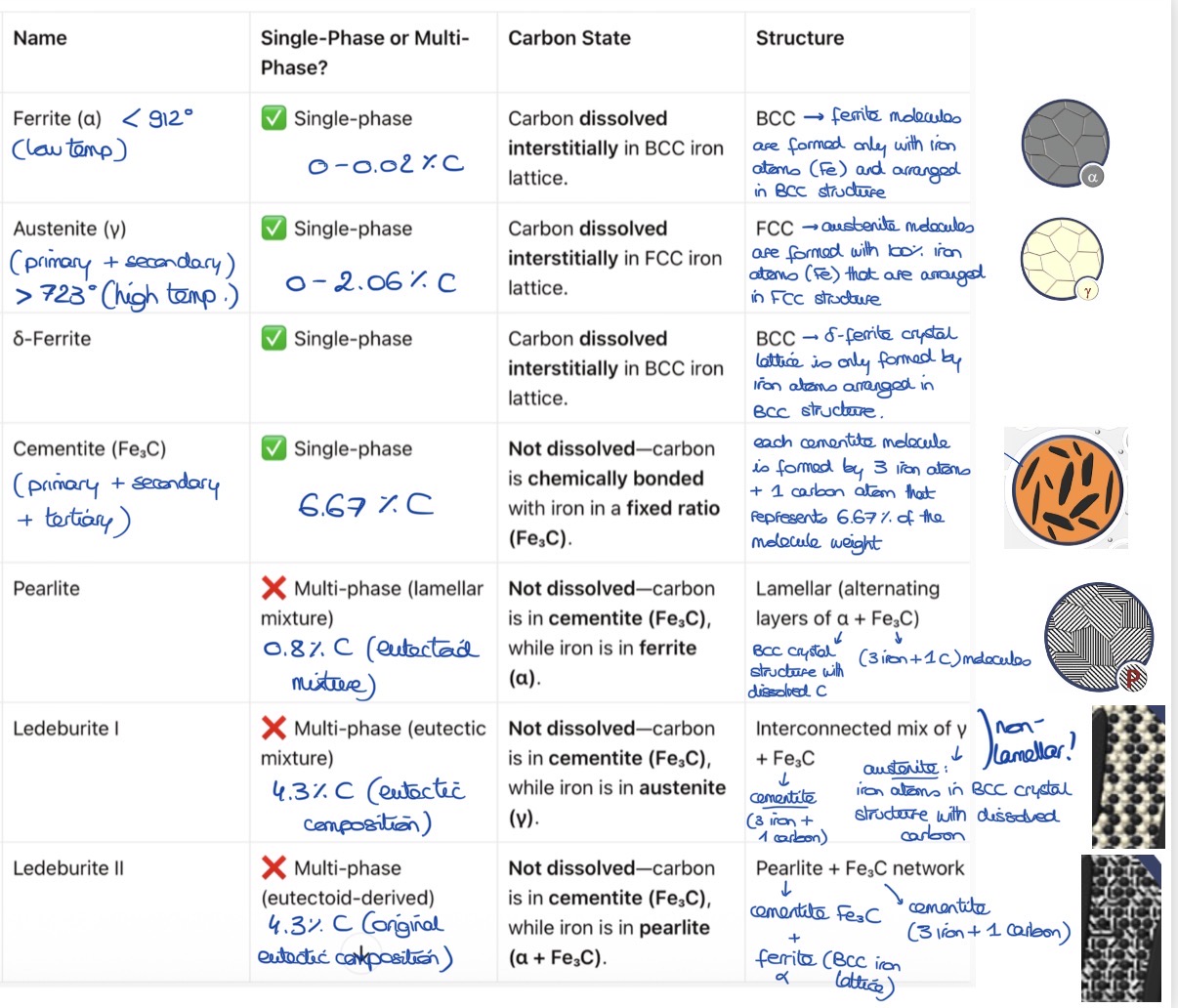
List all solid phases that arise in the iron-carbon phase diagram.
Indicate if they’re single- or multi-phase.
Indicate the carbon state (behavior of carbon atoms in respect to iron atoms)
Indicate their structure and draw it for a sample of each.
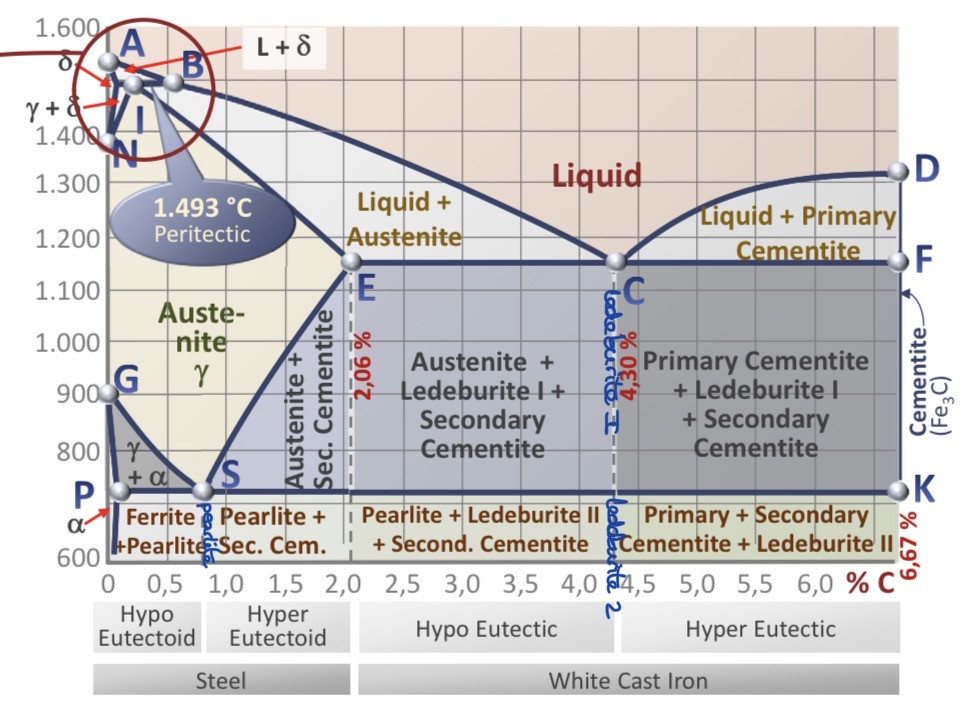
Draw the iron-carbon phase diagram including:
regions with names
lines with names and meaning
key points of specific transformations
key temperatures
key concentrations of C
type of the material according to the overall composition
Explain the iron-carbon phase diagram and draw what each region looks like
Hint: start with 2.06 < C <= 4.3, then 4.3 < C < 6.67, and 0 < C < 2.06
liquid: homogeneous phase
liquid + austenite (gamma):
→ Solid austenite crystal grains with low carbon content begin to form in the liquid.
→ The crystals grow as temperature decreases
→ The remaining liquid becomes richer in carbon
eutectic composition (4.3% C): Eutectic reaction
→ iron & carbon from the remaining liquid solidify simultaneously into austenite (gamma) + cementite (Fe3C) forming ledeburite I (NOT LAYERED)
(Primary) Austenite + ledeburite I + secondary cementite
→ ledeburite I comes from the eutectic reaction of the remaining liquid (of liquid + austenite)
→ (primary) austenite crystals formed earlier in liquid + austenite
→ primary austenite + austenite from ledeburite I reject carbon (see solubility line of gamma) → the excess of carbon forms secondary cementite segregated at grain boundaries
pearlite + ledeburite II + secondary cementite: eutectoid reaction
→ secondary cementite segregated at grain boundaries that formed earlier with the excess of C that no longer solved in austenite (no more secondary cementite forms after the eutectoid reaction)
→ remaining primary austenite (low carbon content = 0.8% because solubility has decreased earlier and C precipitated out) forms pearlite (alpha ferrite + cementite)
→ austenite from ledeburite I also transforms into pearlite and combined with remaining cementite from ledeburite I, forms ledeburite II
liquid + primary cementite
→ solid cementite crystal grains begin to form in the liquid
→ the crystals grow as temperature decreases
→ the remaining liquid becomes richer in carbon
Eutectic composition (4.3% C): eutectic reaction
→ iron & carbon from the remaining liquid solidify simultaneously into austenite & cementite, forming ledeburite I (NOT layered)
Primary cementite + ledeburite I + secondary cementite
→ primary cementite formed earlier in liquid + cementite
→ ledeburite I formed earlier during the eutectic reaction of the remaining liquid
→ austenite from ledeburite I rejects carbon as the temperature and the solubility limit decrease → excess of C forms secondary cementite Fe3C segregated at primary cementite grains boundaries (not visible in microstructure)
Primary cementite + ledeburite II
→ austenite from ledeburite I transforms into pearlite and combined with remaining cementite from ledeburite I, forms ledeburite II
→ primary cementite crystals formed earlier in liquid + cementite
“STEEL CORNER”
ferrite alpha → BCC
Ferrite alpha + TC (tertiary cementite)
→ as temperature decreases, solubility of C in ferrite decreases → the excess of carbon forms tertiary cementite segregated at ferrite grains boundaries
Austenite gamma → BCC
Ferrite + austenite (alpha+gamma)
→ reaching such a low temperature, austenite starts to become unstable and wants to transform into a more stable structure → austenite begins to transform into ferrite
→ as ferrite has a very low carbon solubility while austenite has a high one, as ferrite grows, it rejects carbon into the remaining austenite
→ austenite thus becomes richer in carbon
Eutectoid composition (0.8%C)
→ remaining austenite from previously reaches the eutectoid composition and undergoes eutectoid reaction → becomes pearlite
Ferrite + pearlite
→ ferrite that formed earlier from austenite becoming unstable
→ pearlite that formed from the eutectoid reaction of the remaining austenite
Austenite + secondary cementite
→ as temperature decreases, the solubility of C in austenite also decreases → the excess of carbon forms secondary cementite segregated at Austenite grains boundaries
→ primary austenite grains from earlier
Pearlite + secondary cementite
→ remaining austenite (from the primary grains) becomes too unstable to keep its structure → undergoes eutectoid reaction → transforms into pearlite
→ secondary cementite formed earlier at austenite grains boundaries (now at pearlite grains boundaries)