StemUp: AQA A level Physics 3.2.2 Electromagnetic radiation and quantum phenomena
 Call Kai
 Learn
Learn Practice Test
 Spaced Repetition
 Match
Match Flashcards
 Knowt Play
1/52

There's no tags or description
Looks like no tags are added yet.
Name | Mastery | Learn | Test | Matching | Spaced | Call with Kai |
|---|
No analytics yet
Send a link to your students to track their progress
53 Terms
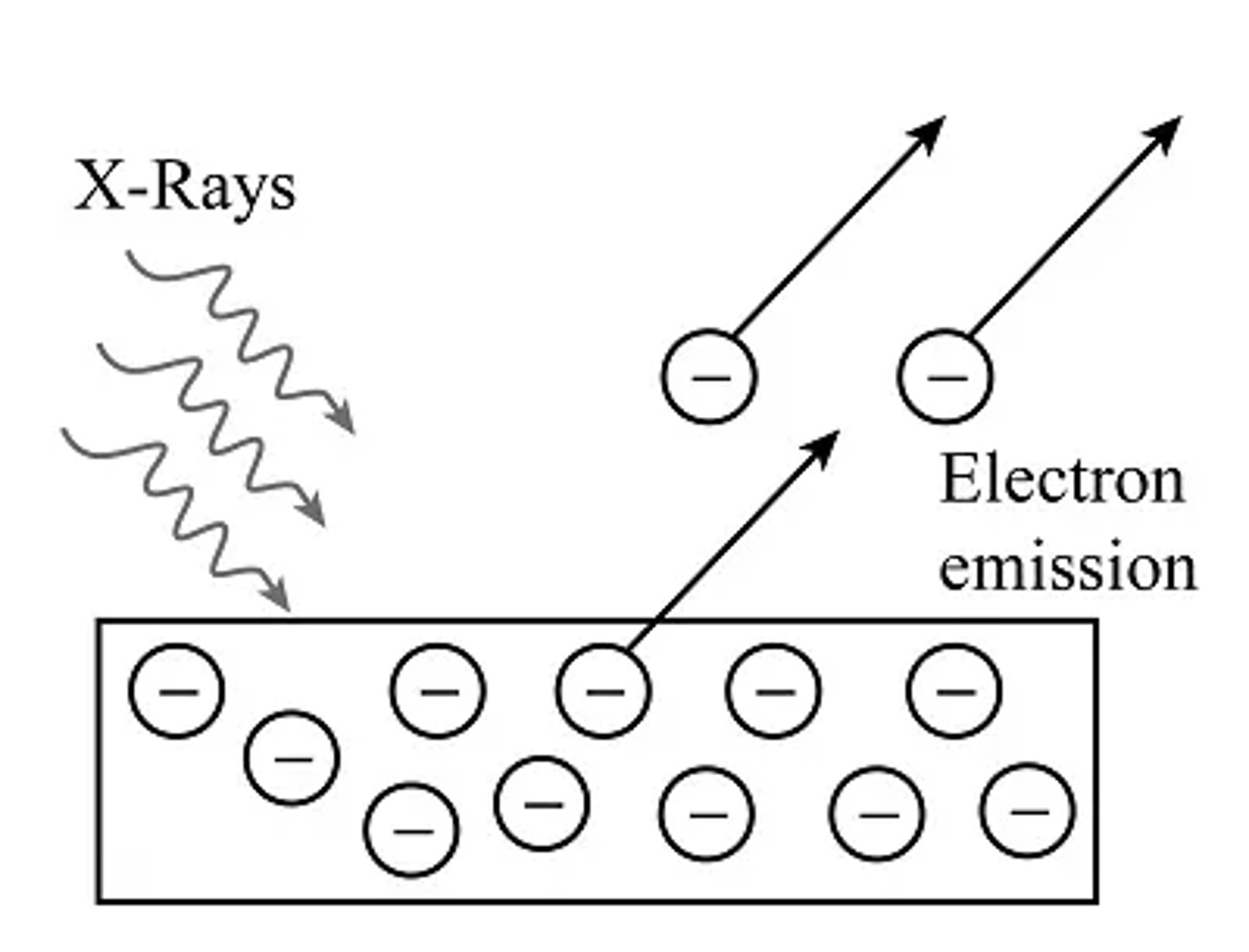
What is the photoelectric effect? (2)
- It is the emission of photoelectrons from a metal surface
- When light of a sufficiently high frequency is incident on it.
What does the photoelectric effect look like? (2)
What is the threshold frequency in the photoelectric effect? (2)
- It is the minimum frequency of light required to emit electrons
- It varies between metals.
What is the equation for the threshold frequency? (2)
- The equation for threshold frequency is f = Φ/h
- Where Φ is the work function of the metal (J) and h is Planck's constant = 6.63 × 10⁻³⁴ Js.
What condition must be met for photoemission to occur? (1)
The energy of an individual photon must be equal to or greater than the metal's work function.
How does wave theory fail to explain the photoelectric effect? (4)
- Any frequency of light should cause photoelectric emission over time but this does not happen
- Electrons are emitted instantly, not the case with wave theory
- The intensity of light only affects the number of electrons emitted but not the energy contradicting wave theory
- Wave theory predicts uniform energy transfer, but photoelectrons have a range of kinetic energies.
What does the photon model say about electromagnetic waves? (1)
They are made up of discrete packets of energy called photons.
How does a photon interact with an electron in the photoelectric effect? (1)
Each electron absorbs a single photon which may provide enough energy to escape the metal.
What is the equation for the energy of a photon? (2)
- Photons have an energy E = hf = hc / λ
- Where E is energy (J), h is Planck's constant = 6.63 × 10⁻³⁴ Js, f is frequency (Hz), c is the speed of light (ms⁻¹) and λ is wavelength (m).
How does light intensity affect the photoelectric effect? (2)
- Increasing intensity increases the number of photons and thus the number of
photoelectrons emitted
- But not their energy.
What is the work function (Φ) in the photoelectric effect? (1)
It is the minimum energy required to release an electron from the metal surface.
What is the stopping potential (Vₛ)? (1)
- It is the potential difference needed to stop photoelectrons with maximum kinetic energy from reaching the collector
- It is the work done to stop all the electrons.
What is the equation for the maximum kinetic energy of a photoelectron? (2)
- Eₖ(max) = eVₛ
- Where Eₖ(max) is maximum kinetic energy (J), e is electron charge (1.6 × 10⁻¹⁹ C), and Vₛ is stopping potential (V).
What is the photoelectric equation? (2)
- E = hf = Φ + Eₖ(max)
- Where E is photon energy (J), h = 6.63 × 10⁻³⁴ Js, f is light frequency (Hz), Φ is work function (J), and Eₖ(max) is max kinetic energy (J).
What is excitation in atomic electrons? (2)
- Excitation occurs when an electron gains energy
- And moves to a higher energy level in the atom
- This only occurs if electrons absorb a photon with the exact same energy as the difference between the energy levels in the atom.
What is ionisation in atomic electrons? (1)
Ionisation occurs when an electron gains enough energy to leave the atom completely.
What condition must be met for ionisation to occur? (1)
The incoming electron's energy must be greater than the ionisation energy of the atom.
What happens when an excited electron returns to a lower energy level? (1)
It emits a photon equal in energy to the difference between the two levels.
How can energy levels be negative in atoms? (1)
To remove an electron for ionisation energy has to be supplied so energy levels can be written as negative.
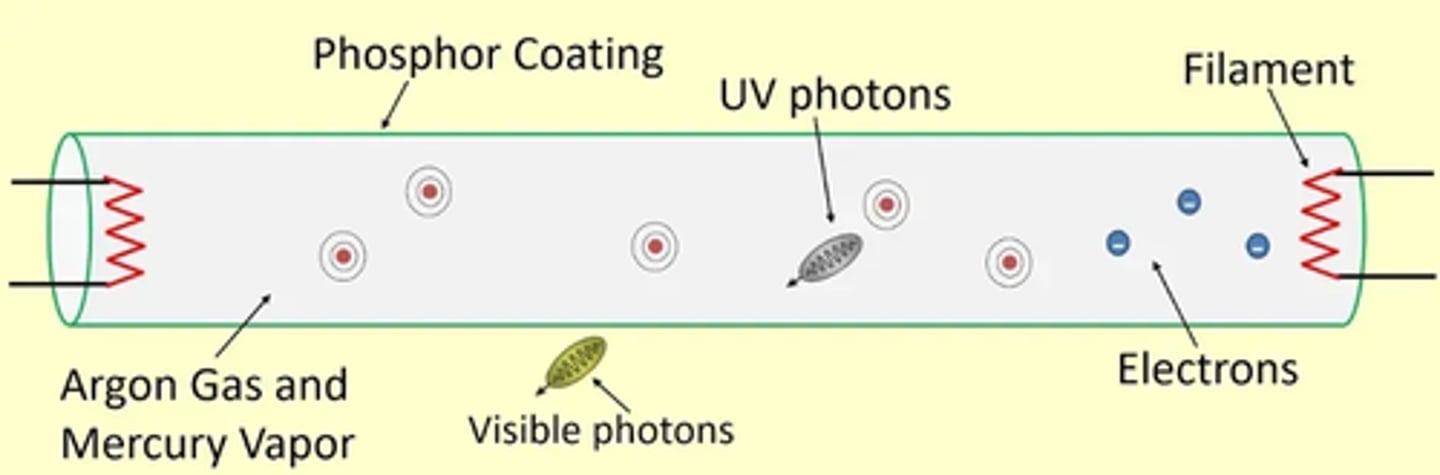
How does a fluorescent tube use excitation to produce visible light? (3)
- A high voltage accelerates free electrons through mercury vapour
- Exciting or ionising mercury atoms
- Which emit visible light when they de-excite.
What do excited mercury atoms emit when they de-excite? (1)
They emit ultraviolet (UV) photons.
What happens when UV photons are absorbed by the fluorescent coating? (1)
The coating emits visible light as its atoms become excited and then de-excite.
What does a fluorescent tube look like? (3)
What is an electron volt (eV)? (1)
It is the energy gained by one electron when it passes through a potential difference of 1 volt.
Why is energy often measured in electron volts instead of joules? (1)
Because atomic energy differences are very small and more convenient to express in eV.
What is the conversion factor between electron volts and joules? (1)
1 eV = 1.6 × 10⁻¹⁹ J.
How do you convert energy from eV to joules? (1)
Multiply the value in eV by 1.6 × 10⁻¹⁹.
How do you convert energy from joules to eV? (1)
Divide the value in joules by 1.6 × 10⁻¹⁹.
How is a line spectrum produced? (1)
It is produced when light from a fluorescent tube passes through a diffraction grating or prism.
What does each line in a line spectrum represent? (1)
A photon of a specific wavelength emitted when an excited electron drops to a lower energy level.
What does the presence of discrete wavelengths in a line spectrum show? (1)
That electrons can only transition between discrete energy levels.
How is a line absorption spectrum formed? (2)
- By passing white light through a cooled gas
- Where atoms absorb specific wavelengths.
What does a line absorption spectrum look like? (2)

What is a continuous spectrum? (1)
These are spectrums of full colour with no gaps.
What can emit a continuous spectrum? (2)
- The spectrum of white light is continuous
- Hot things emit a continuous spectrum.
Why are all wavelengths allowed in a continuous spectrum? (1)
Electrons are not bound to energy levels so all wavelengths are allowed.
What does a continuous spectrum look like? (2)
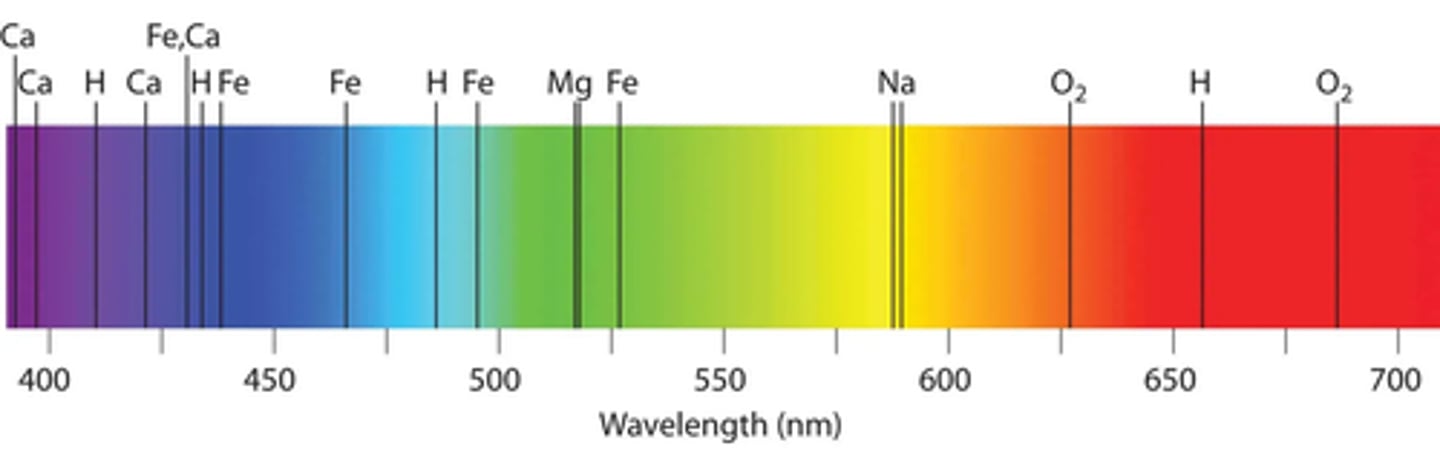
What do the black lines in an absorption spectrum represent? (1)
They correspond to photon energies equal to the energy difference between electron energy levels.
What is the equation linking photon energy to energy levels? (2)
- hf = E₁ − E₂
- Where h is Planck's constant (6.63 × 10⁻³⁴ Js), f is photon frequency (Hz), E₁ and E₂ are the higher and lower energy levels (J).
What does wave-particle duality mean in the context of light? (1)
Light shows both wave-like and particle-like properties.
What are examples of light's wave and particle behaviours? (2)
- Diffraction and interference show wave properties
- The photoelectric effect shows particle behaviour.
How is the wave nature of electrons demonstrated? (1)
Through electron diffraction.
How was electron diffraction carried out experimentally? (2)
- A beam of electrons is accelerated using an electron gun through a vacuum gun towards a thin crystal lattice
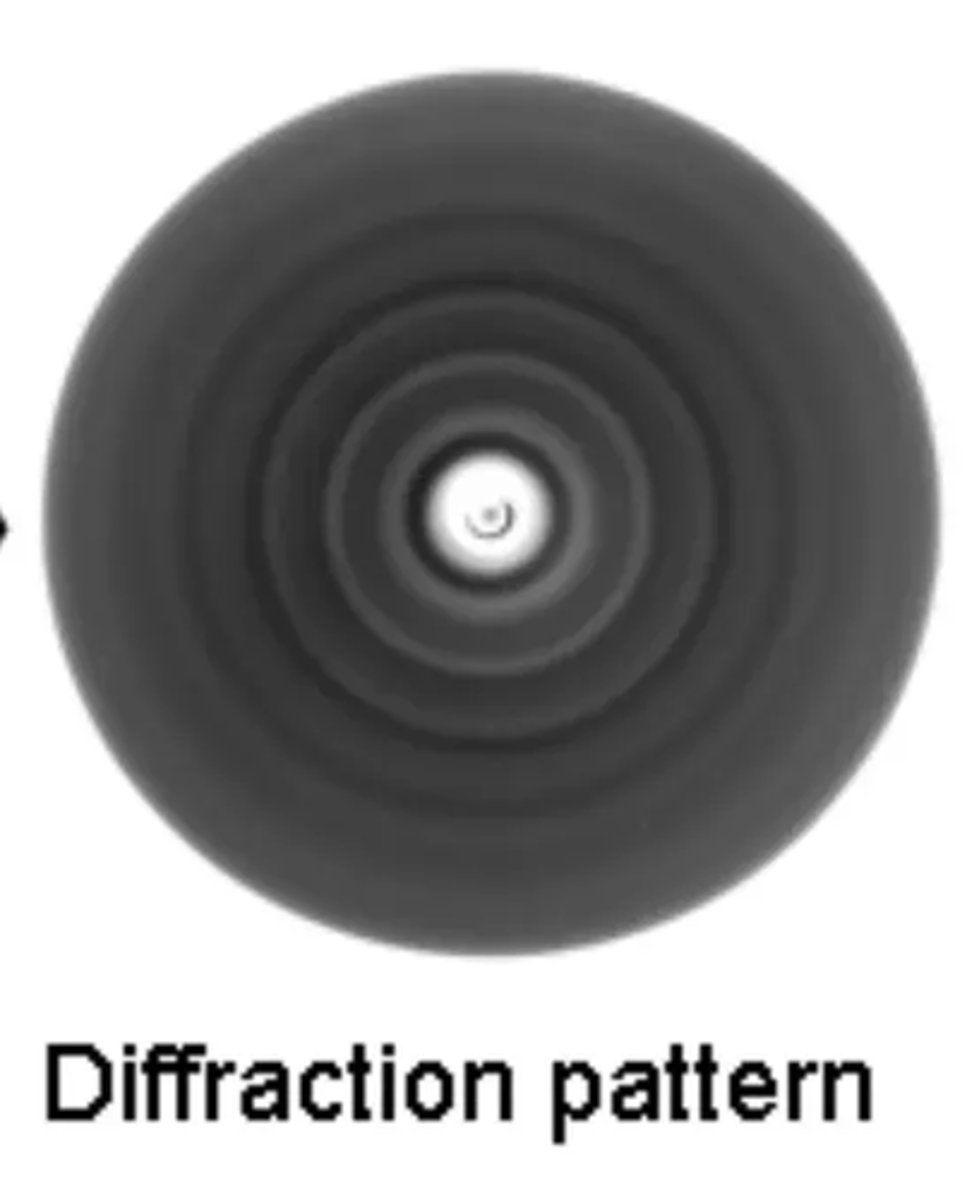
- Electrons interact between atoms in the crystal and form a circular diffraction pattern on the fluorescent screen behind it.
Why do bright rings appear on the diffraction pattern? (1)
This happens when waves interfere constructively.
Why do dark rings appear on the diffraction pattern? (1)
This happens when waves interfere destructively.
What does electron diffraction reveal about electrons? (1)
That they produce an interference pattern, which is a property of waves.
What does the electron diffraction pattern look like? (2)
What is the de Broglie equation? (2)
- λ = h / mv
- Where λ is wavelength (m), h = 6.63 × 10⁻³⁴ Js, m is mass (kg), v is velocity (ms⁻¹).
What happens to the electron diffraction pattern when momentum increases? (1)
The wavelength decreases and the rings move closer together.
What happens to the diffraction pattern when momentum decreases? (1)
The wavelength increases and the rings spread further apart.
When do particles show wave-like behaviour? (1)
Diffraction only occurs if objects have a similar size to their de Broglie wavelength.
How do scientific ideas like wave-particle duality become accepted? (1)
Through experimental evidence and community review over time.
What must happen for a new scientific idea to be validated? (1)
The findings must be published and peer-reviewed.