Psychology VCE unit 3 and 4
 Studied by 0 people
 Call Kai
 Learn
Learn Practice Test
 Spaced Repetition
 Match
Match Flashcards
 Knowt Play
1/34

There's no tags or description
Looks like no tags are added yet.
Name | Mastery | Learn | Test | Matching | Spaced |
|---|
No study sessions yet.
35 Terms
Central Nervous System (CNS)
A major division of the nervous system comprising the brain and spinal cord, which receives neural messages from and transmits neural messages to the peripheral nervous system.
CNS - Brain
a complex structure that receives and processes sensory stimuli from the body and coordinates responses, including voluntary movements, emotions and conscious thought.
CNS - Spinal Cord
a dense bundle of nerves with two main roles; to carry sensory information from the body to the brain and to carry motor information from the brain to the body.
Peripheral nervous system
a major division of the nervous system comprising every neuron in the body outside the central nervous system.
It transmits neural messages between the central nervous system and the body.
is further divided into the somatic nervous system and the autonomic nervous system.
Peripheral nervous system - Somatic nervous system
Transmits motor messages from brain to skeletal muscles to control our voluntary movements. Transmits sensory messages from sensory organs to the brain.
Peripheral nervous system - Autonomic nervous system (ANS)
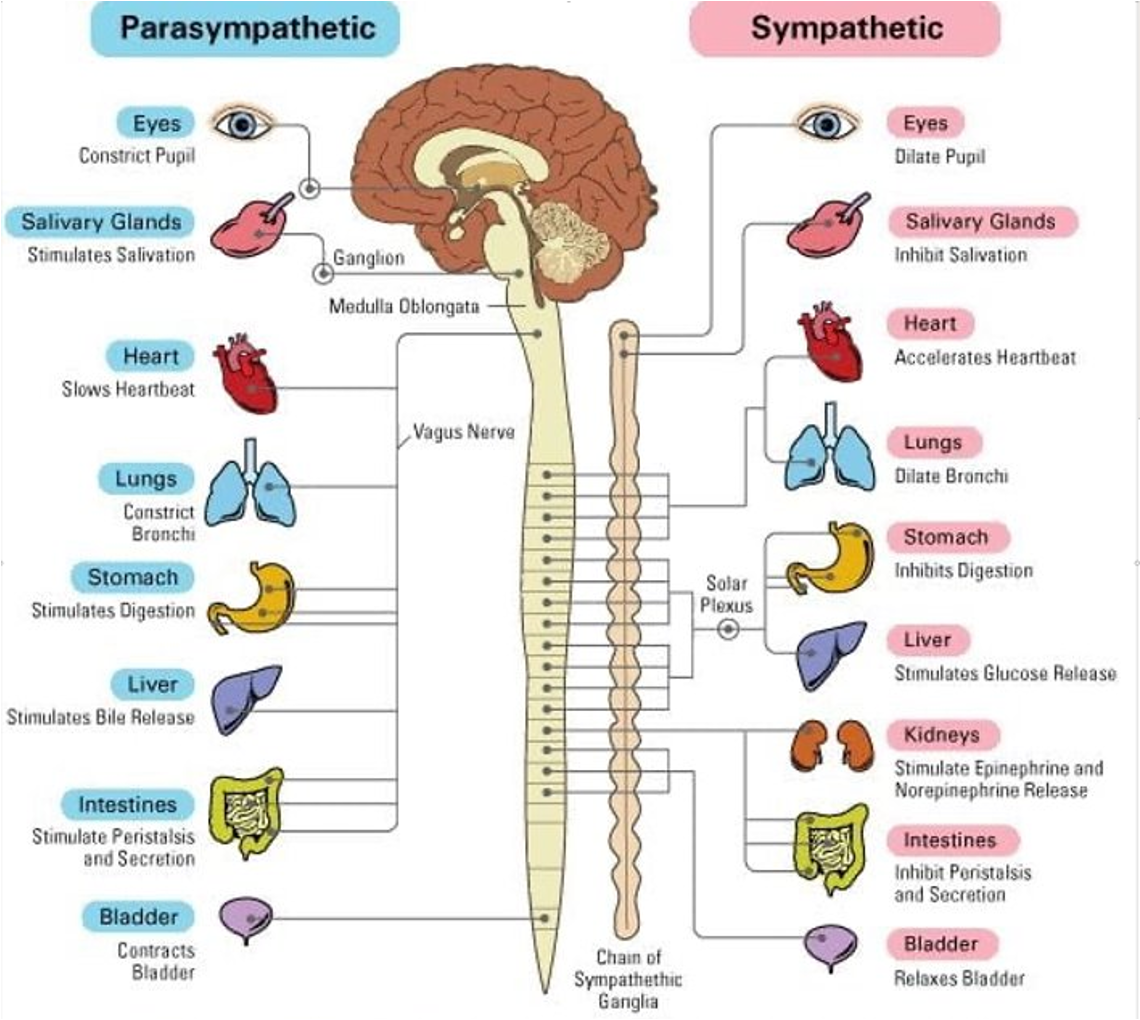
Regulates involuntary bodily processes of visceral muscles, organs and glands. subdivision of the peripheral nervous system that controls the body’s internal environment in an autonomous or self-regulated manner. It is directly connected to our organs, glands and visceral muscles (smooth, involuntary muscles in blood vessels), the stomach, digestive tract and other internal organs.
ANS - Sympathetic nervous system
activities visceral muscles, organs, and glands, preparing the body to respond to a threat or stressor.
which dominates when we are under threat, increasing our arousal and preparing us to deal with the situation.

ANS - Parasympathetic nervous system
Maintains homeostasis and the balanced functioning of visceral muscles, organs, and glands.
which dominates during normal day-to-day activities when we are relatively calm (for example, regulating body temperature to around 37.5°C, maintaining a resting heart rate, etc.). It also returns the body to a calm state after a threatening or stressful situation.
Conscious response
A deliberate and voluntary action that is initiated by the brain and performed intentionally by the brain.
Requires attention to be paid to the stimulus, tends to vary, mostly uses the somatic nervous system, can be learnt, goal-directed, and can be complex or simple responses.
Examples are putting on a jumper when you feel cold, texting on your phone to reply to a friend, etc.
Unconscious response
An automatic and involuntary action that is performed by the brain independently of the brain.
First occur without learning, usually simple responses, mostly uses the autonomic nervous system, tend to occur in the same way each time, does not require attention for it to occur, and purpose is to increase chances of survival.
Examples are pupil size changing in response to light, pulling hand away from a hot pan, ect.
Spinal reflex
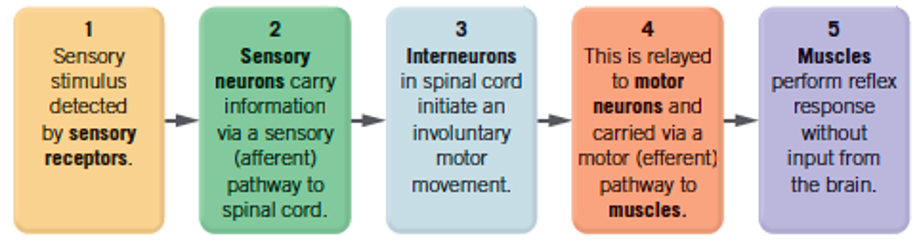
An involuntary, automatic response to sensory stimuli, controlled by the spinal cord without the involvement of the brain. A message is sent from the sense organ and the spinal cord responds directly before the message arrives at the brain. This enables the organism to respond more quickly than if a neural impulse was needed reach to the brain (like with a somatic NS response). In this way, it takes less time to respond and contributes to safety and survival. The brain receives the information once the reflex action has occurred.
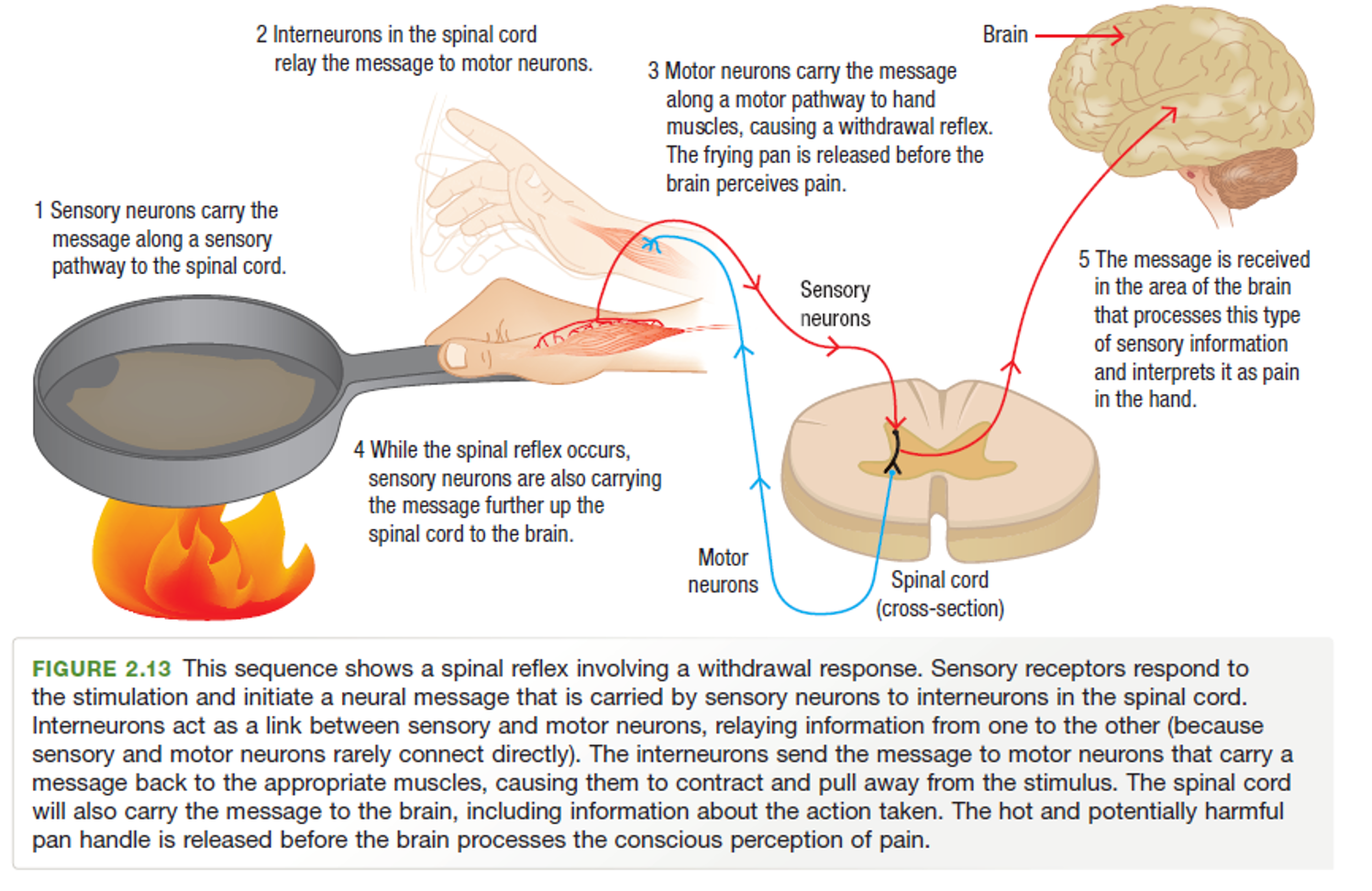

Spinal reflex process
It involves a series of steps that involve sensory receptors, sensory neurons (both within our peripheral nervous system), interneurons (within our CNS) as well as motor neurons and muscles (also within our peripheral nervous system).
Neuron
nerve cell, the basic building block of our nervous system. It receives and transmits information throughout our nervous system.
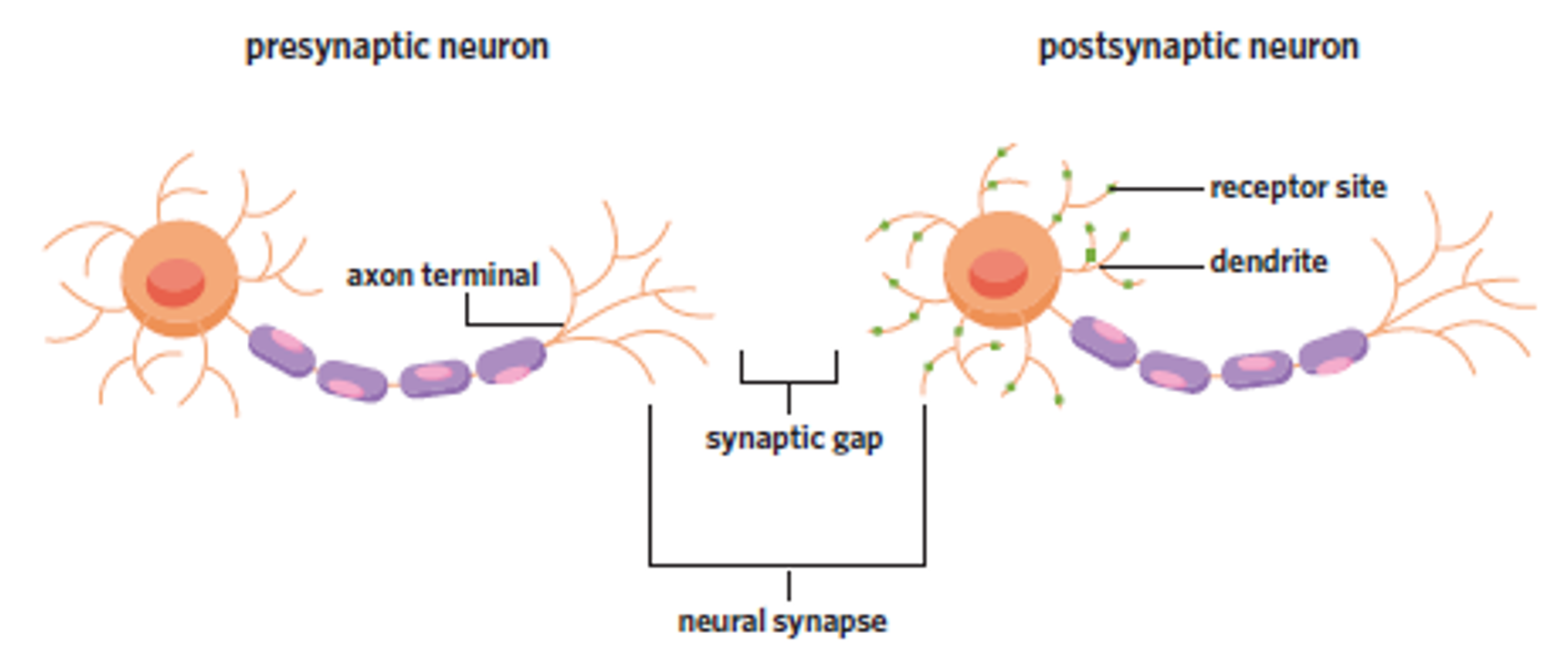
Neural synapse
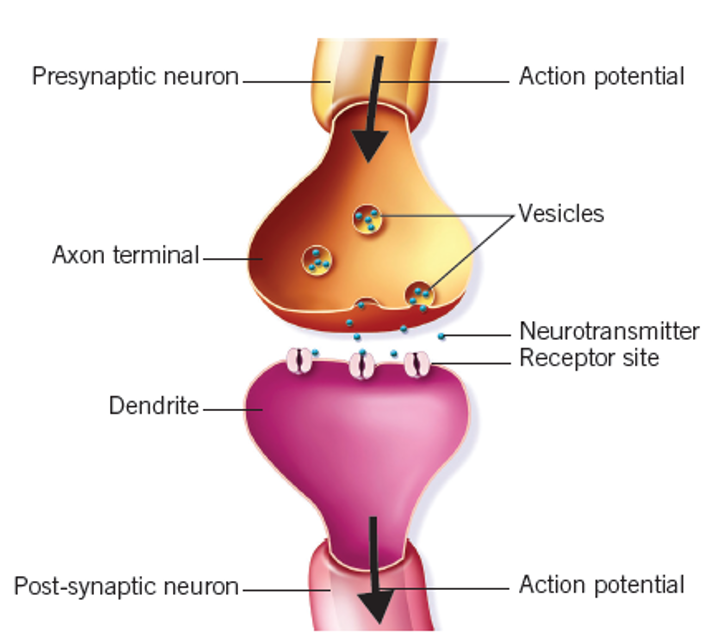
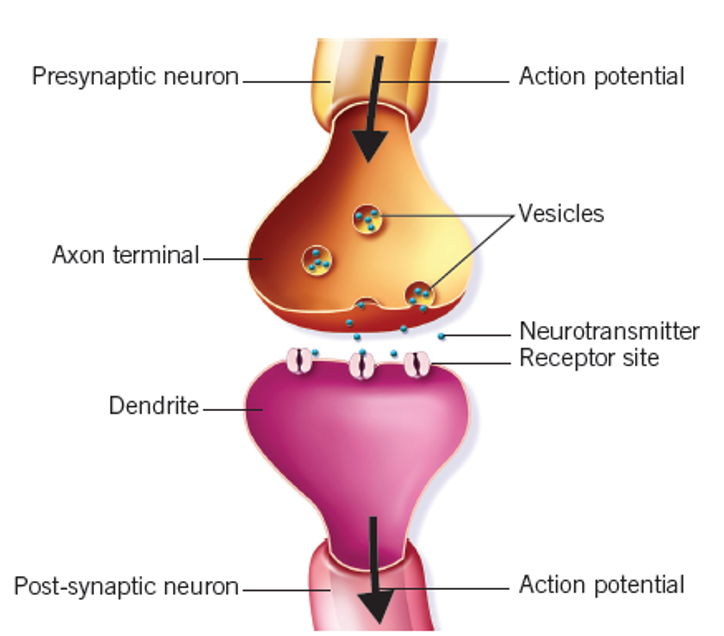
the site where communication typically occurs between adjacent neurons (comprising of terminal buttons, synaptic gap and dendrites).
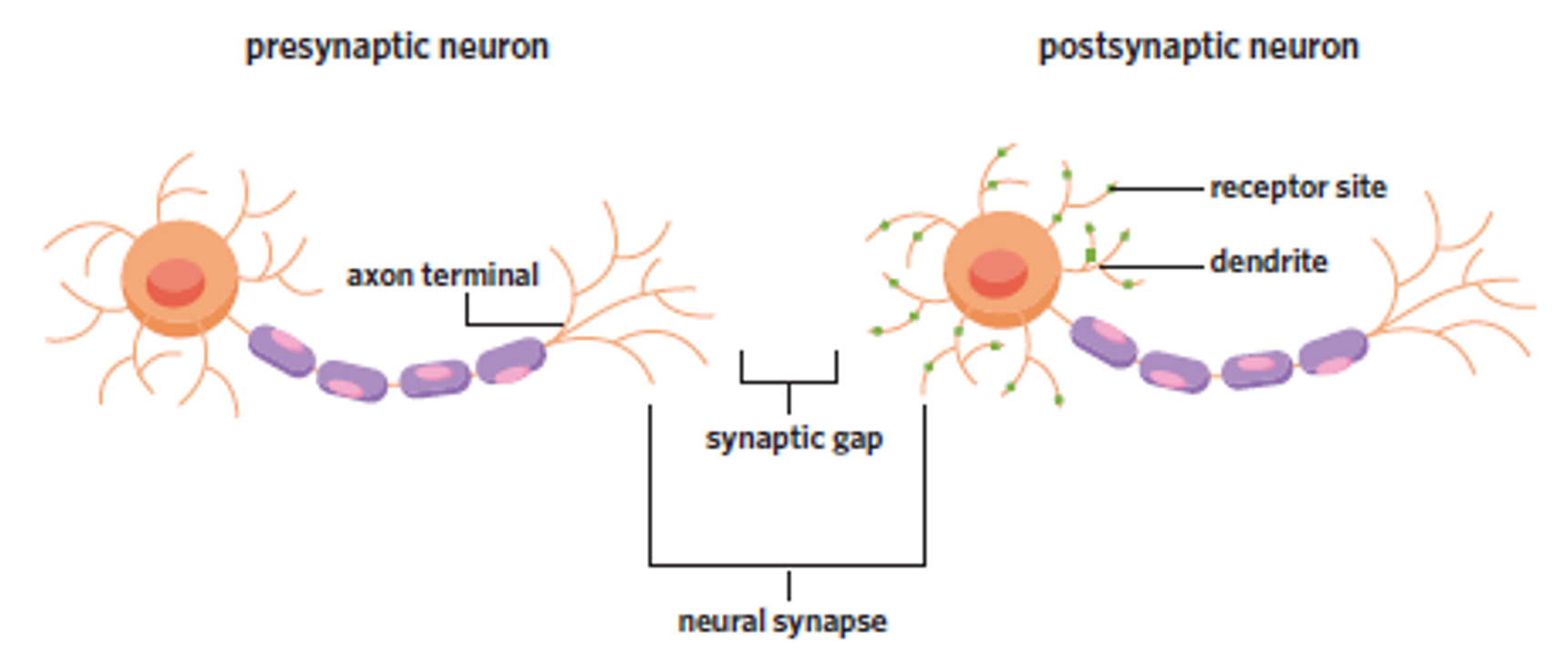
Neurotransmitters
are chemicals produced by neurons that carry messages to other neurons or cells within the nervous system across a synapse.
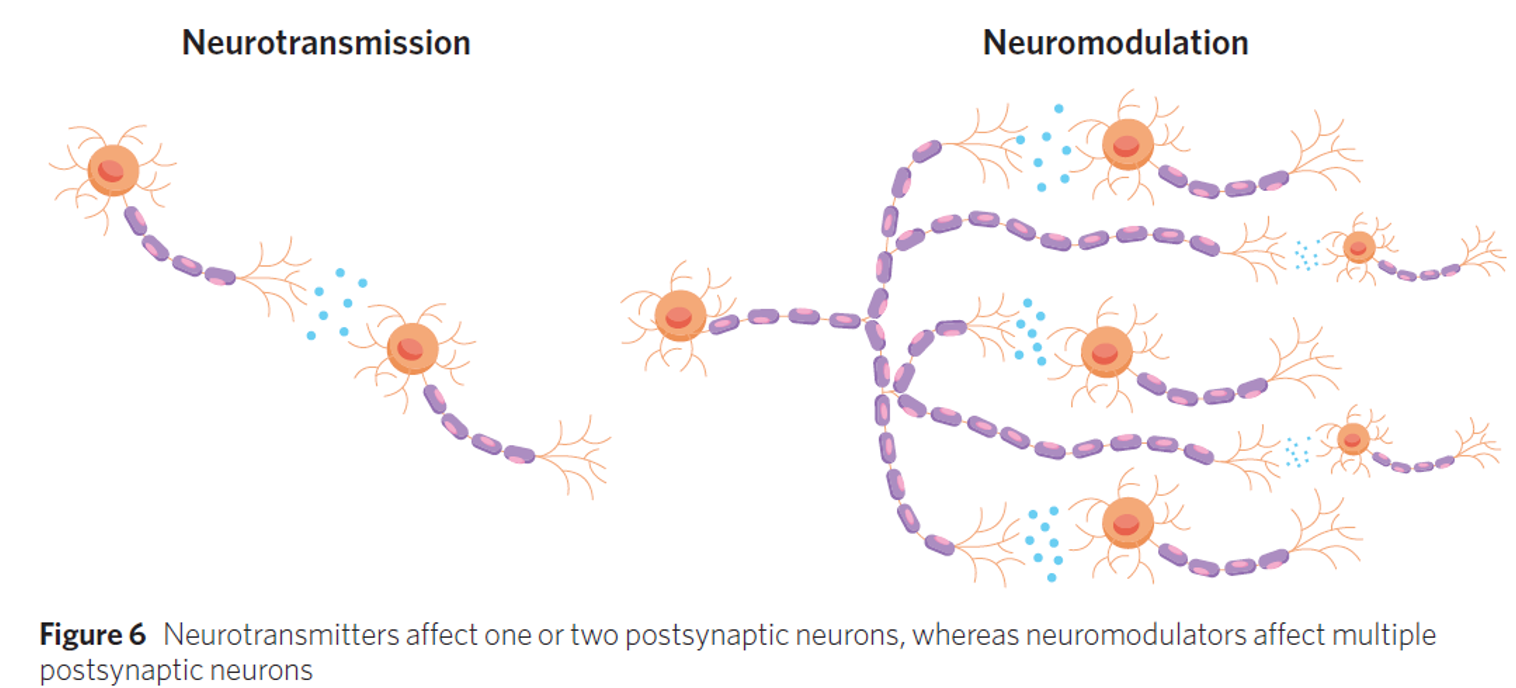
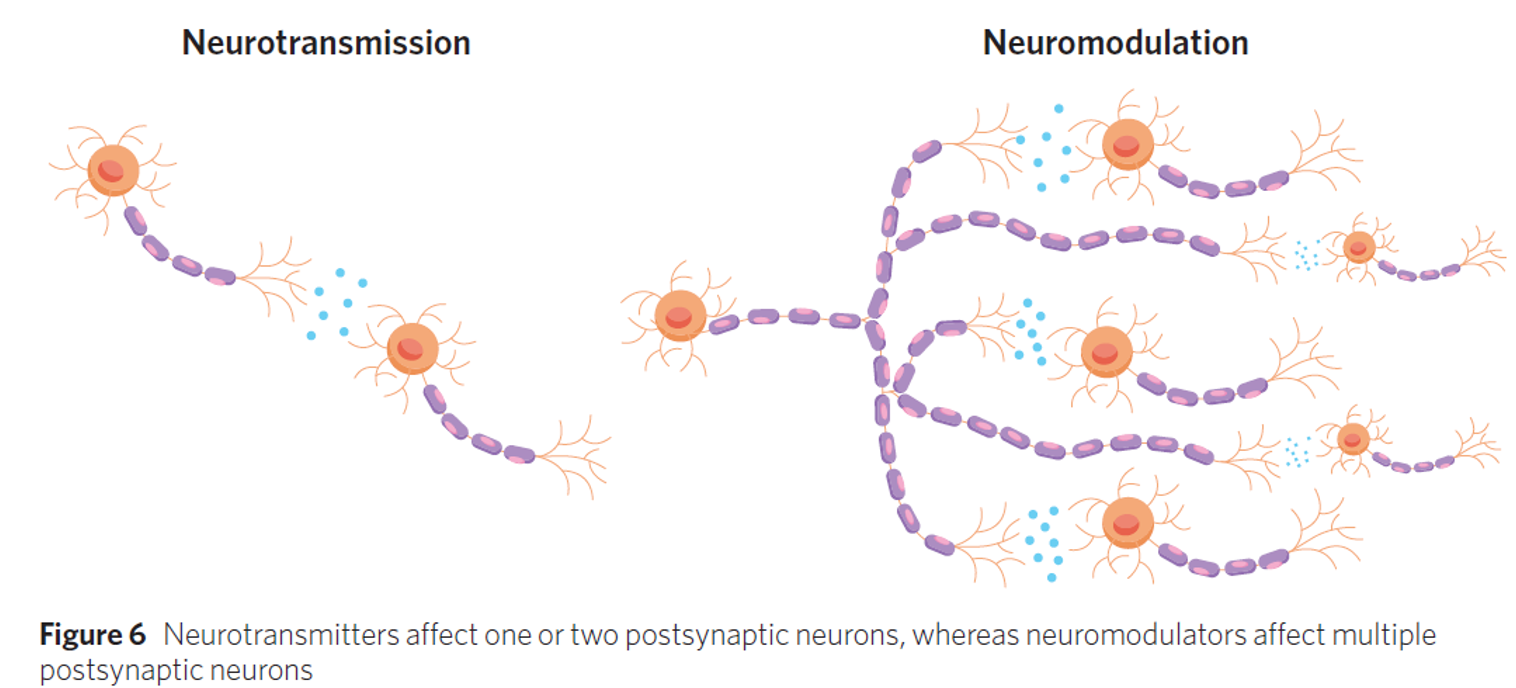
can effect only one postsynaptic neuron.
Each neurotransmitter temporarily binds to a specific receptor site. The molecular shape of the receptor site must be complementary to that of the neurotransmitter, much like a lock and key. Neurotransmitters usually have either an excitatory or inhibitory effect on the post-synaptic neuron.
Description: Chemicals released by a presynaptic neuron to send signals to the post synaptic neuron.
Role: To transmit chemical signals to the adjacent neuron.
Site of release: Into the synapse.
Target: A single post-synaptic neuron.
Speed of action: Moderately fast.
Neurotransmitter - Excitatory
Stimulate or activate post-synaptic neurons, increasing their likelihood of firing. An example of this is glutamate.
Excitatory - Glutamate
is the primary excitatory neurotransmitter in the CNS, making post-synaptic neurons more likely to fire. Activates or stimulates neural activity in the brain. Is involved in neural plasticity and the processes of learning and storing a memory.
Neurotransmitter - Inhibitory
Suppress or slow down post-synaptic neuron activity, decreasing their likelihood of firing. An example of this is GABA.
Inhibitory - GABA
is the primary inhibitory neurotransmitter in the CNS, making post-synaptic neurons less likely to fire. Suppresses or slows down neural activity in the brain. Having low levels is associated with conditions such as anxiety, and specific phobias.
Synapse
The point of communication between two neurons or between a neuron and a target cell, such as a muscle or gland.
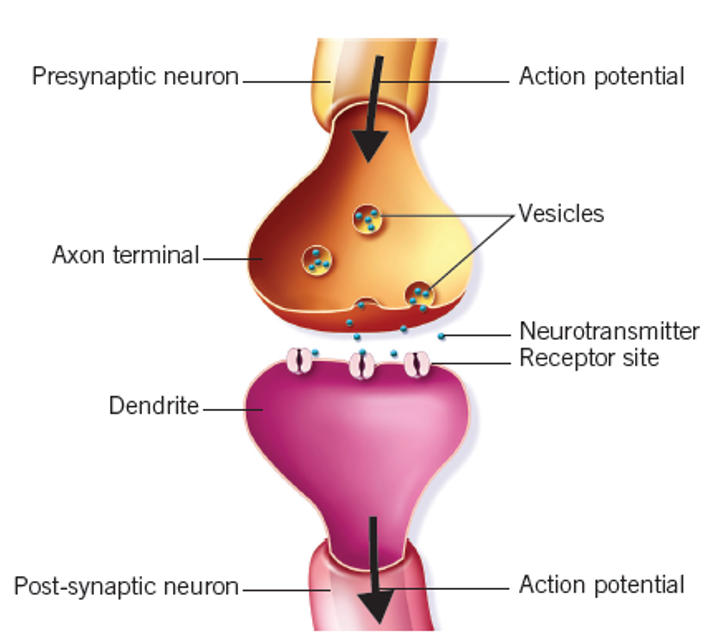
Synaptic vesicles
Store neurotransmitter molecules in the axon terminal of the pre-synaptic neuron.
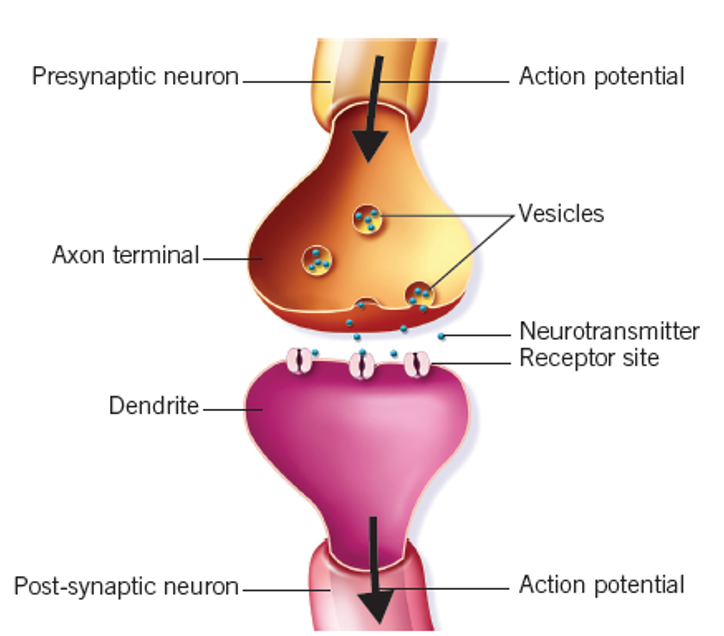
Synaptic gap
The space between the axon terminal of the presynaptic neuron and the membrane of the post-synaptic neuron.
Receptor sites
On the dendrites of neurons receive and detect specific neurotransmitters.
Neuromodulators
neurochemical released into the synaptic gap that bind to receptor sites of a complimentary molecular shape.
change the responsiveness of the receptor sites of a particular neurotransmitter, enhancing the excitatory or inhibitory effects of neurotransmitters. change the neurotransmitter release pattern of the presynaptic neuron. In doing this, they regulate (control or maintain the rate or speed) the signal transmission between neurons.
Tend to be released in a slower, diffuse manner, meaning that targeted brain regions consisting of neural tissue can be affected by their chemical broadcast signals. have a very wide range of action and are longer lasting than neurotransmitters.
can alter both the cellular and synaptic properties of multiple neurons so that neurotransmission between them is altered. This mean change in number of receptor sites or release of neurotransmitters (cellular properties), and strengthening of a neural pathway (Long term potentiation – synaptic properties).
Examples are dopamine and serotonin.
Description: Chemicals released by neurons to alter the effectiveness of neural transmission.
Role: To alter the neural transmission of neurons by controlling the synthesis and release of neurotransmitters.
Site of release: Outside the synapse into the neural tissue in the brain regions.
Target: Groups of neurons.
Speed of action: Moderately slow and last for longer periods.
Neuromodulator - Dopamine
Can have excitatory or inhibitory effects on post synaptic neurons. Plays a role in reward learning, memory, long term potentiation and is associated with wakefulness.
Neuromodulator - Serotonin
Has inhibitory effects on the post-synaptic neurons. 90% of Serotonin is produced in the gut, and plays a role in regulating mood and regulating the sleep-wake cycle.
Synaptic plasticity
Involves specific changes that occur within the synapse, between neurons. The two important processes are long-term potentiation and long-term depression.
Synaptic plasticity - Long-term potentiation (LTP)
The relatively permanent strengthening of synaptic connections as a result of repeated activation of the neural pathway/s.
The long-lasting and experience dependent strengthening of synaptic connections that regularly activate those neural pathway/s.
Synaptic plasticity - Long-term depression (LTD)
the relatively permanent weakening of synaptic connections as a result of repeated low level activation of the neural pathway/s.
The long-lasting and experience dependent weakening of synaptic connections that are not regularly activate those neural pathway/s.
Sprouting
Involves the growth of axon or dendrite fibres at the synapse.
Sprouting - Dendritic spines
Dendrite fibres that grow as a result of sprouting on the post-synaptic neuron.
Sprouting - Filigree appendages
Fibres that grow from the axon terminal of the presynaptic neuron as a result of sprouting.
Sprouting - Synaptogenesis
The formation of new synapses that result from the process of sprouting.
Rerouting
Involves new connections being formed between neurons to establish alternative neural pathways.
Pruning
Involves the removal of excess neurons and synaptic connections to increase the efficiency of neuronal transmissions.