Foundations of Training
 Call Kai
 Learn
Learn Practice Test
 Spaced Repetition
 Match
Match Flashcards
 Knowt Play
1/89

There's no tags or description
Looks like no tags are added yet.
Name | Mastery | Learn | Test | Matching | Spaced | Call with Kai |
|---|
No analytics yet
Send a link to your students to track their progress
90 Terms
What is an agonist?
the muscle directly involved in causing the movement (produces the movement)
What is an antagonist?
the muscle that can stop or slow down the movement (resists the movement)
What is a synergist?
a muscle that assists indirectly in the movement (assists the movement)
What is the agonist, antagonist, and synergist during a bicep curl?
agonist= biceps
antagonist= triceps
synergist= brachialis, brachioradialis, scapular stabilizers, etc.
When it comes to levers, what is the effort force (EF)?
the force acting in the direction that the lever is rotating (the winner)
ie. biceps
When it comes to levers, what is the resistance force (RF)?
creates an opposing torque to the effort force (losing force)
ie. a clicker when you hold it in your hand
What is mechanical advantage (MAd)?
how efficient the lever is; how effective the EF compared to the RF
MAd= EA/RA a large EA and a small RA make the lever more efficient
What does it mean when MA>1?
less effort force needed to overcome load force (mechanical advantage)
What does it mean when MA<1?
greater effort force needed to overcome load force (mechanical disadvantage)
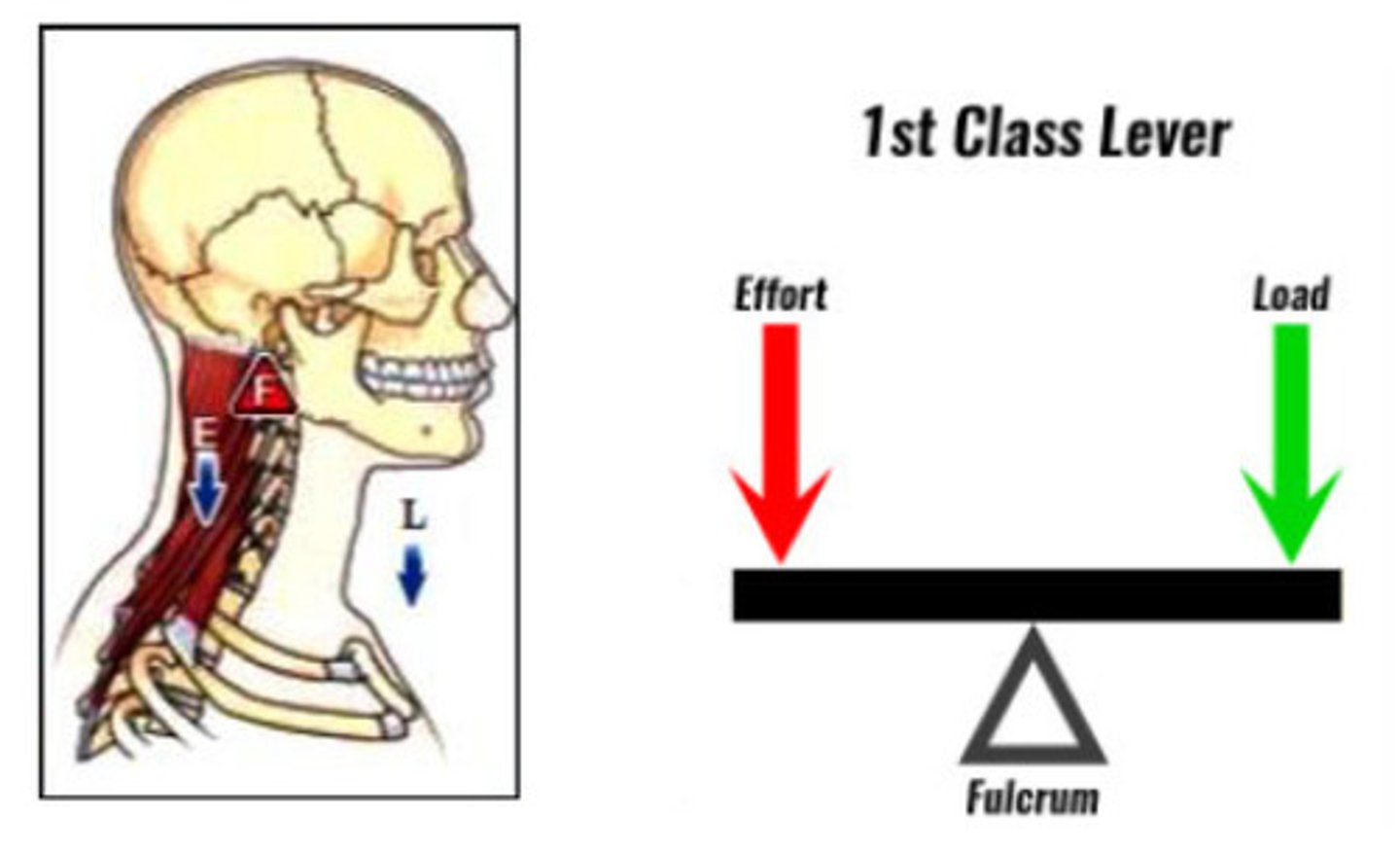
What is a class 1 lever?
can provide mechanical advantage or mechanical disadvantage based on distances from the fulcrum (ie. cervical extension)
-E->F= effort arm (closer to the fulcrum= disadvantage)
-L->F= resistance arm (closer to the fulcrum= advantage)
Which lever is shown here? Hint: EFL
class 1 lever
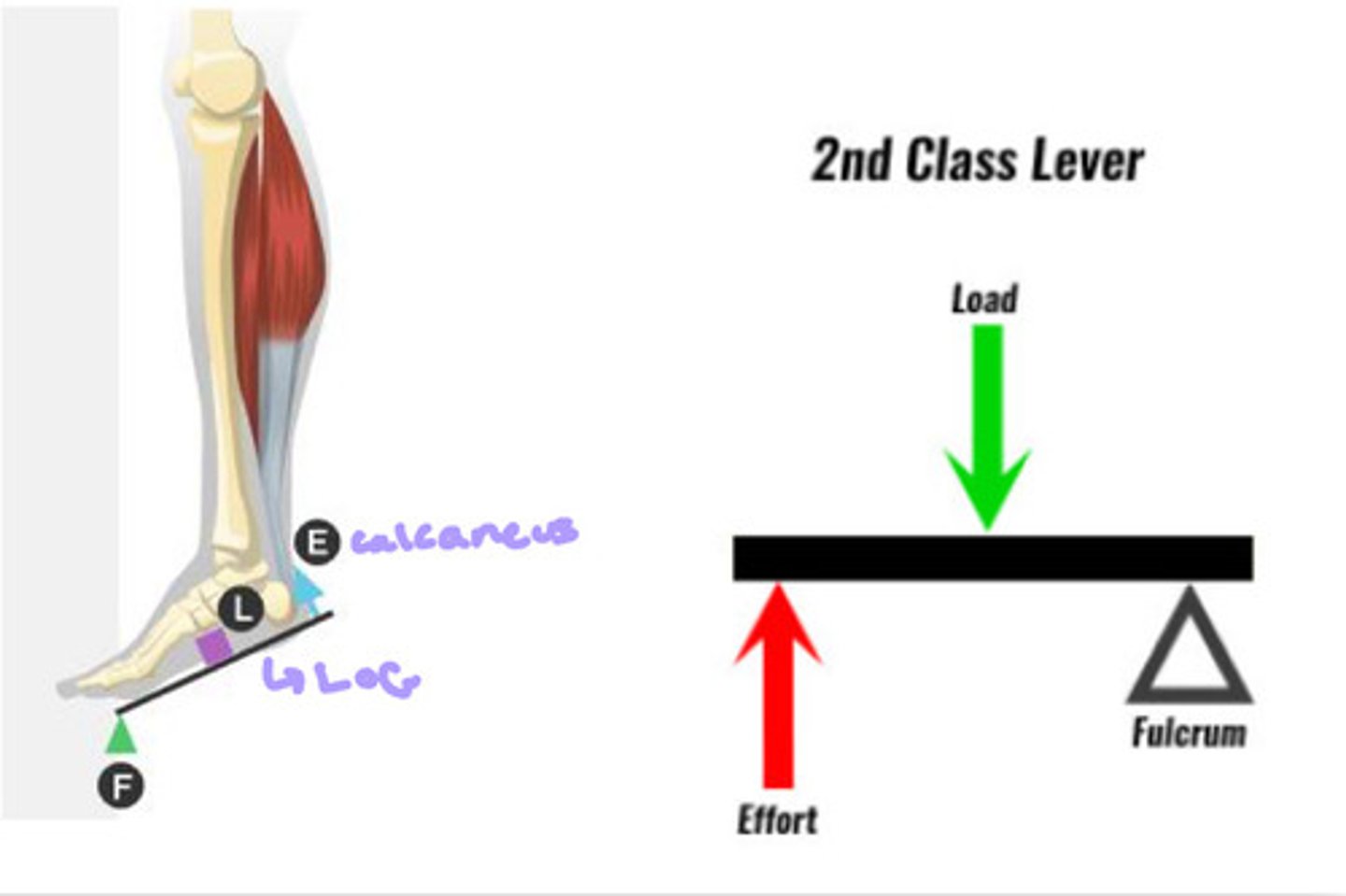
What is a class 2 lever?
always at a mechanical ADVANTAGE; requires lower effort to move the load (ie. heel raise)
Which lever is shown here? Hint: ELF
class 2 lever
What is a class 3 lever?
always at a mechanical DISADVANTAGE (effort arm is ALWAYS shorter than load arm); requires the most effort to move load (ie. bicep curl)
Which lever is shown here? Hint: FEL
class 3 lever
What is strength?
the ability to exert force
What is acceleration?
change in velocity over time (how quickly you build up speed in a given time)
What is the difference between speed vs. velocity?
speed: how fast you're going w/o direction
velocity: how fast you're going in a specific direction
What is force?
how much effort is being used
What is the formula for force?
force (N)= mass (lbs) X acceleration (4.448)
force is in Newtons
What is work?
the product of the force exerted on an object and the distance the object moves in the direction that the force is exerted
work (Nm)= force (N) X displacement (m)
work is in Joules
What is displacement?
how far the object moves
If I am 5'0" and Abby is 5'9", and we are both performing a deadlift with the same exact weight, who has to perform more work?
Abby because she has longer legs (the bar has to travel a further distance)
What is power?
the ability to exert force at high speeds (explosive strength)
power (W)= work ÷ time OR force X velocity
power is in Watts
What is negative work?
work performed on the muscle (eccentric)
What is angular displacement?
the angle through which an object rotates
ie. elbow extension from 90° position= 90° of angular displacement
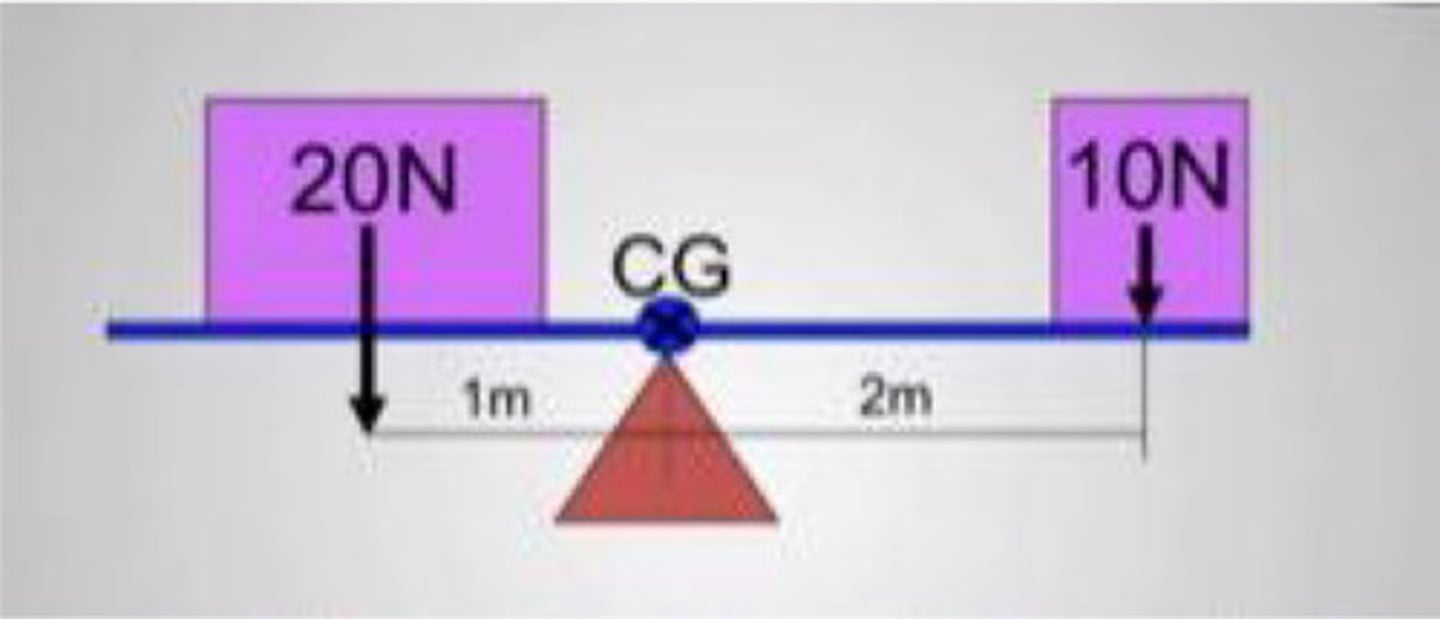
What is the formula for torque?
torque (T)= force (N) X distance (m)
Calculate the torque in the picture on both sides of the fulcrum. Are they balanced?
T= F x d
left side
T= 20N x 1m
T= 20
right side
T= 10N x 2m
T= 20
both sides are balanced
What is the formula for rotational work?
rotational work= torque x angular displacement
How does the muscle cross-sectional area affect strength and power?
-the greater the muscle CSA, the more actin and myosin cross-bridging
-bigger/wider/larger muscle= stronger muscle (has the potential to produce more force)
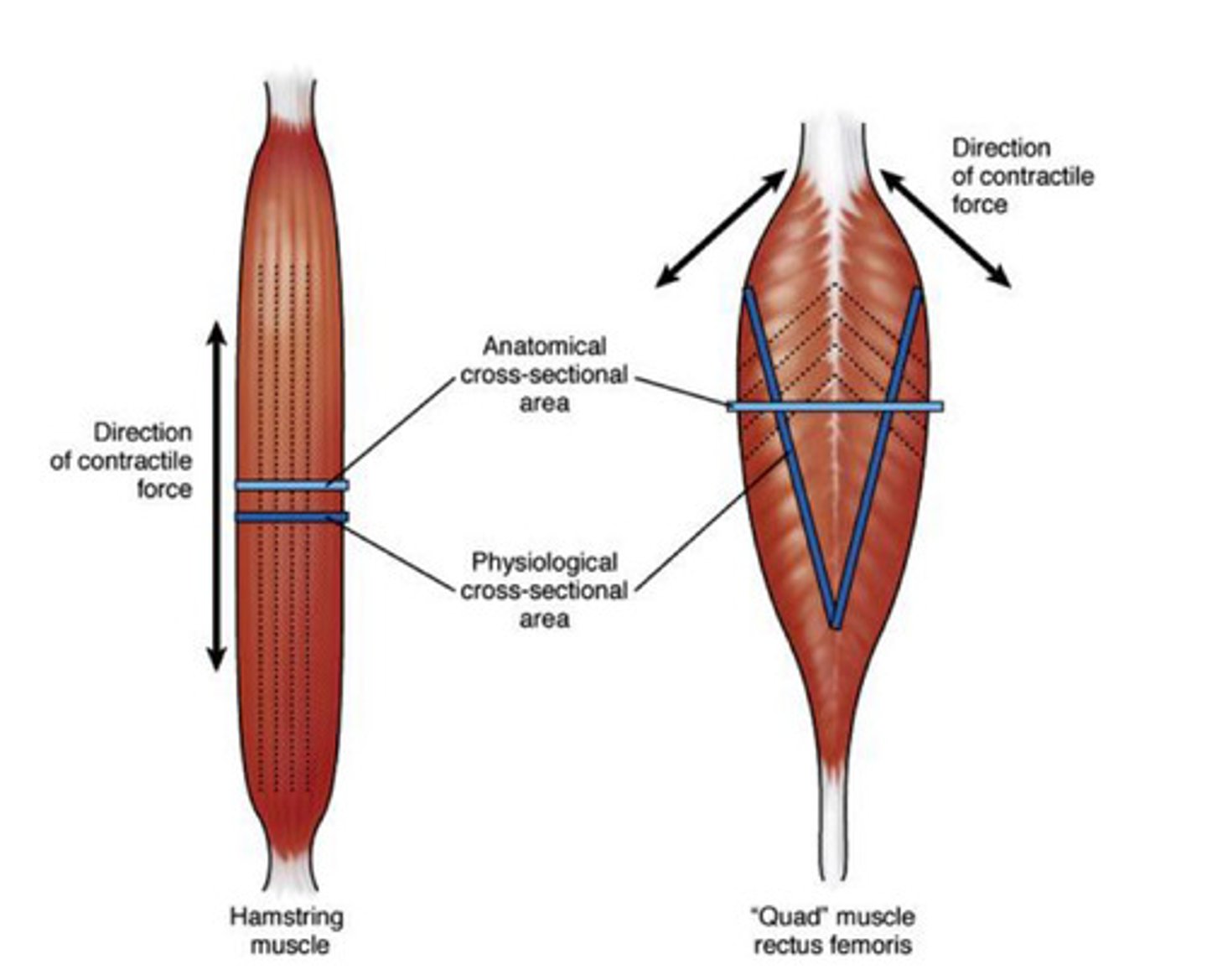
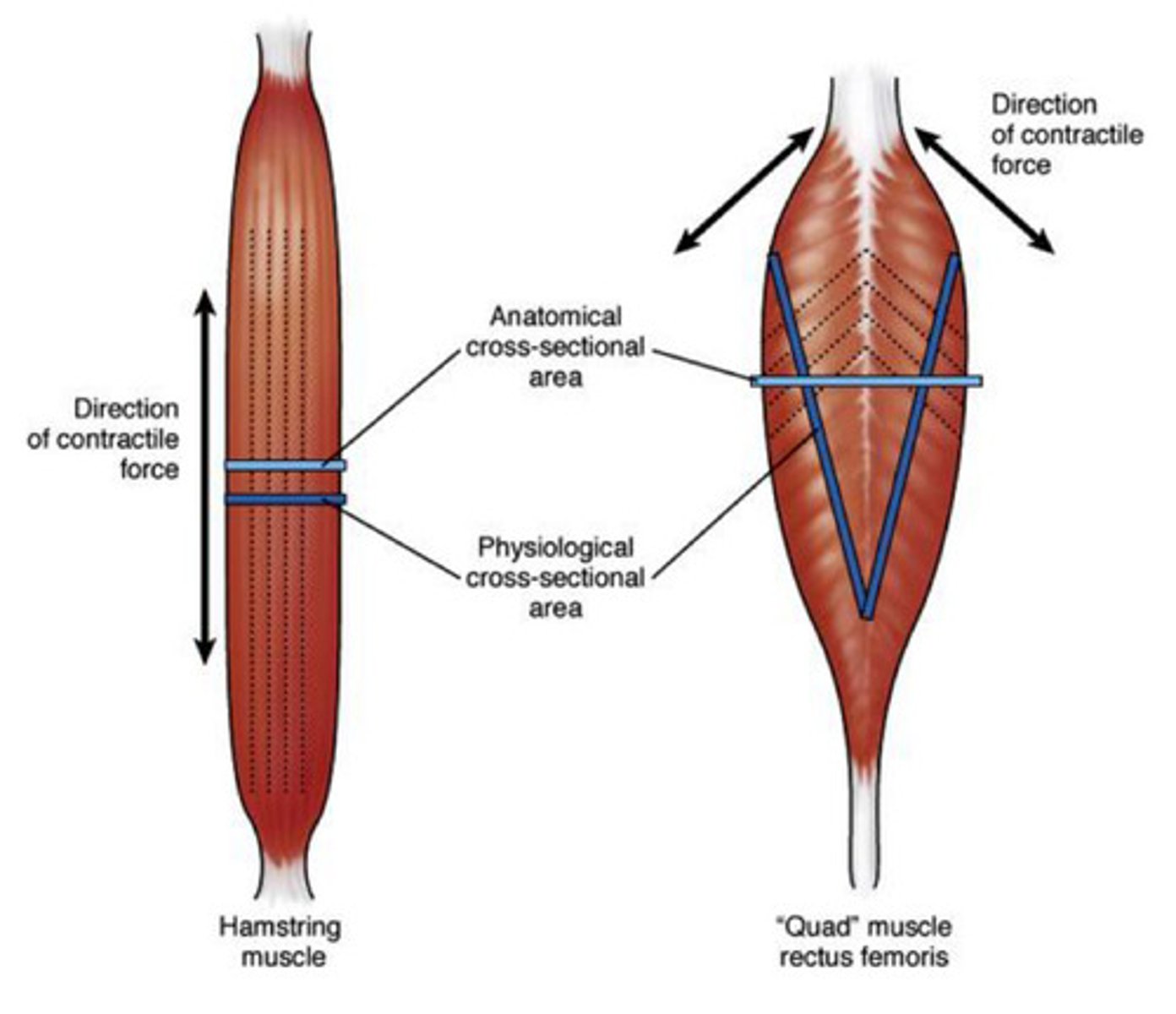
How does muscle fiber orientation affect strength and power?
pennate muscle: muscle fibers have an oblique line of pull
-angle of pennation allows muscle to have more contractile units per CSA
-more pennation= greater force of contraction due to more sarcomeres per CSA
How does muscle length affect strength and power?
at resting length
-the maximum number of cross bridge sites are available
-muscle can generate greatest force
shortened length
-actin filaments overlap
-decreased cross bridge sites
-decreased force capacity
lengthened muscle
-smaller number of actin and myosin next to each other
-decreased cross bridge sites
-decreased force capacity
How does strength to mass ratio affect strength and power?
directly impacts the athlete's ability to accelerate their body
example: max. vertical jump
-a 120lb athlete who can produce only 120lb of force in a back squat
o lower strength reserve
o larger % of force production capacity exerted during a max vertical jump= less explosive
-a 120lb athlete who can produce 150lbs of force in a back squat
o greater strength reserve
o lower % of force production capacity exerted during a max vertical jump= more explosive
How does neural control affect strength and power?
all of none principle
-recruitment affects force output
o how many motor units are activated
o which motor units are activated
-rate coding affects force output
o rate at which motor units are fired (frequency of the twitch)
What are the different types of resistance training?
power: ability to produce force quickly
hypertrophy: increase muscle CSA
endurance: increase muscle resistance to fatigue
strength: increase ability to produce force at a given velocity
What are the different types of lifting?
-weightlifting
-Olympic lifting (explosive movements to train power)
-power lifting (slower to work on strength)
What are examples of Olympic lifts?
-snatch
-clean and jerk
What are examples of power lifts?
-squat
-bench press
-deadlift
What are the 7 foundational movement patterns?
1) squat
2) hinge
3) lunge
4) push
5) pull
6) locomotor
7) bracing & stability
What is the "proper" technique to perform a squat?
-feet shoulder width or slightly wider
-keep torso upright and spine neutral (parallel trunk to shin)
o neutral spine is NOT a flat spine; it is in slight lumbar lordosis
-descend to full depth (when appropriate)
-drive through the feet to return to stand
When might you decrease squat depth?
-lack of mobility
-pain
-lack of end range strength
-injury
What are the traditional strength training exercises for a squat movement pattern?
-barbell back squat
-barbell front squat
-goblet squat
What are the primary muscles that are engaged during a squat?
-quadriceps
-glutes
-hamstrings
-adductors
-spinal erectors (especially at the bottom of the squat)
-abdominals
What are the different squat variations?
-sit to stand
-bow squat
-goblet squat
-front squat
-back squat
-sumo squat
-pin squat
-sissy squat
What are the traditional strength training exercises for a hinge movement pattern?
-conventional deadlift
-romanian deadlift (least amount of knee flexion)
-trap bar deadlift (greatest knee flexion)
If you're training an athlete to work through knee pain, which deadlift exercise will provide the least work on the knee?
romanian deadlift
What are the primary muscles that are engaged during a hinge?
-hamstrings
-glutes
-spinal erectors
-abdominals
*less quad activation during a hinge
What are the different hinge variations?
-hip hinge (tall kneeling, band assisted)
-bench assisted deadlift
-elevated conventional deadlift
-elevated romanian deadlift
-conventional deadlift
-romanian deadlift
-single leg romanian deadlift
-kettle bell swings
-glute bridge
What are the primary muscles that are engaged during a lunge?
-glutes
-quadriceps
-hamstrings
-abdominals
-gastroc/soleus
What are the different lunge variations?
-static lunge
-front lunge
-back lunge
-walking lunges
-bulgarian split squat (can also be considered as a squat pattern)
-side lunge
-curtsey lunge
What are the different types of push exercises?
vertical push: pressing overhead
-ie. overhead barbell press (more deltoid activation)
horizontal push
-ie. bench press (more pectoralis activation)
What traditional exercises are considered a vertical push?
-military press
-push press (use knees for assistance)
-jerk
What traditional exercises are considered a horizontal push?
-bench press
-incline bench press
What are the primary muscles that are engaged during a push movement pattern?
-deltoids
-triceps
-pectoralis major
What are the different push variations?
-bench press
-incline bench press
-military press
-jerk
-push press
-push up
-landmine press
What are the different types of pull exercises?
-vertical pull
-horizontal pull
What are the primary muscles that are engaged during a vertical pull movement pattern?
-latissimus dorsi
-posterior deltoid
-biceps
-rhomboids
-trapezius
What are the different vertical pull variations?
-lat pull down
-chin up
-pull up
-upright row
What are the primary muscles that are engaged during a horizontal pull movement pattern?
-latissimus dorsi
-posterior deltoids
-rhomboids
-trapezius
What are the different horizontal pull variations?
-barbell row
-single arm dumbbell row
-horizontal pull up (Australian pull up)
-TRX row
What is the locomotor movement pattern?
a cyclical movement
-ie. running, cycling, sled push, overhead carry, farmer's carry
-functional movements
-used for aerobic or anaerobic conditioning
-used for work capacity
What is the purpose of the bracing and stability movement pattern?
-maximize the kinetic chain (transfer force from lower body to upper body)
-create a stable base to produce max force
-protect the spine
What are the different types of bracing and stability?
-isometric (ie. plank)
-isotonic (ie. crunch, sit up, Jefferson curl)
What are the primary muscles that are engaged during bracing and stability?
-rectus abdominis
-internal and external obliques
-transverse abdominis
-spinal erectors
What are the global core muscles (aka the big movers)?
-rectus abdominis (produces spinal flexion)
-external obliques (produces flexion, ipsilateral flexion, contralateral rotation)
-internal obliques (produces flexion, ipsilateral flexion, ipsilateral rotation)
-erector spinae (longissimus, spinalis, semispinalis)
-iliopsoas
-quadratus lumborum
What are the local core muscles (aka deep, stability muscles)?
-transverse abdominis
-multifidi
-rotatores
-interspinales
-intertransversales
-diaphragm
-pelvic floor
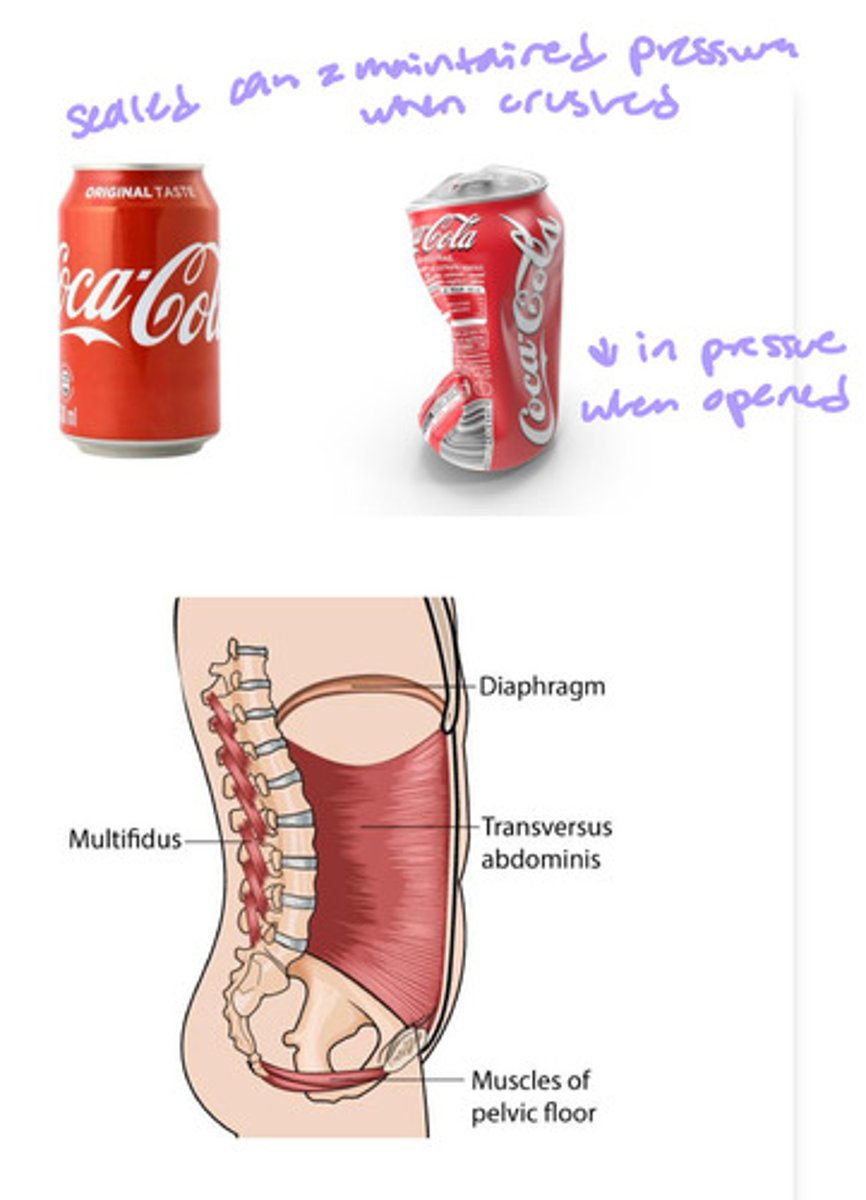
What are the six walls that activate the deep core?
-anterior: rectus abdominis, TVA
-laterally: internal and external obliques
-posterior: erector spinae, multifidus, QL
-superior: diaphragm
-inferior: pelvic floor
*we want to maintain the pressure
What is the role of the diaphragm?
during forced expiration air is driven out as the diaphragm is forced upwards by a rise is intra-abdominal pressure produced by TVA contraction
-diaphragm plays a role in trunk stability by controlling intra-abdominal pressure
-involved in trunk stability and postural control
-enhanced diaphragmatic activation via TVA muscle strengthening exercises increases respiratory volume and lumbar spine stabilization (cardiovascular benefits)
-↓ diaphragm control= ↓ trunk stability
What are the different types of core exercises?
-isometric
-isotonic
o sagittal
o rotary
-unilateral
Which exercises produce the greatest muscle activation of the rectus abdominis?
1) bulgarian split squat
2) back squat
3) static curl up
Which exercises produce the greatest muscle activation of the internal oblique?
1) front plank
2) front plank on swiss w/hip extension
3) kettle bell swing
Which exercises produce the greatest muscle activation of the external oblique?
1) unstable bulgarian (back foot in TRX)
2) stir the pot
3) front plank
Which exercises produce the greatest muscle activation of the erector spinae?
1) barbell deadlift
2) hip thruster
3) hex deadlift
Which exercises produce the greatest muscle activation of the lumbar multifidus?
1) prone trunk extension w/leg extension
2) front plank on swiss w/hip extension
3) bent row @45% body weight
Which exercises produce the greatest muscle activation of the transverse abdominis?
1) side lying lumbar setting on a sling
2) static curl up
What is the very first step before starting any movement pattern?
finding pelvic neutral
How do you find pelvic neutral?
1) place your hands on your ASIS
2) put your thumbs together
3) move into anterior pelvic tilt (should only see thumbs)
4) move into posterior pelvic tilt (should only see fingers)
5) find the midway point/neutral (thumbs should be stacked on top of fingers
*find pelvic neutral in standing, hook lying, quadruped, and learn to dissociate
How can you dissociate once you've found pelvic neutral?
-pelvic clocks
-pelvic tilts
What are the steps for muscle activation before performing a movement pattern?
1) find pelvic neutral
2) activate the transverse abdominis: move fingers just above ASIS and in--> brace
3) active pelvic floor
How can you activate the deep core muscles using pressure biofeedback?
-monitors abdominal wall movement by measuring the pressure change during abdominal hollowing
1) place BP cuff under L3 and inflate to 44mmHg
2) pt performs abdominal draw in maneuver increases the pressure in steps of 2-4mmHg
3) hold contraction while breathing for 15 seconds
*although widely used, may not accurately measure TVA activation
What are some isometric plank progressions?
1) wall plank
2) table/bench plank
3) floor plank on knees
4) floor plank on feet
variations
-arm or leg lifts: added anti extension challenge
-weighted pull through: added anti rotation challenge
-knee to chest: lower body movement on stable core
-plank with arms/feet on swiss ball: added stabilization challenge
What are some isometric side plank progressions?
1) side bridge (side plank of knees)
2) knee assisted side plank (top leg extended)
3) split stance side plank
4) forearm-> extended arm
variations
-star plank: increased hip abductor demands
-arm rotation: increased anti rotation demand
-with hip flexion/extension taps: moving LE on stable core
What are some bear crawl progressions?
1) static bear hold
2) static bear with shoulder tap
3) static bear with leg lift
4) sagittal moving bear
5) frontal moving bear
variations
-static bear with pelvic tilt: lumbopelvic dissociation
-bird dog bear: increase spinal extensor activation
What are some bird dog progressions?
1) quadruped with deep core activation
2) quadruped shoulder taps
3) quadruped hip extension
4) quadruped hip extension lift off
5) bird dog hold
6) bird dog hold with perturbations
What are some deadbug progressions?
1) hook lying bracing
2) hook lying bracing with:
-heel slide (with/without arms)
-heel tap (with/without arms)
3) tabletop bracing with:
-bent knee drops (with/without arms)
-extended knee drops (with/without arms)
-straight leg drops (with/without arms)
variations
-straight leg circles
-isometric contralateral deadbug
What are some unilateral training exercises?
-unilateral overhead press
-unilateral bench press
-Turkish get up
-unilaterally loaded "core" exercises
What are some isotonic sagittal progressions?
-sit ups
-crunches
-back extensions
-leg drops
-Jefferson curls
What are some isotonic rotary progressions?
-chops
-lifts
-rotational med ball throws
-Russian twist
-cable rotation
Case #1: You are working with a 38-year-old female with c/o chronic low back pain with an acute flare up 2 weeks ago when lifting her 1-year-old child out of the crib.
-Pain 2/10 at rest, 6/10 with lifting child, prolonged sitting/standing
-PLOF: previously active in gym with weightlifting 4x/wk
-Lumbar: full ROM, spinal extension and end range flexion limited by pain
-Thoracic: decreased thoracic extension ROM
-MMT: UE grossly 5/5, LE 5/5 except hip extension and abduction which are 4-/5
-postural inspection: excessive lumbar lordosis
How would you warm her up?
What exercises would you prescribe?
warm up
R: stationary bike (5 min)
A: bridge + resistance band (targets both hip extensors/abductors)
M: thoracic extension off foam roller (reduce lumbar lordosis)
P: hinge (light)
exercises
-isometrically train the trunk
-change demand on the back (anti rotation exercises)
-palloff press
-unilateral rows
-bird dog
Case #2: You are working with a 17-year-old level 10 gymnast with a dx of spondylolysis. Pt is in the return to sport phase of rehab.
-Pain 0/10 at rest, 3/10 with back handspring and landing double full (left)
-LE ROM WNL
-Spinal ROM WNL and pain free
-LE MMT: grossly 5/5 BIL except for BIL hip abductors 4/5
-UE MMT: grossly 5/5 BIL
-Core MMT: 4/5
-Flexibility: (+) Thomas Test BIL (ilipsoas); Tight lats BIL
How would you warm her up?
What exercises would you prescribe?
warm up
R: TM, jog, dynamic warm up, jump rope, etc.
A: monster walks, side plank + hip abduction, inchworms
M: QL stretch, deadhands
P: low-level superman, bird dog, sled push
exercises
-OH carry
-farmer's carry
-diagonal lifts (chops/lifts)