Manufacturing Operations & Technology
 Call Kai
 Learn
Learn Practice Test
 Spaced Repetition
 Match
Match Flashcards
 Knowt Play
1/279

Earn XP
Name | Mastery | Learn | Test | Matching | Spaced | Call with Kai |
|---|
No analytics yet
Send a link to your students to track their progress
280 Terms
Technological manufacturing definition
The application of physical and chemical processes to alter the geometry and/or appearance of given starting material to make parts or products; also includes assembly of parts
Alternative manufacturing definition
The transformation of materials into items of greater value by means of one or more processing and/or assembly operations
What do production engineers need to know
Standards, legislation
Technical/business specifications
Product design
Manufacturing system design
Production plan
What are manufacturing industry categories
Primary
Secondary
Tertiary
Primary industries
Those that cultivate and exploit natural resources:
Agriculture/fishing/forestry
Secondary industries
Convert the output from primary industries into consumer and capital goods:
Aerospace/automotive/food processing
Consumer goods
Purchased directly by consumers
Capital goods
Purchased by other companies to produce consumer goods or provide services
Tertiary industries
Provide services rather than tangible goods:
Banking/insurance/education
Activities in manufacturing
Processing and assembly
Material handling
Inspection
Operations management
Operations management
Strategy
Design
Planning and control
Improvement
Low volume production
1-100
Job shop
Medium volume production
100-10,000
Batch
High volume production
>10,000
Mass
Variety and quantity relationship
Inverse correlation
Job shops
Highly flexible production
Multipurpose tools and machines
Customized products
Batch/cellular production
Production in stages
Variety of products from single line
Mass production
Dedicated to standard product
Inflexible
Number of parts
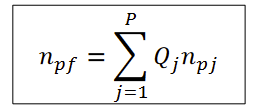
Number of operations
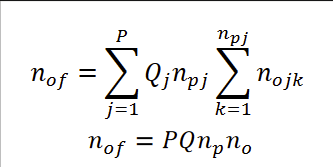
Manufacturing capability
Technical and physical limitations of a manufacturing firm and each of its plants
Technological processing capability
Material
Compatibility
Technical knowhow
Physical product limitations
Size
Weight
Storage
Product capacity
Manning level
Equipment
Speed
Evaluation of processes
Cost
Rate
Quality
Flexibility
Machining definition
Manufacturing processes by which material is removed from raw workpiece
Machining examples
Straight turning
Cutting off
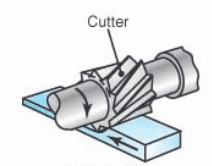
Slab milling
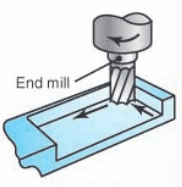
End milling
Straight turning
Workpiece is rotated, cutting tool is moved parallel to remove outer layer
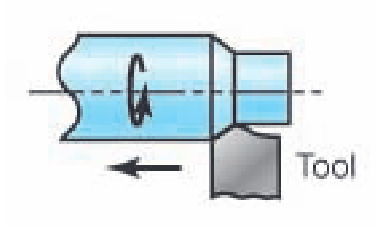
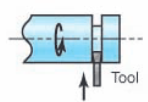
Cutting off
Workpiece is rotated, cutting tool is moved perpendicular inwards to separate parts
Slab milling
Cutting tool is rotated parallel to surface of part, top layer is removed
End milling
Cutting tool is rotated perpendicular to part, removes a cavity
Importance of metal cutting mechanics
Motor selection
Design of structure
Life of tool vs rate of cutting
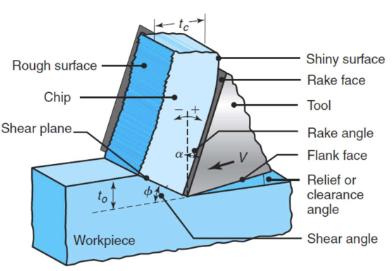
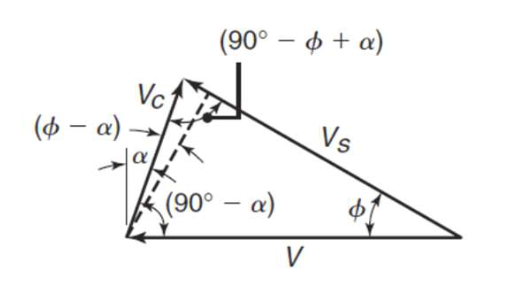
Merchant 2D model for orthogonal cutting
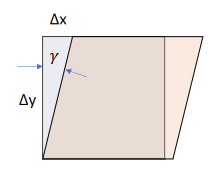
Shear strain
Velocity diagram
Force circle
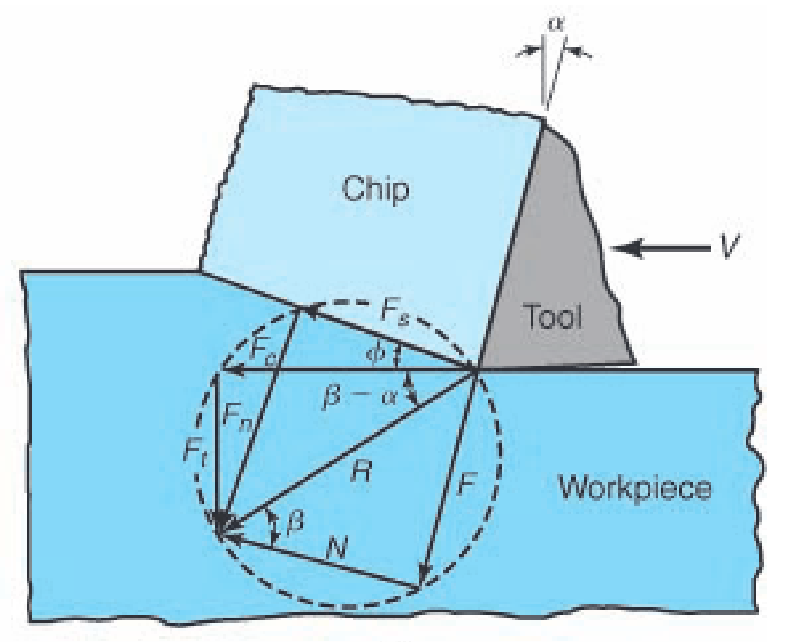
Power =
Force x velocity
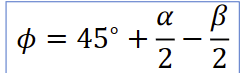
Merchant’s equation
Tool wear equation

Turning
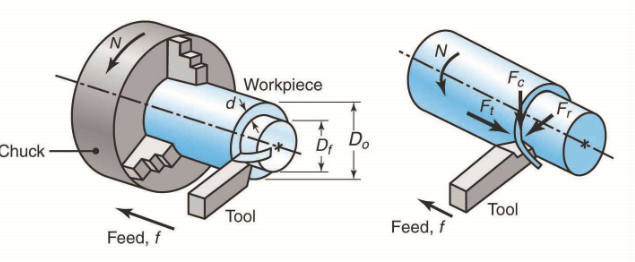
Causes of tool wear
Stresses
Friction
High temepratures
Design for machining
Access for tools
Long sections cause vibrations
Holes cannot change directions
Curved edges difficult to hold
Outside rounds difficult to achieve
When advanced machining technologies are needed
Material is very strong, hard or brittle
Too much heat is generated
Shape is too complex
Workpiece is too flexible
Special surface finish and dimensional tolerance requirements
Advanced machining technologies examples
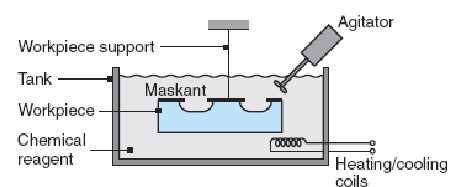
Chemical machining
Electrochemical machining
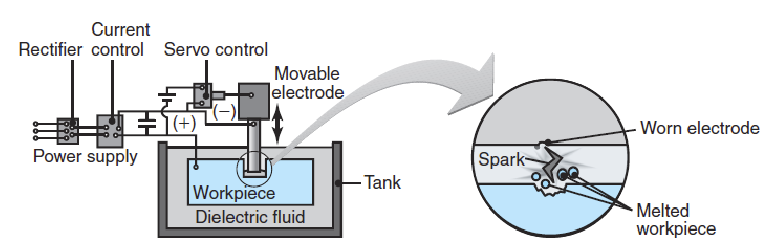
Electrical discharge machining
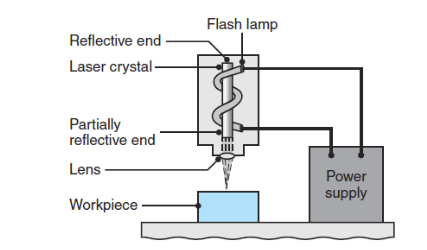
Laser beam machining
Water-jet machining
Abrasive jet machining
Chemical machining
Laser beam machining
EDM
Economics of advanced machinign processes
Costs of tooling and equipment
Operating costs
Material-removal rate required
Level of operator skills
Casting diagram
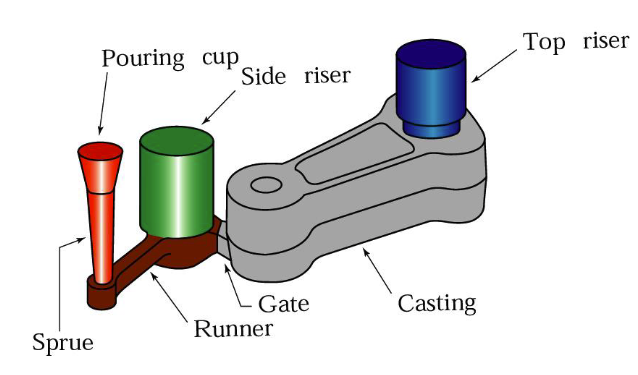
Transformative process
Change the shape of materials without removals or additions
Reynold’s number desired in casting to prevent aspiration
<20,000
Chvorinov’s rule
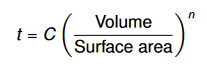
Metal casting definition
Pour molten metal into a mould cavity, let it solidify, remove from mould
Advantages of casting
Complex shapes with internal cavities
Very large parts
Economically competitive with other processes
Near net-shaped process
Scalable
Expendable moulds
Sand casting
Shell mould
Evaporative pattern (lost-foam)
Investment (lost-wax)
Permanent moulds
Permanent mould
Die
Centrifugal
Importance of risers
During solidification, the casting shrinks
True stress
P/A
True strain
ln(l/lo)
Elastic deformation
Deformation disappears when load is removed
Plastic deformation
Deformaiton is permanent
Metal forging definition
Workpiece is shaped by compressive forces applied through dies and tooling
Metal grain in casting

Metal grain in machining from a blank
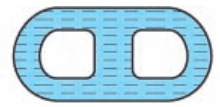
Metal grain in forging

Cold forging requirements
High forces
Ductility at room temperature
Cold forging advantages
Good surface finish
Dimensional accuracy
Hot forging advantages
Lower forces
Hot forging disadvantages
Less accurate dimensions
Poor surface finish
Forgings require finishing operations such as
Heat treatments
Machining to final dimensions
Open-die forging definition
Solid workpiece between two flat dies, reduced in height by compression
Impression-die forging definition
Workpiece takes shape of die cavity between two shaped dies. Occurs at elevated temperatures to lower required forces and increase ductiility
Parting line location
Largest cross-section of part. Straight for simple shapes.
Flash thickness
3% of maximum thickness of forging
Closed die forging diagram
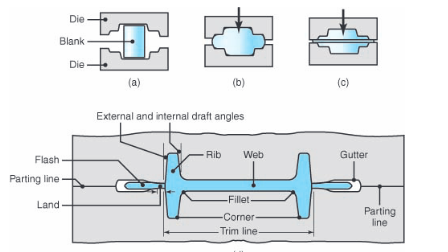
Length of land
2-5 times flash thickness
To remove forgings
Draft angles are needed
Open die forging diagram
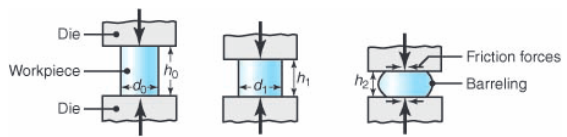
Rolling definition
Rollers reduce the thickness of a strip of metal
Diagram of flat rolling
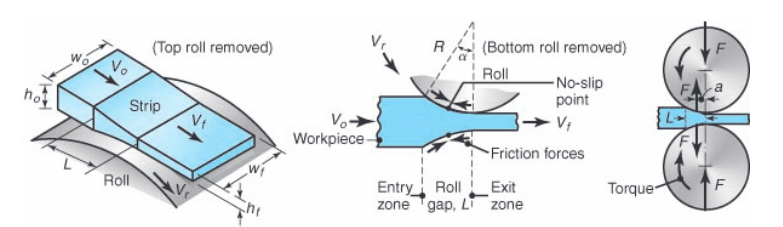
Velocity of strip during rolling
Slower on left, faster on right, same as roller at no-slip point
Why are there fricitonal forces during rolling
Because the strip moves at a different speed than the rollers
How is friction controlled during rolling
Lubricants
Metal extrusion definition
Cylindrical billet is force pushed through a die
Metal extrusion diagram
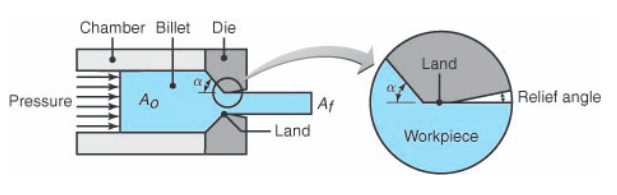
Disadvantages of casting
High energy requirements
Inhomogeneous material properties
Costly lead times
Postprocessing often required
Plastic compared to metal forming
Higher viscocity
Lower surface tension
Lower temperatures
Cannot control properties
Injection moulding diagram
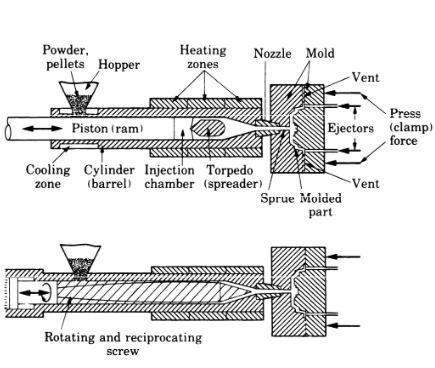
Additive manufactuirng definition
Mass is added to the workpiece to achieve the desired component shape
Additive manufacturing advantages
Fast prototyping
No tooling
Complex/optimized/lighter structures
Material savings
Multiple materials
Customization/personalization
Improved supply chain/on demand manufacturing
Simultaneous production of diverse parts
Additive manufacturing examples
Fused filament fabrication
Stereolithography
Selective laser sintering
Electron beam melting
Binder jetting
Laminated object manufacturing
FFF challenges
Anisotropy
Porosity
Residual stresses
Deposition rate
FFF parameters
Temperature
Extrusion force
Viscocity
Speed
Toolpath
FFF diagram
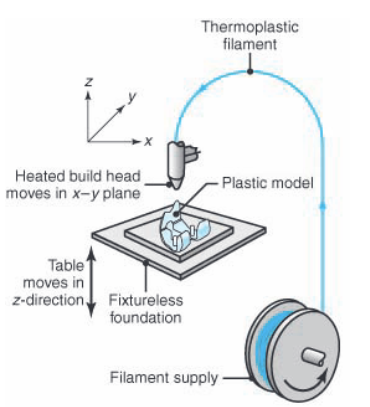
FFF definition
A filament is extruded from a head that moves in two directions, after each layer the table is lowered
SLA diagram
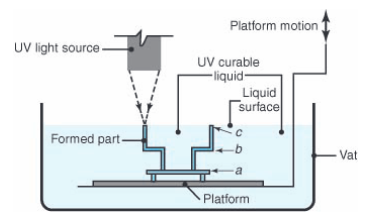
SLA
Liquid polymer is cured selectively to create the component with the use of a UV laser and a vat of polymer
SLS or EBM diagram
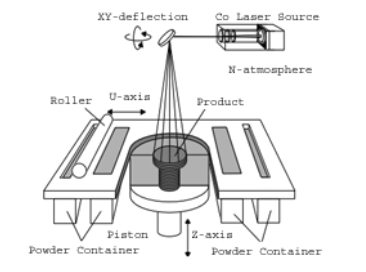
SLS/EBM definition
Nonmetallic or metallic powder is melted using a laser to make the component
Difference between SLS and EBM
Mostly used for plastics vs titanium and cobalt-chrome alloys