Natural vs Artificial Selection
 Call Kai
 Learn
Learn Practice Test
 Spaced Repetition
 Match
Match Flashcards
 Knowt Play
1/15

There's no tags or description
Looks like no tags are added yet.
Name | Mastery | Learn | Test | Matching | Spaced | Call with Kai |
|---|
No analytics yet
Send a link to your students to track their progress
16 Terms
Evolution
The change in inherited traits in a population/species from one generation to the next.
Natural Selection
States that those individuals who are better adapted to their current environment will survive better and therefore pass on these traits to the next generation.
Evolution by Natural Selection
Natural selection makes a population better adapted to the environment over time and
The organisms best adapted to the environment will survive the best, produce more offspring and have these traits passed down to the next generationmakes harmful traits appear less frequently.
Over long periods of time, differential reproduction will change the overall genetic composition of the population to better suit the changing environment
Differential Reproduction
The fitter individuals reproduce more than the less fit
Darwin’s Finches
During his 1835 visit to the Galapagos Islands, Charles Darwin observed finches with diverse beak shapes, which led him to propose that these birds, now known as "Darwin's finches," evolved from a common ancestor through natural selection, adapting to different food sources
Lamarck’s Theory of Evolution
Jean-Baptiste Lamarck, 1809
Stated that Changes Are Adaptations To environment acquired in an organism’s lifetime
Said acquired changes were passed to offspring
Lamark’s Law of Use and Disuse
If a body part was used, it got stronger
If body part NOT used, it deteriorated
Proven incorrect
Natural Selection
Results when the characteristics of a population of organisms change over many generations
Happens because individuals with inherited traits survive specific environmental conditions and pass on their alleles to their offspring
Requirement: MUST be diversity within a species
Wouldn’t be antibiotic resistance if all bacteria were the same
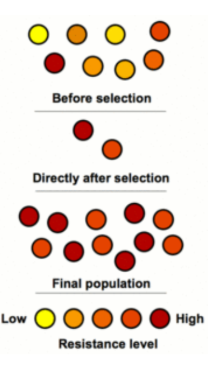
Selective Pressure
Environmental Factors– select for certain characteristics, and against others
Abiotic: Non-living, Natural disasters
Biotic: Living, predators, parasites, competition for resources
Environment exerts a selective pressure on a population
Natural Selection is Situational
Natural selection does NOT anticipate changes in environment – there is no purpose or direction
Individuals in a population have varying traits by chance
One trait may happen to fit the situation and be more likely to survive
Fitness: the relative contribution an individual makes to the next generation
Artificial Selection
Humans select for certain traits, whereas in natural selection, environmental conditions decide which population will survive
Biotechnology
The use of technology and organisms to produce useful products
Selective breeding
a form of artificial selection
Problems with Selective Breeding – Undesirable Traits
Hip Dysplasia in dogs
Purebreds are more prone to this disease than cross-breeds
Inbreeding encourages negative traits- the gene pool is less diverse
Hip dysplasia is common in: Saint Bernard, Great Danes, Labs, German Shepherds, etc.
Monocultures
Extensive plantings of the same varieties of a species over large expanses of land
Advantage: Easier to manage and take care of fields
Herbicides, insecticides and fertilizers are manufactured to meet the needs of a specific crop species
Risks: If a new disease or insect infests the crop population, the whole population could be killed or severely damaged
Gene Banks
Established to protect against monoculture disasters
Contain populations of ancestors of modern plants with various genetic combinations that allowed them to reproduce Seeds can survive for long periods of time, so they can be recovered from early settlements
This genetic diversity is then available to introduce to modern plants if needed