Critical thinking and logic mastery
 Studied by 0 people
 Call Kai
 Learn
Learn Practice Test
 Spaced Repetition
 Match
Match Flashcards
 Knowt Play
1/137

There's no tags or description
Looks like no tags are added yet.
Name | Mastery | Learn | Test | Matching | Spaced |
|---|
No study sessions yet.
138 Terms
Socrates
Taught to question all assumptions. Taught them that ideas were not necessarily correct just because parents/leaders told them so. Examine every idea on its merits alone.
Socratic Method
The method of inquiry he pioneered. Focuses on the development of ideas through constant dialogue. Each argument is teased out and broken down into its underlying assumptions, then each assumption is exposed to ruthless scrutiny no matter who made them and why.
Critical Thinking
Essential component of human progress.
Delphi Project definition of Critical Thinking
"Purposeful, self-regulatory judgment which results in interpretation, analysis, evaluation, and inference, as well as an explanation fo the evidential, conceptual, methodological, criteriological, or contextual considerations upon which that judgement is based."
Basic definition of Critical Thinking
The ability to think about connected ideas thoroughly and independently, basing those ideas on factual evidence.
How is Critical thinking done?
By gathering and categorizing evidence data relevant to their problem to gain relevant knowledge. Connect an issue's disparate parts into one workable framework. Then, divide the data into definitions and categories. Make connections necessary to understand and define the problem.
The process of critical thinking involves...
Perception, Assumptions, Emotions, Language, Arguments, Fallacies, Logic, Problem Solving
Perception
Perceive the situation. How we filter objective reality through our subjective value systems.
Assumptions
Unexamined beliefs taken for granted. Our plans and actions are, usually unknowingly, built on assumptions.
Emotions
Integral part of the critical thinking process.
Language
Words we use are the nuts and bolts of critical thinking. We can turn our thoughts from vague concepts into firm ones by applying precise language to the problem.
Arguments
Well-reasoned list of assumptions and premises.
Fallacies
Consistent human tendencies towards uncritical thinking.
Logic
Structured thinking, designed to evaluate information accurately.
Problem solving
Finding a better way of approaching a problem or achieving a goal means little unless you take steps to apply it practically.
Paul-Elder Framework
Remains the most advanced and widely recognized blueprint for the critical thought and process.
3 sections: reasoning, intellectual standards, and intellectual traits.
Intellectual traits
Intellectual humility, courage, empathy, autonomy, integrity, perserverance, confidence in reason, and fair-mindedness.
Intellectual standards
Clarity, accuracy, precision, relevance, depth, breadth, logic, significance, and fairness.
Reasoning
Act of thinking an issue through, logically and clearly, while drawing well-founded inferences and conclusions on the matter.
Paul-Elder framework (continued and elements)
Framework suggests we pay attention to specific thought elements. By focusing on these elements, we can dig deeper and reach reasonable and practical conclusions.
Purpose
All reasoning strives for something clear and specific.
Point of view
We derive many of our thought patterns from our culture, biases, and self-interested viewpoints. Important part is to be aware of our biases.
Data
Back up our assumptions and conclusions with data.
Interpretation of data
Interpret our data and findings to create a well-founded narrative.
Concepts and Language
We express this narrative in a communicable manner that is readily understood by our audience. We do not sacrifice the veracity of our facts to communicate them.
Implications and consequences
Make sure that our efforts have fulfilled that purpose. We take all of the hard work we put in and use it to address the problem at hand.
Bloom's Taxonomy
Most commonly used blueprint of critical thought.
Bottom to top of pyramid: Remember, understand, apply, analyze, evaluate, and create
Presents a practical path to innovation through critical thinking. Practical scheme with each step building on the previous one.
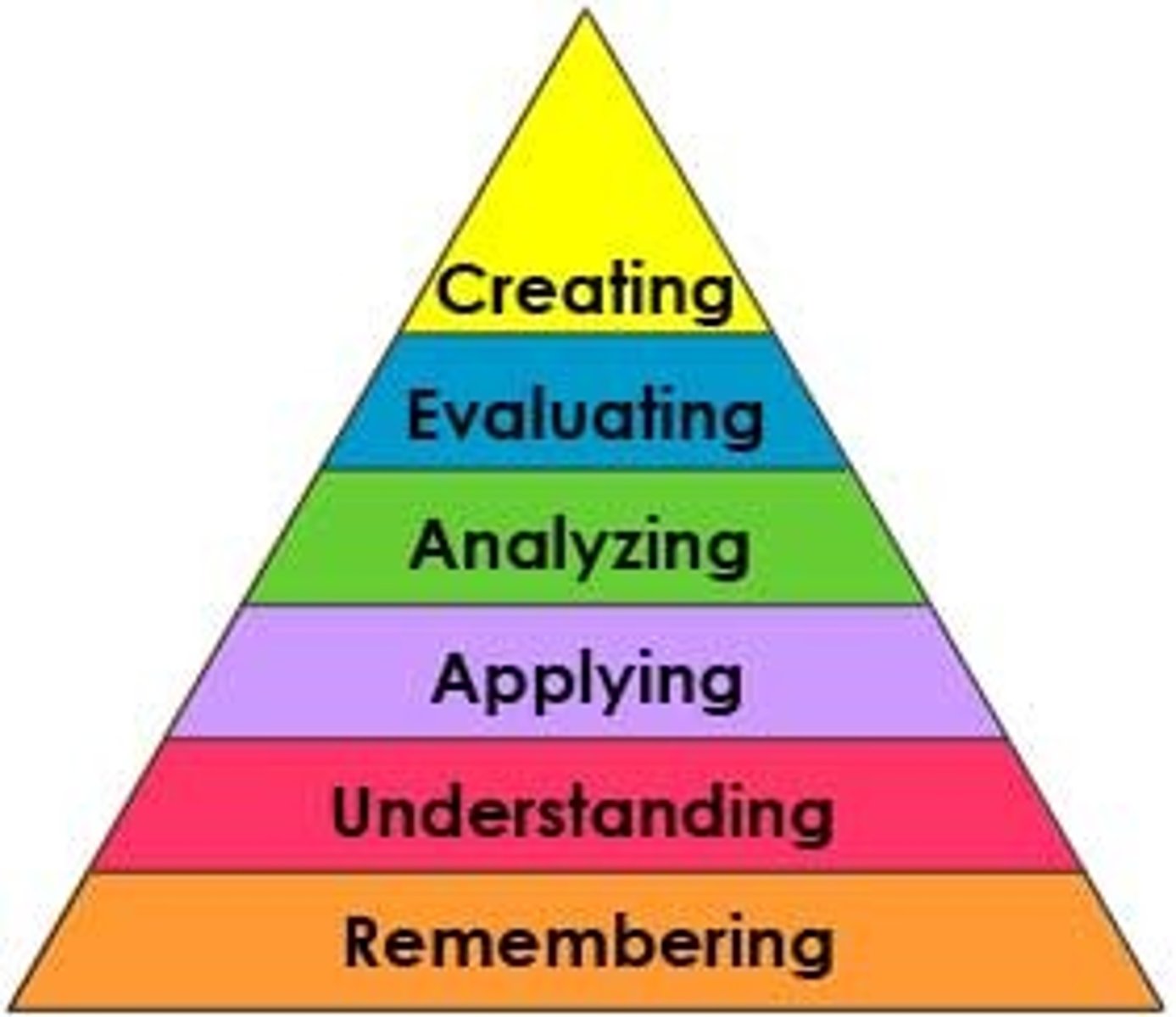
Step 1: Bloom's Taxonomy
Remember: Remember relevant forms and sources of information. Includes facts, concepts, terms, or sources of information you know, such as books or websites.
Step 2: Bloom's Taxonomy
Understand: study relevant materials until you feel you have a full understanding of the issue at hand. DO NOT move on until you feel you can explain all the important facts, concepts, and terms you have remembered.
Step 3: Bloom's Taxonomy
Apply: Look at the knowledge you gathered while working through the two first rungs of Bloom's pyramid.
How does the knowledge apply to the question at hand?
Step 4: Bloom's Taxonomy
Analyze: Break the problem into parts. What are the major elements of the problem? Define them carefully. Make sure you have a full working understanding of what the problem consists of and how it manifests.
Step 5: Bloom's Taxonomy
Evaluate: Ruthlessly subject your work to criticism. If there are any significant flaws in your analysis, reality will unapologetically reveal them.
Step 6: Bloom's Taxonomy
Create: At the end of the long process of planning, unleash the plan. The strands of the argument and analysis come together.
Paul-Elder framwork and Bloom's taxonomy
Excellent guidelines for utilizing critical thinking in a structured way.
Characteristics of critical thinking individuals:
Analytical and careful thinkers, as well as emotional and ethical. A genuine critical thinker exhibits a combination of traits. Critical thinkers couple their intelligence with systematic thinking and emotional courage.
1 Characteristic of critical thinkers: truth seeker
Truth seeker: Relentless pursuit of the truth. That means gathering data and analyzing it to reveal the true nature of things. Value honesty from others and honesty from themselves.
2 Characteristic of critical thinkers: systematic
Systematic: Actively seek to work through their actions carefully and methodically. Before they take a complex action, they will design and then execute a detailed and in-depth plan of how they plan to achieve their specified goal.
3 Characteristic of critical thinkers: analytical
Analytical: Capable of both locating problems and solving them. Will remained focused on the most important components rather than get lost in the details.
4 Characteristic of critical thinkers: open minded
Open-Minded: Never dismiss information based only on its source. Do their best to evaluate its validity on its own merits.
5 Characteristic of critical thinkers: Self confident
Self-confident: Courage to defend and promote unpopular ideas. Willing to confidently support true and logical opinions in the face of significant social opposition. Most challenging and risky elements in wielding critical thinking meaningfully.
6 Characteristic of critical thinkers: Inquisitive
Inquisitive: Not lazy, be willing to put in the work to challenge existing orthodoxy. Work even harder to establish alternatives. Willing to make mistakes. No shortcuts.
7 Characteristic of critical thinkers: Cognitive and Emotional mature
Cognitive and Emotional mature: New information can and should undermine long-held assumptions. Brave enough to follow through, despite the mental discomfort and social risk associated with challenging prevailing norms. Takes courage and humility. Courage to admit that you are bad at something/made the wrong decision and humility to admit that our emotions can get in the way of accurate analysis.
Charitability
To avoud the "straw man" fallacy, it is important to examine an argument fairly. When presenting arguments we disagree with, we often intentionally portray them as absurd.
8 Characteristic of critical thinkers: Foresight
Foresight: Alleviate a great deal of doubt and uncertainty around future developments. Make a reasonable estimation of the most likely developments and plan accordingly. Cultivate foresight by developing an understanding of how others think.
What is key for solving problems?
Risk analysis; a critical thinker will have contingencies worked out for all the most likely eventualities.
Sympathy vs Empathy
Empathy refers to your ability to understand how others think and why. Sympathy involves identifying with another individual or group to the point that you can feel what they do. A deep sympathy may impinge on your critical thinking by forming an emotional bias.
Intellectual integrity
Not believing that the reasoning behind an argument we disagree with is inferior to our efforts. Don't assume rival is ill-informed or does not have all of the facts. Treat the arguments of others fairly.
Does our conscious and unconscious biases play a role in shaping our thoughts and opinions?
Yes, we have significant gaps in our information and knowledge. Practice true intellectual integrity and put aside our biases about other people's intellectual or moral inferiority.
What are barriers to critical thinking?
Beliefs, biases, intuition, and emotions
Affirming the consequent
Occurs in 2 stages (logical fallacy):
-A person believes that an outcome is likely to occur under specific circumstances
-When that outcome materializes, the same person assumes those preconceived circumstances were the cause of it.
Why do we make costly mistakes?
In a complex environment we are unable to process all relevant information in real-time. We rely on simplifications to make quick decisions, and we rely heavily on unexamined beliefs we have accepted earlier in life.
Beliefs:
Ability to question cultural ideals is at the heart of critical thinking. Reexamining beliefs will make a difference in your rational decision-making process. Be open to any outcome which is supported by the evidence, no matter our beliefs.
Biases:
A bias is when an individual has either a strong preference or aversion to something, regardless of its merits. We do not generate or accept ideas to satisfy intellectual curiosity but to satisfy our emotional needs. Bias clouds our judgement and makes it more likely that we will make costly mistakes.
What does our brain actively seek out?
Ideas that will bring order and certainty into our lives. We develop our thought patterns as a means of dealing with uncertainty. Our minds develop a habit of seeking our certainty instead of truth.
Intuition:
An attempt to gain knowledge without indepth reasoning. Allows for successful short-term goals without using the full energy required to process critical thought.
Heuristics
How we turn our intuition into thoughts and action plans. By exposing us to the real uncertainty around us, critical thinking can increase anxiety in the short term.
Association fallacy
Illogical thinking; this is when we consider someone who has ties to a wrongdoer to be guilty, through no fault of their own.
Ad hominem attack: fallcy
Focus on discrediting the source of the argument rather than its validity. We find reasons to doubt the source based on information that is unrelated to the argument we are engaged with.
Emotions:
Anger is incompatible with critical thought. Some emotions make us think more carefully and apply more effort to analysis and solutions, for example, passion for a subject. Help us frame our problems morally and usefully.
Emotions: good and bad
The right emotions ( empathy, compassion, generosity) can bring out our best problem-solving instincts. Negative emotions ( anger, jealousy, self-righteousness, pride) cloud our judgement and make us pursue the wrong objectives, , such as satitating our insecurities or our need for revenge.
2 rules with emotions:
First rule: if your emotions are going to be involved in the process, make sure they are your noble emotions. Empathy, patience, and tolerance are incredible emotions and very helpful in engendering critical thought. Anger and pettiness, and jealousy are undesirable.
Second rule: Emotions can be essential in defining problems and setting our their solutions. They are far less useful in determining the process you followonce the goals and issues are determined.
The internet
Gathering data and information is a crucial element of critical thinking. We rely on the internet for an increasingly large amount of information.
How to tell if a website is a good source
If it is attributed to someone (especially with credentials), not attributed to an interested party, if it contains scientific sources.
Methods of encouraging critical thinking in the classroom:
Project based learning and question generation
How to encourage critical thinking in the workplace:
Hire individuals with a predilection for critical thinking, encourage a culture of critical thought, and stress the process of problem-solving rather than just the solution.
How to sell an argument
Know your audience, clarity (make sure your argument is clear), anticipate counterarguments (understand why you need to listen to counterarguments)
What to adopt for an atmosphere of critical thinking at home
Adopt transperency-clearly explain the rationale behind our actions.
Chores - explain to everyone why you have arranged the chores and other procedures in the current manner.
Family vacation planning- Allow everyone in the family to have a say in the vacation. Help make collaborative decisions and keeps the spouse accountable.
Ill-defined problems
A provenn method of developing critical thinking skills is by working through problems with no clear solution. Our brains become sharper and more critical. Quality of life will improve over time.
Reasoning
Journey of the mind. Humans all reason. We interpret the same things in different ways.
How many laws of logic are there?
4
Law of logic #1
Law of identity: Explains that everything is identical to itself.
Law of logic #2
Law of excluded middle: Each and every thing either is or is not. If there are two contradictory propositions, either the first is true and the second is not true, or the second is true, and the first is not true.
Law of logic #3
Law of non-contradiction: Nothing can simultaneously be and not be. Similar to the law of identity. When two propositions can co-exist, they are not contradictory and do not violate the law of non-contradiction.
Law of logic #4
Law of sufficient reason: Of everything that is, it can be found why it is. Most controvesial law. For every unexplained fact, a rational mind will seek the reason behind it. It must be sufficient.
Concepts important to logic
Claim, Inference, and Argument
Argumentation
Structured expression of logical reasoning
Convincing argument
It is not enough for the conclusions and premises to be true. The premises should also provide compelling reasons to accept the conclusion.
Validity and Soundness
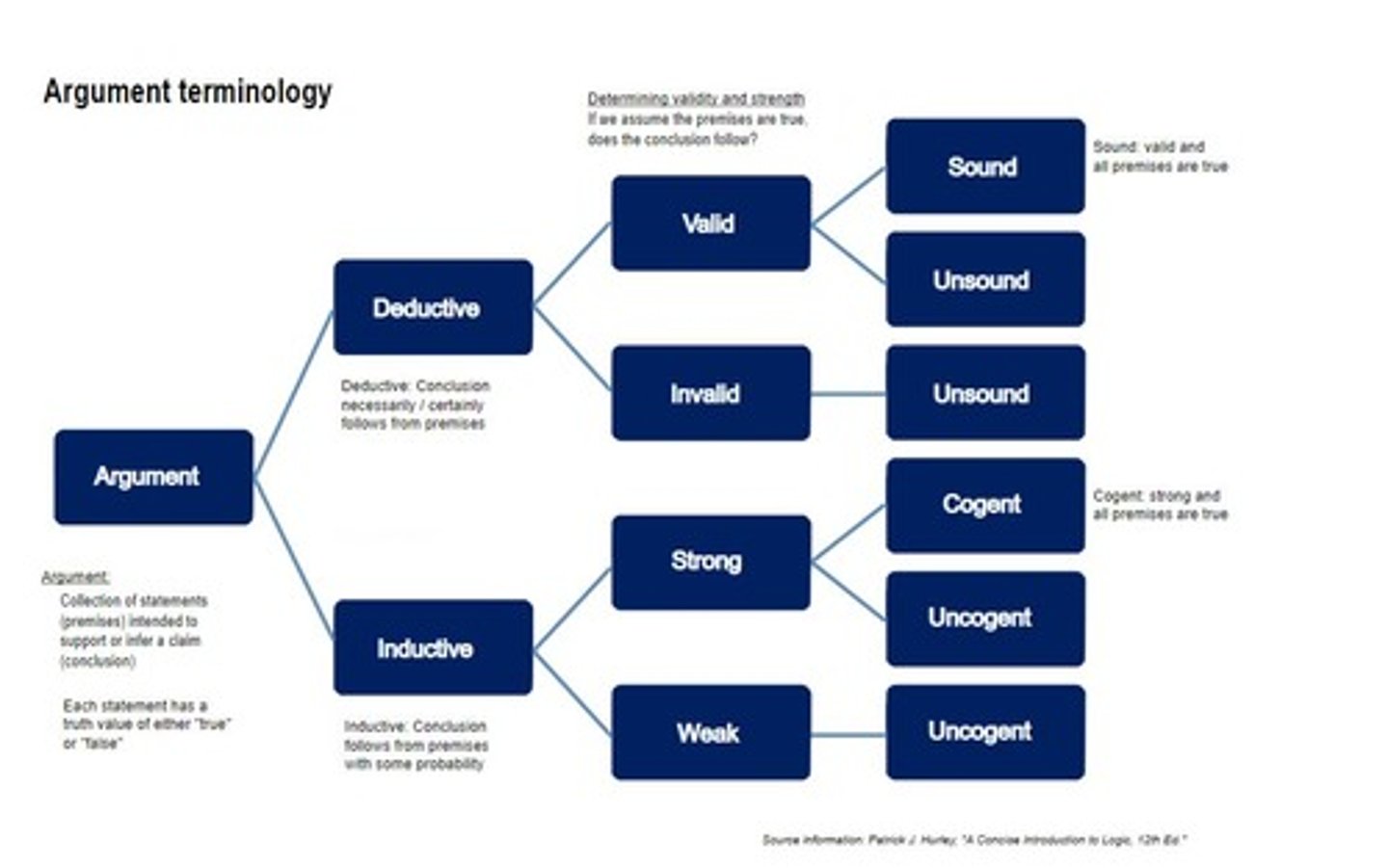
The validity of an argument is completely determined only by its structure, not its content. An argument may be valid even if it is not sound. An argument is valid if it takes a form that makes it impossible for the premises to be true, but the conclusion is false.
Validity vs Soundess
In a valid argument, when all the premises are true, the conclusion is always true. Even if a premise is false, the conclusion can still be true and the argument is valid but unsound. Even when both premises are true, the conclusion can still be false, leading to an invalid argument.
Simple vs complex arguments
Simple arguments have one or more premises and a conclusion. A complex argument has a set of arguments whose premises and/or conclusios overlap.
Deduction and induction
Deductive reasoning is a fundamental form of logical inference that begins with a general theory narrowed down by information and reasoning to reach a specific conclusion. Inductive reasoning proceeds in the reverse direction. It begins with specific observations and infers a general conclusion from them. Requires a larger amount of empirical data than deductive reasoning.
Difference between deductive and inductive argument
Difference lies in the intention of the arguer. IN deductive arguments, the arguer gurantees that the conclusion is true by giving true premises. In inductive arguments, the arguer believes that the truth of the promises only gives good reason to believe that the conclusion is probably true.
Another difference between deductive and inductive argument
Deductive arguments assert the claim that the truth of its premises gurantees the truth of its conclusion. If all the premises are true, then the conclusion must be true. An inductive argument allows for some probability that the conclusion may be more likely true than not true.
Terms used to describe deductive and inductive arguments...
What elements are the cause of logical errors we make almost daily?
Bias, sterotyping, prejudice, and discrimination.
Sterotyping
Involves generalizing a characteristic over an entire group of people.
Bias
A person's attitude leads to prejudice. To prejudge is to render a conclusion before proper reasoning.
Key to good judgement
To distinguish a fallacy from a sound argument. Not all fallacies have serious consequences;some are so commonplace that we encounter them daily.
Fallacy
The use of invalid or otherwise faulty reasoning in the construction of an argument that may appear to be well-reasoned if unnoticed.
What makes it difficult to detect a fallacy in real-world situations?
Cultural sterotypes, cultural biases, and past experiences.
3 steps to identify the type of common fallacy that tricks our minds
1) Identify the wrong premises (the bad proofs)
2) Identify the wrong alternative outcomes
3) Identify logical disconnects between premises and conclusion.
5 basic types of fallacies
Recurring errors in reasoning (def of fallacies)
#1 Fallacy: Affirming the consequent (Modus Ponens)
Based on the result or consequent, the most readily apparent cause is assumed to be true without considering other possible causes. "If P, then Q. A. Therefore, P."
#2 Fallacy: Denying the Antecedent (Modus Tollens)
AKA the fallacy fo the inverse, or inverse error. Denying the antecedent is a formal fallacy wherein the inverse from the original statement is inferred. This is invalid because denying the antecendent does not necessarily imply denying the consequent. Its form is: "If P, then Q. If not P, then not Q."
#3 Fallacy: Affirming a Disjunct
AKA False exclusionary disjunct. A disjunct refers to one of the terms of a disjunctive proposititon that excludes one term from another. The fallacy of affirming a disjunct involved affirming one of two things disjoined, then denying the other term.
Form: "A or B. A. Therefore, not B."
#4 Fallacy: Denying a Conjunct
If a disjunct is a term disjoined from another, then a conjunct is a term joined to another as being in the same class. The fallacy consists of declaring, in the second premise, that one of the conjuncts is false, then concluding the other is true.
2 forms: "Not both p and q. Not p. Therefore q. "
" Not both p and q. Not q. Therefore, p."
#5 Fallacy: The fallacy of the undistributed middle (Non Distributio Medii)
This fallacy is a syllogistic fallacy because it is the form fo a categorical syllogism.
-All A is B
- All B is C
-Therefore, all A is C
The structure has two distinct but related premises, followed by a conclusion that embodies the deductive argument. The middle term is that term included in both syllogisms. Note that the basic syllogistic structure comprises a valid argument because as long as its prepositions are true, then it is logically sound.
Fallacy of the undistributed middle
The middle term is not distributed in either premise. It has the form " All Z is B. All Y is B. Therefore, all Y is Z."
Formal fallacies involve what?
A weakness is the form or technical structure of an argument, rather than whether or not the conclusion is true.
Truth
The truth is hard to accept, especially when it challenges our most precious convictions that are, nevertheless, wrong. Formal errors are more readily found because they are signalled by faulty arugment structures.
 Note
Note  Flashcards (61)