Neuro Parts 1-7 Combo
 Call Kai
 Learn
Learn Practice Test
 Spaced Repetition
 Match
Match Flashcards
 Knowt Play
1/277

There's no tags or description
Looks like no tags are added yet.
Name | Mastery | Learn | Test | Matching | Spaced | Call with Kai |
|---|
No analytics yet
Send a link to your students to track their progress
278 Terms
What are the five main regions of the CNS?
Spinal cord
Cerebrum
Diencephalon
Brainstem
Cerebellum
What is the primary function of the spinal cord in the CNS?
It serves as the communication highway between the periphery and the rest of the CNS through ascending sensory tracts and descending motor tracts and also mediates reflexes
What is the primary function of the cerebrum?
It is the largest part of the brain and handles:
cognition
voluntary movement
sensation
language
memory
emotion
executive function
What is the primary function of the diencephalon?
The diencephalon is a deep relay and control area that helps:
Process information
Regulate body homeostasis
Influence endocrine/melatonin function
Contribute to movement circuits
through the:
Thalamus
Hypothalamus
Epithalamus
Subthalamus
What structures make up the brainstem?
Midbrain
Pons
Medulla
What is the primary function of the brainstem?
Connects the cerebrum to the spinal cord and cerebellum
Contains many cranial nerve nuclei
Regulates vital functions
What is the primary function of the cerebellum?
It coordinates:
movement
posture
balance
motor learning
compares intended movement with actual movement
What does the sagittal plane divide?
Left and right
What structures are seen in a mid-sagittal view of the brain?
Corpus callosum
third ventricle
aqueduct
fourth ventricle
brainstem
cerebellum
What does the coronal or frontal plane divide?
Anterior and posterior
What structures are commonly seen in a coronal view of the brain?
Both hemispheres at once
lateral ventricles
corpus callosum
thalamus
basal ganglia
internal capsule
What does the horizontal or axial plane divide?
Superior and inferior
What is a horizontal or axial plane useful for in brain imaging?
common on CT and MRI
shows rostral-to-caudal relationships, ventricles, deep nuclei, and anterior and posterior horns
What is found in gray matter?
Neuron cell bodies
dendrites
synapses
glia
blood vessels
mostly unmyelinated axons
What is the main role of gray matter?
Processing and integration of information
What is found in white matter?
Mainly myelinated axons
What is the main role of white matter?
Fast communication between cortical, subcortical, brainstem, and spinal cord regions
Where is gray matter located in the brain?
On the surface/cortex
This is the outer layer of the cerebrum
In deep nuclei
These are deeper collections of neuron cell bodies, like parts of the basal ganglia, thalamus, etc
Where is white matter located in the brain?
Deeper in the brain where it forms tracts such as the corpus callosum and internal capsule
How are gray matter and white matter arranged in the spinal cord?
Gray matter is central in an H or butterfly shape and white matter is on the outside
How does the arrangement of gray and white matter in the spinal cord compare to the cerebrum?
It is reversed or flipped compared with the cerebrum
Which spinal cord levels have the most white matter?
Cervical levels
Why do cervical spinal cord levels have the most white matter?
Because they carry nearly all ascending and descending tracts
Why do cervical spinal cord levels also have more gray matter?
Because they contain neurons for upper limb innervation
Which spinal cord levels contain the lateral horn?
Thoracic levels
What is the function of the lateral horn in the thoracic spinal cord?
It contains sympathetic autonomic neurons
At what spinal cord levels are sympathetic autonomic neurons found in the lateral horn?
T1 to L2
How does gray matter in the thoracic spinal cord compare with cervical and lumbar levels?
Thoracic levels have less gray matter
How does white matter in lumbar and sacral spinal cord levels compare with cervical levels?
Lumbar and sacral levels have less white matter than cervical levels
Why do lumbar and sacral spinal cord levels have less white matter?
Because fewer ascending and descending tracts remain
Why do lumbar and sacral spinal cord levels have proportionally more gray matter?
Because they contain more lower limb motor and sensory neurons
Gray matter = the “thinking/processing centers”
Which spinal cord enlargements have more gray matter for limb innervation?
Cervical and lumbar enlargements
What is the key idea to remember about gray matter and limb innervation in the spinal cord?
Gray matter is increased where limb innervation is needed, especially in the cervical and lumbar regions
What are the four major lobes of the cerebrum?
Frontal
Parietal
Temporal
Occipital lobes
What is the main role of the frontal lobe?
Voluntary motor function
Motor planning
Executive function
Decision-making
Personality
Speech production
Which language area is found in the frontal lobe?
Broca’s area
What is Broca’s area responsible for?
Speech production
What is the main role of the parietal lobe?
The main role of the parietal lobe is sensory processing, especially body sensation and spatial awareness
Somatic sensation
Touch
Pressure
Temperature
Pain
Proprioception
Spatial awareness
Sensory integration
What is the main role of the temporal lobe?
Auditory processing
Language comprehension
Memory
Emotional processing
Which language area is found in the temporal lobe?
Wernicke’s area
What is Wernicke’s area responsible for?
Language comprehension
Which temporal lobe structure is important for memory?
Hippocampus
What is the main role of the hippocampus?
Formation of new memories and learning
What is the main role of the occipital lobe?
Primary visual processing
Visual perception
Color recognition
Orientation
Depth perception
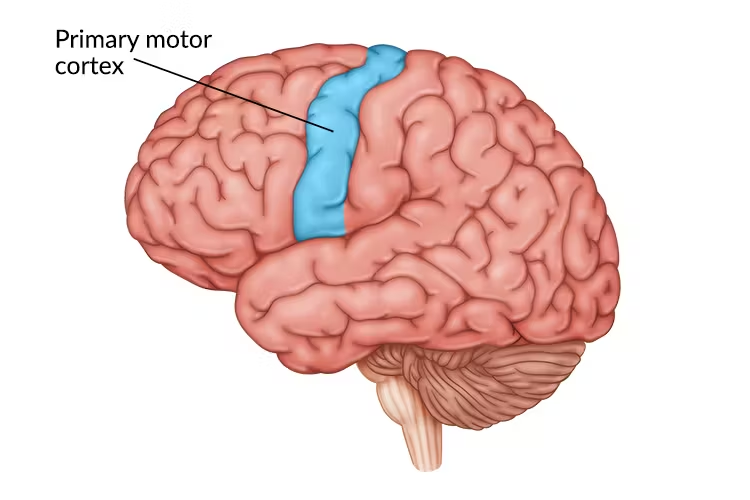
Where is the primary motor cortex located?
Precentral gyrus of the frontal lobe, anterior to the central sulcus
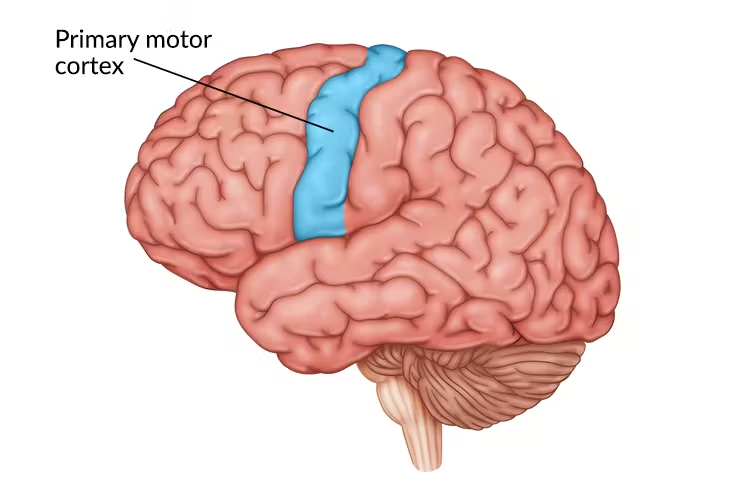
What does the primary motor cortex do?
Sends voluntary motor commands DOWN through descending motor pathways
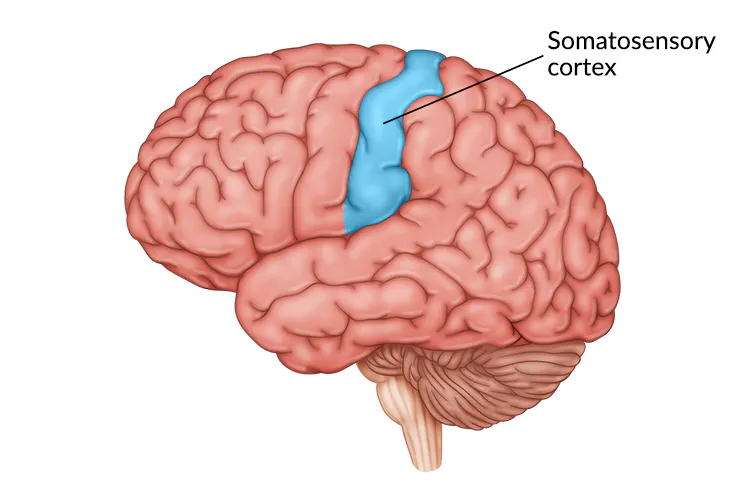
Where is the primary somatosensory cortex located?
Postcentral gyrus of the parietal lobe
Posterior to the central sulcus
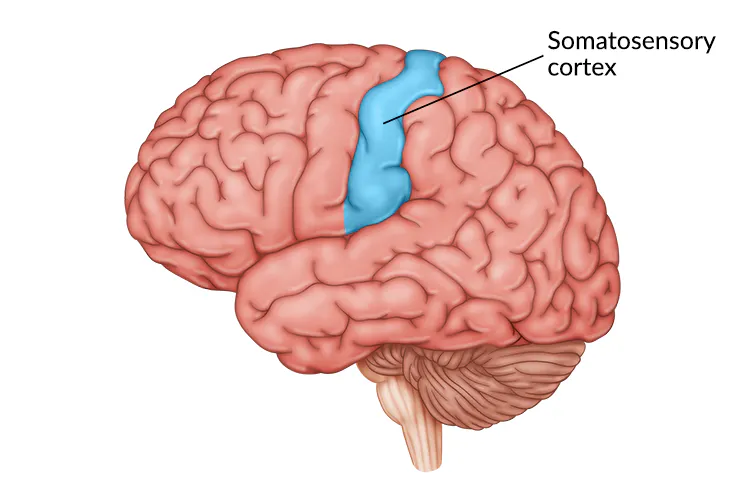
What does the primary somatosensory cortex receive?
Touch, pain, temperature, and proprioceptive input UP from the body
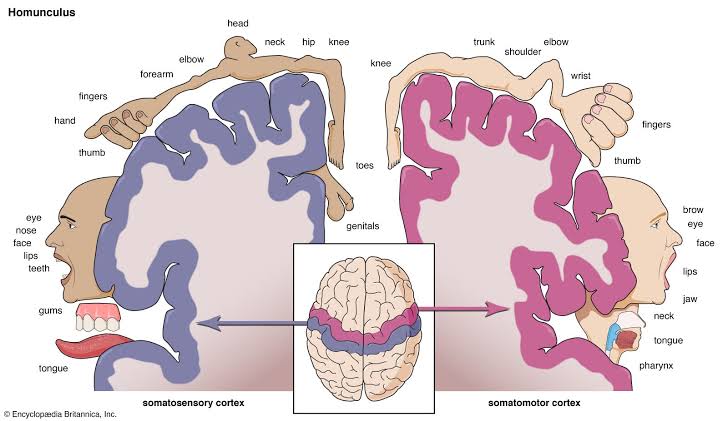
How are the primary motor and primary sensory cortices organized?
Somatotopically as a homunculus
What side of the body do the motor and sensory cortices mostly control or process?
The contralateral side of the body
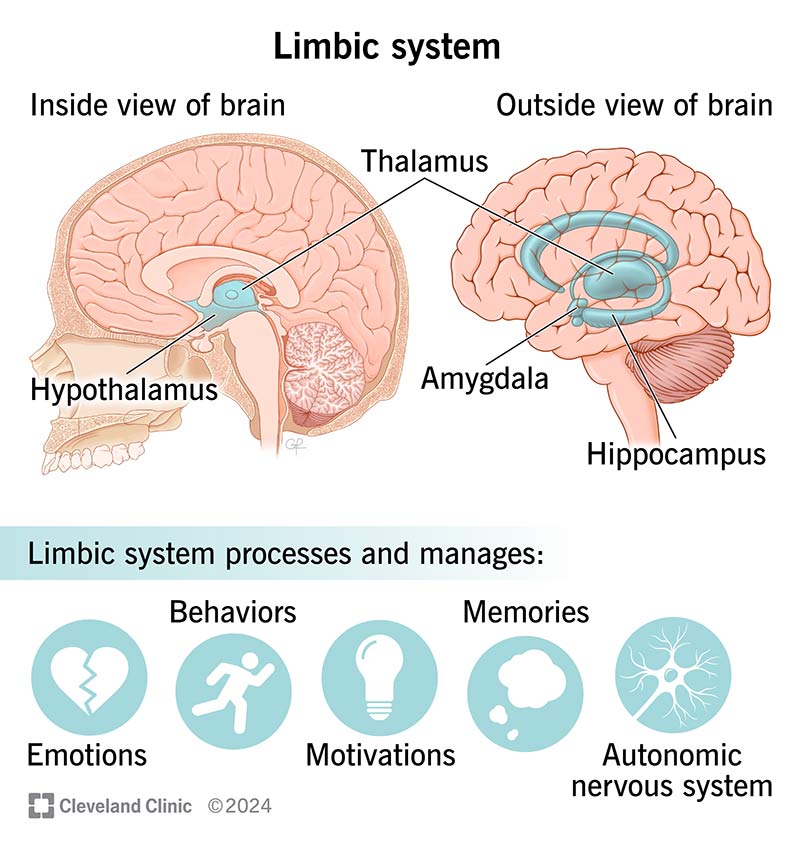
What is the limbic system involved in?
A network of brain structures involved in:
Emotion
Memory
Motivation
Drive
Threat response
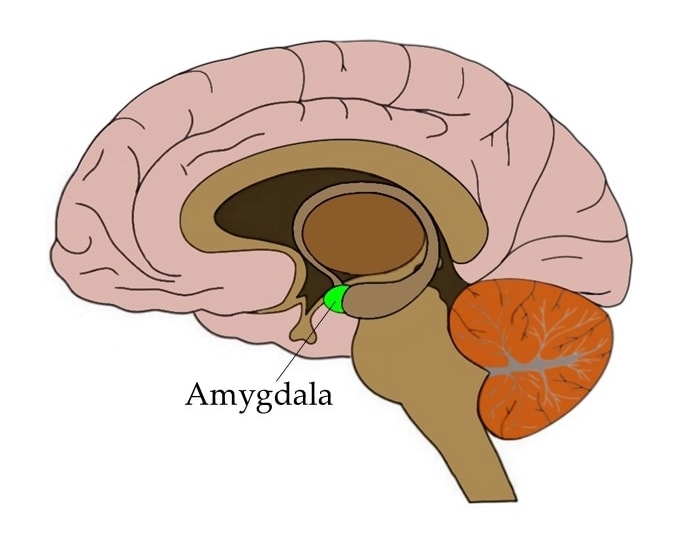
What is the role of the amygdala (part of limbic system)?
The amygdala helps process emotion, especially:
Fear/threat detection
Fight-flight-freeze responses
Aggression
Emotional memory
What structures help link emotion with autonomic and visceral responses?
Cingulate cortex
Insula
Hypothalamus
Where is the motor homunculus located?
Precentral gyrus of the frontal lobe, just anterior to the central sulcus
Where is the sensory homunculus located?
Postcentral gyrus of the parietal lobe, just posterior to the central sulcus
What part of the homunculus represents the lower limb and foot?
Medial cortex
What part of the homunculus represents the trunk, upper limb, hand, face, lips, and tongue?
More lateral cortex
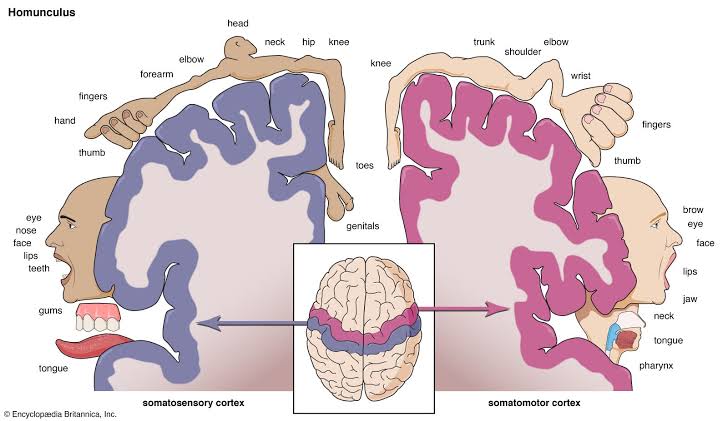
Why do the hands, lips, and face have large cortical areas on the homunculus?
They require more complex and important motor or sensory control, not because they are physically larger
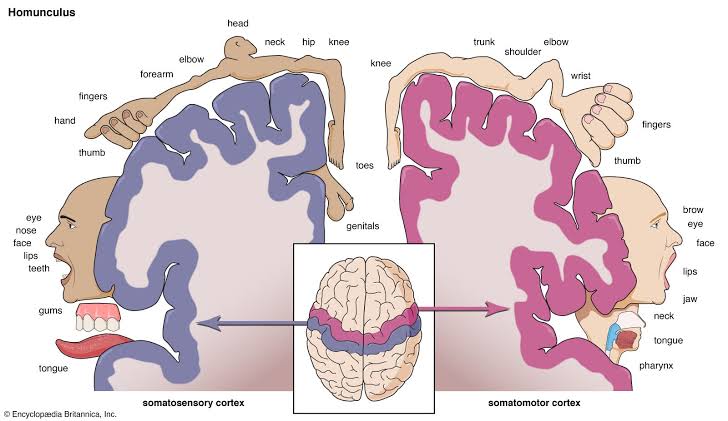
What lesion could cause right leg weakness from motor homunculus damage?
Left ACA stroke affecting the medial left precentral gyrus
L damage → R leg weakness
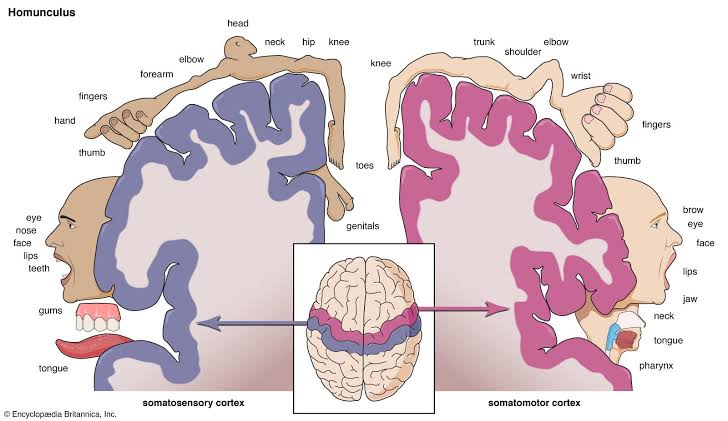
In a left ACA stroke causing right leg weakness, what part of the homunculus is damaged?
Lower limb region of the motor homunculus
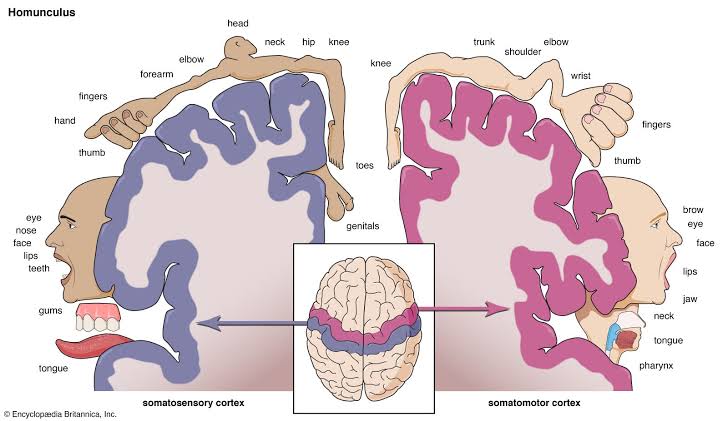
What lesion could cause right facial droop and right arm weakness?
Left MCA stroke affecting the lateral precentral gyrus
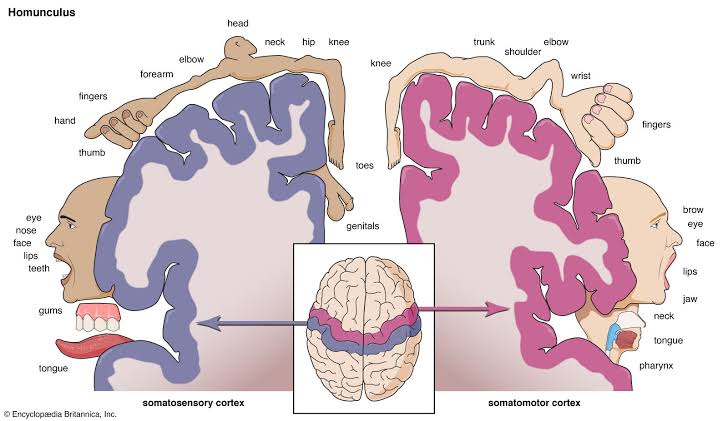
In a left MCA stroke causing right facial droop and right arm weakness, what part of the homunculus is damaged?
Face and upper limb region of the motor homunculus
What lesion could cause left hand numbness or poor hand proprioception?
Right parietal lesion affecting the lateral postcentral gyrus
In a right parietal lesion causing left hand numbness, what part of the homunculus is damaged?
Hand region of the sensory homunculus
What lesion could cause left leg sensory loss?
Right medial postcentral lesion
In a right medial postcentral lesion causing left leg sensory loss, what part of the homunculus is damaged?
Lower limb region of the sensory homunculus
What are the four cortical lesion syndromes known as the 4 A’s?
Aphasia
Apraxia
Agnosia
Astereognosis
What is aphasia?
Impaired language due to damage to language areas of the brain
What functions can aphasia affect?
Speaking
Understanding
Reading
Writing
What is Broca’s aphasia?
Language comprehension is relatively intact, but speech is slow, effortful, and nonfluent
Broca = Broken speech
What is Wernicke’s aphasia?
Speech may be fluent and smooth BUT does not make sense, and language comprehension is impaired
Wernicke = Word salad
What is “word salad” associated with?
Wernicke’s aphasia
What is apraxia?
Difficulty planning or sequencing learned movements even when strength and basic sensation may be adequate
How can apraxia affect function?
Apraxia impairs motor planning, so the person may:
Struggle with speech
Fine motor tasks
Gross motor tasks
Functional activities
Even when strength and basic sensation are intact
Apraxia = “A-practice-ia”
Like they can’t properly “practice/perform” a learned motor skill on command
What is agnosia?
Inability to process or recognize sensory information despite intact basic sensation
Example: they can see an object but cannot identify what it is
What can a person with agnosia have trouble identifying?
Agnosia is the inability to recognize or interpret sensory information, such as objects, people, sounds, shapes, smells, or visual input, despite the basic sense being intact
What is astereognosis?
Inability to recognize a familiar object by touch alone
What does astereognosis usually reflect?
Impaired somatosensory association or integration
What brain area is often involved in astereognosis?
Parietal cortex
Can basic touch still be intact with astereognosis?
Yes, basic touch may still be felt even though the object cannot be recognized by touch alone
What structures make up the diencephalon?
Thalamus
Hypothalamus
Epithalamus
Subthalamus
What is the thalamus?
Two egg-shaped collections of nuclei in the diencephalon
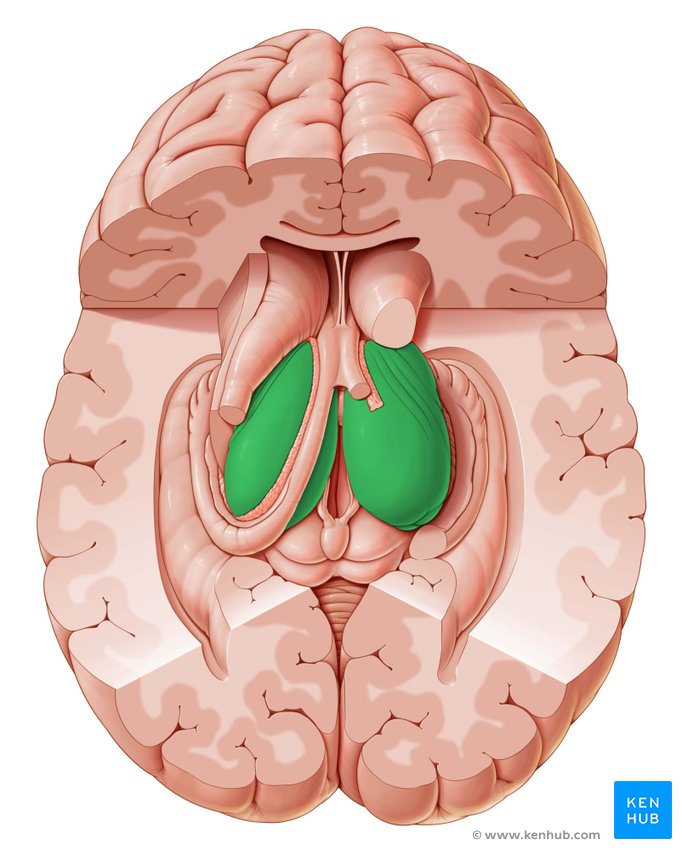
What is the main role of the thalamus?
It acts as a major relay station to the cerebral cortex for sensory and motor information
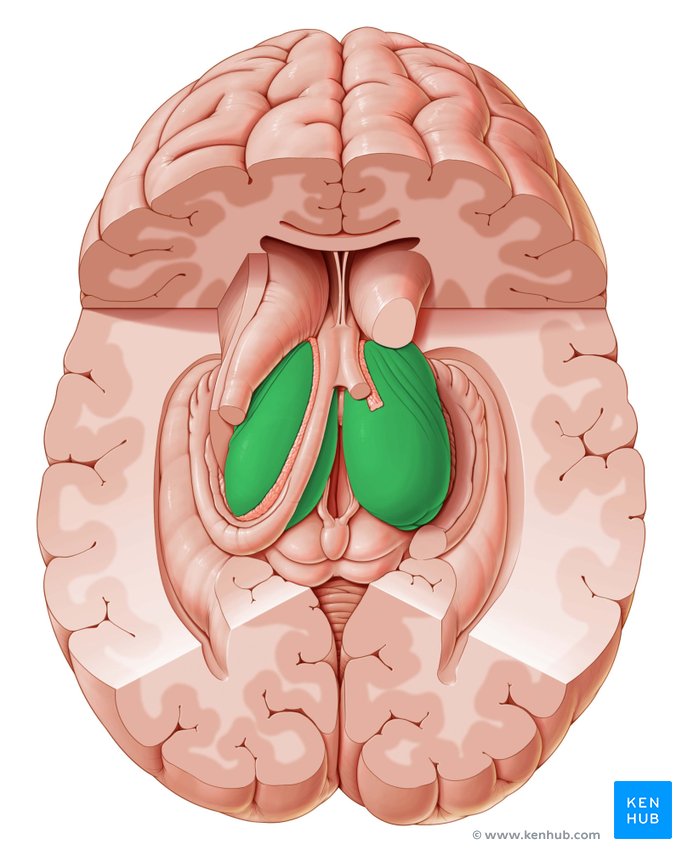
What other functions is the thalamus involved in?
Memory
Emotion
Consciousness,
Arousal
Attention
Sleep-wake regulation
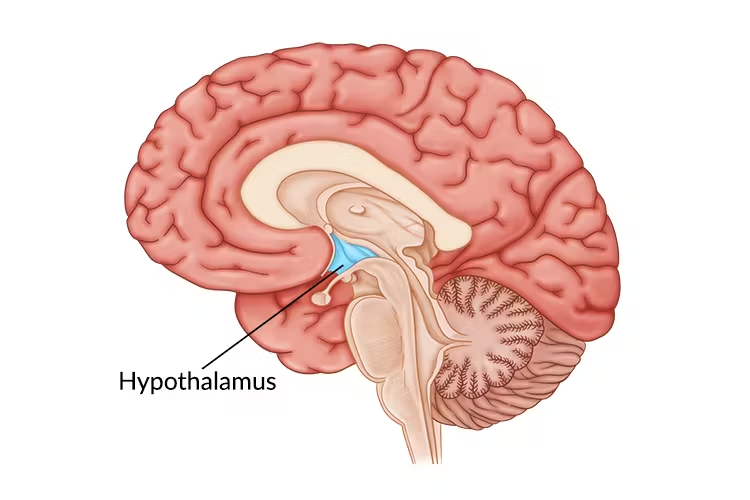
What is the hypothalamus?
The homeostasis center of the brain
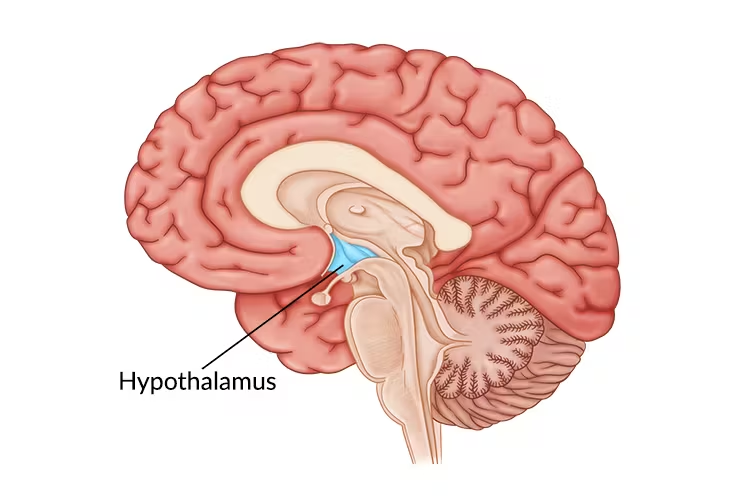
What body functions does the hypothalamus regulate?
Body temperature
Hunger
Thirst
Metabolic rate
Fluid and chemical balance
Autonomic function
Pituitary hormone release
What is the epithalamus?
A diencephalon structure that includes the pineal gland
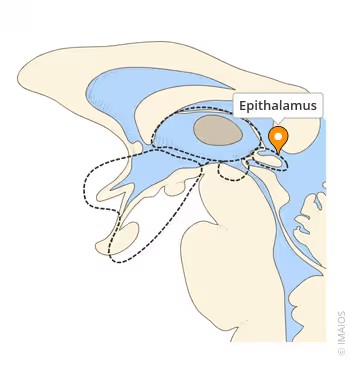
What does the epithalamus influence?
Melatonin secretion and endocrine/circadian rhythms, mainly through the pineal gland
Epi-thalamus = evening thalamus
because melatonin rises at night
What structure is included in the epithalamus?
Pineal gland
What is the subthalamus involved in?
Basal ganglia motor control circuits
What is the role of the subthalamic nucleus?
It helps control movement and stop unwanted movement
Which diencephalon structure is most associated with sensory and motor relay to the cortex?
Thalamus
Which diencephalon structure is most associated with homeostasis?
Hypothalamus
Which diencephalon structure is most associated with melatonin secretion?
Epithalamus
Which diencephalon structure is most associated with stopping unwanted movement?
Subthalamic nucleus
What is the main role of the basal ganglia?
To modulate movement by:
Helping start desired movements
Suppress unwanted movements
Rapidly stop actions when needed
What are the three major basal ganglia motor pathways?
Direct pathway
Indirect pathway
Hyperdirect pathway
What is the nickname for the direct pathway?
Go pathway
to be direct…GO! GO! GO!
What does the direct pathway do?
Facilitates desired movement
How does the direct pathway facilitate movement?
It disinhibits (removes the brake from) the thalamus, allowing the thalamus to excite/activate the motor cortex