perception - 11 intro
 Call Kai
 Learn
Learn Practice Test
 Spaced Repetition
 Match
Match Flashcards
 Knowt Play
1/20

There's no tags or description
Looks like no tags are added yet.
Name | Mastery | Learn | Test | Matching | Spaced | Call with Kai |
|---|
No analytics yet
Send a link to your students to track their progress
21 Terms
What is sound?
-variation In pressure of air
-picked up by ears and reulsts in perception of sound
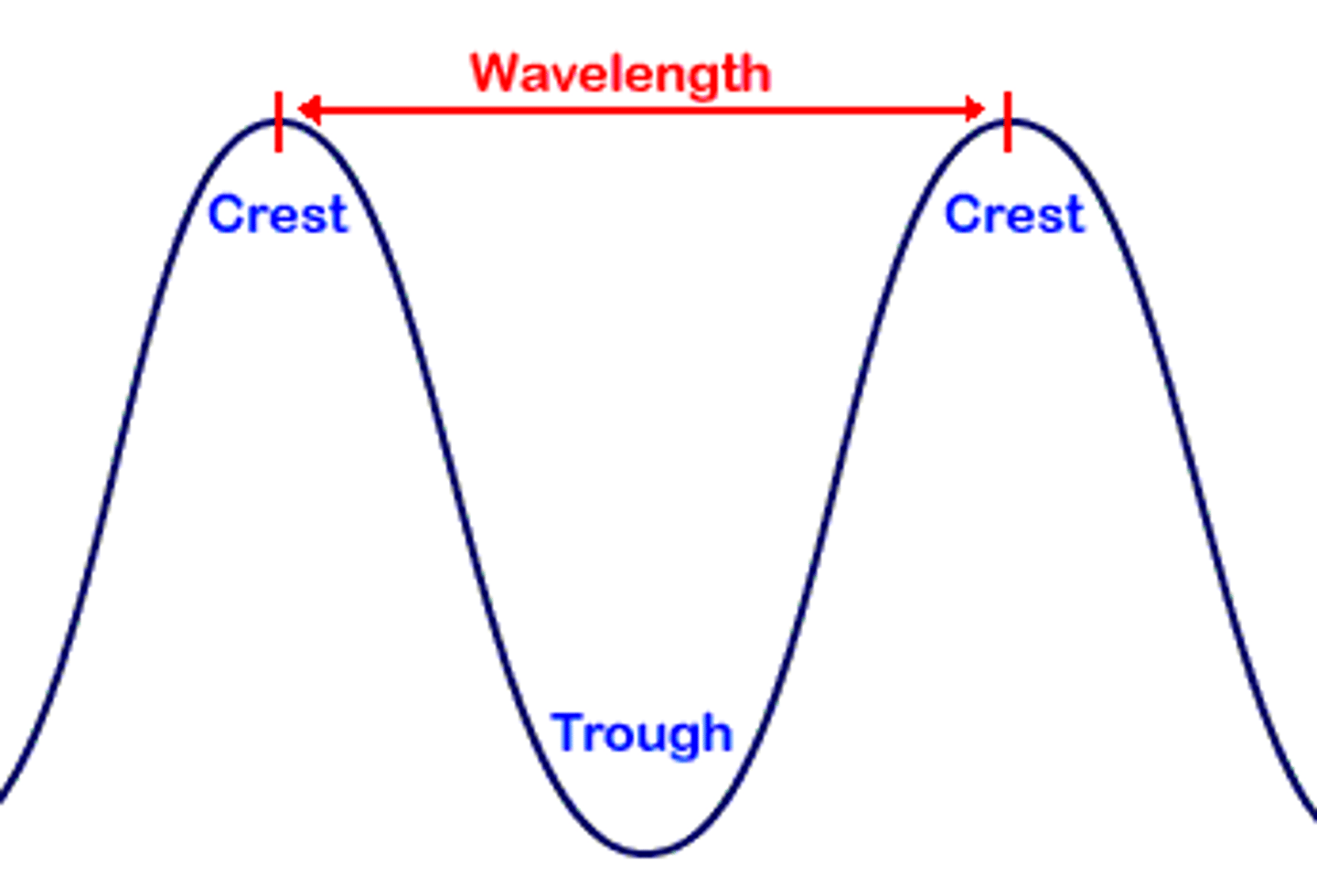
frequency + wavelength
Wavelength is the distance between one peak (in pressure) and the next (blue)
Frequency is the number of pressure cycles per second at point in space (Hz) (red)
-if frequncy is faster wavelength will be shorter
sounds vs light waves - numbers
speed: 340 m/s 300,000,000 m/s
wavelengths: 1.7 cm to 17 m 400-700 nm
Frequency: 20-20,000 Hz Thz (trillions of cycles persecond)
what the differences with sound waves mean
-can almost forget light is wave and can think it as ray
-because so small/speedy
1) Sound transmission from place to place can cause discernible delays (as the speeds are discernable to a human - can see before here)
2) The perception of different frequencies/wavelengths is much more significant for hearing
3) Sound can wrap around obstacles (eg your head, obstacle, corners - unlike light)
water waves analogy
Imagine two sets of water ripples meet
-useful analogy
Waves on the surface of water are a useful analogy
-go out in circles around where smth happens on water
The only important difference is that sound waves radiate in three dimensions, rather than two - the wavefront is spherical, not circular.
-when waves meet they pass through each other
-any point on water surface is now two waves added together
physical vs psychological terms highness
frequency (Hz) vs pitch (psych)
-relayed in a simple linear relationship -- but how this works is controversial
physical vs psych volume
Physical
-amplitude - how much pressure varies (Pa or N/m squared)
-intensity - about energy levels relate to pressure squared (W/msquared)
-sound level (decibels)
Psychological
-loudness
defining 0 dB
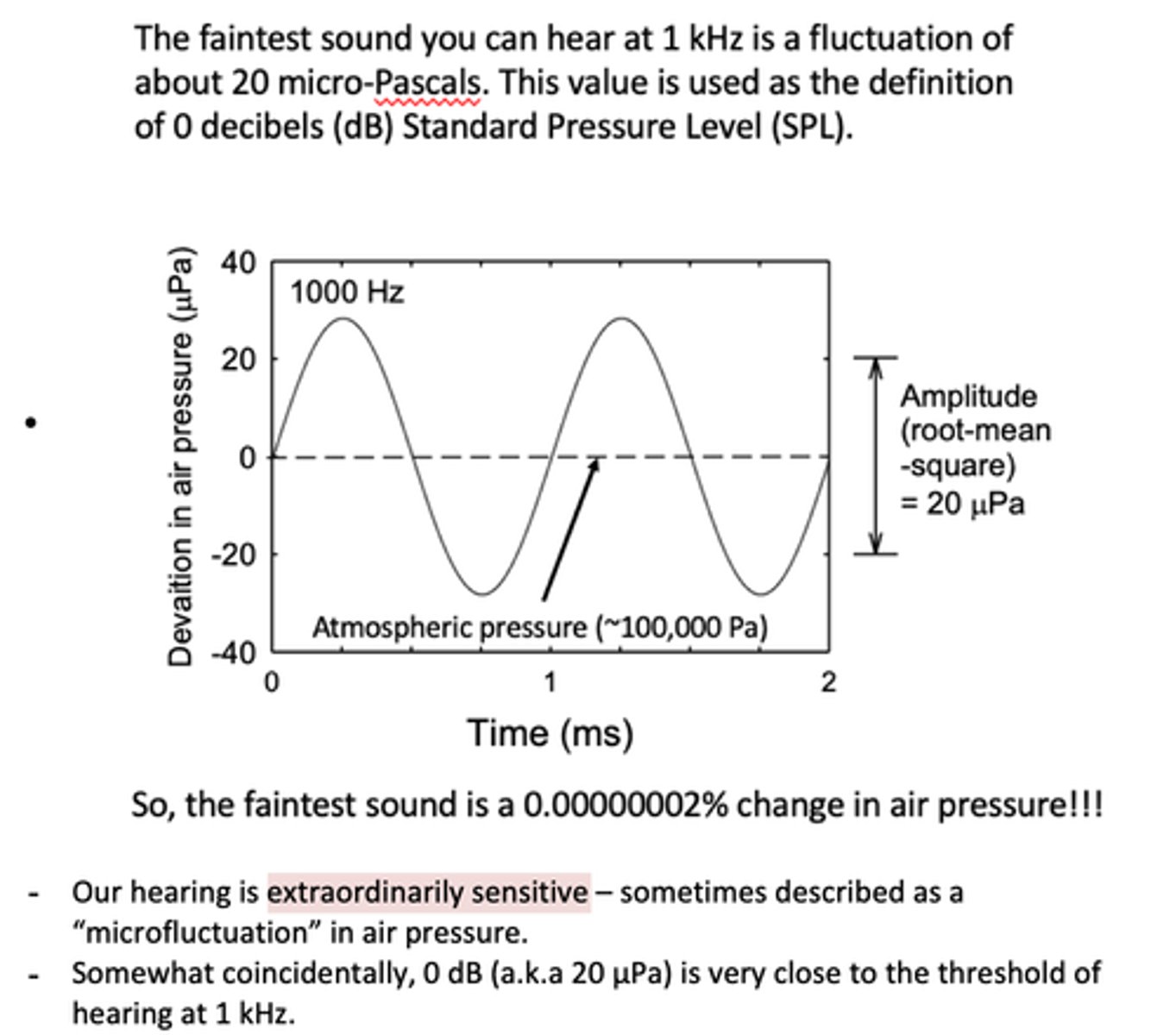
The faintest sound you can hear at 1 kHz is a fluctuation of about 20 micro-Pascals. This value is used as the definition of 0 decibels (dB) Standard Pressure Level (SPL).
comparing pressure levels
atmohsperic pressure is approximately 100,000 Pa
the faintest sound is a 0.00000002% change in air pressure!!! (the 0db)
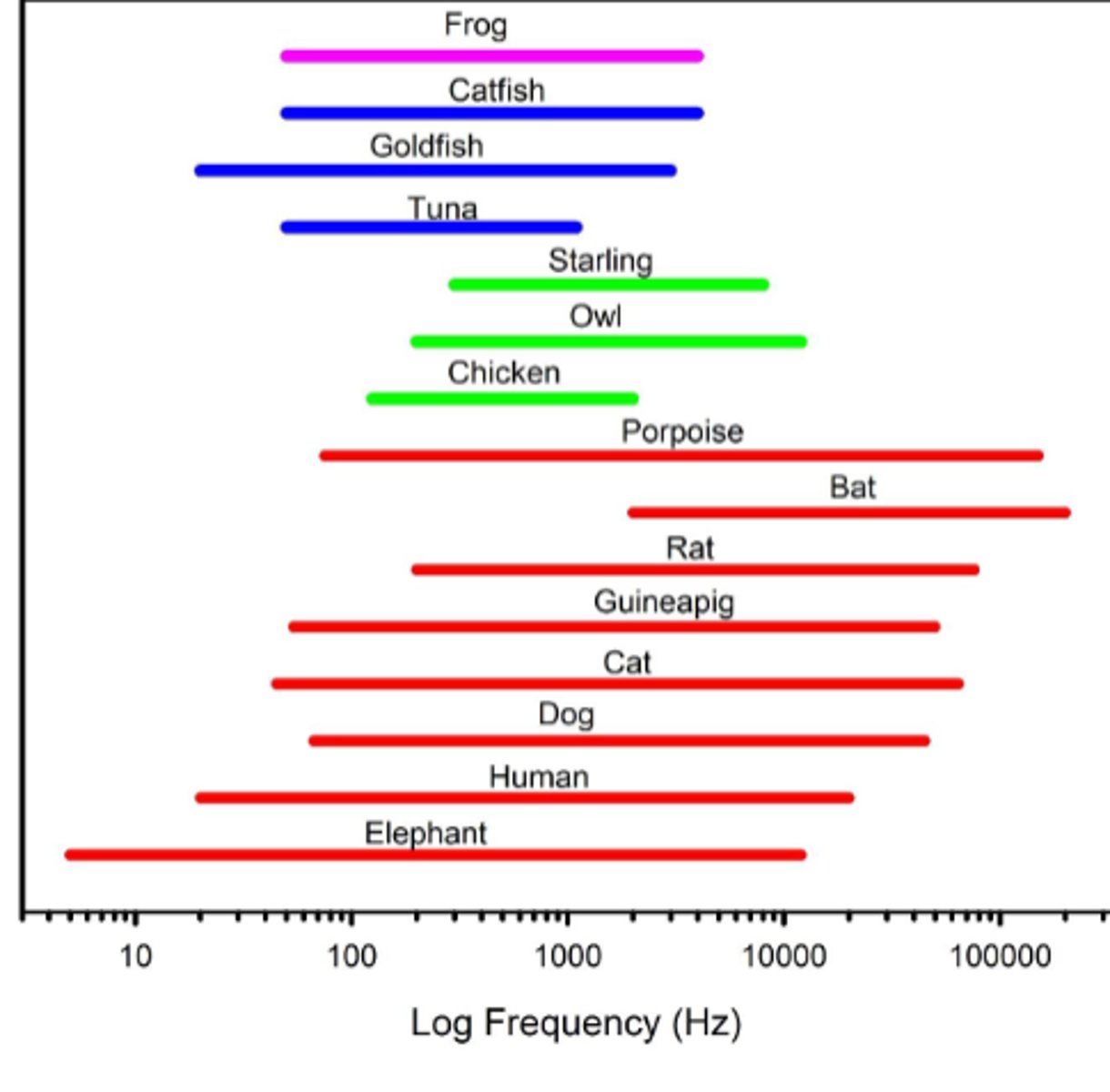
The detectable frequency ranges for different species
-mammals are good - ggenerally long range
-and generally these ranges are the same size
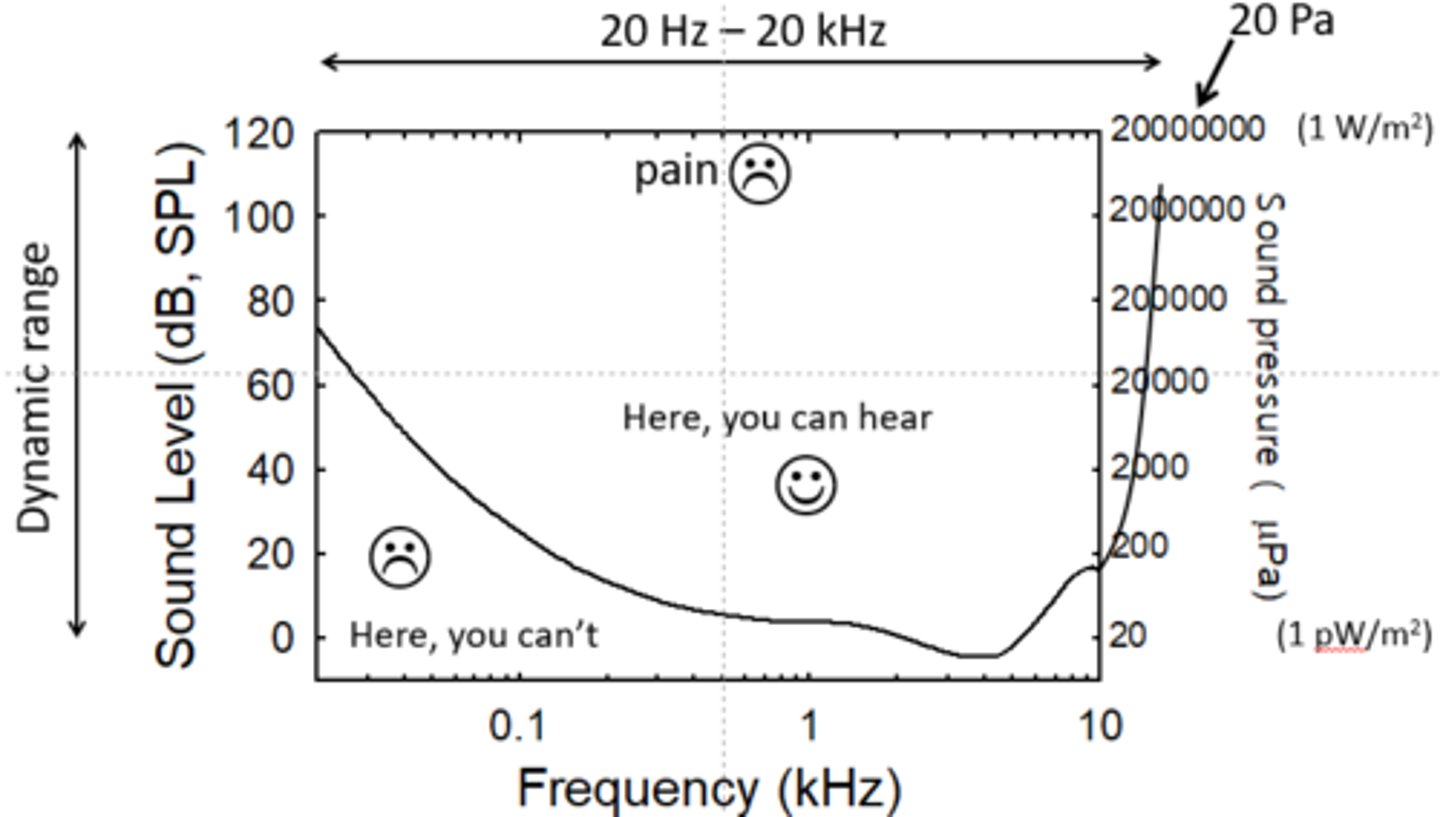
Detection threshold at different frequencies
-humans go up to 20 kHZ but it gets a loss worse especially with ages
sooo confused
faintest + most intense sound you can hear + in between
The faintest sound you can hear is 0 dB (SPL).
The most intense sound youcan bear is 120 dB (SPL).
What happens in between?
-people will adjust convo volume so always about 10 louder than outside
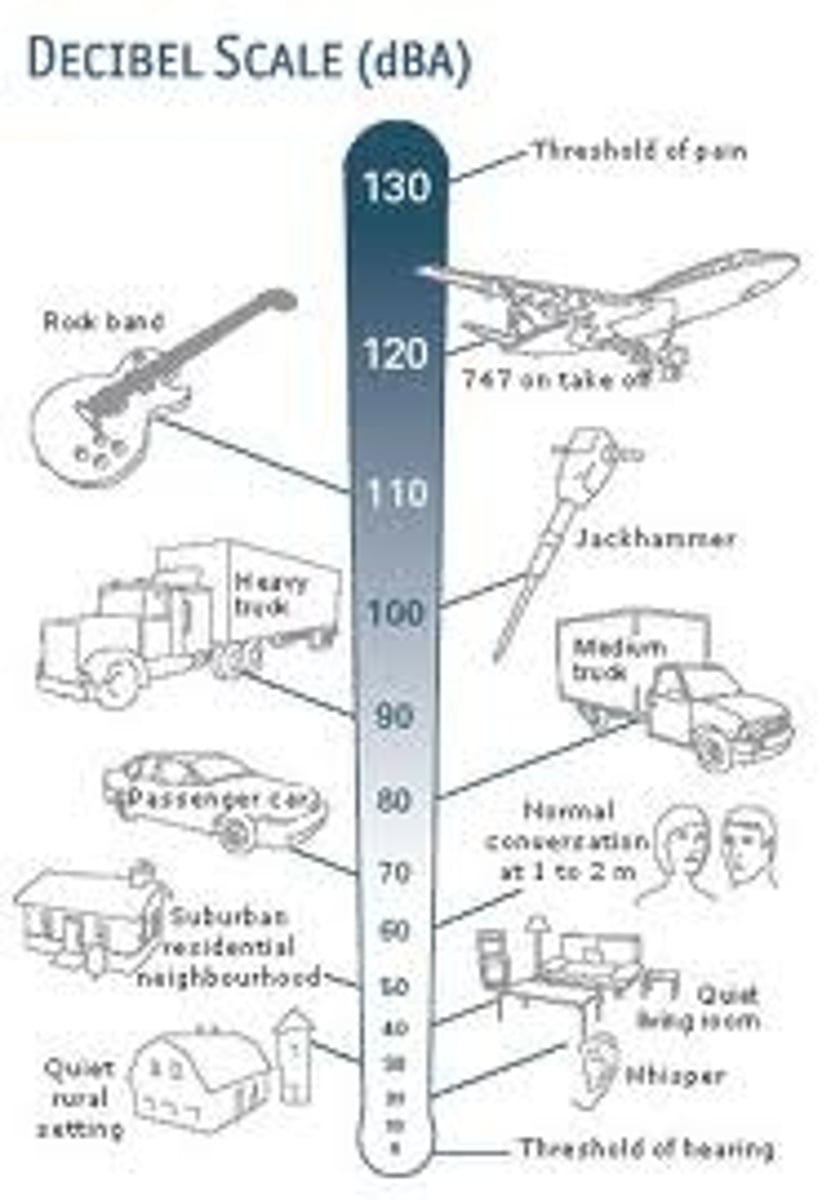
loudness and decibells
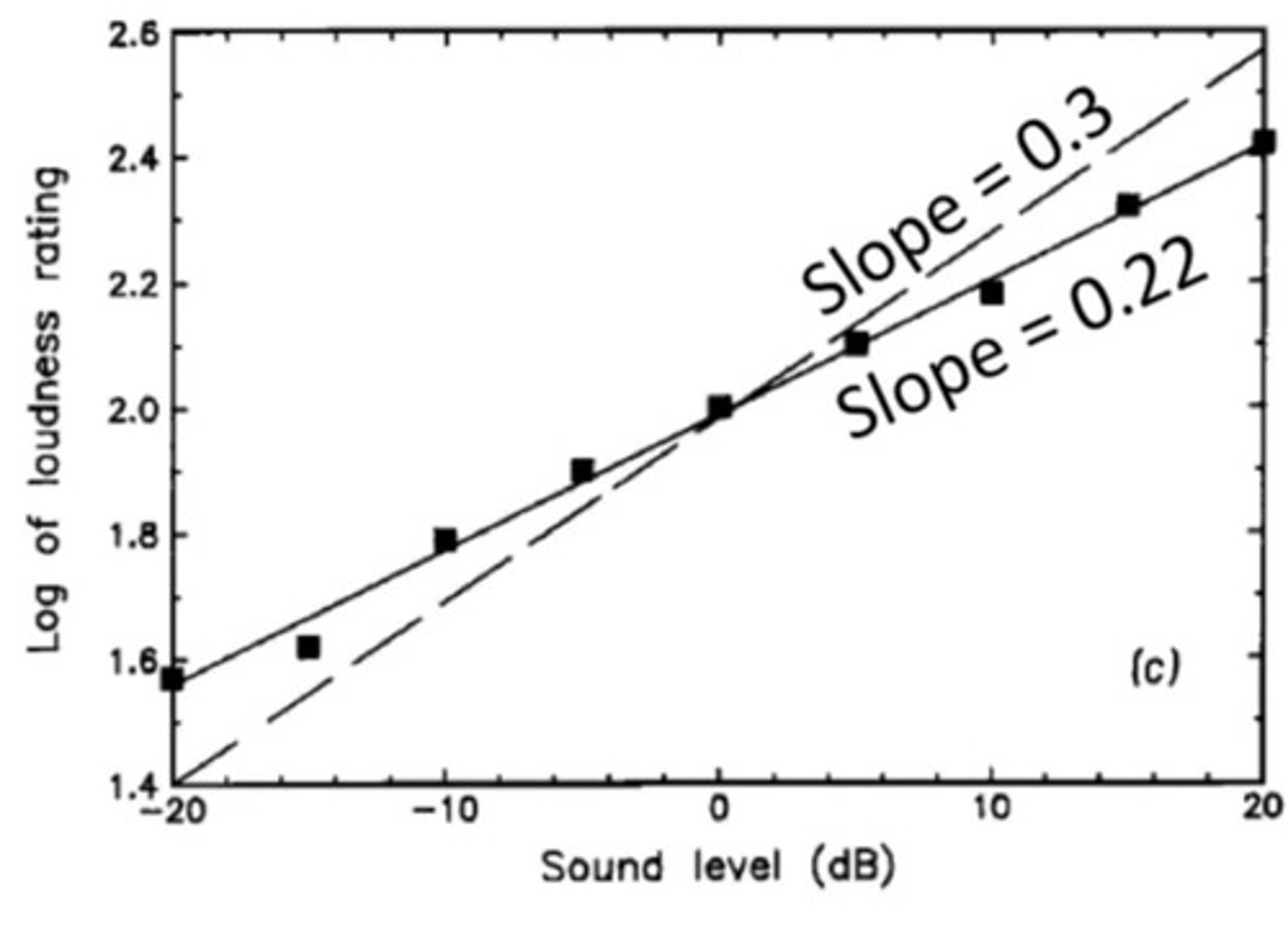
Loudness does not increase in proportion with either sound amplitude or intensity.
This is one reason why sound engineers invented decibels. In decibels a ten-fold increase is 10 dB and a hundred-fold increase is 20 dB etc.
A ten-fold increasing in intensity (i.e. 10 dB) is about equivalent to a doubling of loudness (so still not quite right)
Magnitude estimation of loudness
Listener assigns numbers to the loudness of each sound which varies in level, compared to a reference sound with the value of "100"
-makes slope which doubles every 10 db
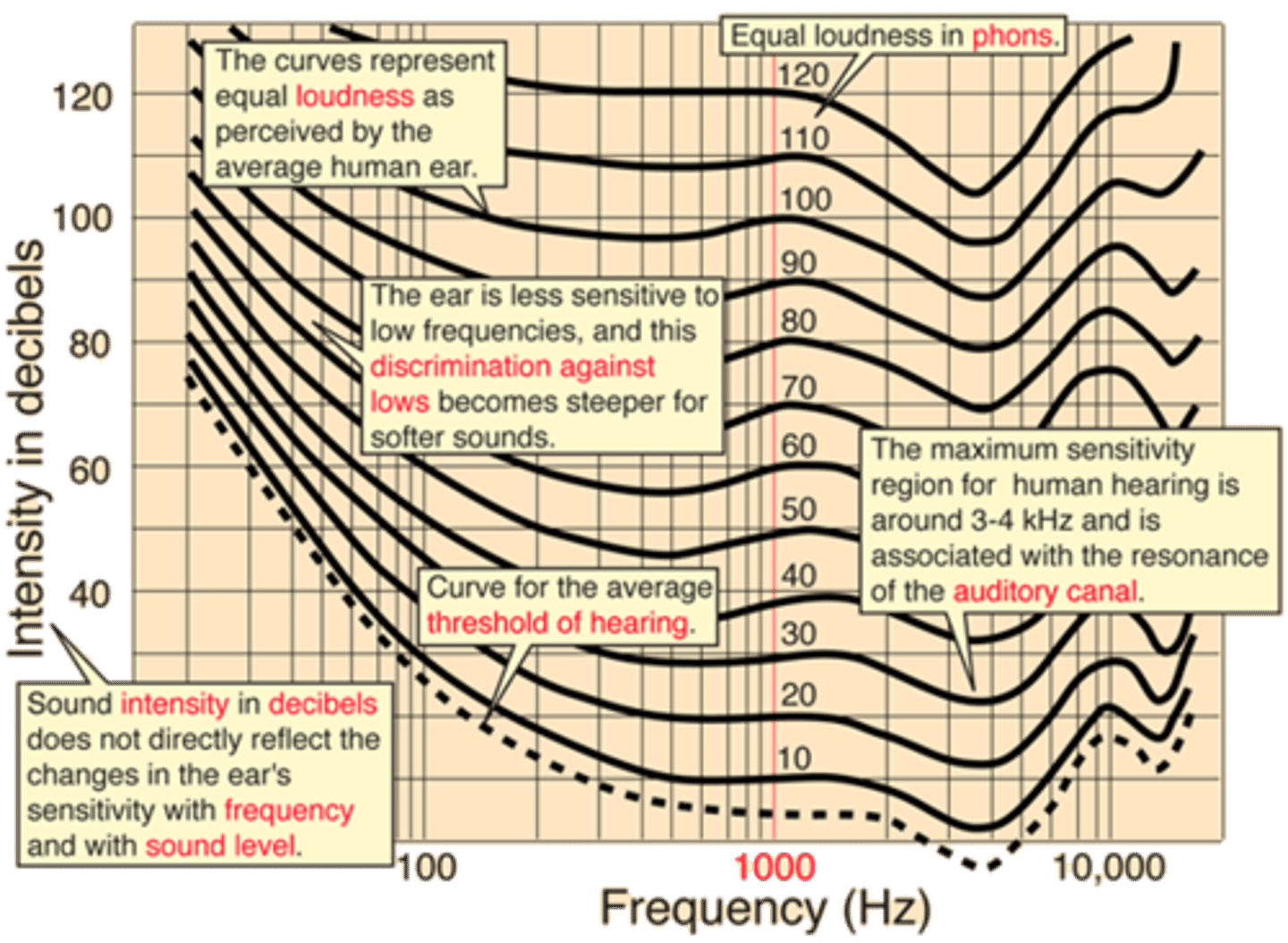
Do sounds of the same pressure level but different frequencies have the same loudness?
Nope!
Equal-loudness contours
-the curves represent equal loudness as generally perceived by human ear and this changes across frequency
-this means listening to music at low sound levels base can fall away whereas stronger at high levels
what decibels/loudness effected by
Decibels is a physical measurement of enrgy in the sound - therefore osnt relate to how we percieve things
We've been mainly tlking about pure tones ut there are all sorts of complex sounds in envrionments that don't just very in loudness andd ptich
complex tones def
"Any sound that consists of more than one frequency component (sine wave) combined togeth" -ai
The combined waveforms repeat themselves: they are "periodic."
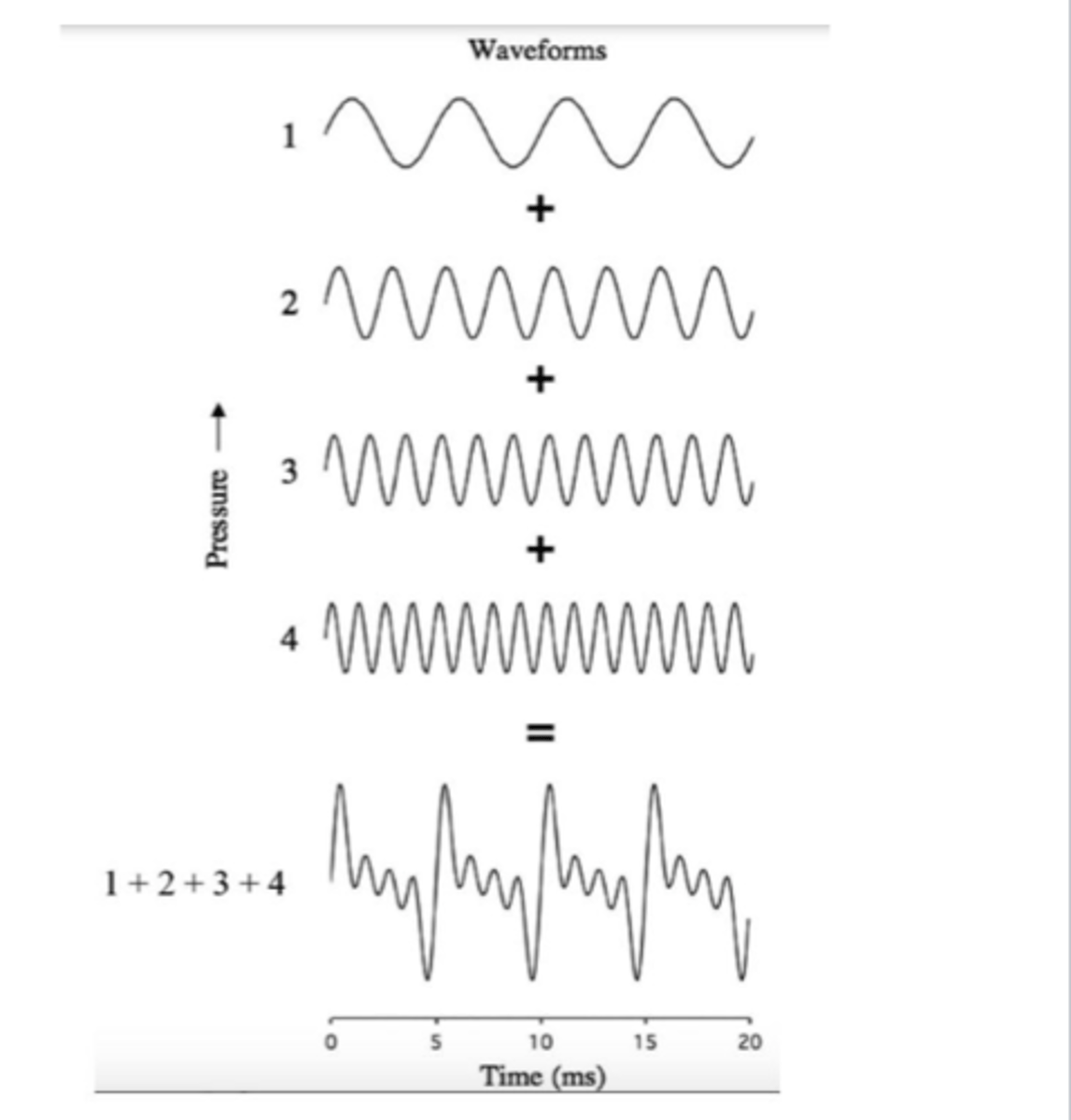
Complex tones typr
eg harmonic complex - made by musical instruments by peoples voices etc
-tones with lots of different frequencies that gel together
-because 200,400 nd 600 multiples of 200
-many things produce harmonic sound - all the theings we percieve as musical
-how do we hear more than one thing at once
-the repetition rate is actually the same rate as the lowest frequency in, uh, in the set (differences bween each n and the next)
spectogram shows
frequency by time
colour represents amplitude (energy)
Spectograms
ADD PIC
-are hard to read
-distinctive sounds like hair dryer just look like blur
-humans have harmonic voices
summary
• Sounds are very small fluctuation in ambient air pressure.
• Sounds vary in frequency and amplitude (sound pressure),
resulting in differences in perceived pitch and loudness.
• Humans can hear frequencies between 20 Hz and 20 kHz and
sound pressures between 20 Pa and 20 Pa (0 and 120 dB SPL)
• Loudness does not increase in proportion with sound pressure,
but much more slowly.
• The loudness of a sound depends on its frequency as well as its
sound level
• Most real sounds contain many different frequencies at once. (hard to maake pure tone need a tuning fork)
• Musical sounds tend to be harmonic and have repeating
waveforms.