Thermodynamics OSU w0-w1
 Call Kai
 Learn
Learn Practice Test
 Spaced Repetition
 Match
Match Flashcards
 Knowt Play
1/62

Earn XP
Description and Tags
week 0 covered, week 1 covered
Name | Mastery | Learn | Test | Matching | Spaced | Call with Kai |
|---|
No analytics yet
Send a link to your students to track their progress
63 Terms
static principle
A pure substance requires knowledge of 2 independent, intensive properties to define the state (know other properties)
Intensive
independent of mass: T P v
Extensive
depends on mass: u m E V h s
relative temps/pressures
C, F, KPa (gage), KPa (vacuum)
absolute temps/pressures
K, R, KPa
Ideal gas laws (2)
PV = mRT
Pv = RT
In the ideal gas law with R (w line above), what is the equation for R?
R = R^- / M
molarity equation
m = n / M
For KE, PE, and U, which uses KJ and which uses J?
U uses KJ, rest J
isometric
the volume is constant: v1 = v2
isoveric
Pressure is constant: P2 = P1
isothermal
Temperature is constant: T2 = T1
polytropic
p2v2 = p1v1
pv^n is constant
isentropic
s2 = s1
Pressure
P (Pa, bar)
specific volume
v (m^3/Kg)
specific internal energy
u (KJ/Kg)
energy per mass
e (J/Kg)
internal energy
U (KJ)
total energy
E (J)
distance from x
z (m)
total enthalpy
H (J)
specific enthalpy
h (J/kg)
specific entropy
s (Kj/Kg*K)
total entropy
S (KJ/K)
gas property units
R (KJ/Kmol *K)
heat transferred
Q (Btu/hr)
specific heat (all eqs)
c_v = du/dt
cv = u_2 - u_1 integral t1 →t2 c_v dt
c_v = (T2 + T1)/2 (closed systems only)
if a system is closed, assume:
PE and KE = 0 if no info given
use a cv, cp, c_something value to use
u_2 - u_1 = c_x(T2-T1)
If using the ideal gas equation in a closed system
always assume ideal gas
assumptions for isoveric systems
p2 = p1 and if the system is closed:
m1RT1 / v1 = m2RT2 / v2
T2/T1 = v2/v1
m2 = m1
assumptions about isometric systems
v2 = v1 and if the system is closed:
T2/T1 = P2/P1
m2 = m1
assumptions about isothermal systems
since we know T2 = T1 then:
P1V = mRT1
if closed:
P1/P2 = v2/v1
refrigerants
things that may change phase
phases (7)
supercooled or compressed liquid
saturated liquid
saturated liquid + vapor mixture
saturated vapor
superheated vapor
critical point
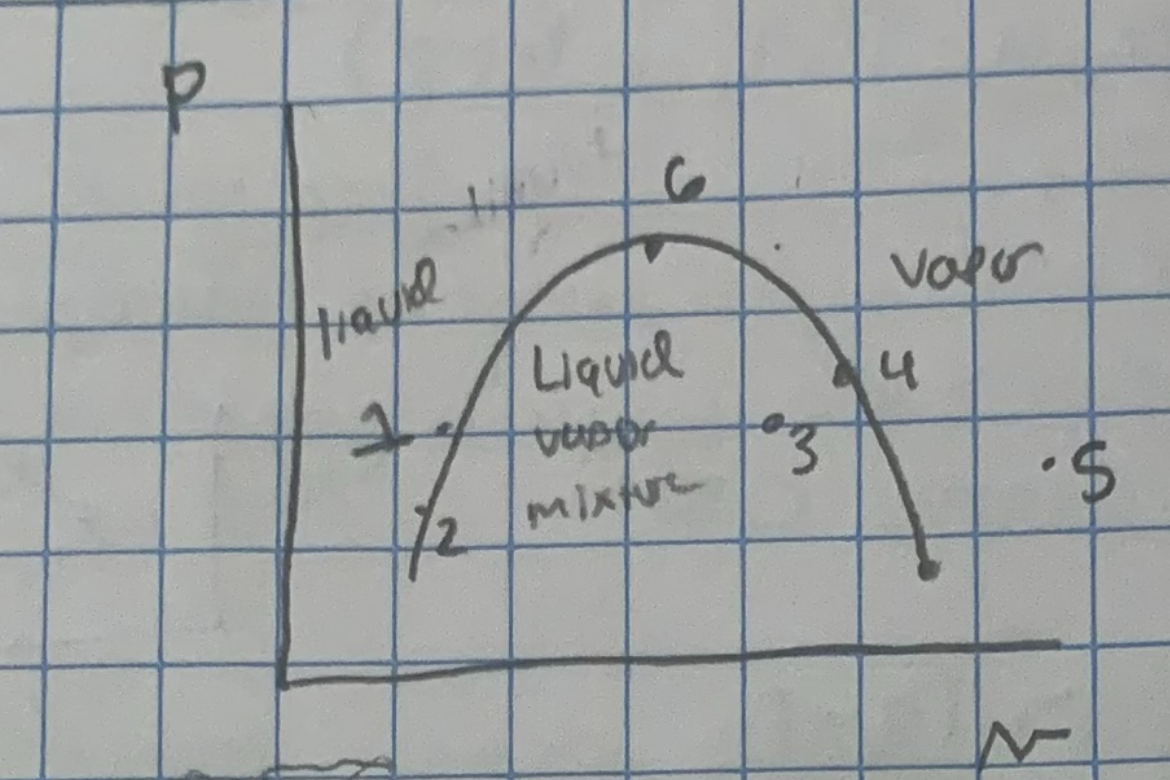
specific heat vs. pressure phases plot
supercooled or compressed liquid
saturated liquid
saturated liquid + vapor mixture
saturated vapor
superheated vapor
critical point
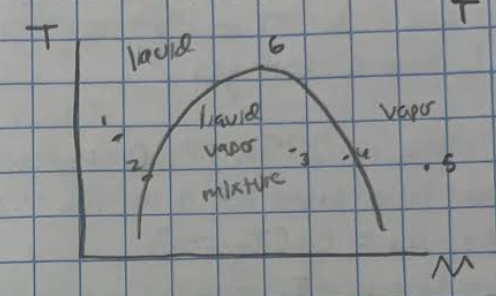
specific heat vs. temperature phases plot
supercooled or compressed liquid
saturated liquid
saturated liquid + vapor mixture
saturated vapor
superheated vapor
critical point
quality
x = mg / (mf + mg)
unitless
mg = mass of vapor (kg)
mf = mass of liquid (kg)
quality of a
saturated liquid: ___
saturated vapor: ___
saturated mixture: ___
x=0
x=1
0 < x < 1
finding phases with vf, vg and T_sat given pressure and temperature
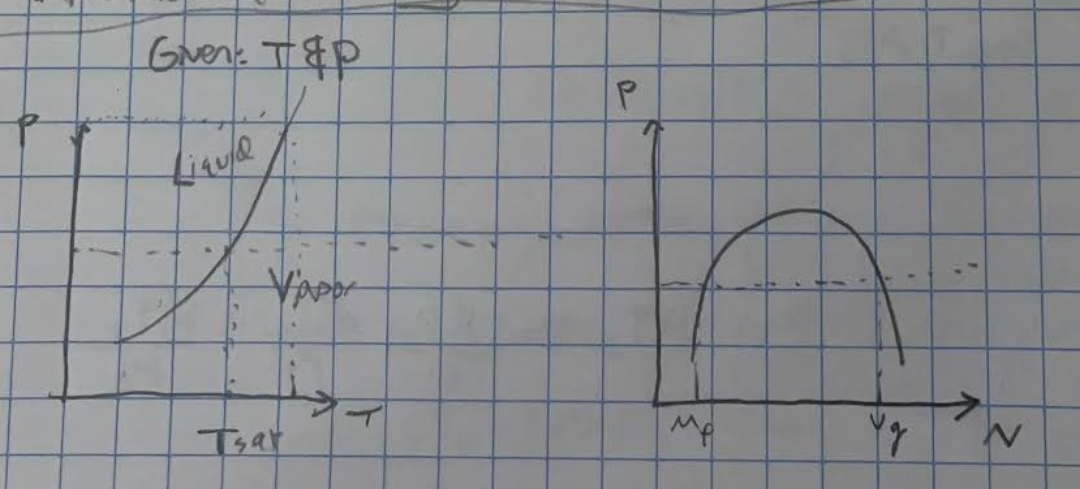
when referring to water in this class, what state is it in?
vapor!
If a material is in a saturated state:
temperature and pressure are dependent
so
P = psat@T
or
T = Tsat @P
a material is a subcooled liquid if
T < T_sat @ P
P > P_sat @
a material is a superheated vapor if
T > T_sat @ P
P < Psat @ T
if v > vg, u > ug, h > hg, etc.
the material is a ____
superheated vapor
if v < vf, u < uf, h < hf, etc
the material is a _____
supercooled liquid
if vf < v < vg
(samr for uu,h,etc)
the material is a _____
saturated mixture
if v = vf the material is a ____
if v = vg the material is a ___
saturated liquid
saturated vapor
for finding properties, the 1st step is to determine the region, What do we do if we determine its a saturated liquid?
use “f”
v = vf, u = uf, h = hf, etc
for finding properties, the 1st step is to determine the region, What do we do if we determine its a saturated vapor?
use “g”
v = vg, etc
for finding properties, the 1st step is to determine the region, What do we do if we determine its a saturated mixture?
use quality: x = xg(xf + xg)
v = (1-x)vf + x*vg
u = (1/x)uf + x^ug
h = (1/x)uf + x^hg
an additional way to write the quality equation using v, vg, and vf
x = (v - vf)/(vg - vf)
If you have T, use list ___
if you have P, use list ___
A-2
A-3
if a material is a superheated vapor, that means (T,P)
T > Tsat @P
P < Tsat @T
if a material is a supercooled liquid
use A-5 if P > 2.5 MPa
use A-2 if P <= 2.5 MPa
and assume u = uf @T, v = vf @T
change in energy equation for a closed system
E_2 - E_1 = Q-W
Q is positive when it ____ the system
Q is negative when it ____ the system
enters
leaves
work equation for this class
W = S *integral(V1,V2) Pdv
work per mass
w = W/m = integral(w1,w1) Pdv
for isoveric processes with work
P2 = P1
W = P * integral(v1,v2)dV = P(V2-V1)
for isoveric processes
v2 = v1
W_b = 0
W_b = work done on the boundary
dealing with ideal gases
for isoveric situations:
W = P2V2 - P1V1 = m2RT2 - m1RTv
dealing with ideal gases
for isothermal processes:
m2RT2 = P2v2 = m1RT1 = P1V1
P1V1ln(V2/V1) = mRT1ln(V2/V1)