Ch 7: The Moon and Tides
 Studied by 4 people
 Call Kai
 Learn
Learn Practice Test
 Spaced Repetition
 Match
Match Flashcards
 Knowt Play
1/14

There's no tags or description
Looks like no tags are added yet.
Name | Mastery | Learn | Test | Matching | Spaced |
|---|
No study sessions yet.
15 Terms
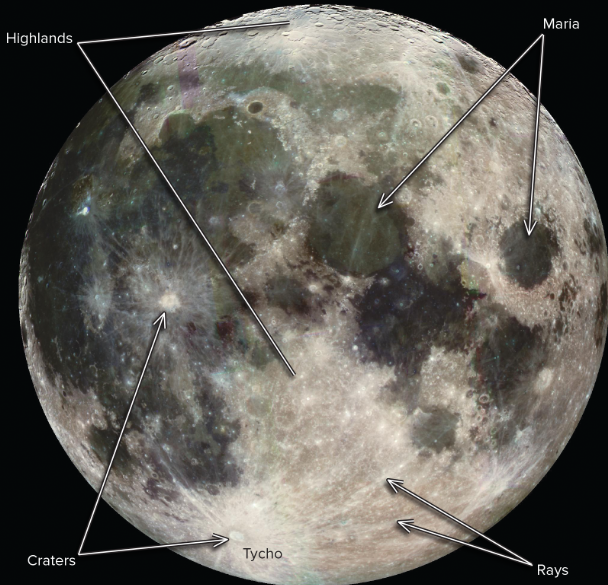
Describe a crater & how it’s formed.
Why do some craters contain maria?
Circular pit, usually raised rim, sometimes has a central peak caused by impacts from large bodies like asteroids
Craters may contain maria due to some large impacts being filled with lava
How do the maria differ from the highlands?
The highlands are bright areas that surround the maria. They are composed of different rock types
Maria: basalt, dark, congealed lava, rock rich in iron & magnesium
Highlands: rock rich in calcium & aluminum silicates
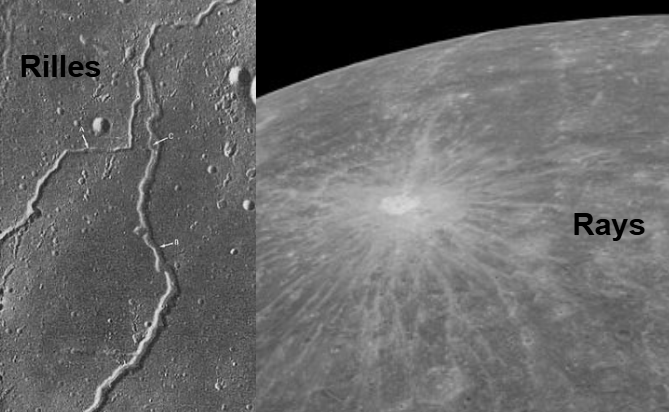
What are lunar rilles? What are rays?
Rilles are lunar canyons, most likely caused by lava flows or crustal cracking
Rays are long, light streaks of pulverized & melted rock that radiate outward
What formed the maria?
Why are they smooth?
Maria were most likely formed by ancient lava that flowed into large impact basins left by massive asteroids. Once the lava flooded & cooled, it solidified into basaltic rock.
The lava flows continued until after the impacts tapered off, allowing for the maria to remain smooth
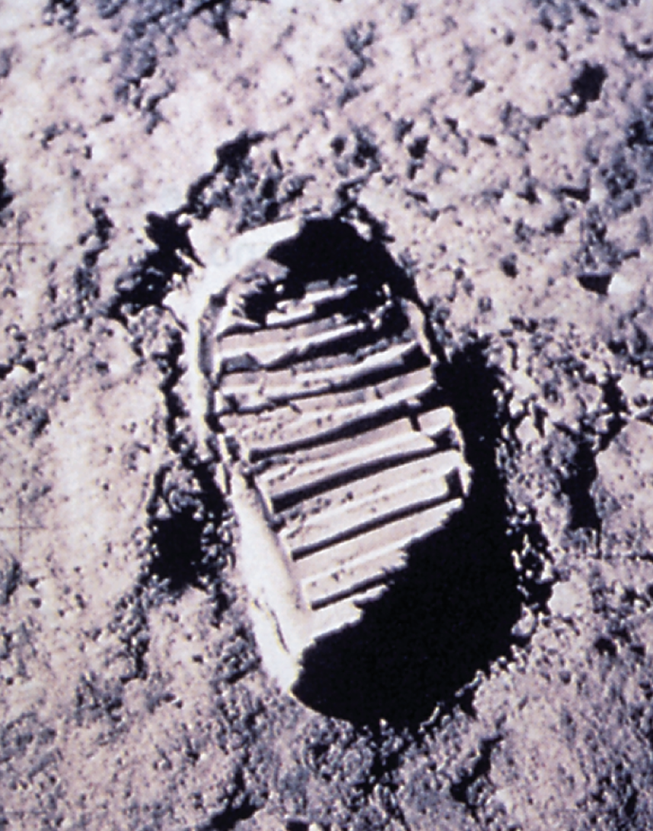
What is regolith?
How does it form?
A “blanket of rock” tens of meters deep, made of rock chunks & fine powder
Result of successive impacts breaking rock into smaller pieces
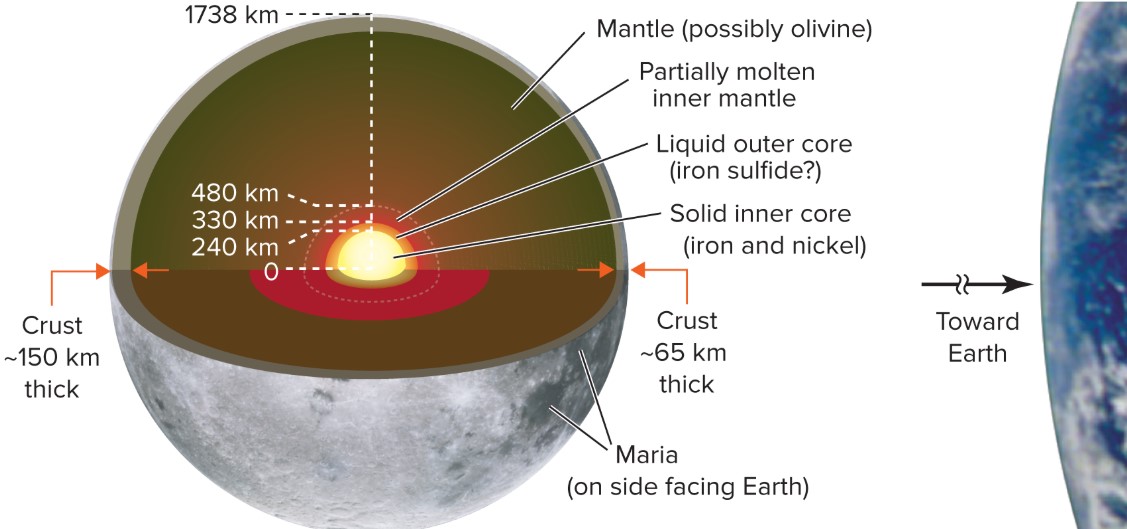
List the structure & composition of the Moon from surface to core.
Crust: thinner on side that faces Earth, made of silicate rocks rich in aluminum
Mantle: rich in olivine (peridot), may be partially molten, little movement due to cooled interior
Core: small iron core with an outer liquid part
How is the Moon’s structure & composition different from Earth’s?
The Moon’s crust is asymmetrical, its interior is colder which makes the mantle virtually inactive, & its core has much less iron than Earth
Why does the Moon lack an atmosphere?
It lacks the gravitational strength to hold an atmosphere &
due to its cool interior, there is no volcanic activity
List 2 ways to measure the distance to the Moon.
By measuring its angular size & by measuring the time it takes a radar/laser signal to reach the Moon & bounce back to Earth
How do astronomers think the Moon formed?
What supports this theory?
Formed by debris blasted out of Earth by a collision with a Mars-sized body; as the debris cooled, its gravity drew it together into the Moon
- lack of water on the Moon (probably vaporized due to the heat of the collision)
- low iron content of Moon (only Earth’s crust would have been blasted off, which doesn’t have a lot of iron compared to core),
- similarities/differences in composition are explained by the Moon being partly made of Earth & partly of the Mars-sized impact object)
How does the Moon formation theory explain why Earth & Moon have such different densities?
The Moon doesn’t contain large amounts of iron, which makes it much less dense than Earth. Iron is heavily present in Earth’s core, making the planet denser.
If the Moon formed from part of Earth’s crust as explained by the theory, then it wouldn’t have gained much iron since the majority of iron was located in Earth’s core.
Why is the Moon’s surface heavily cratered but Earth’s is not?
Earth renews its crust due to having an active mantle. New crust forms & old crust is absorbed into the mantle at the plate tectonics. Also, erosion from atmosphere/weather erases craters.
The Moon does not have an active mantle, therefore it cannot renew its crust, which is why so many crater impacts remain. Lack of atmosphere/weather/water means no erosion.
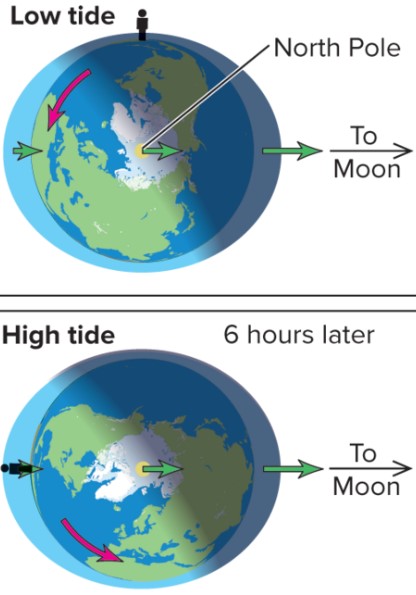
How are tides formed on Earth?
Gravitational attraction of the Moon causes oceans to be pulled towards the Moon (tidal bulge). The opposite side ocean also rises since the Moon is pulling Earth away from the water.
As Earth rotates, different regions move through these bulges, causing high & low tides.
Why does the Moon form 2 tidal bulges on Earth?
Tidal bulge is caused by Moon’s gravity pulling water towards it.
Moon also pulls Earth away from the ocean on the opposite side, causing a tidal bulge on opposite side of Moon’s location.
Describe the Moon’s rotation. How has it been affected by tidal interaction with Earth?
Tidal breaking causes the Moon to have synchronous rotation, same side always faces Earth.
Just as the Moon raised tides on Earth, Earth raised tides on the Moon. This slowed the Moon’s spin when it was young, causing it to slow to the point of synchronous rotation