Cell Structure and Function Final
 Studied by 1 person
 Call Kai
 Learn
Learn Practice Test
 Spaced Repetition
 Match
Match Flashcards
 Knowt Play
1/311

There's no tags or description
Looks like no tags are added yet.
Name | Mastery | Learn | Test | Matching | Spaced |
|---|
No study sessions yet.
312 Terms
genetic code
relationship between the DNA base sequence and the linear order of amino acids in the proteins
How many DNA bases are there
4
How many amino acids are there
20
doublet code = - bases specify a single amino acid
2
doublet code is - because only 16 possible combinations
inadequate
the triplet code is where there are combinations of - bases to specify amino acids
3
the triplet code has - possible combinations and is enough for all - amino acids
64, 20
Doublet code example
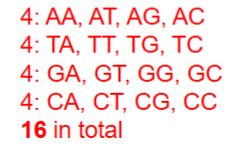
triplet code example

Codon
sequence of 3 nucleic acids coding for 1 amino acid (triplet code)
All 64 codons are used in the -
translation of mRNA
61 codons specify -
the addition of specific amino acids to a growing polypeptide chain
AUG is the -
start codon
UAA, UAG, and UGA are - which -
stop codons, terminate polypeptide synthesis
genetic code is - for all organisms
universal
Every codon has - meaning
one
The - is unambiguous
genetic code
The genetic code is degenerate;
many of the amino acids are specified by more than one codon
Most mutations to the genetic code cause -
codon changes and a changed amino acid
central dogma
DNA makes RNA makes protein
Sometimes - is the final product in the flow of genetic information
RNA
RNA is converted to DNA through a process called -
reverse transcription
Reverse transcription is catalyzed by the - called -
enzyme, reverse transcriptase
Viruses that carry out reverse transcription are called -
retroviruses
Example of a retrovirus
HIV, which causes AIDs, other retroviruses cause cancer in animals
transcription
RNA synthesis using DNA as a template
Messenger RNA (mRNA) =
RNA that is transcribed into protein
Ribosomal RNA (rRNA) =
an integral component of the ribosome
Transfer RNA (tRNA) =
molecules serve as intermediaries, bringing amino acids to the ribosome
Translation
synthesis of protein using the information in the RNA
Mutations that alter sequences near
the 5′ end of mRNA result in alterations
near the corresponding protein’s N-
terminal end, whereas mutations that
alter the 3′ sequences of mRNA result in
alterations in the protein’s C-terminal
end. What do these findings imply?
The order of nucleotides from 5′ to 3′ in mRNA
determines the order of amino acids from N- to
C-termini.
RNA - chemically similar to DNA
is
RNA contains -, DNA contains -
ribose, deoxyribose
RNA has the base - instead of -
Uracil, thymine
RNA is - stranded and -
single, highly flexible
RNA can form various structures by -
complementary base pairing within single strands.
RNA’s are synthesized from a - template
DNA
In mRNA synthesis 1 - strand is copied
DNA
In mRNA synthesis the strand being copied is called the -
template strand
The strand not being copied in mRNA synthesis is called the - because it is similar to the mRNA sequence.
coding strand
Direction of RNA synthesis
5’ to 3’ direction
Several DNA sequences code for -
tRNA, rRNA
Only a subset of the DNA in any organism codes for a -
protein
In eukaryotes regulatory RNA molecules are encoded such as -
siRNA, miRNA, and Non-coding RNA
Non-coding regions
Much of the human genome does not code for anything meaningful, and is not transcribed.
Much of the RNA from the human genome - translate to or code for proteins.
does not
Tandemly Repeated DNA
the multiple repeated copies are arranged next to each other in a row.
Interspersed repeated DNA
unique sequences that are found individually, but in multiple places in the genome (ex. LINEs and SINEs)
Transposable elements
most interspersed repeated DNA consists of families of transposable elements which can move around the genome and leave copies of themselves behind.
Roughly half of the human genome consist of
mobile DNA elements
LINEs
most abundant form in the genome, contain genes required for their own mobilization
SINEs
rely on enzymes from other elements for their movement.
Most common SINE in humans =
Alu sequences
10% of human genome
Which DNA sequences are to be transcribed must be -
regulated
Transcription Unit
The DNA components that give rise to one RNA molecule
RNA polymerase
an enzyme to use DNA as a template to add new ribonucleic acids on a growing strand of RNA
Promoter
A sequence of DNA that can decide where RNA polymerase can bind
TSS (Transcription Start Site)
a sequence of DNA that can decide where transcription starts
Start Codon
A coding sequence to start the first amino acid
Start codon in DNA =
ATG
Stop codon
a coding sequence to stop the addition of the first amino acid.
Stop codon in DNA =
TAA, TAG, TGA
Stop codon in RNA =
UAA,UAG, UGA
Stop codon - stop transcription
does not
Transcription stages
Binding
Initiation
Elongation
Termination
Binding promoter
RNA polymerase recognizes and binds to a promoter sequence on DNA.
This causes local unwinding of the double helix, forming a transcription bubble
Initiation of RNA synthesis
RNA polymerase begins synthesizing RNA using one DNA strand (template strand).
Elongation – RNA polymerase moves along DNA
RNA polymerase travels down the DNA.
As it moves, it continues unwinding DNA ahead and elongating the RNA chain by adding nucleotides.
Termination – (RNA polymerase releases RNA) is when
Eventually, RNA polymerase reaches a termination signal.
It dissociates from the DNA, and the new RNA molecule is released.
Many bacterial promoters contain - associated with particular strong promoters.
Upstream elements (UP)
Transcription start site is almost always a - and usually an -
purine, adenine
At 10 bp upstream of the start site is the sequence - called the -
TATAAT, -10 sequence or the Pribnow box
At or near the - is the sequence - which is recognized by RNA polymerase subunits to start transcription
-35, TTGACA
Bacterial Cells have a - that synthesizes all major classes of RNA
single kind of RNA polymerase
RNA polymerase is a large protein consisting of -
two a subunits, two b subunits, and a dissociable subunit called the sigma factor
The core enzyme lacks the - and can carry out RNA synthesis
sigma subunit
The holoenzyme contains - subunits and is required to ensure transcription initiation within the DNA molecule
all
RNA chain elongation continues as -
RNA polymerase moves along the DNA molecule
RNA is elongated in the 5’ to 3’ direction and each new nucleotide is added to the - end
3’
As polymerase moves along the DNA strand, the double helix is - and DNA behind it is - into a double helix
unwound, rewound
RNA backtracking
the polymerase backs up slightly to replace an incorrect nucleotide with a correct one
Occasional errors in RNA molecules - as critical as errors in DNA replication
are not
Elongation of the RNA chain proceeds until the RNA polymerase copies a sequenced called the -
termination signal.
Many termination sequences contain a - sequence followed by several -
GC-rich, U’s
The GC region in the RNA forms a - pulling the RNA molecule away from the DNA.
hairpin loop
When the bonds between the U’s and A’s break during termination of RNA synthesis,
the RNA is released
A DNA sequence might be the promoter that drives expression of a dynein motor gene. You make a mutation that removes the sequence TATATAT from the −25 region of this putative promoter. If the original sequence serves as a promoter, what should happen to transcription of the dynein motor gene in the mutant?
Transcription should decrease.
Transcription in Eukaryotic cells has additional - compared to prokaryotes
complexity
RNA polymerases in eukaryotes require additional proteins called -
Transcription factors
-Different RNA polymerases transcribe one or more different classes of RNA
3
Eukaryotic promoters are more varied than - ones, some even located downstream of the gene
bacterial
RNA cleavage/processing is more important than - in determining the 3’ of the mRNA transcript.
termination of transcription
Pre-mRNA contains - and - splicing result in mRNA maturation
coding (exons), noncoding regions (introns)
RNA processing
done on newly formed RNA molecules, chemical modification during and after transcription.
A - is always required for RNA polymerase binding to promoters
general transcription factor
Transcription factors bind - elements first and recruits - to the promoters on DNA to initiate transcription.
DNA, RNA polymerase
Protein-protein interactions
play a prominent role in eukaryotic transcription
Transcription factors
bind the promoter in a defined order, starting with TFIID
preinitiation complex
a large complex of proteins on the promoter
TFIID is essential for
beginning the process of transcription