Part 1 of Final - tenses and such
 Studied by 0 people
 Call Kai
 Learn
Learn Practice Test
 Spaced Repetition
 Match
Match Flashcards
 Knowt Play
1/32

There's no tags or description
Looks like no tags are added yet.
Name | Mastery | Learn | Test | Matching | Spaced |
|---|
No study sessions yet.
33 Terms
how to do form informal affirmative commands
usually the same form as el/ella in the present indicative
What are common irregular affirmative (not negative) tu commands?
decir → di
venir → ven
ir → ve
ver → ve (notice its the same as ir, use context)
poner → pon
tener → ten
ser → sé
what would “tan sabroso como” mean? A comparison of equality
as flavorful as
True or False: In affirmative commands, reflexive, indirect, and direct object pronouns are always attached to the end of the verb. In negative commands, these pronouns always precede the verb.
true
How to form formal formal (ustedes/ ustedes) commands?
dropping final -o of the yo form of the present tense
for -ar verbs, add -e or -en
for -er & -ir verbs, add -a or -an
ex. limpie (limpar)
How to form a formal negative command?
just add a “no” before the verb
How to form comparisons of inequality?
más/ menos + [adjective, adverb, noun] + que
How to form negative tú commands?
drop the final -o from the yo form of present tense
for -ar verbs:
add -es
for -er & -ir verbs
-as
ex. no hables
When a comparison involves a numerical expression what do you use in stead of “que” for the comparison?
use “de” instead of que?
ex. hay mas de cincuenta naranjas?
How do you form a comparison with verbs?
[verb] + más/menos que
ex. mis hermanos comen mas que yo.
how to say “the worst” in spanish?
el/la peor
how to construct a superlative in Spanish?
el/la/los/las + [noun] + más/menos + [adjective] + de
ex. es el mas elegante de la cuidad.
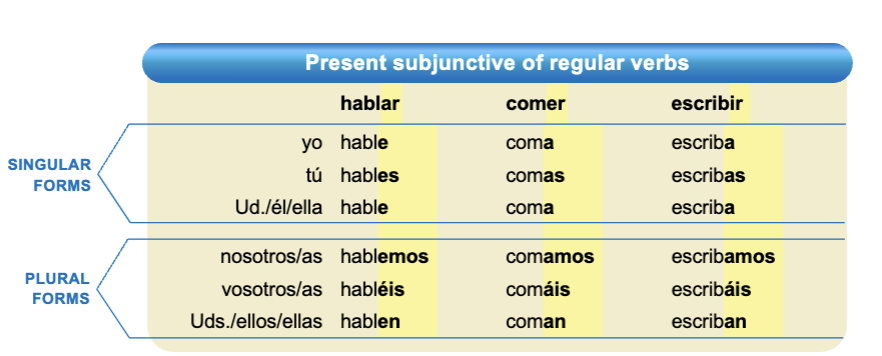
How do you form the present subjective?
form the yo present indicative
drop the -o ending
for -AR verbs
-e, -es, -e, -emos, -éis, -en
for -er and -ir verbs
-a, -as, -a, -amos, -áis, -an
What is WEIRDO? What does each letter stand for?
It tells you when the subjunctive form is triggered
Wishes
Emotions
Impersonal Expressions
Requests/ recommendations
Doubt/ Denial
Ojala
What are from phrase triggers of the subjunctive for Wishes (Weirdo)?
if the subject changes
deseo que - i wish
espero que - i hope
necesito que - i need
prefiero que - i perfer
quiero que - i want
insisto que - i insist
What are from phrase triggers of the subjunctive for emotions (wEirdo)?
if the subject changes
me alegra que - it makes me happy that…
me enoja que - it angers me that…
me gusta que
What are from phrase triggers of the subjunctive for impersonal expressions (weIrdo)?
if the subject changes
es necesario que
es importate que
es mejor que
es deseable que - its desirable that
es preferible que
es prohibido que
What are from phrase triggers of the subjunctive for requests/recommendations (wieRdo)?
if the subject changes
aconsejo que - to advice
exijo que - to demand
pido que - to ask for
permito que - to permit
recomiendo que - to recommendar
sugiero que - to suggest
What are from phrase triggers of the subjunctive for doubt/denial (wierDo)?
even if the subject does not changes
dudo que - i doubt that
no creo que
no pienso que
no es cierto que
es improbable que
if I say “ no dudo que” thats INDICATIVE cuz theres no doubt
What are from phrase triggers of the subjunctive for Ojala (wierdO)?
even if the subject does not change
Ojala que…
What are some examples of some indefinite words?
also
algun - some/any
alguien - someone
siempre
tambien
What are some examples of negative words?
nada
nadie
ninguno/ ningun - none, not any, neither, nor
nunca, jamás - never, not ever
tampoco - neither, not either
Por and Para are used to describe aspects of movement, time, and action. Describe how each is used with movement differently?
Por - through or by a place
the tour took us through downtown
nos llevo por el centro
Para
towards a desitnations
my friends are going to the stadium
ellos van para el estadio
Por and Para are used to describe aspects of movement, time, and action. Describe how each is used with time differently?
Por - duration of an event
Ana chatted for two hours
ana chateo por dos horas
Para - action deadline
escribir un ensayo para mañana
i have to write an essay by tommorrow
Por and Para are used to describe aspects of movement, time, and action. Describe how each is used with action differently?
Por - reason or motive for an action or circumstance
i got home late because of traffic
tarde por el traffico
Para - Indication of for whom something is intended or done
a surprise for Eduardo
una sorpresa para Eduardo
What are the relative pronouns? How are they used
que and quien(es),
“that”
the vacuum that works well
Explain how the subjunctive is used in adjective clauses?
We are looking for someone hardworking?
the person may or may not exist, so subjunctive, cuz indefinite
Explain how the subjunctive is used in adverbial clauses?
With certain conjunctions, the subjunctive is used to express a hypothetical situation, uncertainty as to whether an action or event will take place, or a condition that may or may not be fulfilled.
toma un foto antes que se vaya
dejar un recado en caso de que Gustavo me llame
a menos que
con tal (de) que (provided that)
If subject changes:
para que
sin que
What is the present perfect? How to conjugate haber into the present perfect? When does the past participle change in form?
I have done something
uses haber + past participle [-ido, -ado] (no word separating)
he, has, ha, hemos, han
only changes in form when used as an adjective
Clara ha abierto las ventanas vs. Las ventanas estan abiertas
Clara has opened the windows
What is el preterito pluscuamperfecto de indicativo? How do form it? What word is it often used with?
past perfect - what someone had done or had occured before another past action, event, or state
form with the imperfect of haber (había, habías, había, habíamos, habían) + past participle
often used with “ya”, antes de…
ex. Ella ya había salido cuando llamaron
ex. antes de este ano nunca habia estudiado espanol.
What are the two ways to form the future? What about the irregulars? What are common irregulars?
ir (conjugate) + a
add the following endings to the infinitive form of the verb, same for all
estudiaré
estudiarás
estudiará
estudiaremos (notice no accent)
estudiarán
if irregular, add the same ending to the irregular stem?
diré - decir
haré - hacer
podré - poner
querré - querer
tendré - tener
hay - habrá
What is the conditional tense? What are the conditional endings? For irregulars? Give example of common irregulars?
Explains what you would do or what would happen under certain circumstances
"Si tuviera más dinero, iría de compras" (If I had more money, I would go shopping) for a hypothetical situation.
also used to make requests
¿Me podrías ayudar con mi tarea?
Add following endings to the infinitive (same for all)
visitaría
visitarías
visitaría
visitaríamos
visitarían
similar to the future, add the endings to the irregular stem
decir - diría
hacer - haría
poder - podría
poner - pondría
haber - habría
tener - tendría
venir - vendría
 Note
Note  Flashcards (359)