Week 15
 Studied by 0 people
 Call Kai
 Learn
Learn Practice Test
 Spaced Repetition
 Match
Match Flashcards
 Knowt Play
1/60

There's no tags or description
Looks like no tags are added yet.
Name | Mastery | Learn | Test | Matching | Spaced |
|---|
No study sessions yet.
61 Terms
what type of speech sound disorder is apraxia?
motor speech disorder
apraxia of speech
deficits in motor planning or motor programming
brain has trouble telling or coordinating muscles how and when to move to make sounds
what phase of speech production in communication is apraxia?
phase 3: motor planning and programming
phase 3: motor planning and programming task
specify movement parameters
range of motion
strength
speed
direction
degree of muscle contraction
phase 3: motor planning and programming impairment domain
motor speech (apraxia)
phase 1: ideation task
communicative intent
phase 1: ideation impairment domain
cognitive
phase 2: language task
word retrieval
phonological mapping
syntactic formation
phase 2: language impairment domain
language
phase 4: motor execution task
execution of movement to have acoustic output
phase 4: motor execution impairment domain
motor speech (dysarthria)
weak muscle tone
CAS formal definition
a neurological childhood SSD in which the precision and consistency of movements underlying speech are impaired
hallmarkers of CAS
impairment in planning or programming spatiotemporal movement parameters of movement sequences
errors in articulation
errors in prosody
what does CAS often co-occur with?
expressive language impairment
CAS cause
usually unknown/idiopathic
continuous movement is required for….
the act of speaking
end goal when working with CAS
continuous movement
continuous movement
speech is produced as specific sequences of movement that are not discrete but blend from one gesture to another
ex: no stopping or pauses of the movement during the syllable production
characteristics present in CAS but not discriminative
limited consonant and vowel repertoire
use of simple syllable shapes
SODA errors
poor standard scores on artic tests
poor intelligibility
children with functional SSD may also have these characteristics
discriminative characteristics in CAS
difficulty moving from one articulatory configuration to another when the child attempts the continuous movement across syllables
groping and/or trial and error behavior, especially when they are trying to imitate
distortions of intended vowels
intrusive schwa occurs in word final and within word positions
prosodic errors
lexical stress errors
equal stress
inconsistent voicing errors
to be classified with CAS, how many characteristics need to be observed?
at least 4 of the 10 listed signs
how to differentially diagnose CAS from inconsistent error patterns?
inconsistent error pattern characteristics are key
normal movement parameters, no groping
speech rate and prosody are good
childhood dysarthria results from…
damage to the nervous system
etiologies associated with dysarthria
cerebral palsy
brain tumros
TBI
down syndrome
dysarthria characteristics
decreased respiratory support
weak articulatory contacts
strained voice due to decreased respiratory support
In some children with dysarthria, CAS or other speech disorders may ________
co-occur
CAS assessment protocol
history review
testing
speech samples from free/structured play
artic or phonology test
oral-mech exam
oral non-verbal apraxia exam
dynamic motor speech exam
other SSDs will not show deficits in which exams?
oral non-verbal apraxia exam and dynamic motor speech exam
when do you use a oral non-verbal apraxia exam?
only if groping is present during the oral-mech exam
why is a dynamic motor speech exam the most important tool in CAS assessment?
helps make further judgements regarding the presence and severity of CAS markers
dynamic motor speech exam identifies…
what type of cues elicit successful imitations
speech errors that occur in spontaneous speech
DEMSS criterion-referenced assessment
facilitate, confirm, or rule out a diagnosis of CAS
estimate the severity of a child’s disorder
inform the development of treatment goals
decide on the most effective methods of cueing during treatment
DEMSS scoring
obtain component scores for 4 parameters:
vowel accuracy
prosodic accuracy
overall artic accuracy
entire word must be accurate
consistency
use the PML to determine
how we will organize practice
how we will provide type and amount of feedback
cueing strategies
goal of CAS treatment
to improve an individual’s ability to assemble, retrieve, and execute motor plans for speech
focus of CAS treatment
continuous movement
achieving artic configurations and transitioning into and out of these configurations
“making movements in the context of speech”
“making movements in the context of speech” changes _________
everything
goal writing
conditions of practice
stimuli/target words
feedback
treatment techniques
conditions of practice
schedule shorter frequent sessions
ex. 5x week, 20-30min
maximize the # of practice trials per session (high amount)
use of reinforcers that take very little time (ex. quick turn games)
new ways to keep their interest w/o taking them away from the task
use reinforcers that keep the child’s attention to the clinician’s face
stimuli/target words
whatever you choose, you need to keep movement in mind
various lengths and phonetic complexity
ex. a variety of syllable shapes
crafted around vowels in error
important and functional words/phrases in classroom and at home
CAS treatment techniques
a combination of:
artic techniques for phonetic placement and movement
strategies focusing on speech rate and prosody
multisensory cueing strategies
also consider:
AAC devices to facilitate functional communication
phonetic placement and movement
adressing both consonant errors AND vowel distortions in CAS
vowels are often distorted due to…
increased or decreased jaw opening
openness
lips that are too rounded or too retracted
movement
T/F: speech rate strategies involves modifying the use of rate within a session
true
speech rate strategies
start very slowly at first
child learns to hold the initial artic position longer than they usually do
gradually increase speech rate with continued practice trials
until the child is producing the movement accurately at a normal rate with a normal prosody
the use of slower rate and staying in the initial configuration helped maximize ___________
proprioception
perception or awareness of the position and movement of the body
prosodic strategies
work on prosody very early, eliminating syllable segmentation
work on establishing correct lexical as well as phrasal stress early in treatment
varying to help the child establish flexibility in their motor planning and programming
work on prosody very early, eliminating syllable segmentation
smooth movement without pauses during syllables
work on establishing correct lexical as well as phrasal stress early in treatment
phrasal stress
“Bob hit the ball”
“Who hit the ball?” “BOB hit the ball”
“Did Bob kick the ball?” “Bob HIT the ball”
“Did Bob hit the truck?” “Bob hit the BALL”
lexical stress
“BA-by” vs. “BA-BY”
varying to help the child establish flexibility in their motor planning and programming
excited voice vs. question voice vs. alien voice vs. happy voice
Dynamic Temporal and Tactile Cueing (DTTC)
integral stimulation technique that involves watching, listening, and imitating a model to practice speech movements
DTTC hierarchy
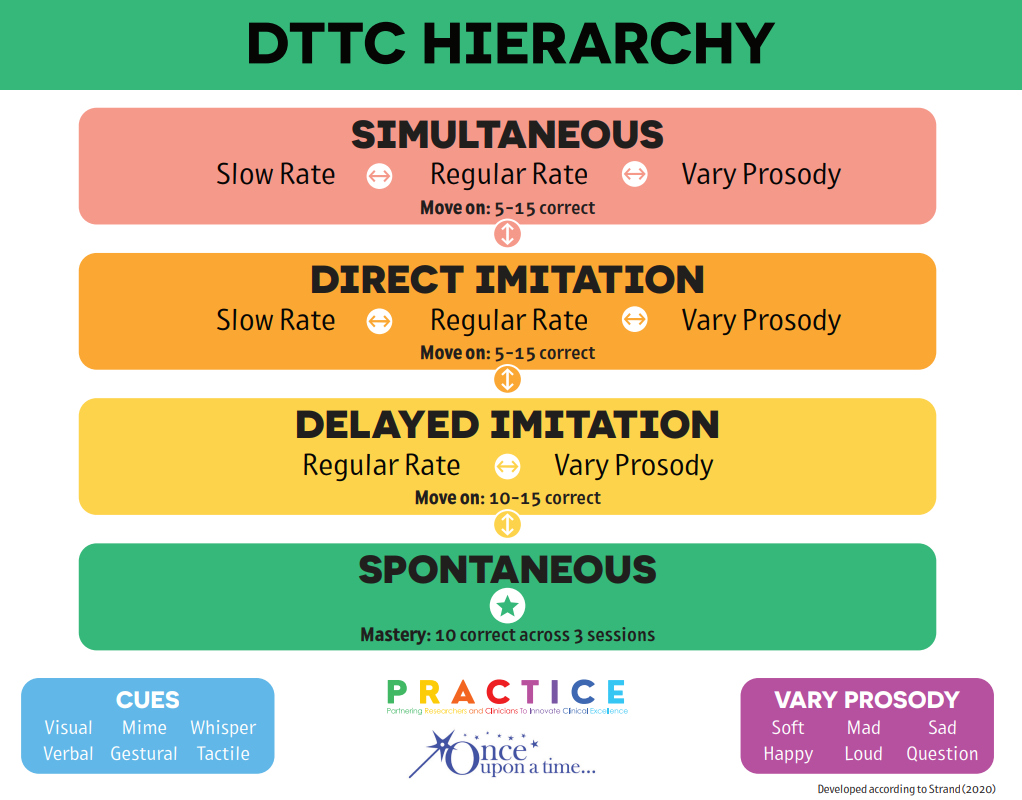
DTTC goal
shaping movement gestures or transitions for speech production and the continued practice of those gestures in the context of speech
DTTC prerequisites
able to focus attention to the SLP’s face for at least a few minutes at a time
able to at least attempt direct imitation
DTTC key idea
the use of a specific hierarchy of temporal delay in each block of practice
DTTC rationale
providing max support at first, and then the child takes the increasing responsibility for assembling, retrieving, and executing motor plans with progressively less cueing
learning → generalizing
at each level of the DTTC hierarchy
start slowly, and move toward normal rate
provide variability in practice
provide multisensory cues as needed
fade ASAP
provide KP feedback at first, then move to KR feedback
DTTC main takeaway
before moving to the next level of the hierarchy, the child needs to show accurate movement at normal rate, speak in varied prosody, and show no effortful production
K-SLP
motor programming approach
speech is broken down into smaller units (C, V, syllables, words)
built back up into the target behavior
adds/fades cues as needed
target vocab is reinforced to give a child a functional vocab
NDP3
motor programming approach
building from core units of speech (phonemes) and simple syllables
phonological skills are incorporated through use of minimal pairs
ReST
PML approach
stimuli
repetitions of varied sequences of real or nonsense syllables
intensive practice
producing multisyllabic pseudo-words to improve speech sound production
PROMPT
sensory treatment approach
uses tactile-kinesthetic-proprioceptive cues
supports and shapes movements of the oral articulators