7.6 Different Market Structures
 Call Kai
 Learn
Learn Practice Test
 Spaced Repetition
 Match
Match Flashcards
 Knowt Play
1/115

There's no tags or description
Looks like no tags are added yet.
Name | Mastery | Learn | Test | Matching | Spaced | Call with Kai |
|---|
No analytics yet
Send a link to your students to track their progress
116 Terms
What is a market structure + what does this determine (4)
The way in which a market is organised in terms of certain characteristics which can be used to explain the behaviour of firms in a market
The characteristics of a market that determine:
1. Level of competition
2. Firm behaviour
3. Price setting
4. Efficiency.
What are the main features used to identify market structures (4)
• number of buyers and sellers
• degree of product differentiation
• barriers to entry and exit (ease of entry)
• availability of information - the extent to which all firms in the market have the same information
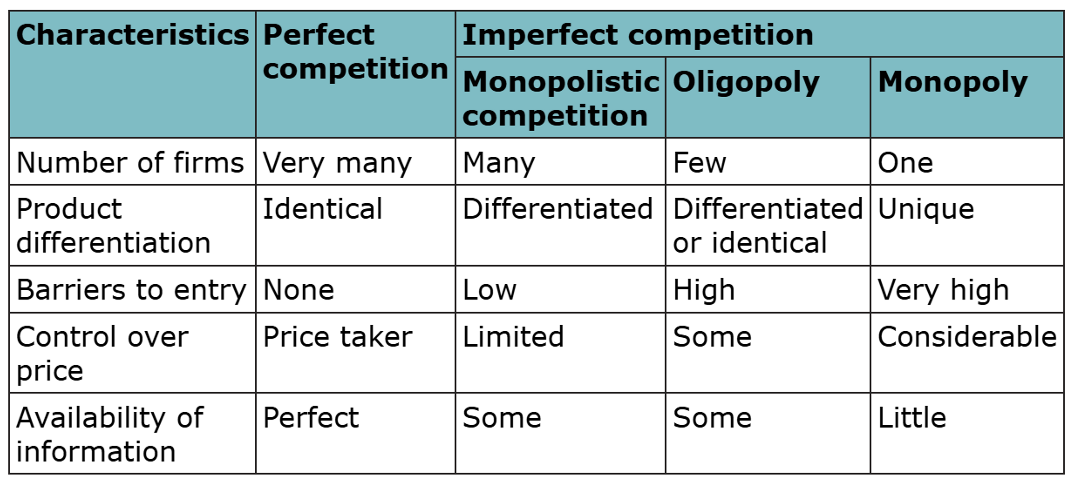
What are the four types of market structure and their level of competition
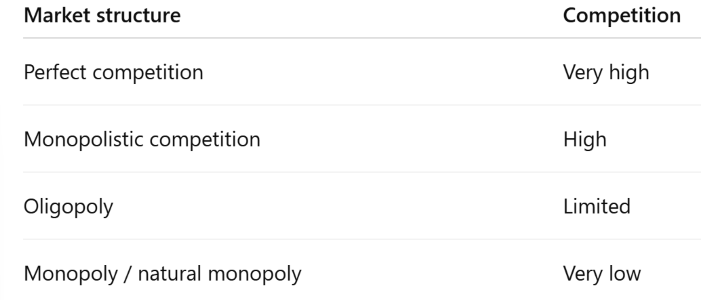
Where does each market sit on the spectrums of competition (number of firms, barriers to entry, control over price charged)
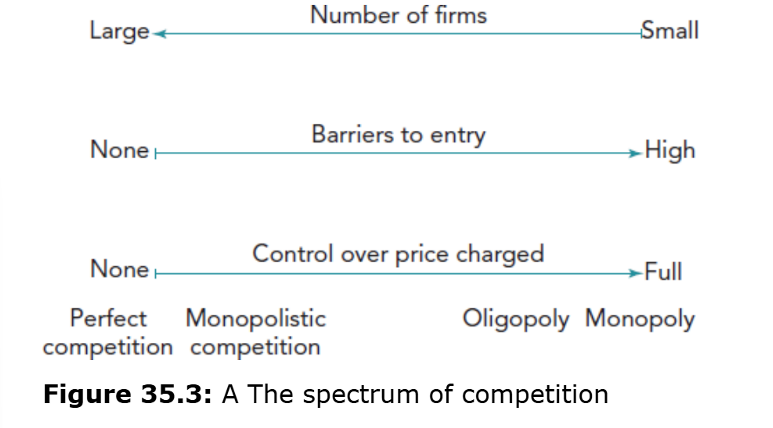
What is perfect competition
An ideal market structure with many buyers and sellers, homogeneous (identical) products, free entry and exit, and perfect information. - sometimes referred to as total competition
What are the five key features of perfect competition
• Large number of firms
• Homogeneous products (identical)
• Firms are price takers (decided by the price mechanism)
• Perfect information (of market conditions - products, prices and means of production)
• No barriers to entry or exit (complete freedom)
What is the point of this theoretical extreme of perfect competition
Acts as a benchmark when assessing the efficiency of real-world markets
Examples of the closest market to perfect competition (2)
Agriculture - not, because products are not identical
Global market for foreign exchange
What shape is the demand curve in perfect competition and why
Straight horizontal line at market price as demand is perfectly elastic
What does it mean if firms are price takers in perfect competition
Firms cannot influence market price and must accept the price determined by market demand and supply.
What is the shape of the average revenue curve in perfect competition
A horizontal line equal to market price.
What is the relationship between AR and MR in perfect competition
Average revenue equals marginal revenue.
What is the profit-maximising condition for firms
Firms maximise profit where marginal revenue equals marginal cost (MR = MC).
What does the perfect competition model look like in graphs (4)
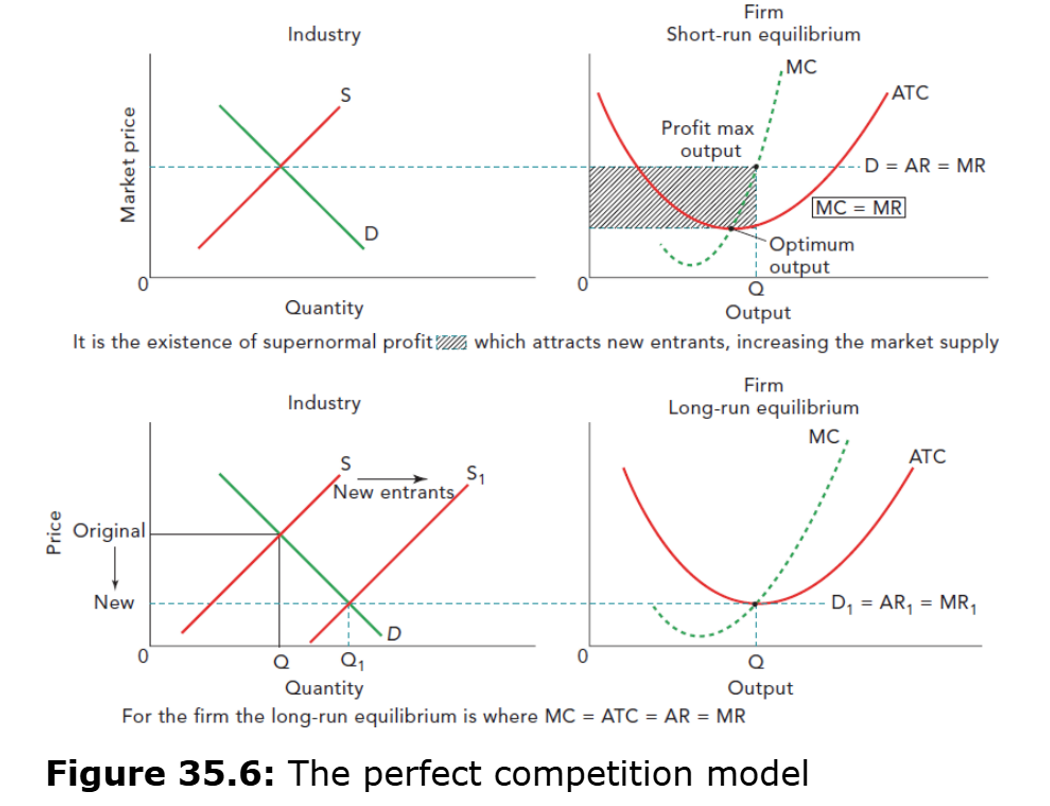
What types of profit can firms earn in the short run under perfect competition
Firms may make:
• supernormal profit
• normal profit
• subnormal profit
What is the shutdown condition for a perfectly competitive firm in the short run
The firm should shut down if average revenue is less than average variable cost (AR < AVC).
What is the shut-down price
A firm will stop production when price falls below average cost curve
What happens if many firms leave the market
A reduction in the overall market supply, which will raise the market price and in turn gives the rest of the firms an opportunity to continue producing and at least make normal profit.
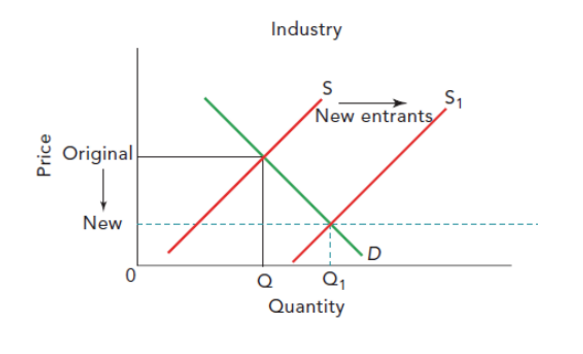
What happens in the long run under perfect competition
Firms enter or exit the market until only normal profit is earned.
• Supernormal profit → new firms enter
• Subnormal profit → firms exit
• Result: normal profit only
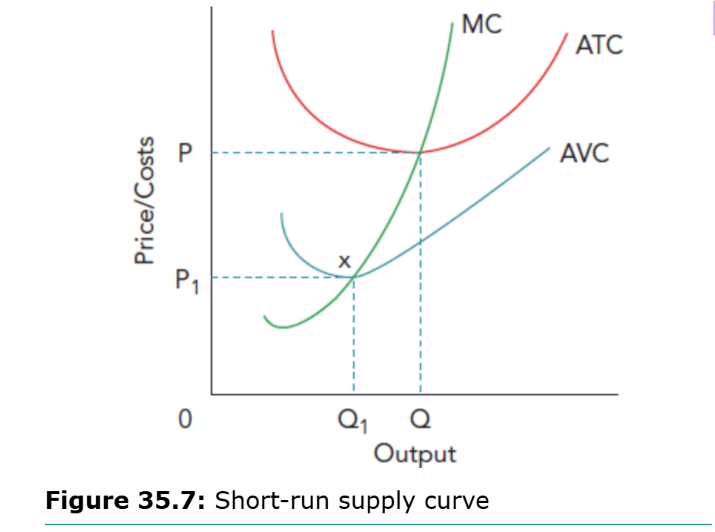
What determines a firm's short-run supply curve in perfect competition
In perfect competition, a firm's short-run supply curve is the portion of its Marginal Cost (MC) curve above the minimum Average Variable Cost (AVC).
• The firm produces where MC = Price (MR).
• If price falls below minimum AVC, the firm shuts down to avoid losses greater than fixed costs.
What does a firm's short-run supply curve look like on a diagram (MC, ATC, AVC)
What is the only way to boost profit in perfect competition
Increase productivity and lower average total cost
Why do firms earn only normal profit in the long run under perfect competition + how can this be shown on a graph
Free entry and exit eliminate supernormal and subnormal profits.
Why is perfect competition allocatively efficient
Price equals marginal cost (P = MC).
Why is perfect competition productively efficient
Firms produce at the lowest point of the average cost curve.
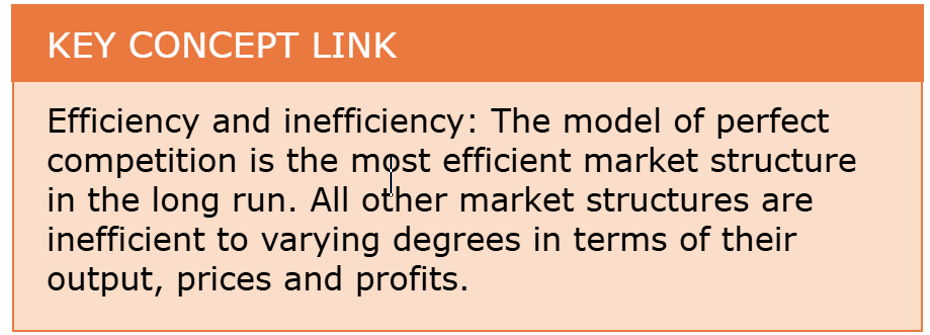
Key concept link - which is the most efficient market structure
What is imperfect competition
Any market structure except for perfect competition
What are the 4 types of imperfect competition
Monopolistic competition
Oligopoly
Pure monopoly
Natural monopoly
What is monopolistic competition
A market structure with many firms selling differentiated products and facing low barriers to entry.
What are examples of monopolistic competition (3)
• Restaurants
• Hairdressers
• Clothing brands
What are the key features of monopolistic competition (4)
• A large number buyers and sellers
• Product differentiation (quality and product differentiation)
• Some price-setting power (price makers)
• Free entry and exit (few barriers) - easy for firms to recoup their capital expenditure on exit from the market.
What is price competition
Where firms compete on price to attract customers
What is non-price competition
Where firms use methods other than price to attract customers from rival producers
What is the shape of the AR curve in monopolistic competition
Downward sloping due to product differentiation.
Where does marginal revenue lie in relation to average revenue in monopolistic competition and why
Marginal revenue lies below average revenue
Because firms must lower price to sell additional units.
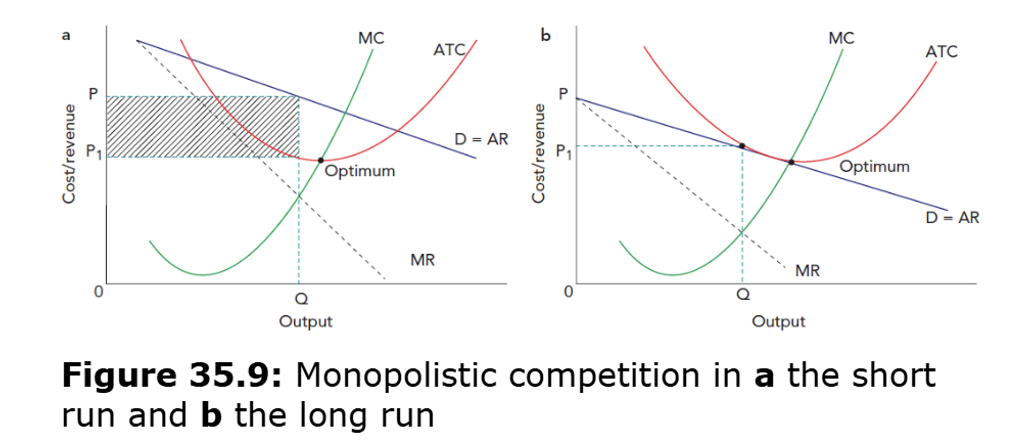
What profits can firms earn in the short run under monopolistic competition
Supernormal profit, normal profit, or subnormal profit.
What happens to profits in the long run under monopolistic competition
Firms earn only normal profit due to entry and exit.
• Entry erodes supernormal profit
• Firms earn normal profit only
What is excess capacity in monopolistic competition
When firms produce at an output below the minimum point of average cost.
What does monopolistic competition look like in short run and long run on graph (2)
Is monopolistic competition allocatively or productively efficient (or both or neither)
It is neither allocatively nor productively efficient.
Why is monopolistic competition not allocatively efficient
• Allocative efficiency occurs where P = MC.
• In monopolistic competition, firms face a downward-sloping demand curve, so they set P > MC to earn profit.
• This means consumers pay more than the marginal cost of production.
Why is monopolistic competition not productively efficient
• Productive efficiency occurs at the lowest point of the AC curve.
• In monopolistic competition, firms operate to the left of minimum AC because excess capacity exists due to product differentiation.
• Output is therefore not produced at the lowest possible cost.
Classic example of monopolistic competition
A classic example of monopolistic competition in Economics is the coffee shop market.
For example:
Starbucks
independent cafés
local coffee chains
What is an oligopoly
A market structure dominated by a few large firms with high barriers to entry, where each firm’s actions affect the others.
- A market situation where the total output is concentrated on the hands of a few firms
What are five key features of an oligopoly
• Few dominant firms
• High barriers to entry
• Interdependence - decisions are interdependent
• Products can be differentiated or undifferentiated
• Price rigidity due to uncertainty and risks associated with price competition
What is interdependence
When firms must take into account the likely reactions of rival firms when making decisions about price, output, or non-price competition.
What is price rigidity
Where prices are unchanged despite a change in costs
What are examples of oligopolies (3)
• Mobile networks
• Airlines
• Supermarkets
What is interdependence in oligopoly
When each firm’s decisions affect and are affected by other firms.
Why is price rigidity common in oligopolies
Firms fear price wars if they cut prices and losing customers if they raise prices.
What is the problem with studying oligopolies
Their behaviour can follow two very different routes:
Aggressive competition
Co-operation and collusion
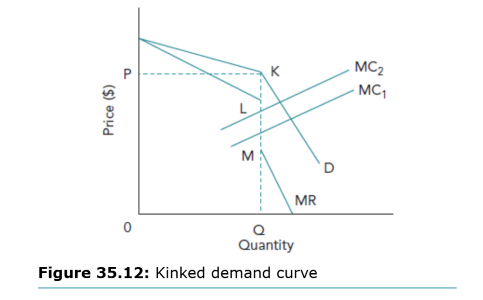
What is the kinked demand curve theory
A theory explaining price rigidity in oligopoly using different price elasticities for price rises and falls.
• Demand is more elastic for price rises
• Demand is less elastic for price cuts
• Leads to stable prices
What does the kinked demand curve look like
What does the kinked demand curve assume
Oligopolistic firms are interdependent - there is no collusion between firms.
Main 2 criticisms of the kinked demand curve
Missing a proper explanation on where the kink should be
Does not represent how firms behave in real oligopolistic markets - (no account for price competition)
What is price competition in oligopoly
Competition based on lowering prices, often avoided due to the risk of price wars.
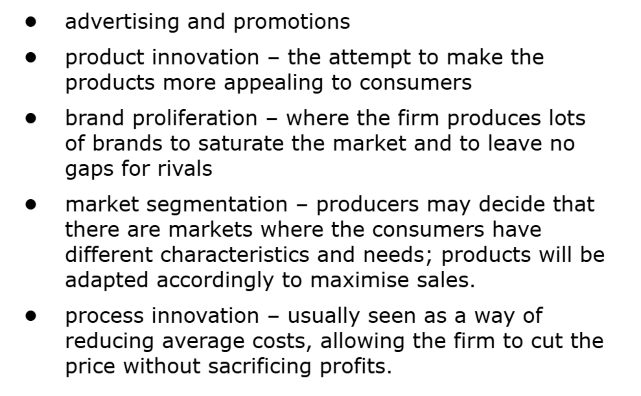
What is non-price competition in oligopoly (5)
What is collusion
An agreement between firms to:
• fix prices
• limit output
• increase profits
• Share markets
What is a cartel
A formal collusive agreement between firms.
What are the five conditions for an effective cartel
Few firms
Similar costs
High barriers to entry
Inelastic demand
Strong enforcement
What are the 4 consequences of collusion
Higher prices
Reduced output
Allocative inefficiency
Loss of consumer welfare
What is the Prisoner’s Dilemma in oligopoly
A model showing why firms have an incentive to cheat on collusive agreements but also why collusion is unstable.
Why is collusion often unstable
Each firm:
• benefits individually from cheating
• but collective cheating makes all worse off
Exam tip: Always link to self-interest and profit maximisation.
What is price leadership
A situation in a market whereby a particular firm has the power to change prices, the result of which is that competitors follow this lead
What is a monopoly
A market structure with one dominant firm having a very large market share (price maker) and high barriers to entry.
What are the 4 key features of monopoly
One seller - no close substitutes.
Price maker
High barriers to entry
Abnormal profits possible long run/potential for supernormal profit in the long run.
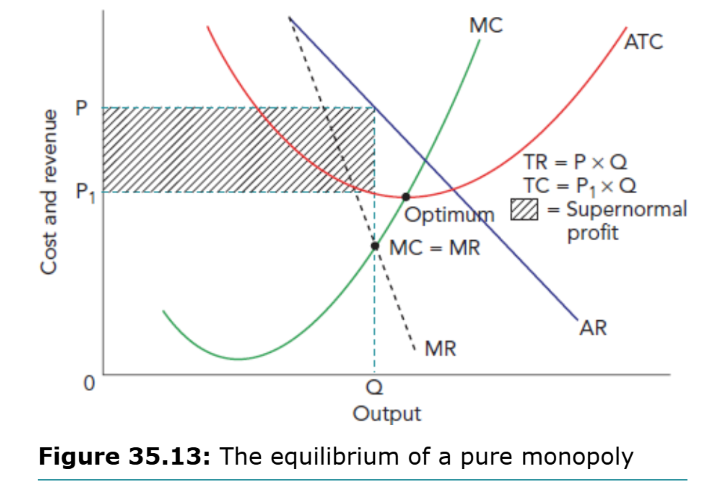
What is the shape of the AR curve in monopoly
Downward sloping.
Where does a monopolist produce
At the output where marginal revenue equals marginal cost.
How does a monopolist set price
By charging the price from the average revenue curve at the profit-maximising output (MC=MR)
What does a pure monopoly diagram look like (MC, ATC, AR, MR)
Is a monopoly allocatively efficient
No, because price is greater than marginal cost (P > MC).
Is a monopoly productively efficient
No, because output is not produced at minimum average cost.
In a monopoly, why is there no distinction between short-run and long-run
Because of the barriers that prevent the entry of competitors.
There is no economic incentive for the monopolist to move away from the profit-maximising output (Q)
What is a natural monopoly
A monopoly where economies of scale are so large that one firm can supply the market at lower cost.
What are examples of natural monopolies (3)
• Water supply
• Electricity distribution
• Rail infrastructure.
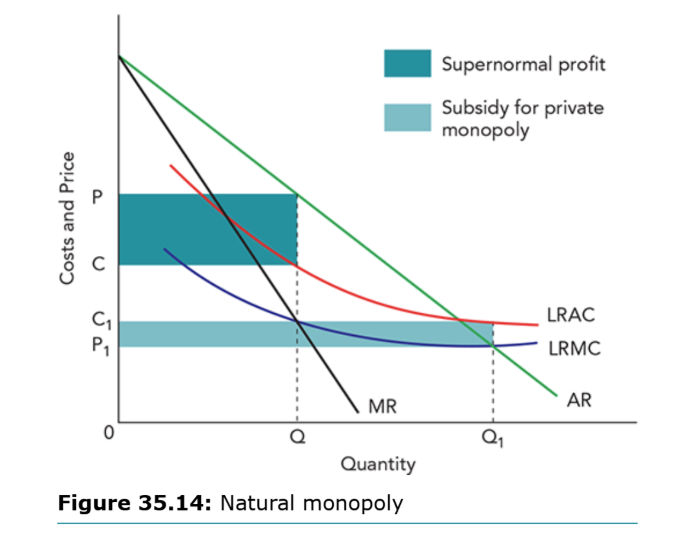
What does a natural monopoly look like on diagram (LRAC, LRMC, AR, MR) + explanation (7)
• LRAC is downward-sloping due to large economies of scale
• One firm can supply the whole market at lower cost than multiple firms
• Profit-maximising monopoly: MR = LRMC → price P, output Q
• At P, price > LRAC → supernormal profit
• Socially efficient outcome: price = LRMC → lower price P₁, higher output Q₁
• But at P₁, price < LRAC → firm makes losses
• Losses require government subsidy or public ownership
What is the difference between a monopoly and monopolistic competition
They are opposites
• Monopoly: One firm dominates the market, no close substitutes, high barriers to entry.
• Monopolistic competition: Many firms, differentiated products, low barriers to entry.
Characteristics of market structures table:
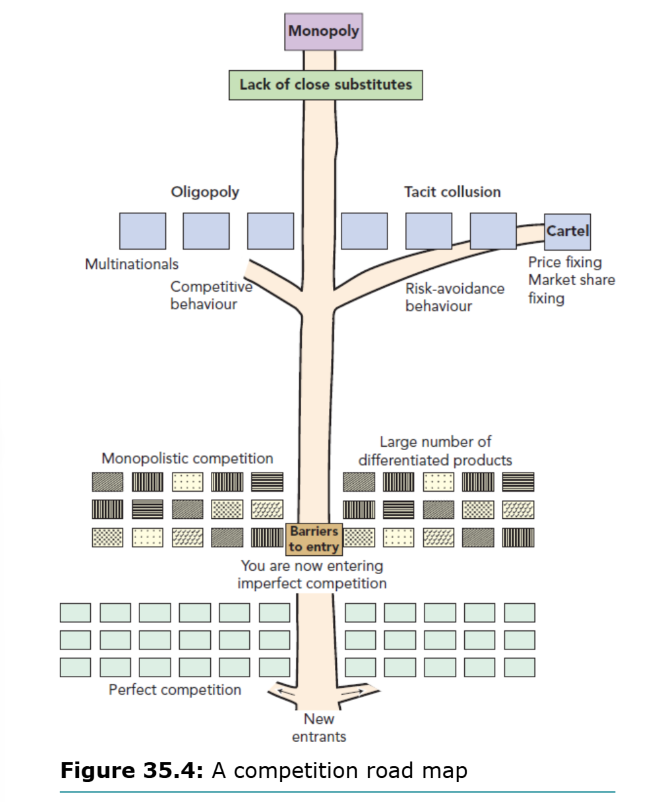
How to identify what type of market one is (Competition road map)
What are barriers to entry and the four types
Obstacles/restrictions that deter or prevent new firms from entering a market/industry.
Can be legal, market, cost or physical
How do barriers to entry give firms a degree of market power
As decisions by existing firms can be made without the risk or their market share or price being challenged from outside
When do legal barriers of entry occur
Often when economic activity is state-owned or the good is produced under licence for the government - usually created to achieve social and political objectives.
What are some examples of legal barriers to entry (3)
• Patents - competitors cannot copy a product without permission from the owner
• Licences
• Copyrights
What is the argument for removing legal barriers to entry (e.g. privatising and deregulating)
The injection of competition will bring additional economic and social benefits through a more efficient allocation of resources.
How can existing firms make entry for firms more difficult using market barriers to entry (2)
By saturating the market with lots of brands giving consumers what appears to be a wide range of choice.
Branding gives the firm greater market power because consumers do not see the rival firm's product as a close substitute on account of extensive advertising.
What are some examples of market barriers to entry (3)
• Brand loyalty
• Advertising
• Network effects
What are cost barriers
• High start-up or operating costs that make it difficult for new firms to enter a market.
What are some examples of cost barriers to entry (4)
• Economies of scale
• Predatory pricing
• Expensive machinery
• Research and development
When do physical barriers occur
When some firms have access to raw materials, components or retail outlets, which make it difficult for new firms to make an impact.
In particular vertically integrated businesses will be protected by the fact their rival's costs will be higher.
What are some examples of physical barriers to entry (2)
• Ownership of key resources
• Infrastructure control
What are barriers to exit (3)
• Sunk costs (e.g. R&D) cannot be recovered when a firm leaves.
• Resources cannot be easily transferred to other uses.
• High cost of failure discourages firms from entering the market.
Draw a diagram comparing a perfectly competitive industry with a profit-maximising industry (perfect competition vs monopoly)
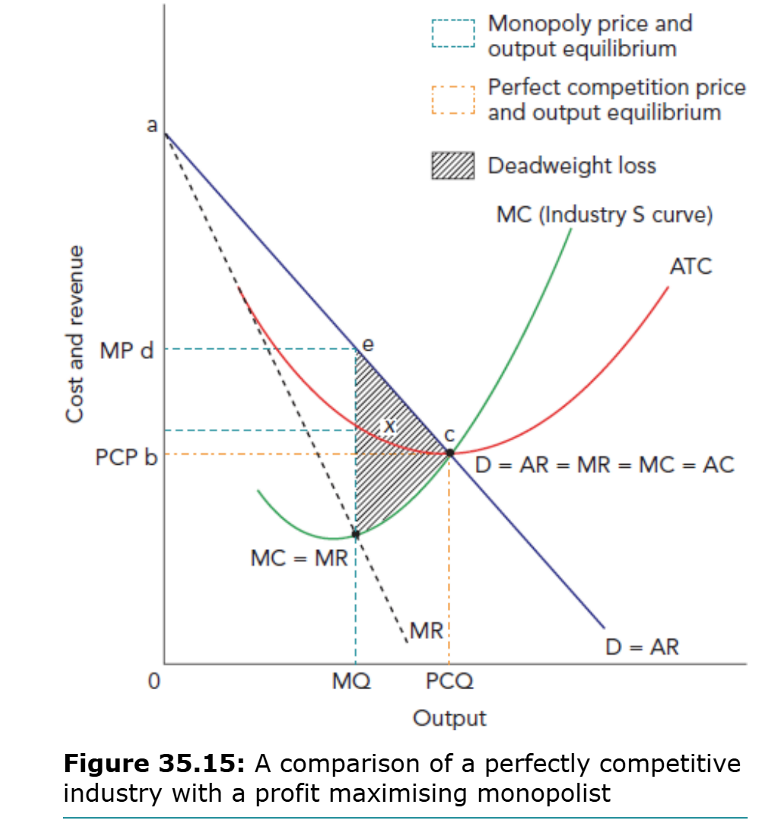
What observations can be made by comparing the two equilibrium positions of perfect competition and monopoly (7)
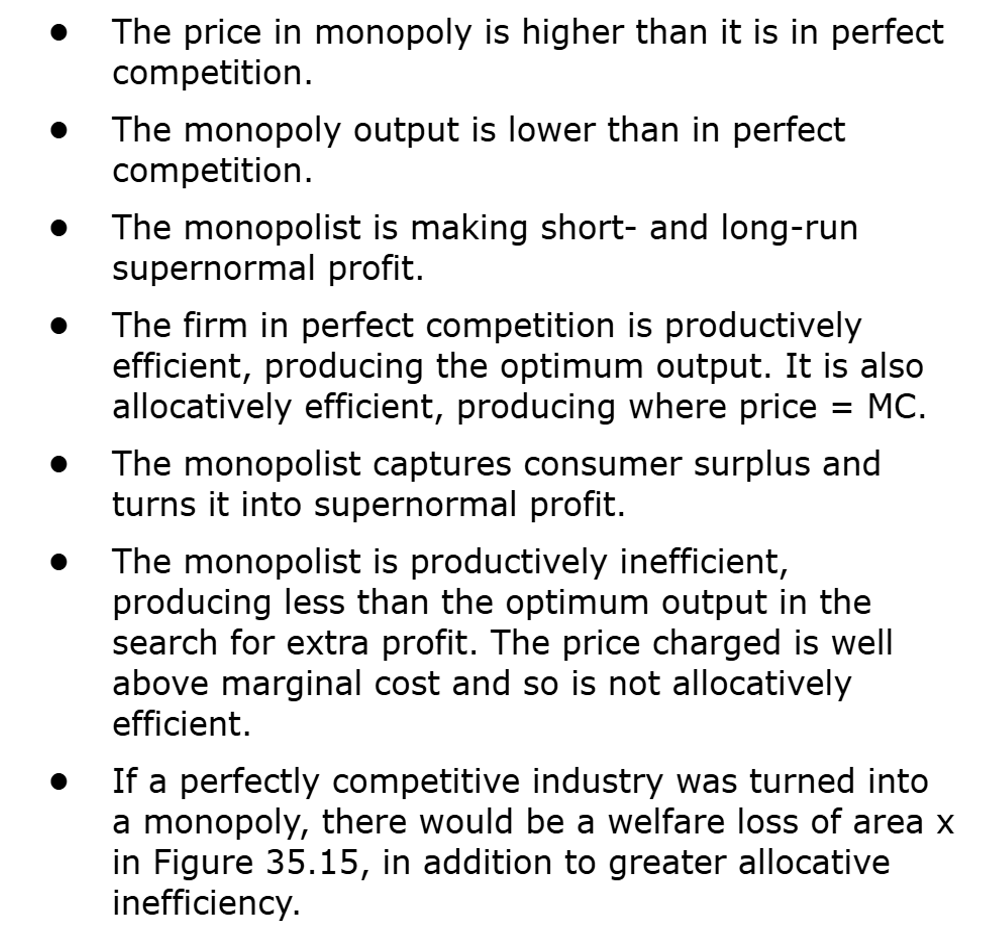
What does the diagram (comparing monopoly and perfect competition) also show about the inefficiencies (3)
What are the two criticisms of comparing real-world monopolies to perfect competition
Perfect competition is unrealistic
It’s a theoretical ideal; more realistic comparisons are monopolistic competition or oligopoly, which also show inefficiencies and wasted resources (e.g. advertising).Assumes identical costs
Ignores that monopolies may gain economies of scale, lowering unit costs → a monopolist could charge lower prices than in perfect competition while still earning supernormal profit.
What are the positive aspects of monopoly in certain circumstances (5)
• A monopolist may only earn normal profit if fixed costs are very high.
• Stable (guaranteed) profits allow long-term planning and investment.
• Profits can fund process innovation, lowering unit costs.
• Profits can fund product innovation, improving quality or choice.
• If economies of scale and innovation benefits are passed on, consumers may gain despite supernormal profit.
What is the main criticism of state-owned monopolies
The absence of competition makes them less efficient
Monopolies are said to suffer from what type of inefficiency
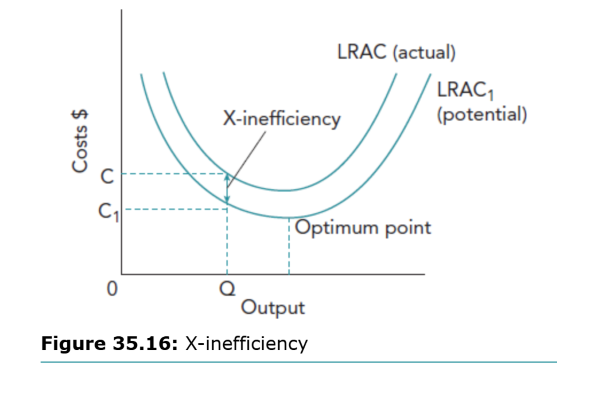
X-inefficiency
What is X-inefficiency
A lack of efficiency caused by weak competitive pressure leading to higher costs.
- The firm is not producing at the lowest possible cost for a given level of output
Where a firms cost are above those experienced in a more competitive market
X-efficiency diagram