ARE 5.0: Project Management
 Studied by 0 people
 Call Kai
 Learn
Learn Practice Test
 Spaced Repetition
 Match
Match Flashcards
 Knowt Play
1/282

There's no tags or description
Looks like no tags are added yet.
Name | Mastery | Learn | Test | Matching | Spaced |
|---|
No study sessions yet.
283 Terms
Application for Payment (A201; Article 9)
Submitted by the Contractor to the Architect. Itemized and prepared in accordance with Schedule of Values. Architect reviews and submits to the owner so that they can pay the contractor, or withholds for valid reasons.
Partnering
Stakeholders in a project all participate in decision-making process. Can produce closer communication and shared responsibilities but requires more difficult management.
Project Manager
Coordinates the activities of all the members of the design and construction teams related to the firm
Architecture Team members identified on proposal for project
Firm Principal; Lead Designer; Project Manager; Key Consultants
Assembling of project team (important considerations)
-Type/Complexity of Project
-Size of Project
-Staff Availability
-Experience Levels
-Billing Rates
-Personalities
Bar Chart (Gantt Chart)
Simplest and most common for scheduling a design project.
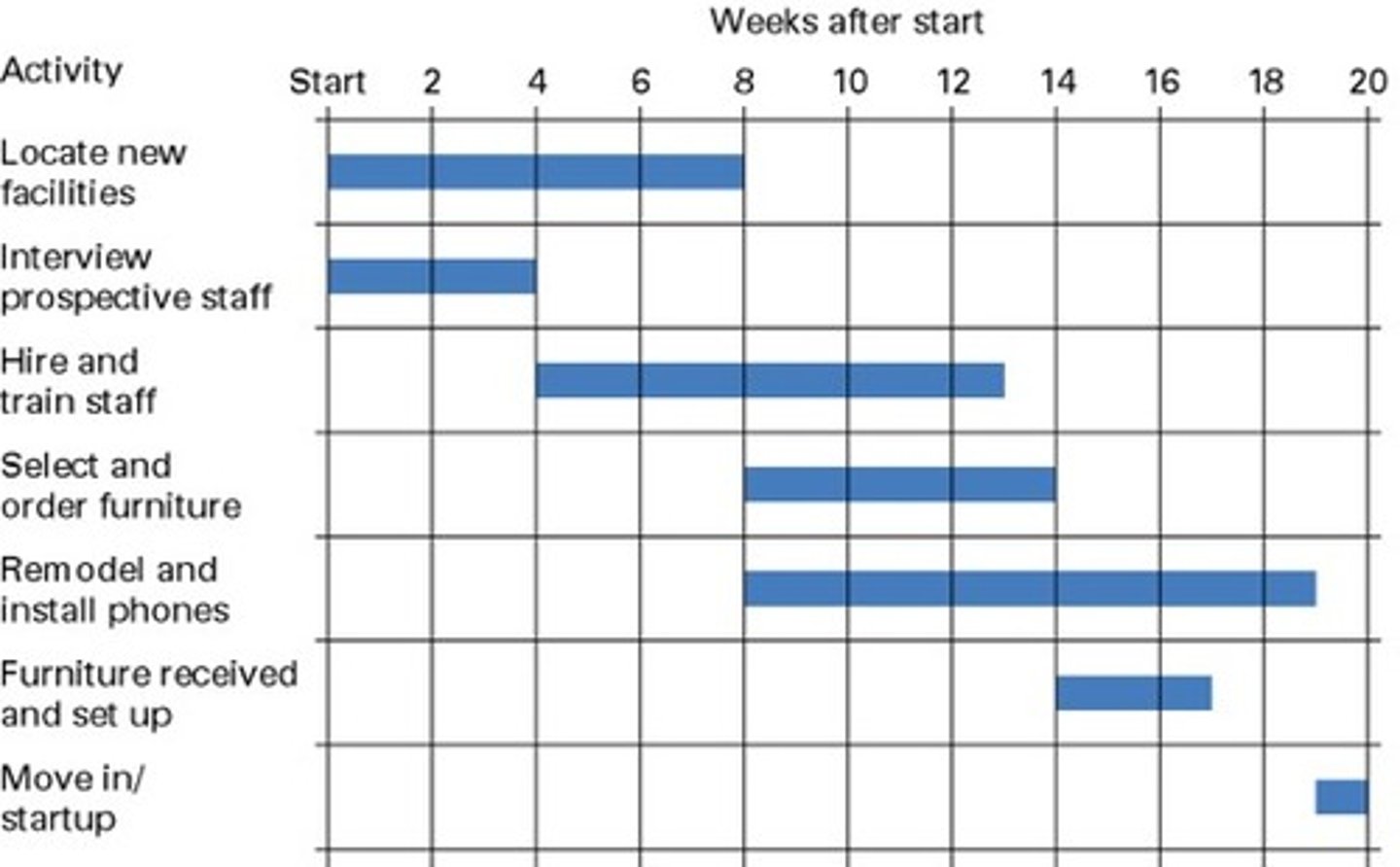
Dependency
When one task must be completed before another one can begin. Represented by an arrow on a Gantt Chart, or a dashed arrow (dummy) on Critical Path Method.
Critical Path Method
A scheduling tool more common to construction projects. Sequence of tasks depicted graphically, with tasks duration and earliest and latest start and finish times. Solid arrows represent tasks; a task cannot begin until all tasks leading into a circle are completed. Dependencies represented with dashed lines called dummies.
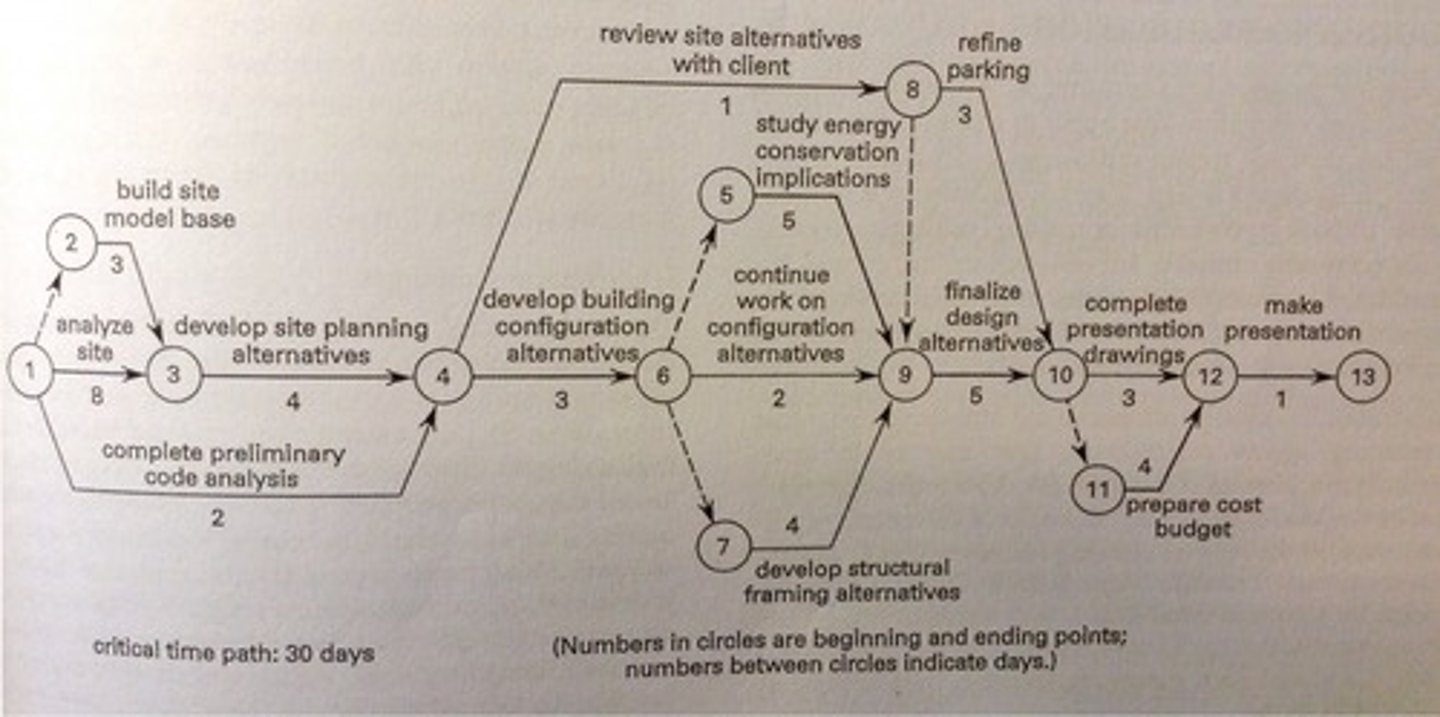
Critical Path
The sequence of tasks that must be started and finished on time to meet the project's deadline.
Float
Maximum length of time that a noncritical task can be delayed or extended before it causes a delay in the overall project.
Work Plan (or Fee Projection)
Detailed project schedule that breaks down project into its component tasks and assigns specific staff and resources to each task. Also details how the fee will cover the cost of staff and project expenses (after deducting profit and overhead).
total working fee
The fee available to pay people to do the job after subtracting fees for profit, consultants and other expenses.
Fee per Phase
Phase's percentage, multiplied by total working fee
Top-Down Approach
Estimate the total fee needed to complete a project using rules of thumb and historical data. Subtract other expenses to get direct fee, and allocate direct fee to each phase.
Bottom-Up Approach
Break projects into individual tasks. List tasks in chronological order. Estimate number of hours to complete each task and assign a staff member with a specific billing rate to each task to calculate total estimated working fee.
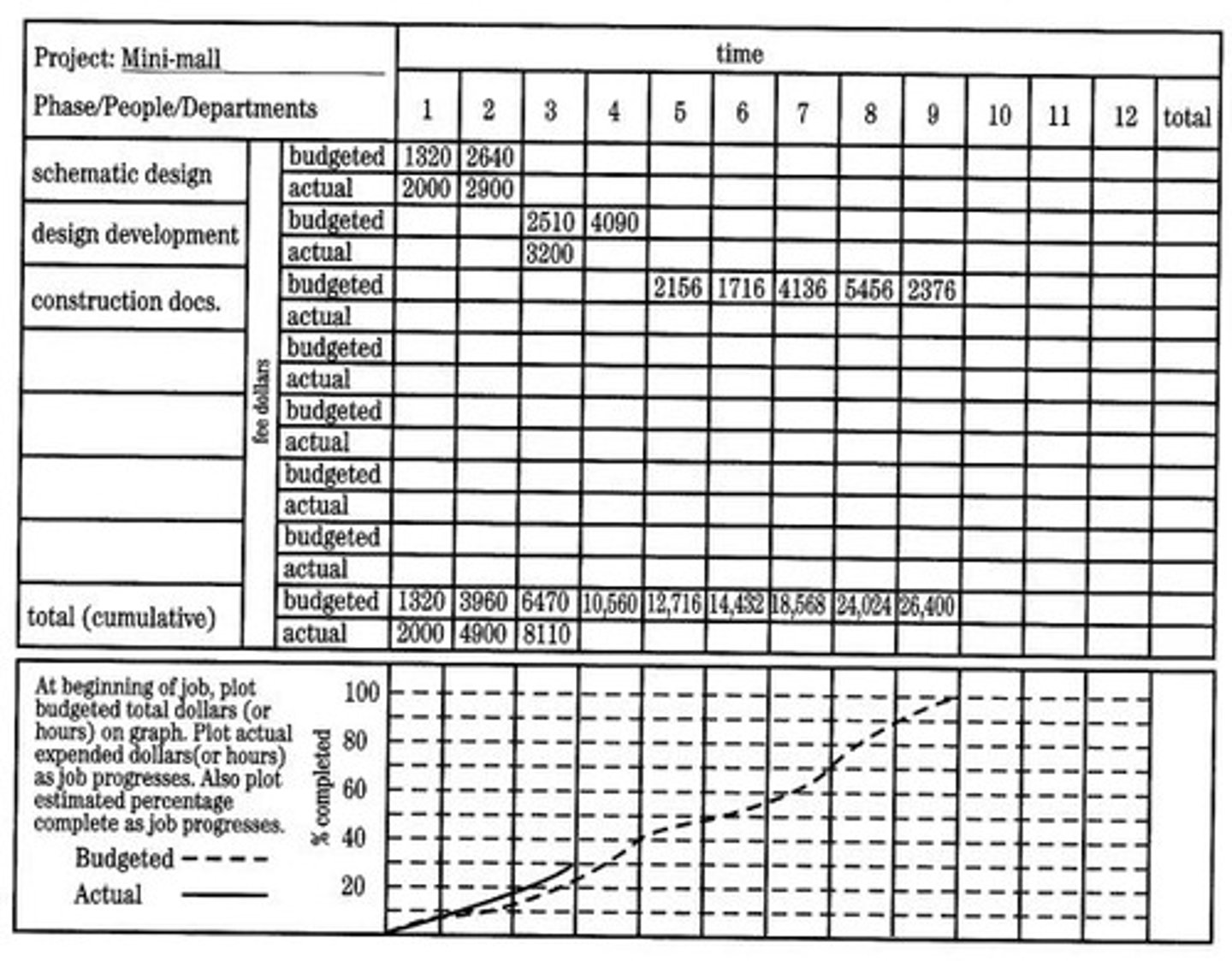
Project Monitoring Chart
A chart comparing actual time (or fees) to budgeted time (or fees). Can be generated using info from time sheets.
Full Wall Schedule
A method for developing a preliminary schedule where all team members are brought together to determine tasks and scheduling. Vertical lines on wall represent weeks, team members asked to place a start and finish card for each task on the wall in location representing necessary time for task.
Consultant
An expert who is not part of the firm's regular staff but is employed to work on one or more specific projects. They are responsible for the accuracy and consistency of their own drawings but architect is liable to owner for their work,
Structural Engineer
Consultant that designs any new structure or structural modifications. Produces and drawings and specifications for the structural portion of project.
Mechanical Engineer
Consultant that designs and produces the drawings and specs for heating, ventilating, and air conditioning (HVAC) system, as well as plumbing systems. Can design fire protection systems as well.
Electrical Engineer
Consultant that designs and produces the drawings and specs for the power system and lighting system. Often will design telephone system, signal systems, and security systems as well.
Project Notebook
Tool that allows PM to immediately access information for planning, coordinating, and monitoring the project.
Items Contained in Project Notebook (8)
- General Reference
- Contracts
- Fees and Schedules
- Programming
- Budget
- Job Communication
- Construction Administration
- Closeout/ Follow-Up
Elements of Meeting Minutes Template (7)
- Project Name and Number
- Date of Meeting
- Location of Meeting
- Time of Meeting
- People in Attendance and their Organizations
- Subjects Covered
- Follow-up or Action Items
Project Perfection Syndrome
The desire to continue to pursue perfection. Marginal progress toward perfection comes at the expense of a great deal of additional time and resources. Occurs when contractual and office quality standards have been met, but production staff want to continue refining and improving design.
Basic Services (B101; Article 3)
Article 3 of B101 contract: Describes the activities of the architect during each phase of a traditional design-bid-build project.
Additional Services (B101; Article 4)
Article 4 of B101 contract: Describes other services that an architect may perform in addition to basic services. These can be performed in exchange for additional compensation.
Schematic Design, Design Development, Construction Documents, Bidding and Negotiation, Construction Administration.
Phases of a traditional design-bid-build project as outlined in the B101 contract. (B101; Article 3)
Examples of Additional Services (B101; Article 4)
Programming; BIM; LEED (and the like); post-occupancy evalutations; detailed cost estimating... many more...
(AIA Document) G612
Owner's Instructions to the Architect: Helps owner gather initial information for project.
Standard of Care (B101; Article 2)
"The Architect shall perform its services consistent with the professional skill and care ordinarily provided by architects practicing in the same or similar locality under the same or similar circumstances. The architect shall perform its services as expeditiously as is consistent with such professional skill and care and the orderly progress of the Project."
Architect's insurance (required per B101)
- General Liability
- Automobile Liability
- Worker's Compensation
- Professional Liability
Structural, Mechanical and Electrical (B101; Article 3)
Engineering services Architect is responsible for
Owner's Responsibilities (B101; Article 5)
- Program
- Land Survey
- Geotechnical Engineer
- Tests, inspections and reports req'd by law
- Legal, Insurance and Accounting services req'd
for project
(AIA Document) G601
Request for Proposal - Land Survey; used if architect agrees to hire land surveyor
(AIA Document) G602
Request for Proposal - Geotechnical Services; used if architect agrees to hire Geotechnical Engineer
Instruments of Service (B101; Article 7)
Drawings, Specs and other Documents authored by the Architect and their consultants.
Waiver of Consequential Damages (B101; Article 8)
"The Architect and Owner waive consequential damages for claims, disputes or other matters in question arising out of or relating to this agreement..." This limits claims to damages arising directly from a breach of the contract.
Hazardous Materials (B101; Article 10)
"...Architect shall have no responsibility for the discovery, presence, handling removal or disposal of, or exposure of persons to, hazardous materials or toxic substances in any form at the Project site."
Privity (B101; Article 10)
"Nothing contained in this Agreement shall create a contractual relationship with or a cause of action in favor of a third party against either the Owner or Architect." Principal that a contract can not be used as the basis of a legal claim except by those who are parties to it.
Causes of Action (B101; Article 10)
Contracts can change statues. B101 places a cap of 10 years on owner's ability to file claim against architect.
Waiver of Rights (aka Waiver of Subrogation)(B101; Article 8)
"To the extent damages are covered by property insurance, the Owner and Architect waive all rights against each other and against the contractors, consultants, agents and employees of the other for damages, except such rights as the may have to the proceeds of such insurance as set forth in AIA Document A201-2007..." Owner and Architect cannot sue each other for damages if they are covered by property insurance. Prevents insurance company from suing any principal participants to recover what has been paid for an insured loss.
Right to Photograph (B101; Article 10)
Architect is allowed reasonably to time to photograph completed work for marketing materials, unless client has previously notified architect in writing that subject is confidential or proprietary.
Termination (B101; Article 9)
Either party can terminate agreement with no less than 7 days notice if other party fails substantially to perform according to terms of the agreements. Architect can suspend within 7 days if owner fails to pay fees. Architect must be compensated for prior work if project is suspended or terminated. Owner can terminate per their convenience.
Cost of the Work (B101; Article 6)
Cost of labor and materials furnished by owner and cost of items spec'd or designed by the architect, plus a reasonable allowance for overhead and profit. Does not guarantee cost of bids, but must adhere to owner's budget.
If Bids are Greater than Budget (B101; Article 6)
-Increase Budget
-Authorize rebidding or negotiation
-Terminate the project
-Cooperate with the architect to revise the project's scope or quality
-Implement mutually acceptable alternative
(AIA Document) B200 Series
Standard Form of Architect's Services. Used to provide additional services.
Additional Services that require compensation (B101; Article 4)
-Changes to Initial Information
-Material Changes to project (schedule, budget. delivery method, etc)
-LEED, or similar
-Changes to Instruments of Services that have already been prepared due to change in laws or code.
-Preparing digital data for transmission
-Preparing design documentation for alt bids
-Attending/Prepping for Public Meetings
-Attending/Prepping for dispute resolutions where architect is not party to
-Evaluation qualifications of bidders
-Consultation about replacement of work due to fire, etc.
-Assisting IDM, if not architect
-Any services necessary b/c owner failed to make decision on time.
Additional Services where owner can decide on compensation (B101; Article 4)
-Reviewing submittals out of sequence
-Responding to excessive RFI's
-Prepping CO's or CCD's that req. eval of contractors proposals
-Evaluating extensive number of claims
-Evaluating substitutions proposed by owner or contractor and revising drawings
-Providing construction services 60 days or more after substantial completion date.
Mediation (B101; Article 8)
A process in which a neutral thrd party helps disputing parties negotiate a settlement, using rules established by the American Arbitration Association. No dispute resolution proceedings with binding outcomes may be held before at least 60 days from the date request for mediation was filed.
Arbitration (B101; Article 8)
A formal, legally binding process for resolving disputes without litigation. Arbiters with experience in construction industry will hear the arguments of both disputing parties and render a binding decision. More difficult to appeal than litigation.
Compensation Methods (B101; Article 11)
- Stipulated Sum (fixed fee)
- Cost Plus Fee
- Percentage of Construction Cost
- Unit Cost
Stipulated Sum (fixed fee) (B101; Article 11)
Owner Pays architect a particular amount for a specific set of services. Typically paid out monthly. Does not include reimbursable expenses.
Reimbursable Expenses (B101; Article 11)
Expenses paid by the architect related directly to the project. Includes postage, reproductions, transportation and travel expenses, project specific communication costs, project websites, project insurance, renderings and models.
Cost Plus Fee (B101; Article 11)
Actual expenses of doing a job plus a reasonable fee for profit. Actual expenses include salaries, benefits, direct expenses, and office overhead.
Percentage of Construction Cost (B101; Article 11)
Professional fee is a percentage of the overall cost of construction. No longer popular...Owner sees it as giving architect incentive to raise construction cost; For architects, inexpensive buildings can be as much or more work than expensive ones.
Unit Cost (B101; Article 11)
Fees are based on a definable unit. Good for repetitive jobs.
(AIA Document) B101 SP
Owner-Architect Agreement for a Sustainable Project
Sustainable Objective (B101 SP)
A goal to be achieved by incorporating sustainable measures into the design, construction, maintenance, and operations of the project. Could be based on Code or could be voluntary.
Sustainability Workshop (B101 SP)
A meeting where team members confirm the sustainable objective, establish the goals and expectations for the project, and discuss possible sustainable measures.
Sustainable Measure (B101 SP)
A specific design or construction element, or a post-occupancy use, operation or monitoring requirement, that must completed to achieve sustainable objective.
Sustainability Plan (B101 SP)
Contract document that identifies:
-Sustainable Objective
-Sustainable measures used to achieve objective
-Strategies used to implement sus. measures
-Associated responsibilities of Owner, Arch and Contractor
-Details about design reviews
-Details about testing to verify sus measures
-Details about sustainability documentation
Sustainability Certification (B101 SP)
Certification of a sustainable design, construction, environmental performance, or energy performance, issued by a certifying authority such as USGBC
Contract Documents (A101 & A201; Article 1 & 9)
- The Agreement
- General, Supplemental and Special Conditions
- Drawings
- Specifications
- Addenda
- Modifications
- Other documents listed in agreement (article 9)
Common compensation methods for construction
-Stipulated Sum
-Guaranteed Maximum Price
-Cost-plus-fee
-Unit Price
Date of Commencement (A101; Article 3)
Start of construction phase of project. Used to measure the construction completion time (aka contract time).
Substantial Completion (A101; Article 3 & A201; Article 8)
Stage at which the work is sufficiently complete so that the owner can occupy it or use it for its intended purpose. Can be expressed with a specific calendar date or a number of calendar days from commencement. Certified by architect.
Liquidated Damages (A101; Article 3)
Fees paid by the contractor to the owner for every day a project is late (except for uncontrollable circumstances). Often accompanied by bonus provisions for early completion.
Contract Sum (A101; Article 4)
compensation the contractor will receive for doing the work
Progress Payments (A101; Article 5)
Payments made periodically (e.g. monthly) as the project progresses. Contractor submits applications for payment to architect. Amount due is based upon percentage of completed work, plus amount allocated for materials and equipment purchased and stored on site.
Final Payment (A101; Article 5)
Covers payment of unpaid balance of the contract sum to contractor at the end of the project.
Schedule of Values (A101; Article 5)
Allocates total contract sum to various portions of the work.
Retainage (A101; Article 5)
Percentage of each payment (usually 10%) witheld until final completion of work.
Actions IDM must take (within 10 days of receiving a claim.) (A101; Article 6)
-Request addt'l info as needed
-Reject the claim in whole or part
-Approve claim
-Suggest a compromise
-Advise the owner and contractor that the IDM is unable to resolve claim.
The Work (A201; Article 1)
the construction and services required by the Contract Documents, whether completed or partially completed, and
includes all other labor, materials, equipment and services provided or
to be provided by the Contractor to fulfill the Contractor's obligations.
The Work may constitute the whole or a part of the Project.
Modifications to Contract Documents (A201; Article 1)
1. a written amendment to the Contract signed by both parties
2. a Change Order
3. a Construction Change Directive 4. a written order for a Minor Change in the Work issued by the Architect.
Relationships not created by Contract Documents (A201; Article 1)
1. between the Contractor and the Architect or the Architect's consultants,
2.between the Owner and a Subcontractor or a Sub-subcontractor, 3. between the Owner and the Architect or the Architect's consultants
4.between any persons or entities other than the Owner and the
Contractor.
The Project (A201; Article 1)
The Project is the total construction of which the Work performed under the Contract Documents may be the whole or a part and which may include construction by the Owner and by separate contractors.
The Specifications (A201; Article 1)
that portion of the Contract Documents consisting of the written requirements for materials, equipment, systems, standards and workmanship for the Work, and performance of related services.
Instruments of Service (A201; Article 1)
Representations, in any medium of expression now known or later developed, of the tangible and intangible creative work performed by the Architect and the Architect's consultants under their respective professional services agreements.
Times a contractor can ask an owner for proof that they can pay (A201; Article 2)
0. Prior to commencement of the work.
1. The Owner fails to make payments to the Contractor as the Contract Documents require
2. A change in the Work materially changes the Contract Sum
3. The Contractor identifies in writing a reasonable concern regarding the Owner's ability to make payment when due.
Owner's right to carry out the work (A201; Article 2)
If the Contractor defaults or neglects to carry out the Work in accordance with the Contract Documents and fails within a 10 day period after receipt of written notice from the Owner to commence and continue correction of such default or neglect with diligence and promptness, the Owner may, without prejudice to other remedies then Owner may have, correct such deficiencies. C.O. will be issued deducting payments from contract sum, must be approved by Architect.
Warranty (A201; Article 3)
The Contractor warrants to the Owner and Architect that materials and equipment furnished under the Contract will be of good quality and new unless the Contract Documents require or permit otherwise.
Role of the Contractor (A201; Article 3)
The Contractor shall supervise and direct the Work, using the Contractor's best skill and attention. The Contractor shall be solely responsible for, and have control over, construction means, methods, techniques, sequences and procedures and for coordinating all portions of the Work under the Contract, unless the Contract Documents give other specific instructions concerning these matters.
Permits, Fees, Notices and Laws (A201; Article 3)
§ 3.7.1 Unless otherwise provided in the Contract Documents, the Contractor shall secure and pay for the building permit as well as for other permits, fees, licenses, and inspections by government agencies necessary for proper execution and completion of the Work that are customarily secured after execution of the Contract and legally required at the time bids are received or negotiations concluded.
Concealed or Unknown Conditions (A201; Article 3)
If the Contractor encounters
conditions at the site that differ materially from those ordinarily found to exist...Contractor shall promptly provide notice to the Owner and the Architect before conditions are disturbed and in no event later than 21 days after first
observance of the conditions. Architect determines if conditions are materially different enough to effect contract sum or time.
Human Remains or Wetlands (A201; Article 3)
If, in the course of the Work, the Contractor encounters human
remains or recognizes the existence of burial markers, archaeological
sites or wetlands not indicated in the Contract Documents, the
Contractor shall immediately suspend any operations that would affect them and shall notify the Owner and Architect.
Allowances (A201; Article 3)
Architect's estimated cost of a particular material or piece of equipment when actual cost cannot be precisely determined. "Covers the cost of materials and equipment delivered to site and all required taxes..Whenever costs are more than allowances, the Contract Sum shall be adjusted accordingly by Change Order"
Superintendent (A201; Article 3)
A representative of the contractor who is in attendance at the site during performance of the work. Communications from them are binding as if given by contractor. Cannot be changed without owner's consent.
Submittals (A201; Article 3)
Shop Drawings, Product Data, Samples with the purpose to demonstrate the way
by which the Contractor proposes to conform to the information given
and the design concept expressed in the Contract Documents for those portions of the Work for which the Contract Documents require them. They are not themselves a part of the contract documents. Must be approved by the Architec.
Record Documents (A201; Article 3)
The Contractor shall maintain at the site for the Owner one copy of the
Drawings, Specifications, Addenda, Change Orders and other Modifications, in good order and marked currently to indicate field
changes and selections made during construction, and one copy of approved Shop Drawings, Product Data, Samples and similar required submittals. These shall be available to the Architect and shall be delivered to the Architect for submittal to the Owner upon completion of the Work as a record of the Work as constructed.
Design Services by Contractor (A201; Article 3)
The Contractor shall not be required to provide professional
services that constitute the practice of architecture or engineering unless such services are specifically required by the Contract Documents for a portion of the Work or unless the Contractor needs to provide such services in
order to carry out the Contractor's responsibilities for construction means, methods, techniques, sequences and procedures...the Owner and the Architect will specify all performance and design criteria that such services must satisfy.
Contractor's indemnification if owner and architect (A201; Article 3)
Contractor shall indemnify and hold harmless the Owner & Architect, from claims resulting from performance of the Work, provided that such claim is attributable to bodily injury, sickness, disease or death, or to injury to or destruction of property (other than the Work itself), but only to the extent caused by the negligent acts or omissions of the Contractor or anyone for whose acts they may be liable...
Contractor's Construction Schedules (A201; Article 3)
Created promptly after Contractor is awarded project...shall not
exceed time limits current under the Contract Documents, shall be
revised at appropriate intervals as required by the conditions of the Work and Project, shall be related to the entire Project to the extent required by the Contract Documents, and shall provide for expeditious and practicable execution of the Work.
Cleaning Up (A201; Article 3)
The Contractor shall keep the premises and surrounding area
free from accumulation of waste materials or rubbish caused by
operations under the Contract. If contractor doesn't, has to reimburse owner.
Access to Work (A201; Article 3)
Contractor has to allow architect and owner to visit the work.
Administration of the Contract (A201; Article 4)
"Architect will be the owner's representative during construction ...[and] have authority to act on behalf of the Owner only to the extent provided in the Contract
Documents."
Architect's Responsibilities on Site (A201; Article 4)
"The Architect will visit the site at intervals appropriate to the stage of construction, or as otherwise agreed with the Owner, to become generally familiar with the progress and quality of the portion of the Work completed, and to determine in general if the Work observed is being performed in a manner indicating that the Work, when fully completed, will be in accordance with the Contract Documents." Architect has no say on means and methods or safety precautions.
Architect reports to owner (A201; Article 4)
1. known deviations from
the Contract Documents and from the most recent construction schedule
2. defects and deficiencies
observed in the Work.
Communications Facilitating Contract Administration (A201; Article 4)
1. Owner and Contractor communicate through architect about matters relating to the Contract.
2. Communications to Subs and Suppliers will be through Contractor.
3. Communications to separate contracts will be through Owner