Lab 6: Plants + Fungal Diversity
 Call Kai
 Learn
Learn Practice Test
 Spaced Repetition
 Match
Match Flashcards
 Knowt Play
1/36

There's no tags or description
Looks like no tags are added yet.
Name | Mastery | Learn | Test | Matching | Spaced | Call with Kai |
|---|
No analytics yet
Send a link to your students to track their progress
37 Terms
What are Fungi?
Fungi are heterotrophic eukaryotes with absorptive nutrition
What group are fungi part of?
Opisthokonts
describe absorptive nutrition
in which enzymes are secreted into the environment to break down organic substrates and nutrients are absorbed across the cell wall
what is the body of a fungus known as?
mycelium or thallus
life cycle of most fungi
haplontic
fungi can be unicellular or multicellular. multicellular fungi are composed of what>
hyphae (filaments that are a single cell thick)
hyphae in many fungi may be divided by what?
septa (cross walls) to create individual cells
what do we call hyphae that do not have septae
aseptate or coenocytic
what are fruiting bodies?
multicellular reproductive structures (e.g. mushroom)
hyphae may differentiate into what 3 possible structures?
spores, resting structures, nutrient acquisition structures
many fungi are dimorphic. what does this mean?
they are capable of switching between two forms: mycelial and yeast (unicellular) forms
Fungi are recognized into 6 phyla:
Ascomycota
Basifiomycota
Glomeromycota
Zygomycota
Chytridomycota
Microsporidia
However, what problem remains?
uncertainty. therefore, they are usually presented as a polytomy
What fungi phyla accounts for the majority of all described fungal species? What group are they sister taxa to?
Ascomycota and Basifiomycota. They are sister taxa in Dikarya group.
specific characteristic in Dikarya group
at one stage in their life cycle, two haploid nuclei are present in a single cell
most fungi spend the majority of their life as what?
foraging hyphae
Does the dikaryotic fungi have both a haplontic and diplontic stage?
no. only a haplontic stage
what is special about fungi reproduction?
fungi lack gametes. they instead have mating types (compatibility of hyphae)
plasmogamy
the plasma membrane of two hyphae fuse and form a dikaryon (a single cell with two haploid nuclei)
karyomary
in which the two haploid nuclei fuse to form a single diploid nucleus
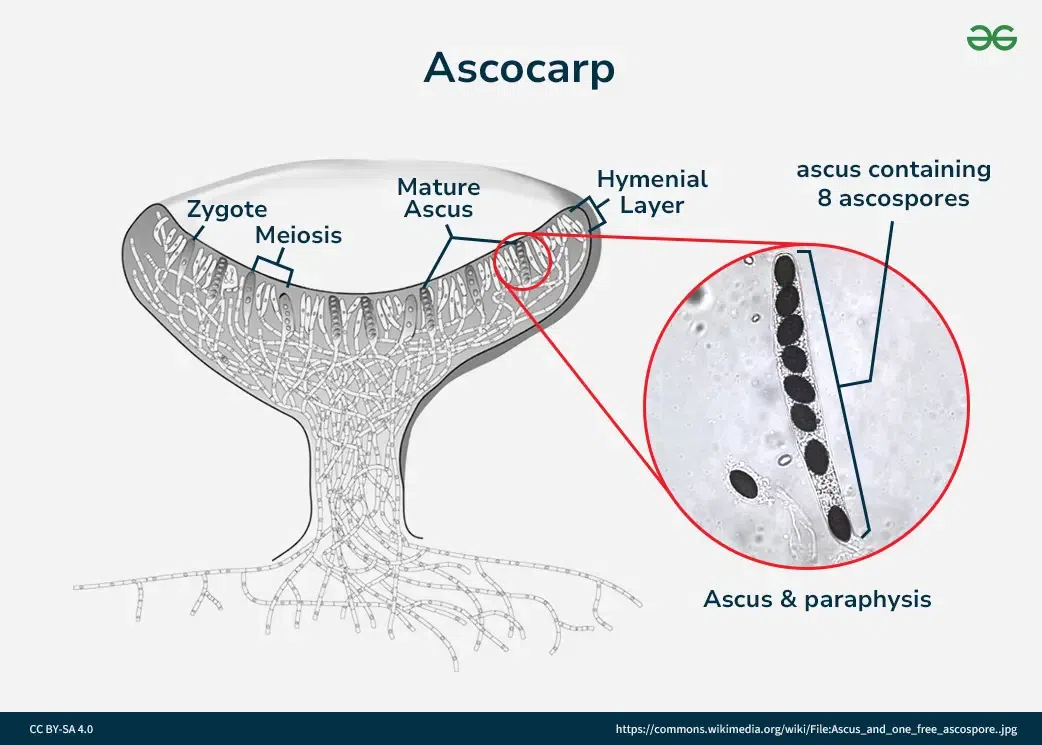
defining structure of Ascomycota
ascus (a sac that encloses eight haploid spores)
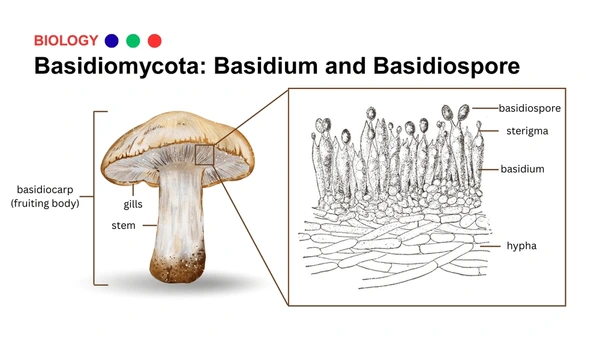
defining structure of Basidiomycota
basidium (a club-like structure with four external spores)
how are spores dispersed?
via fruiting bodies
what are special about lichens?
they have a symbiotic relationship between fungus, green alga, cyanobacteria, or both.
what does mold refer to?
refers to fungi with microscopic reproductive structures (mostly saprobes)
5 morphological features most helpful in the identification of fungi
gills, pores, or spines (on underside of cap)
honeycomb-like cap with singular pits or saddle-like cap with fluted stalk or cap with no stalk
how do all fungi get their nutrients?
from decomposing matter
Ascomycota: habitat, cell type, characteristic(s), reproduction
terrestrial, unicellular or filamentous with septate hyphae, sexual reproduction via asocarps that bear asci
basidiomycota: habitat, cell type, characteristic(s), reproduction
mostly terrestrial, filamentous with septate hyphae, sexual reproduction via basidiocarps
what is the fungal component of a lichen referred to? what is the algal and bacterial component known as?
mycobiont; photobiont
most lichening forming fungi are obligately (independent/dependent) on their photobiont
dependent
there are 3 main growth forms of lichens: foliose, fruticose, crustose.
what is the growth form of foliose?
lichens are leaf-like in shape and tend to be flattened
there are 3 main growth forms of lichens: foliose, fruticose, crustose.
what is the growth form of fruticose?
lichens are erect or pendent and cylindrical. they have a distinct three-dimensional structure
there are 3 main growth forms of lichens: foliose, fruticose, crustose.
what is the growth form of crustose?
lichens are flattened and fused very tightly to their substrate
what type of lichen (foliose, fruticose, crustose) would be found on rocks or bark?
crustose lichens
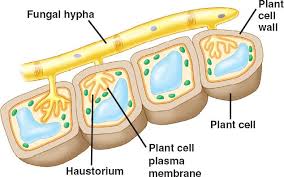
in some lichens, what forms to get the nutrients from algae?
haustoria
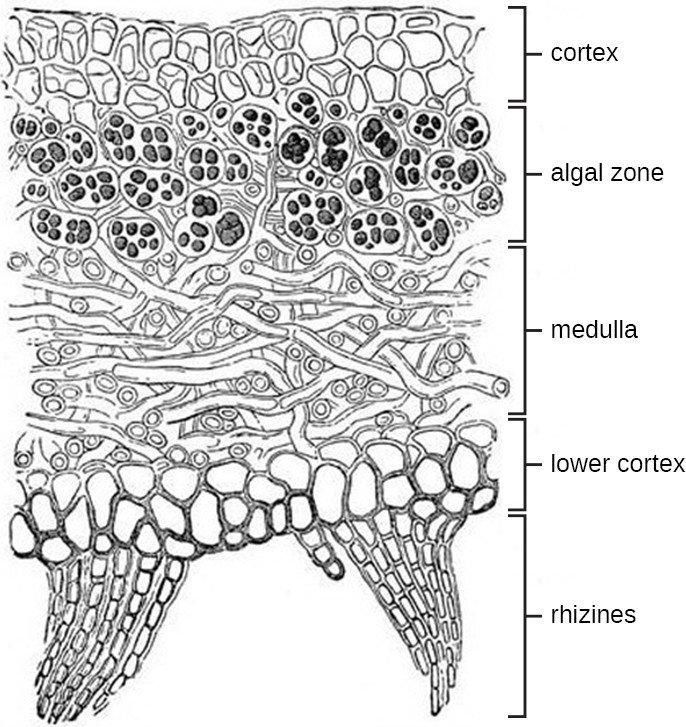
what do we call a mass of woven hyphae that provide the structure of the lichen?
medulla
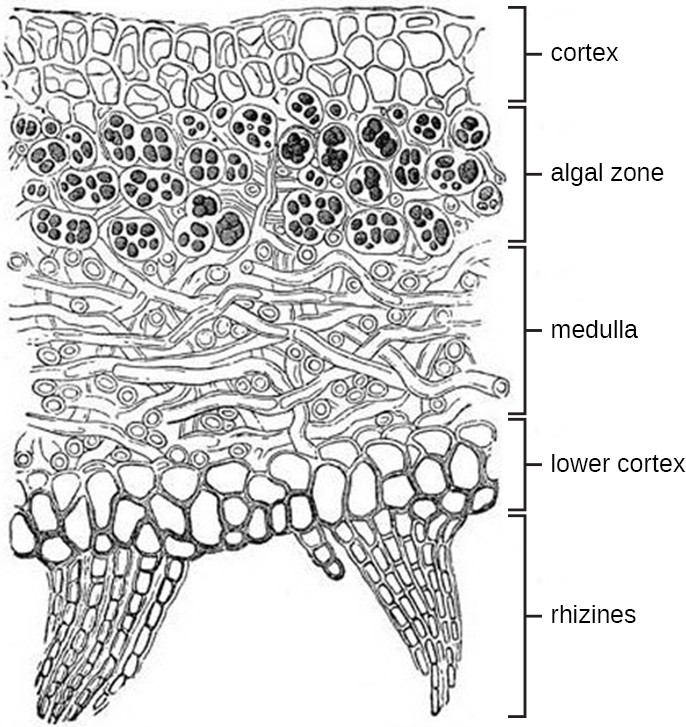
this structure is present on the lower cortex of a lichen and serves to anchor the lichen to a substrate
rhizines