Erik Homburger Erikson (1902-1994)
 Call Kai
 Learn
Learn Practice Test
 Spaced Repetition
 Match
Match Flashcards
 Knowt Play
1/18

Earn XP
Description and Tags
A Search for Identity
Name | Mastery | Learn | Test | Matching | Spaced | Call with Kai |
|---|
No analytics yet
Send a link to your students to track their progress
19 Terms
Erik Erikson: Introduction
Like Adler, provided some commonly used terms
“Identity Crisis”
Trained by ANNA Freud
Diverged somewhat from Freud
Development covers the lifespan
Emphasized ego more than id
Introduced impact of culture on individual
Erikson: History
Several “identity crises”
Abandoned by father
Mother married pediatrician three years later
Told about this MUCH later; changed name at 37
School age, he was rejected because of Jewish heritage but Danish look (blond, blue-eyed)
Later, converted to Christianity
Did poorly in school
Except in art class!
Taught art to Freud’s patients in 1927 (25 years old)
Studied psychoanalysis of children
1933, joined Psychoanalytic Institute
Several “identity crises”
Met Canadian woman and immigrated to Boston
Treated children at Harvard and Massachusetts Hospital
Failed first course at Harvard
Failed course at Yale
Traveled to CA to work with Sioux and Yurok Indians
“Identity Confusion” . . . Sense of “uprootedness”
Ultimately, was a professor at University of California at Berkeley
Went back to MA at retirement in 1970
Performed Psychobiographies
Dr. D’s Guide to the Importance of Erikson!
Erikson incorporated culture into personality development
Answers questions about identity issues between cultures
Development lasts a lifetime
Thank goodness!!!!!!!
Developmental Stages
Universal – All people encounter them
But culture organizes the experience of its members
Cultures not only provide the setting in which crises are encountered but provide continuing support for the ego development that has occurred
Especially when threatened in later life
Psychosocial Stages
Psychosocial refers to union of Freud’s physical yearnings (id) and cultural forces
Epigenetic Principle – describes the process of development
Emerging one on top of another over time
Resolution depends on the positive to negative ratio
Positive outcomes yield “virtues”
Crises
Rise to the surface when the environment makes demands of us: Called a crisis
Involves a shift in perspective —> new strengths can develop
Can choose adaptive or maladaptive solutions
More adaptive responses lead to “virtues”
Passage is not automatic, and environment can help or hinder our progress
Ritualizations help resolve a conflict
E.g., social opportunities to support growth
Ritualisms don’t: They are too rigid
E.g., elitism
Chart
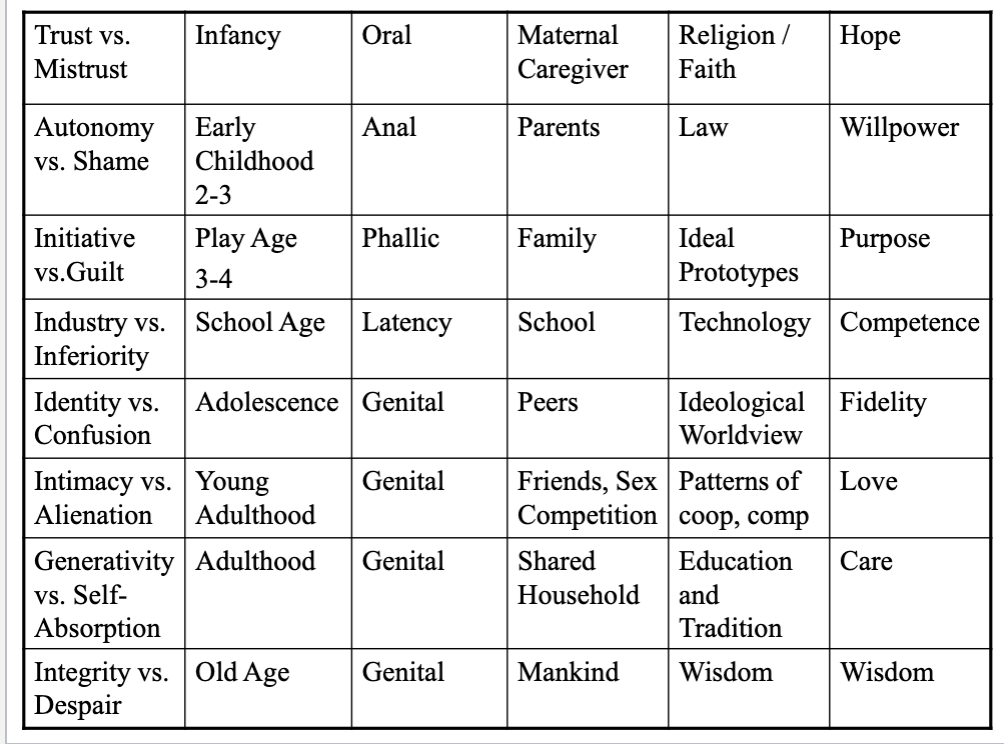
Stage 1: Trust vs. Mistrust
Basic trust: The sense that others are dependable and will provide what is needed
Food, milk, and sensory stimulation
Otherwise, basic mistrust is formed
Some sense of mistrust is inevitable, as no parent can provide exactly what is needed exactly when it is needed! (Trust me)
Stage 2: Autonomy vs. Shame/Doubt
Child becomes adequate (autonomous) in:
Toilet training (emphasized by Freud)
Ambulation
Interpersonal relationships
Otherwise, there is shame in Self
Some degree of Shame is necessary and good, but a high degree of autonomy should prevail
Stage 3: Initiative vs. Guilt
The child begins determining what type of person they are going to be, as they begin to interact more with others (“intruding others’ space”)
Child develops a conscience (Freudian)
If the child is supported and acts appropriately, they will have more initiative than guilt
Stage 4: Industry vs. Inferiority
The child “learns to win recognition by producing things.”
If the child perseveres and creates good, quality objects, they will become industrious
If not, this leads to a feeling of inferiority
Stage 5: Identity vs. Identity Confusion
In adolescence, the task is to answer the question, “Who am I?”
Must be agreed upon by individual and society
Identity confusion occurs when a coherent identity cannot be established
A negative identity may also be established
Based on social norms
A moratorium may be established
Adolescents are encouraged to explore possibilities (e.g., change majors, etc.)
Fidelity: Sustaining loyalties despite possible aversive consequences
Stage 6: Intimacy vs. Isolation
Cannot occur until identity has been established!
Intimacy is the fusion or merging of identities with a friend or lover
One’s own identity is not threatened, however
NOT the same as sexual intimacy
RESEARCH: Intimacy increases during early adulthood (Reis et al., 1993)
Stage 7: Generativity vs. Stagnation
Generativity is the interest in guiding the next generation
Highly involved in their work and the growth of young people
Concerned about broad social issues
Are able to strike a balance between self-serving and societal-serving needs
E.g., parenting, teaching, mentoring
Alternative is stagnation
Stage 8: Integrity versus Despair
Integrity
Being able to look back and say that one’s life was meaningful and valuable
Not wishing that things had been different
The alternative is despair
Research - Cross-cultural differences in psychosocial stages
McClain (1975): South African blacks scored lower on identity development than whites
To Erikson, an indication of ritualism – namely, racism
Research - Male and Female Identities
Differences
Women emphasize interpersonal issues
Men emphasize occupational issues
Similarities
Men and women do not differ in their level of achieved identity
It appears that, while the result is the same, the process is different
Erikson Contributions and Limitations
Contributions
Role of culture and lifelong development, as previously discussed
Identity is dynamic!
Limitations
Some descriptions are somewhat ambiguous
Willpower
Wisdom
Erikson: Differences from Freud
De-emphasized the importance of unconsciousness
Focused on psychosocial stages
Decreased role of sexual stages
“Fixation” does not cause “stagnation,” generally speaking
But identity must be established for intimacy to occur