Psych 100 part 1
 Call Kai
 Learn
Learn Practice Test
 Spaced Repetition
 Match
Match Flashcards
 Knowt Play
1/50

There's no tags or description
Looks like no tags are added yet.
Name | Mastery | Learn | Test | Matching | Spaced | Call with Kai |
|---|
No analytics yet
Send a link to your students to track their progress
51 Terms
What is psychology?
the study of mental processes and behavior
4 goals of psychologists
- description of what they observe
- explanation of why a mental process or behavior is occuring
- prediction of the circumstances that lead to a certain behavior or mental process
- provide advice on how to control behavior and mental processes
Influences of when studying behaviors and mental processes
- the brain (neuron activity, brain structure, genes)
- the person (emotions, ideas, thoughts)
- the group (friends, family, population, culture)
what is philosophy
the study of knowledge, reality, and the nature of meaning and life
what did philosophers study
- how the human mind worked
- how the body relates to the mind
- whether knowledge was inborn or learned from experience
Early philosophers and what they understood
- Hippocrates
- Plato
- Aristotle
These philosophers proposed problems and solutions which is the core of modern scientific methods
what is the role of philosophy in the psychology's development
people thinking systemactically about the human mind and behaviour
Rene Descartes
- First of the modern philosophers and an early scientist
- Believed that the meaning of the natural world should be understood through science and math
Johannes Muller
Advocated for scientists to study the relationship between physical stimuli and their psychological effects
Herman von Helmholtz
measured the speed of neural impulses and discovered that neural impulses were not instantaneous
What is the role of physiology and psychophysics?
people thinking about the relationship between human biology and anatomy and human thought and behaviors
Charles Darwin and the theory of evolution
- proposed the theory of evolution in his book The Origin of the species
- all life on Earth comes from on common ancestor
- natural selection and adaptive variations
Natural selection
chance variations in one's behavior are passed down from parents to children
Adaptive variations
some variations are more advantageous because they help an organism survive
Darwin's role in psychology
Theory of evolution by natural selection offered insight into how and why human brains and bodies developed the way they did
- our brain and nervous systems were "selected: b/c they helped us survive
Wilhelm Wundt
- Father of experimental psychology
- eastablished the first psychology lab in Germany
- Studied psychology through empirically-drvien experiments
Wilhelm Wundt's role in psychology
- begun studying psychological phenomena scientfically
- different psychological scientists began debating the right scientific methods for understanding and studying human psychology
Edward Titchener
- developed structuralism as an attempt to try to identify all the elements of consciousness
- Introspection - careful, reflective an systematic observation of the details of mental processes
Structuralism
Looking for the elements of consciousness
- the goals was the describe observable mental processes rather than to explain, predict, or control
- the principle was rejected by other psychologists, but some elements survived
Structuralism contribution to psychology
- psychologists should focus on observable events
- scientific study should focus on simple elements as building blocks of complex experiences
Functionalism
The flow of consciousness
- William James believed that mental processes were fluid instead of fixed elements
- emphasized the functions of the mind in adapting to a changing environment
Functionalist scientist contribution to psychology
- used empirical methods that focused on the causes and consequences of behavior
- emphasis was also placed on studying animals, children and individuals with mental disorders
Willam James
- set up one of the first psycholgy labs in the US at Harvard
- wrote the first psychology textbook, Principles of psychology
Gestalt psychologists
- said consciousness cannot be broken down into elements
- said that we percieve things as whole perceptual units
- the whole is greater than the sum of its parts
- learning is tied to what we percieve
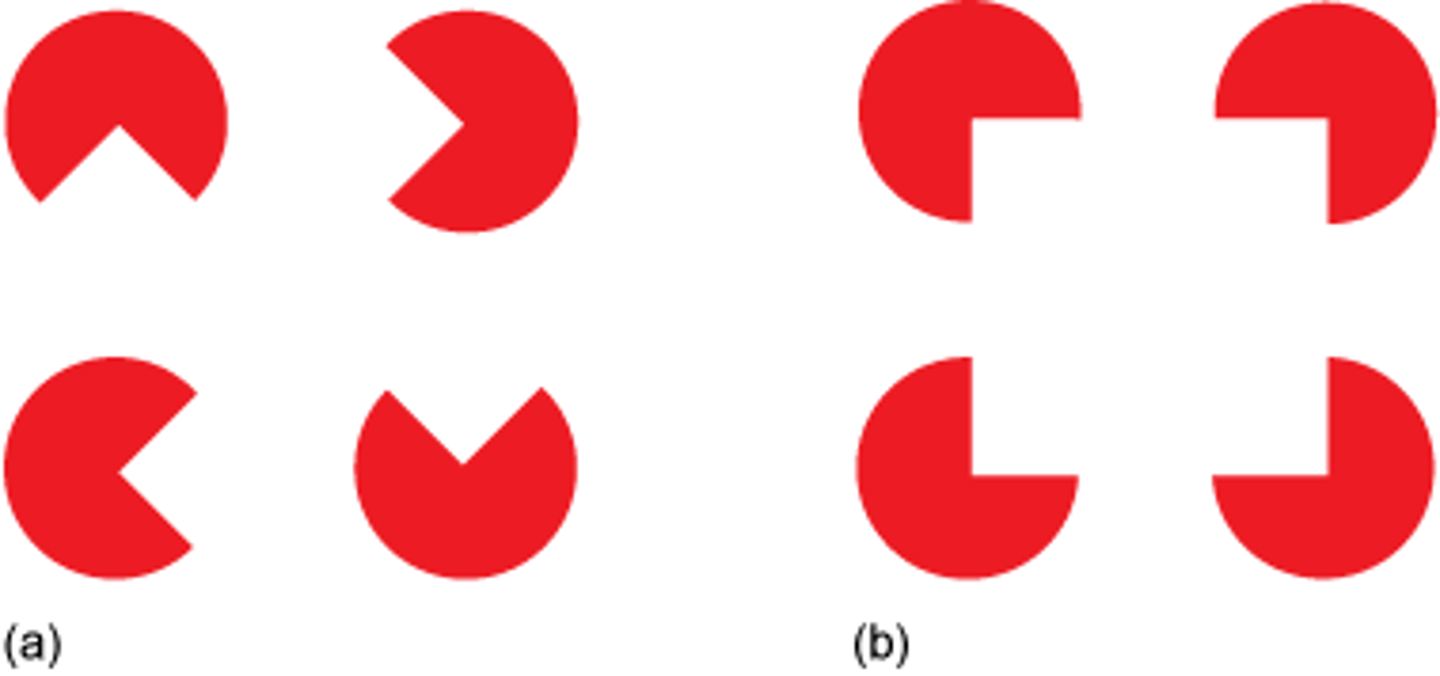
Kanzia illusion
- We see things not merely as there are but how how our brains interpret them
- this visual illusion causes your visual system to create a floating square that does not actually exist
Sigmund Freud
- championed the belief that peoples' behaviors are based on their unconscious desires and conflicts
- Freud developed a form of therapy, psychoanalysis, that aimed to resolve unconscious conflists
Psychoanalytic theory
highlight the importance of unconscious processes
Behaviourism
psychological research should only focus on behavior you can observe
Edward Thorndike
proposed research finding form the study of animals could help explain human behaviour
Ivan Pavlov
- discovered dogs could learn to associate a bell with an automatic behaviour
- called classical conditioning
John B. Watson
- conducted the Little Albert experiment, demonstrating that children (people) could be classically conditioned
B.F. Skinner
- developed operant condition to shape behaviour
- reinforcement increases and punishment decreases the likelihood of a behaviour occuring
Albert Bandura
- described social learning in children
- we now know that this type of learning can be observed in several species of primates
Behaviourism contribution to psychology
observable behavior is an important way to study human psychology
- hard to know what's going on in smo's mind
Humanistic psychology
- subjective experiences may be more important than behaviour
- focus on capacity for personal, positive growth and the freedom to choose one's own destiny
Carl Rogers
- developed "client centred therapy"
- the client is an equal and a client's thoughts and feelings should be mirrored
- the atmosphere should have unconditional support and positive regard
Abraham Maslow
Developed a theory of motivation that consists of a hierarchy of needs
Huamistic psychology contributions
Subjectivity and human potential are important targets of study
- you often can't directly study this with just behavior
cognitive psychology
the role of mental processes in how people process information, develop language, solve problems and think
cogitive psychologist compare the human mind?
to a computer
Uric Neisser
coined the term "cognitive psychology" as the study of information processing
Cultural psychology
the study of how cognitive processes vary across different population due to socio-cultural envrionments
cross cultural psychology
the study of the cognitive processes that are universal regardless of culture
cognitive psychology contribution
- useful to think of the human mind like it's a computer
- the brain has some core "hardware" that helps us compute things
- the brain also has "software" that is programmed by our cultural surroundings
Psychobiology/Neuroscience
the study of brain structure and activity and how this relates to/controls behaviour
Karl Lashley
Attempted to determine which areas of the brain are responsible for memory, learning and other functions
Donald Hebb
Canadian scientist that developed the concept of cell assembly
- neurons develop networks of connections based on experiences as we develop and interact with our environments
psychobiology/neuroscience contributions
- the brain is at the centre of human psychology
- brain structure and function are important targets of study
(now technology)
3 branches of psychology
1. Clinical and counselling psychology
- work as therapists
2. Academic psychology
- work as professors, teaching and research
3. Applied psychology
- work in schools, marketing firms, research institutions, applying psychology to real-life situations
Shared value of all psychologists
- theory driven: use theories to explain behavior
- empirical: based on research
- multi-level: explained by the brain, the individual and the group
- contextual: psychological perspectives continue to evolve, which impacts work in psychology
Current trends in psychology
Growing diversity
- more women, minority
- clutural psych
Advances in technology
- computers and brain imaging techniques have led to new research in cognitive and social neurosciences