thermo
 Call Kai
 Learn
Learn Practice Test
 Spaced Repetition
 Match
Match Flashcards
 Knowt Play
1/61

There's no tags or description
Looks like no tags are added yet.
Name | Mastery | Learn | Test | Matching | Spaced | Call with Kai |
|---|
No analytics yet
Send a link to your students to track their progress
62 Terms
isobaric work
-p(v2-v1)
“assuming no stagnation pressure losses”
means can use bernoulli in pipe even though no streamline
combustion chemical reaction
CH4 + 2O2 → CO2 + 2H2O
mass flow rate (thermo)
m = (work output rate=power output) / (Wnet)
cv equation
cv = cp - R
adiabatic equation
P1V1gamma = constant
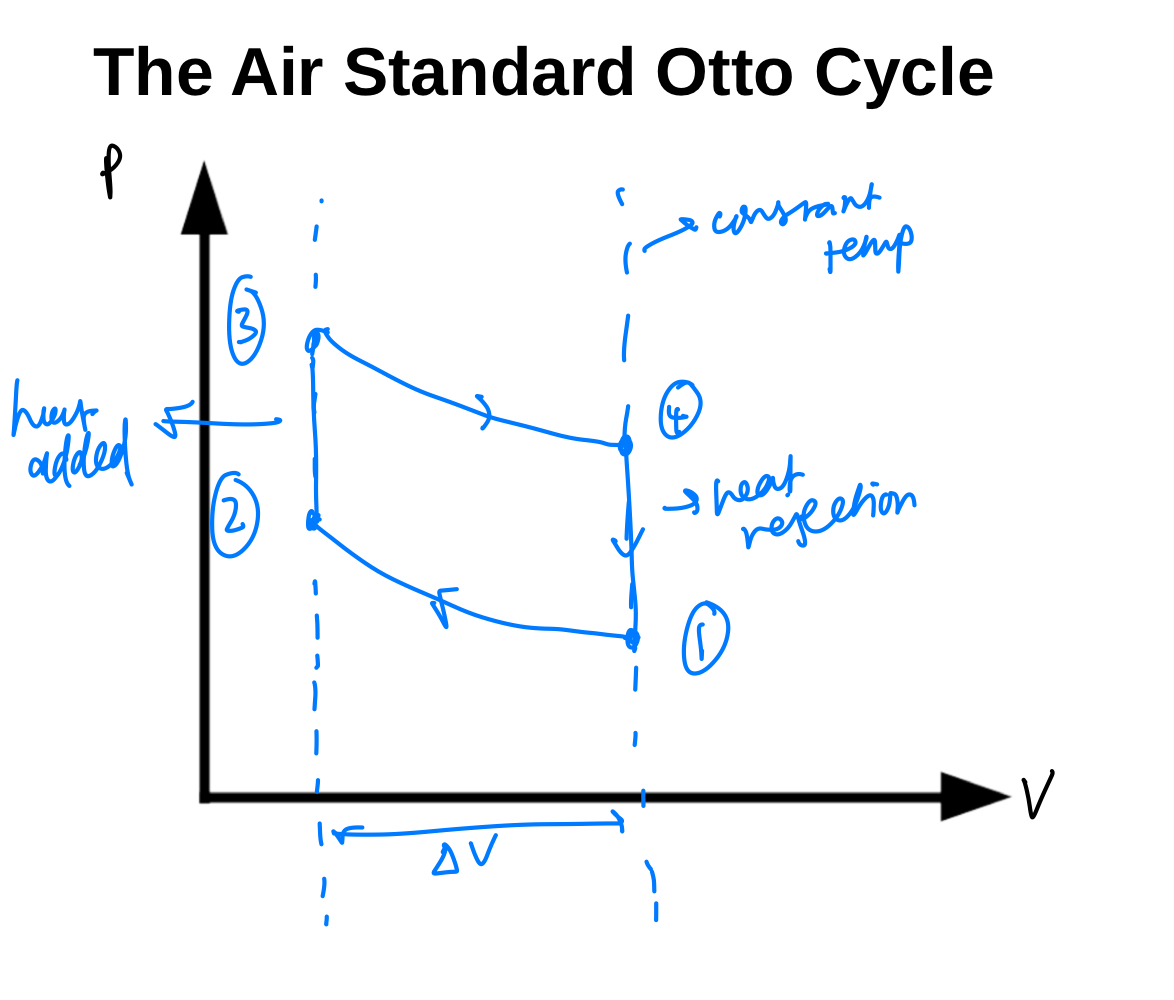
OTTO cycle PV diagram
otto cycle cycles
1-2: adiabatic compression (isentropic)
2-3: heat added at constant volume
3-4: adiabatic expansion (isentropic)
4-1: heat rejected at constant volume
pros of hydrocarbon fuels
pro: high energy density
con: pollution
isochoric work (constant volume)
0
adiabatic work
first one in formula book
isothermal work
second in formula book
isothermal change in internal energy
U = 0 because no change in temp
enthalpy change in ideal gas
He - Hi = Cp (Te - Ti)
work in turbine
W < 0 because work developed from gas or liquid passing though blades
Pump/Compressor Work
W > 0
compressor - work done on a gas passing them through to raise pressure
pump - work input give energy to liquid passing through
gamma equaiton
gamma = Cp / Cv
first law
Qh - Qc = W
thermal efficiency
output/input in terms of Qh, Qc and W
corollary 1
impossible to make a system that can transfer hear from a cooler to hotter body without work
fridges and hear pumps
corollary 2 and 3
reversible cycles
reversible cycles/engines (engines) are more always efficient than a heat engine
all reversible engines have the same efficiency
corollary 4
its impossible to reduce temp of a system to zero kelvin in finite number of operations\
entropy, temp relation dS = dQrev/T - at T=0 S=0 = perfect order, very difficult to reach
Efficiency rev = 1 - Tc / Th (carnot efficiency)
corollary 5
carnot efficiency eq. = max efficiency achieved when heat transferred only between Th, Tc
HENCE
A multi-reservoir engine exchanges heat at intermediate temperatures
→ reduces effective temperature differenceSmaller temperature differences → less work extracted per unit heat
THEREFORE
multi reservoir engines still reversible but less efficient
corollary 6 (clausius inequality)
heat transferred/temperature ≤ 0
= 0 → reversible cycle
< 0 → irreversible cycle
measures how ideal a cycle is
leading to entropy eq. in corollary 4
for irreversible ΔS > ΔQ/T (entropy of universe always increasing)
corollary 7
FOR REVERSIBLE PROCESS between final states ΔS = ∫ΔQ/T
heat is path dependent (how you get from state 1 to 2 matters)
entropy is path independent only what state 1 and 2 is matters
isentropic (reversible adiabatic process)
PTγ/γ-1 = constant
T-S diagram
magnitude of net heat transfer for any reversible cycle = area enclosed by cycle
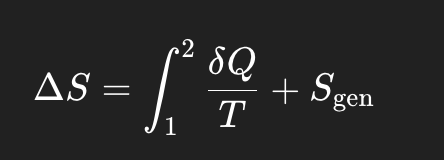
corollary 8 - entropy change in any process
First term: entropy transfer with heat
Sgen : entropy generated due to irreversibilities (friction etc.)
Reversible: Sgen = 0
Irreversible: Sgen > 0
system entropy stays same but change in entropy of surroundings changes
internal energy formula
ΔU = mCv(ΔT)
COP formula
B = Qh or Qc / W (depedns if fridge or heater)
thermal efficiency eq. and terms
n = Wnet/Qh = 1 - Qc/Qh
Qh = Wnet + Qc
Qh = heat input
Qc = heat rejected (output)
reversible process
very slow so stays near equilibrium, no losses, gas pressure inside = pressure of surroundings
irreversible process
Sgen = 0
“free expansion” means irreversible and that Pext = 0
W = -Pext dV
carnot cycle efficiency
n = Wnet / Qin = TH - TC / TH = 1 - Qout/Qin
carnot cycle (all reversible)
1-2: isothermal expansion (TH)
2-3: Adiabatic expansion
3-4: Isothermal compression (TC)
4-1: Adiabatic compression
joule brayton cycle (all reversible)
1-2: adiabatic compression
2-3: heat addition at constant pressure
3-4: adiabatic expansion
4-1: heat rejection at constant pressure
efficiency for joule brayton
n = -Wnet / Q23
Wnet for joule brayton
W34 + W12 = cp(T3 - T4) + cp (T2 - T1)
rp
pressure ratio = p2 / p1 = p3 / p4
bar to pascal
1 Pa = bar x105
turbine and compressor
modelled as joule brayton cycle
left (1-2) is compressor (isentropic compression)
right (3-4) is turbine (isentropic expansion)
power to drive part
(mass flow rate)(specific to part work)
work for compressor = cp[T2-T1]
work for turbine = cp[T3-T4]
work for whole cycle Wnet = W12 + W34
heat input between turbine and compressor (Ideal)
Q = mass flow rate * cp[T3 - T2]
isentropic joule cycle efficiency compressor/whole cycle
compressor: T2s - T1 / T2 -T1
whole cycle efficiency: Wnet / Q23
isentropic joule cycle efficiency turbine
turbine: T3 - T4 / T3 - T4s
s bit on bottom
smaller - bigger
the actual temperature at exit from compressor
T2 not T2s
What part drives the other in joule cycle
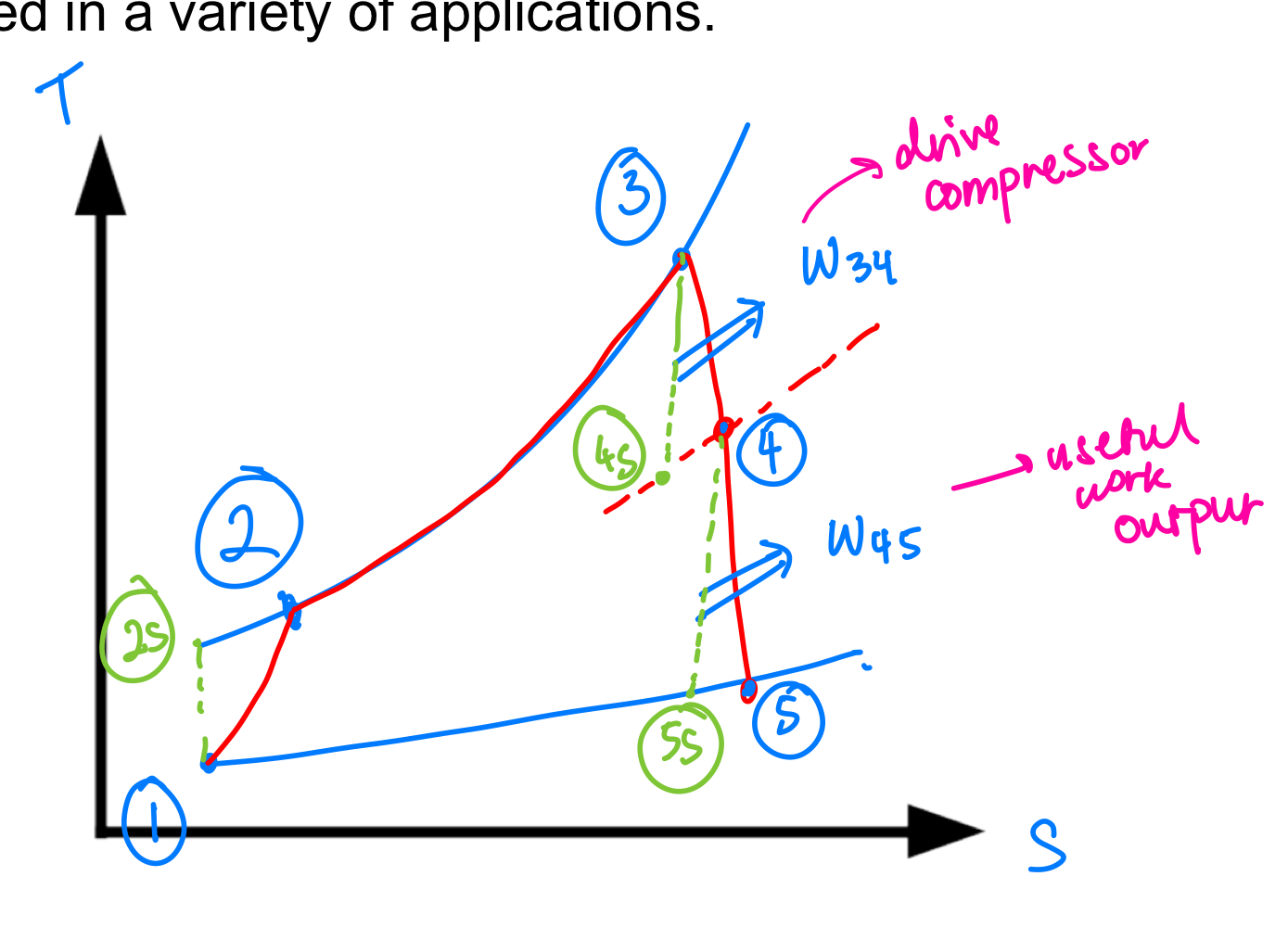
turbine produces shaft work that drives compressor (T-S diagram just about thermodynamic states)
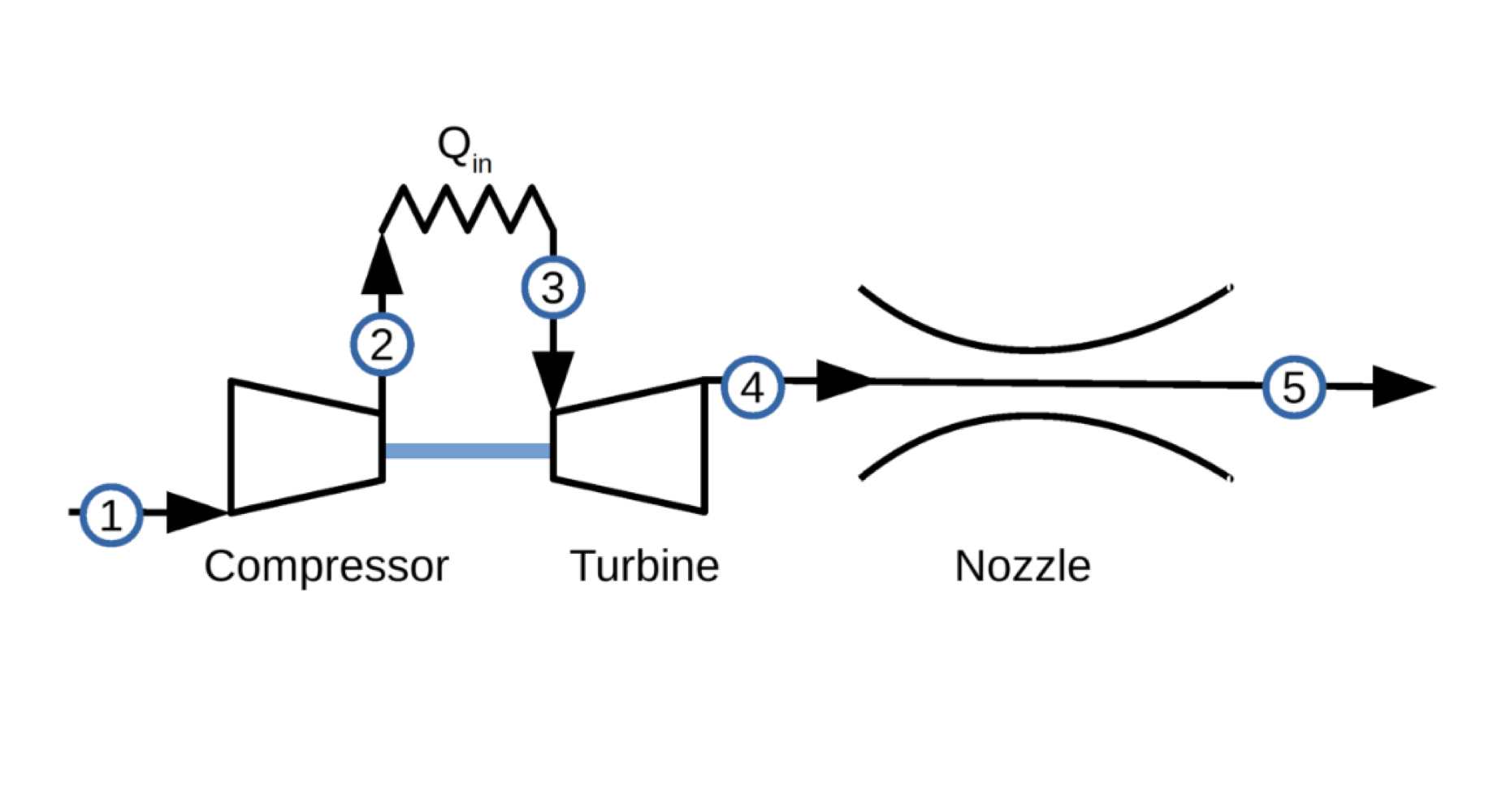
JOULE CYCLE WITH NOZZLE
W12 = W34
for thrust of nozzle use SFEE to find V5
then F = (mass flow rate)(V5)
ideal nozzle T5s/T4 = T5 / T4
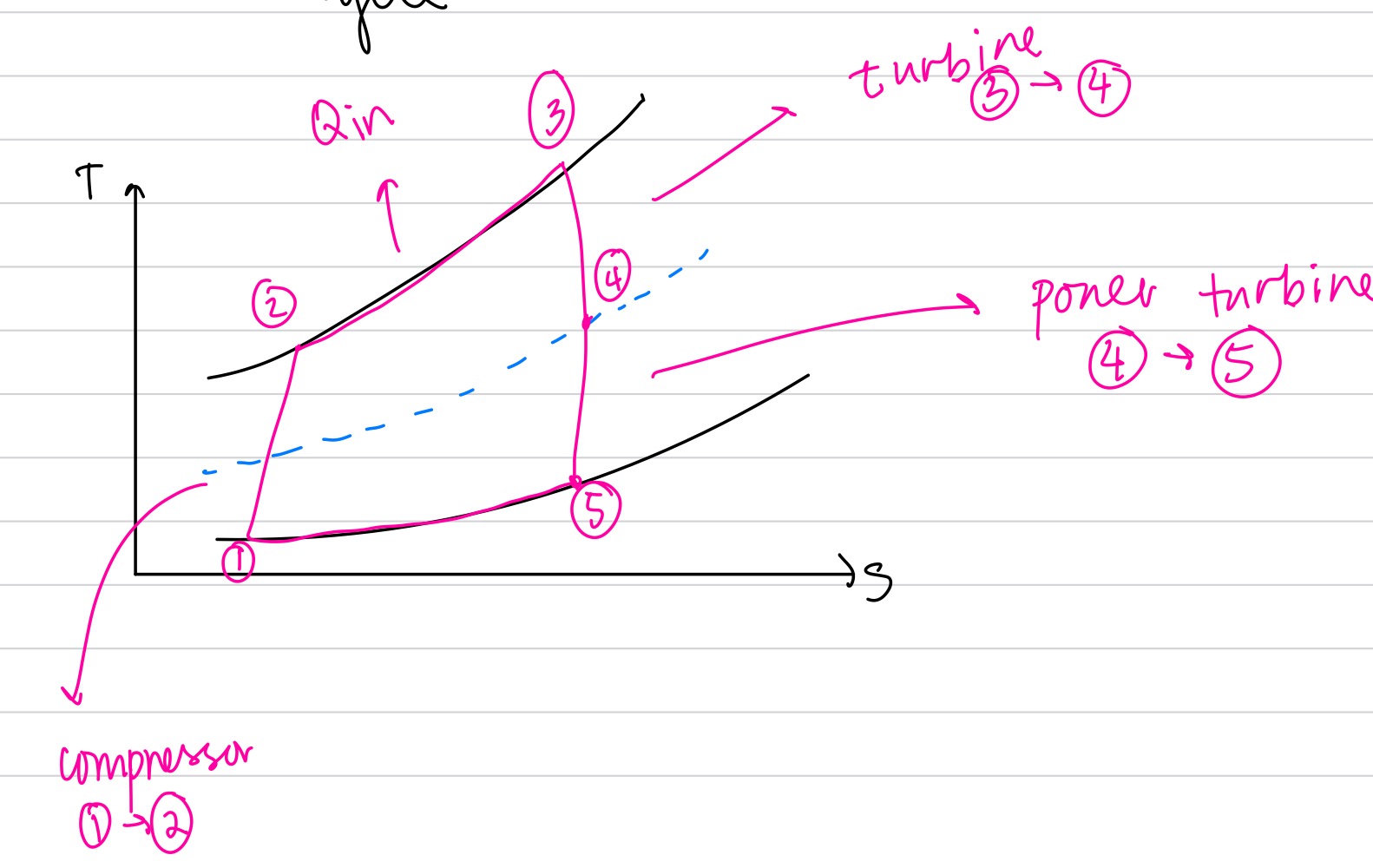
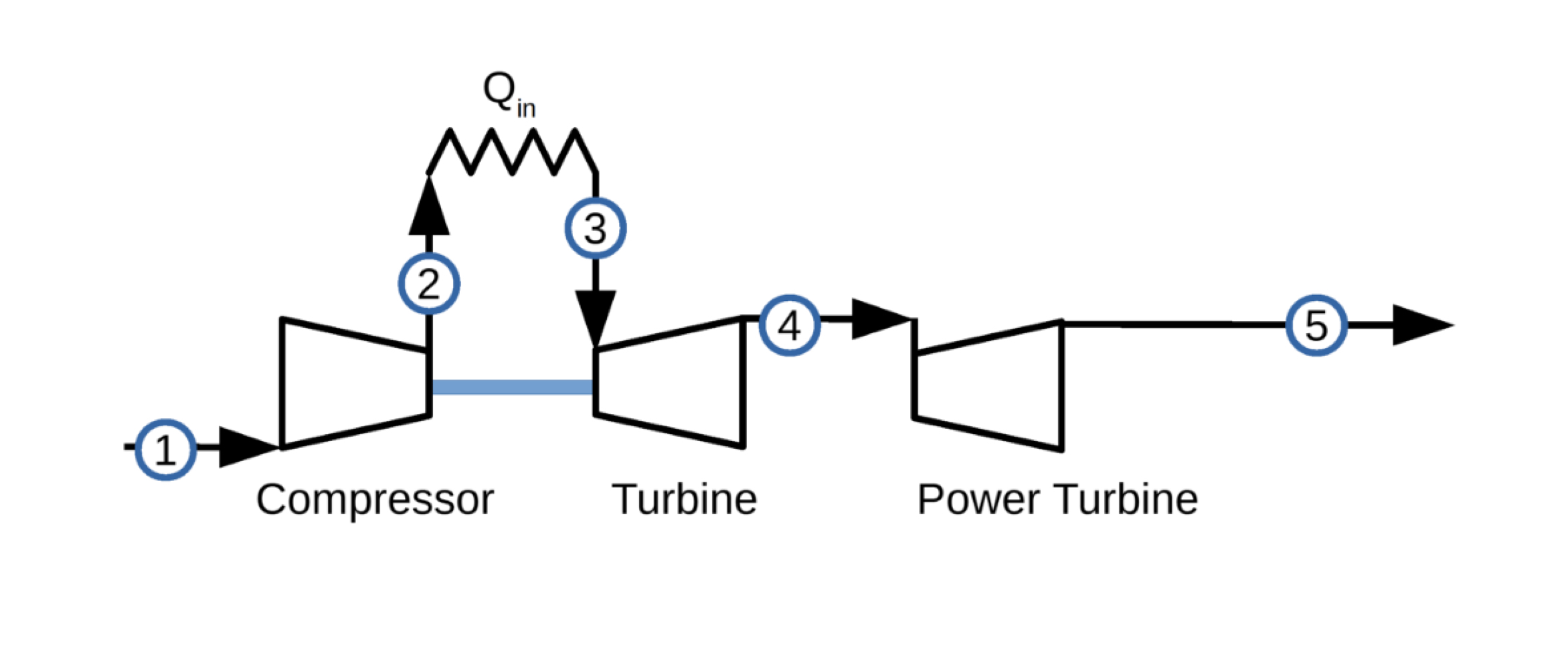
JOULE CYCLE WITH POWER TURBINE
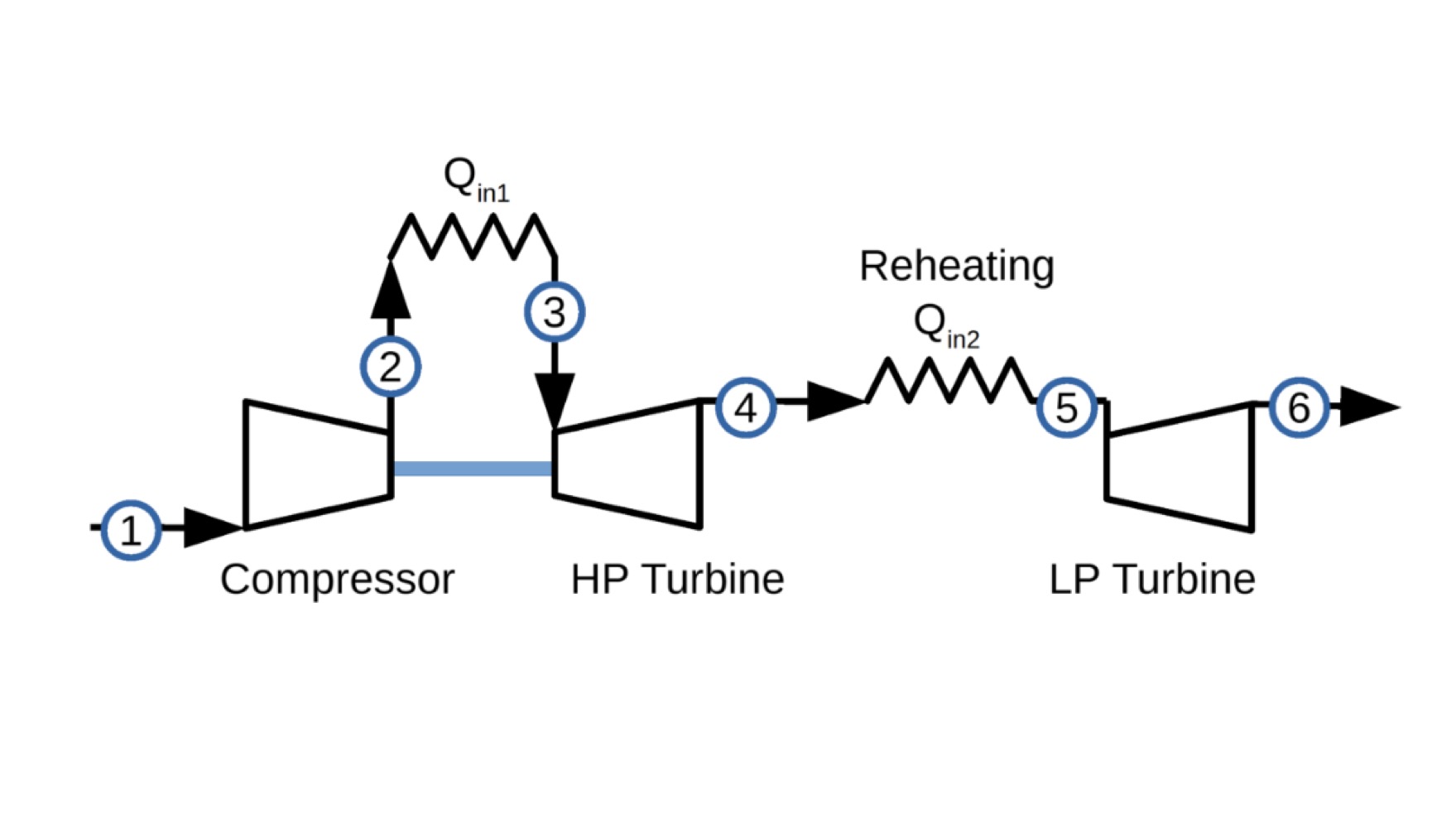
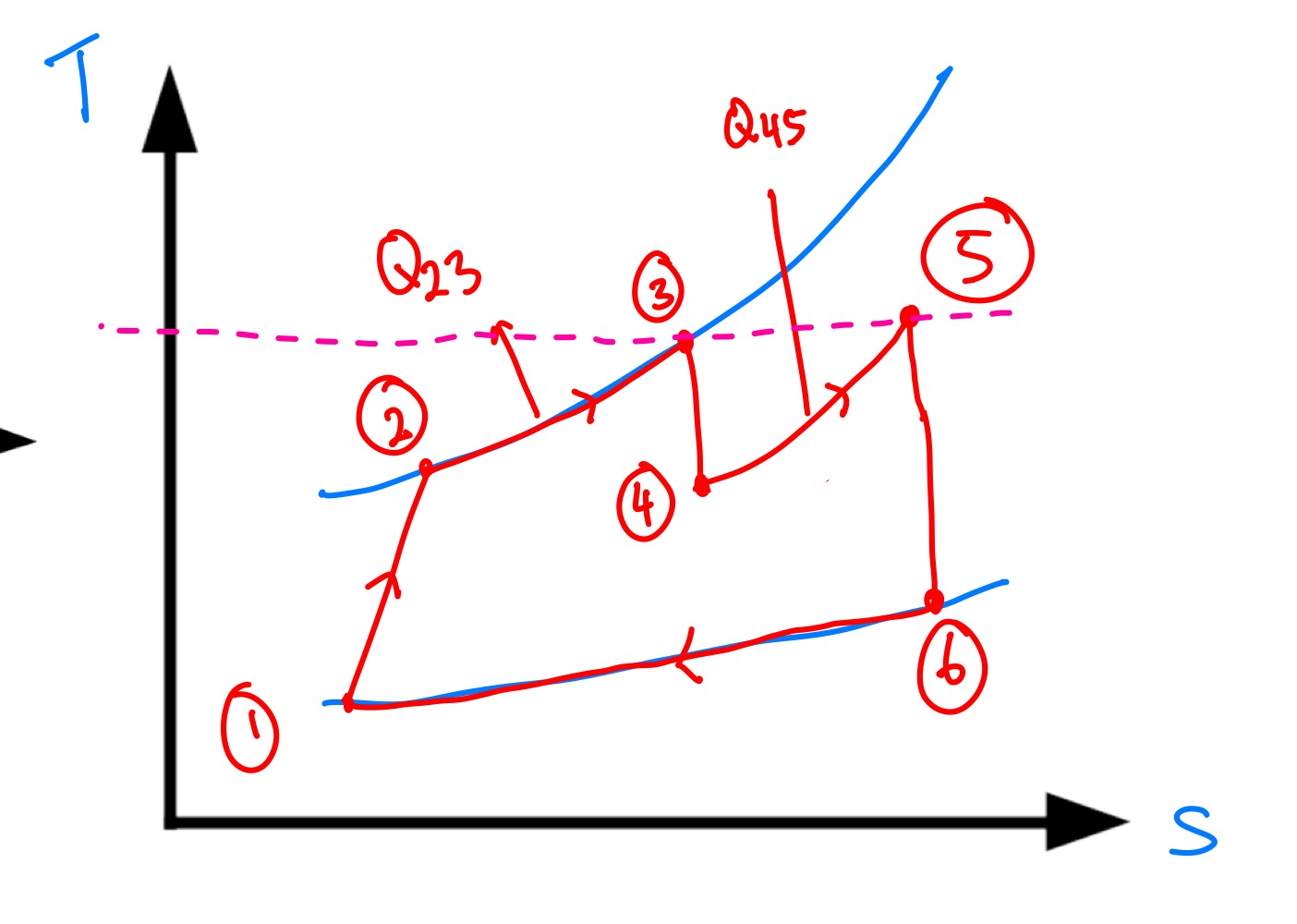
JOULE CYCLE WITH REHEAT
HP turbine drives compressor
Wc = - WHP
- WLP = WNET = cp(T5 - T6)
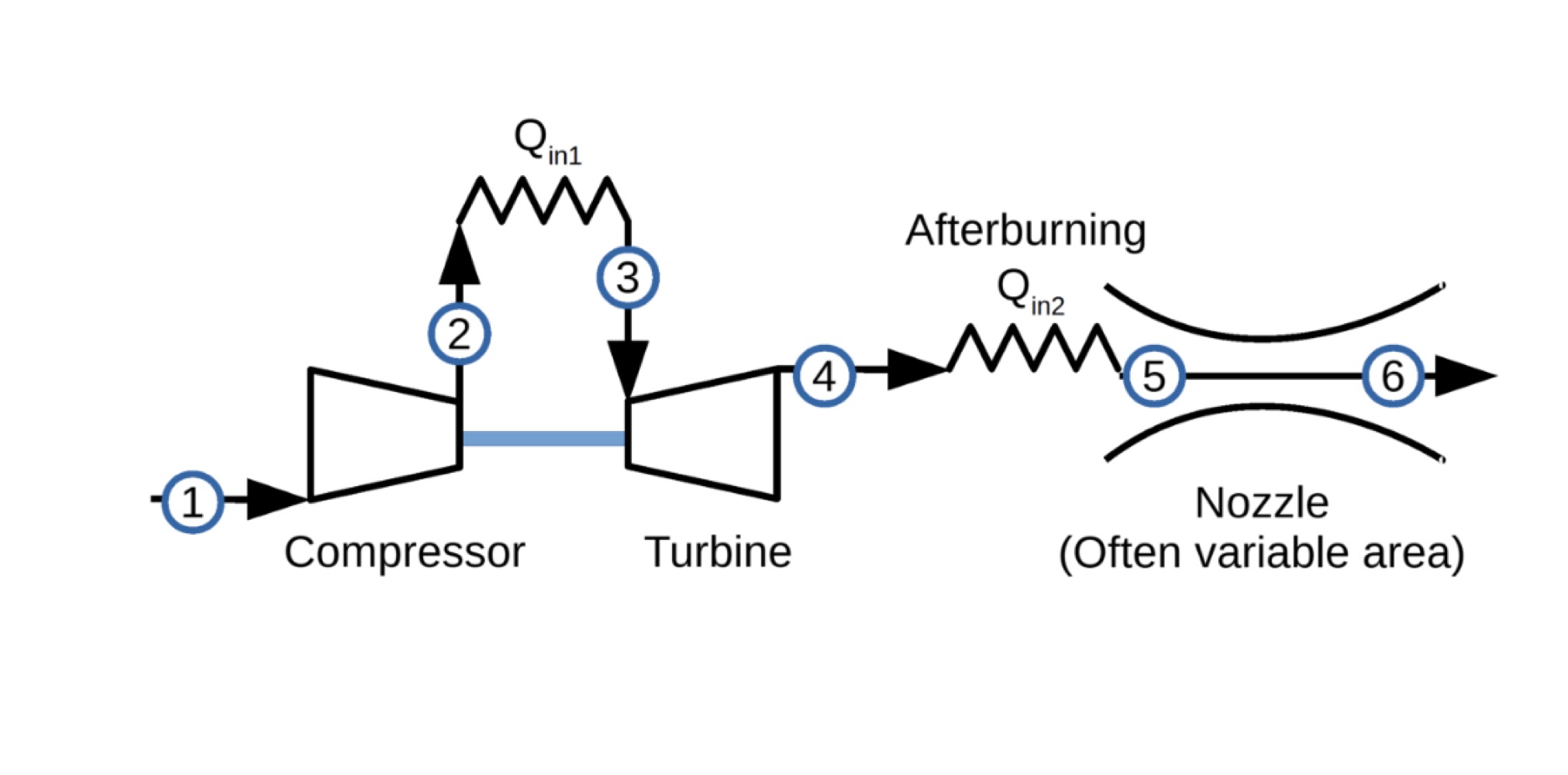
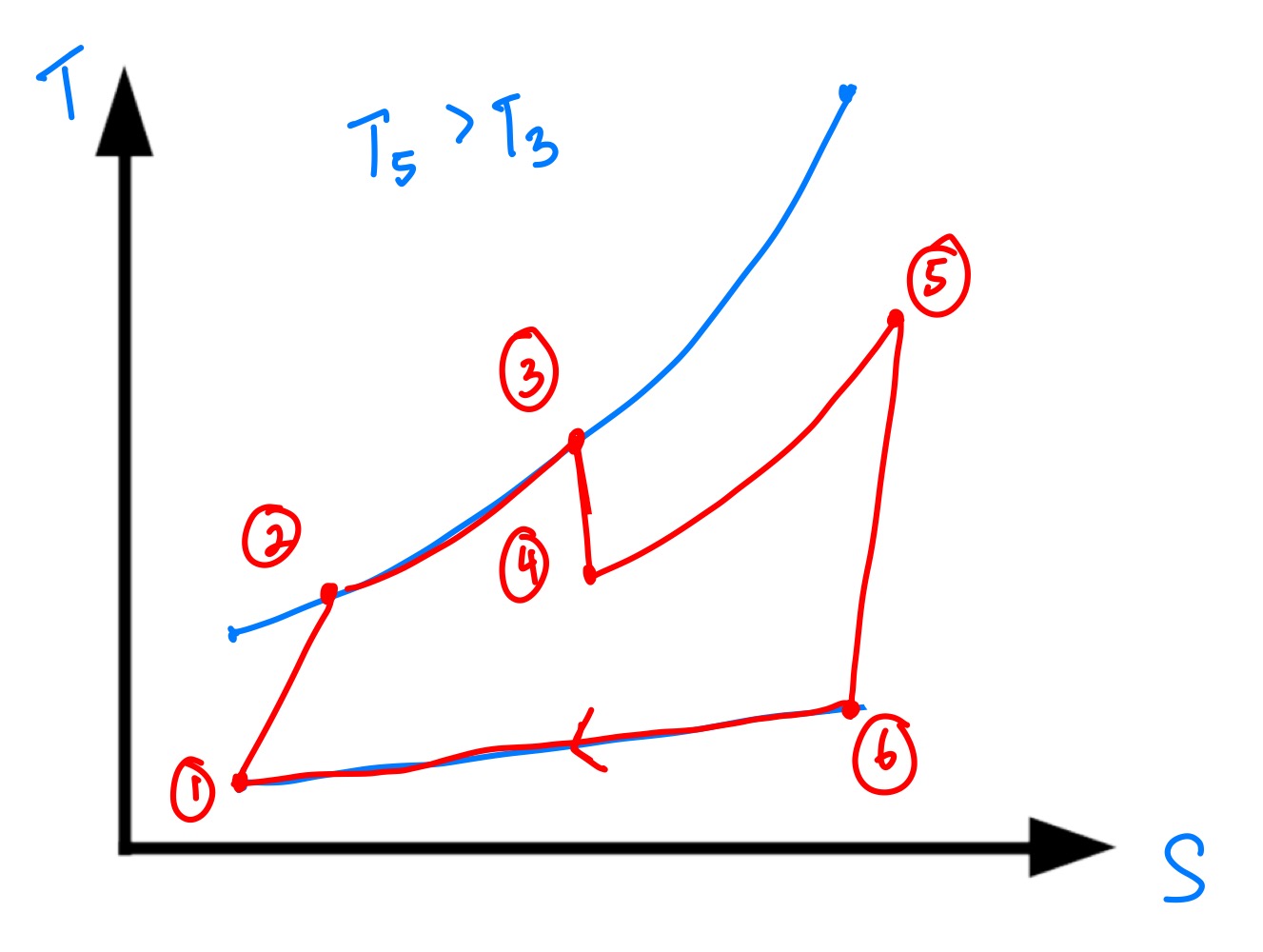
JOULE CYCLE WITH AFTERBURNING
bar to pascal
1 bar = 105 Pa
turbine efficiecny
actual/ideal (s)
compressor efficiecny
ideal (s) / actual
for temperature pressure ratios equaiton
always use s version of top temperature eg. T2s not T2
Joule cycle horizontal bits
constant pressure
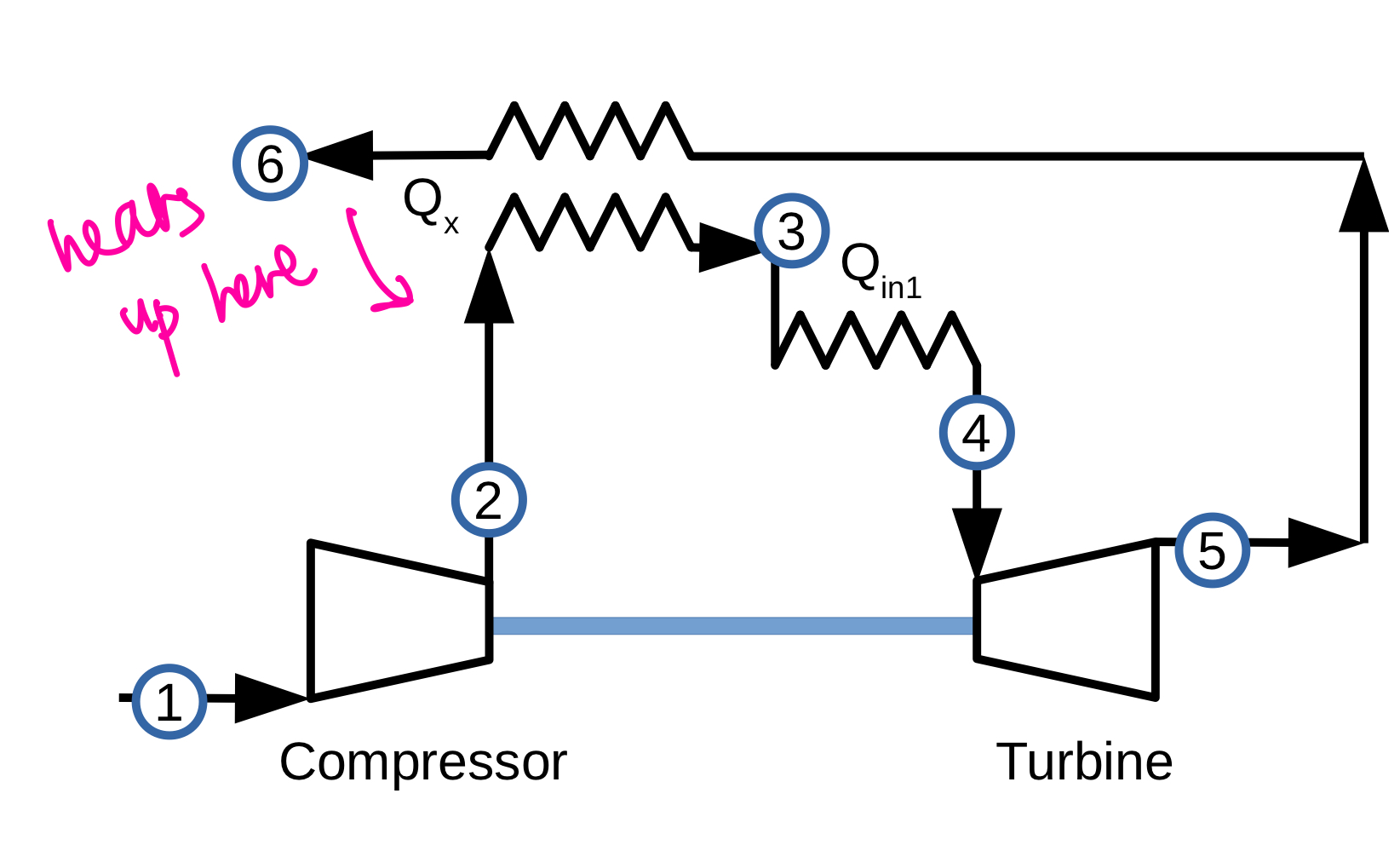
JOULE CYCLE WITH HEAT EXHANGER
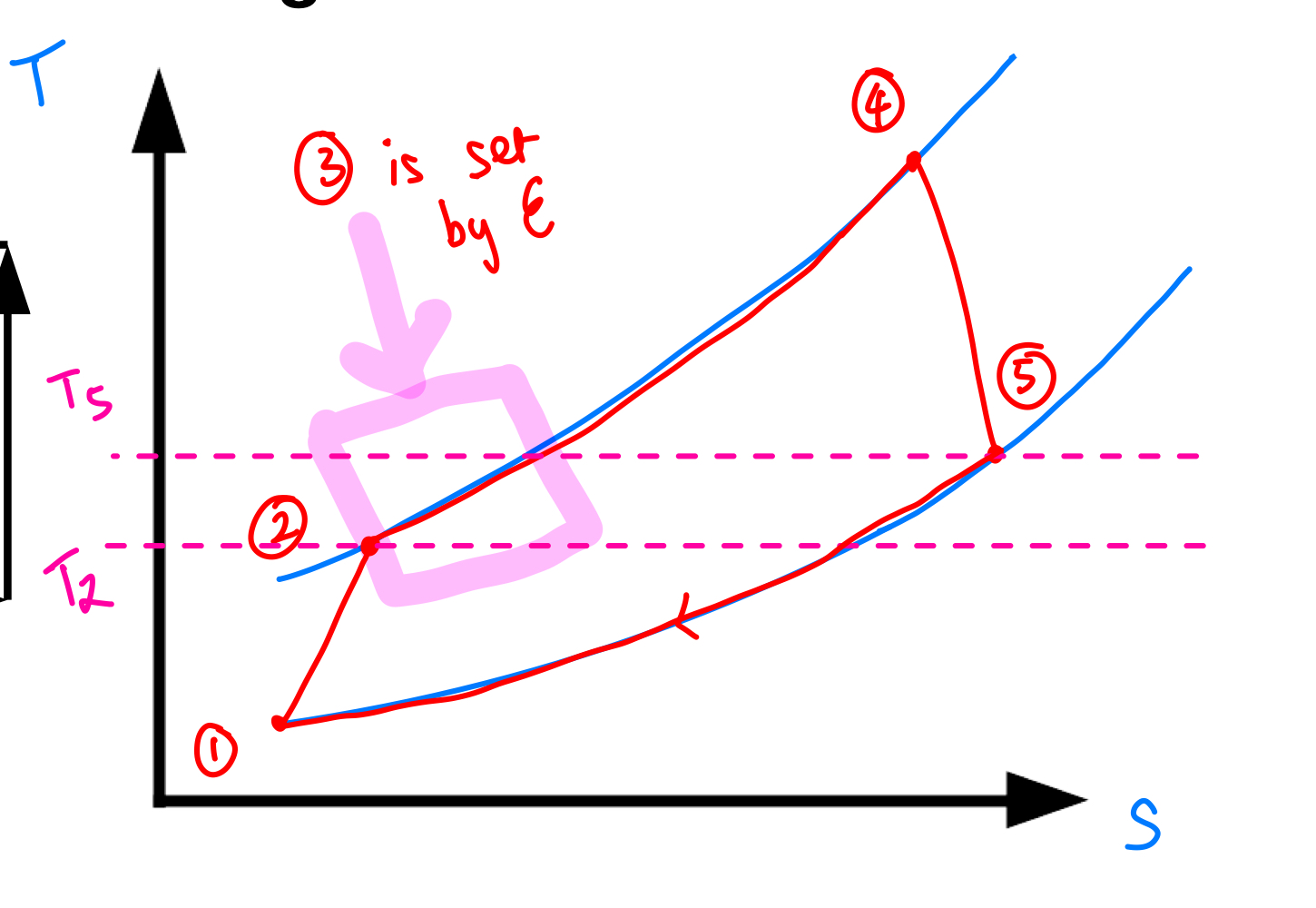
ε = actual temp rise / max temp rise = T3 - T2 / T5 - T2
max pos value ε = 1 so T3 = T5
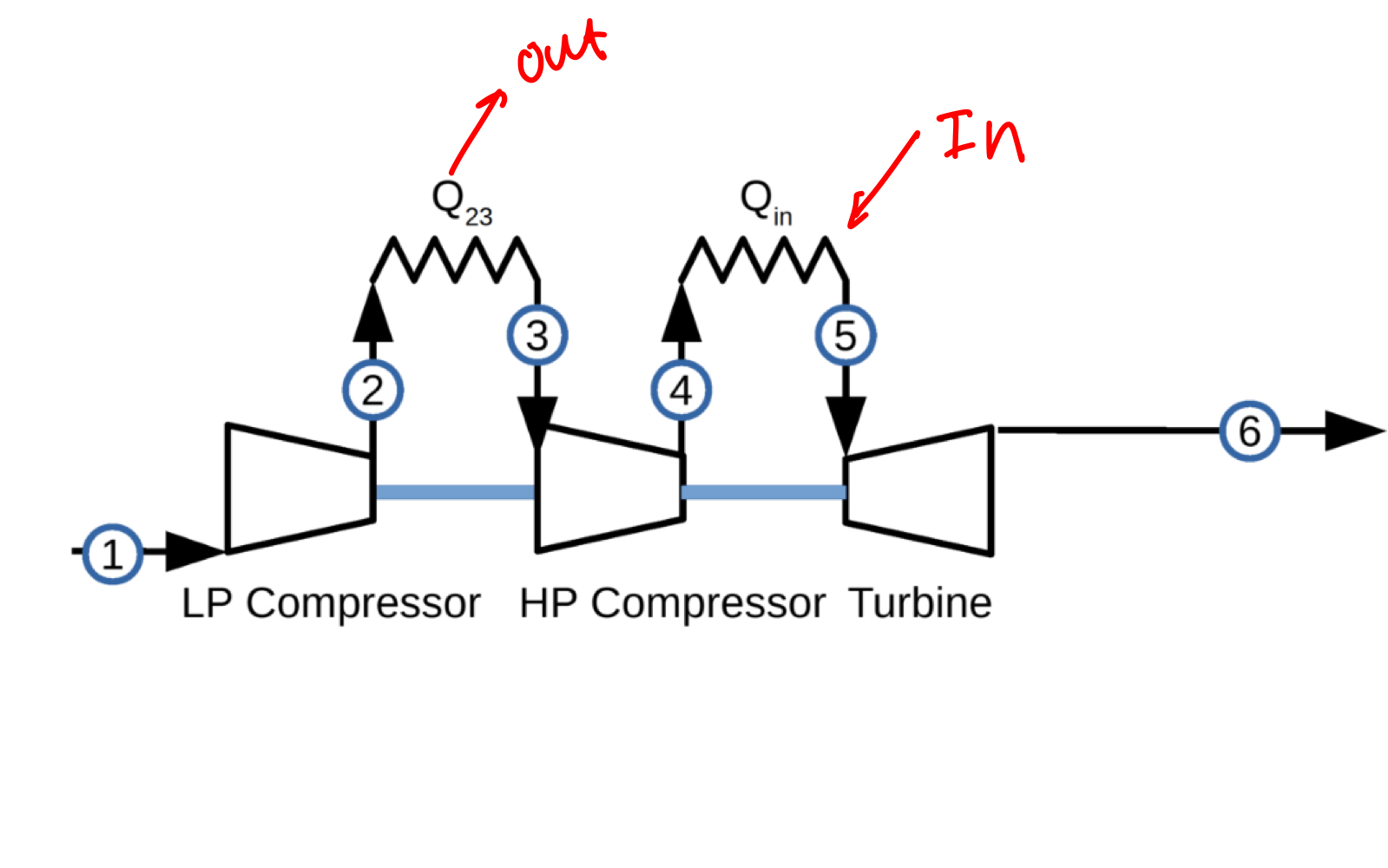
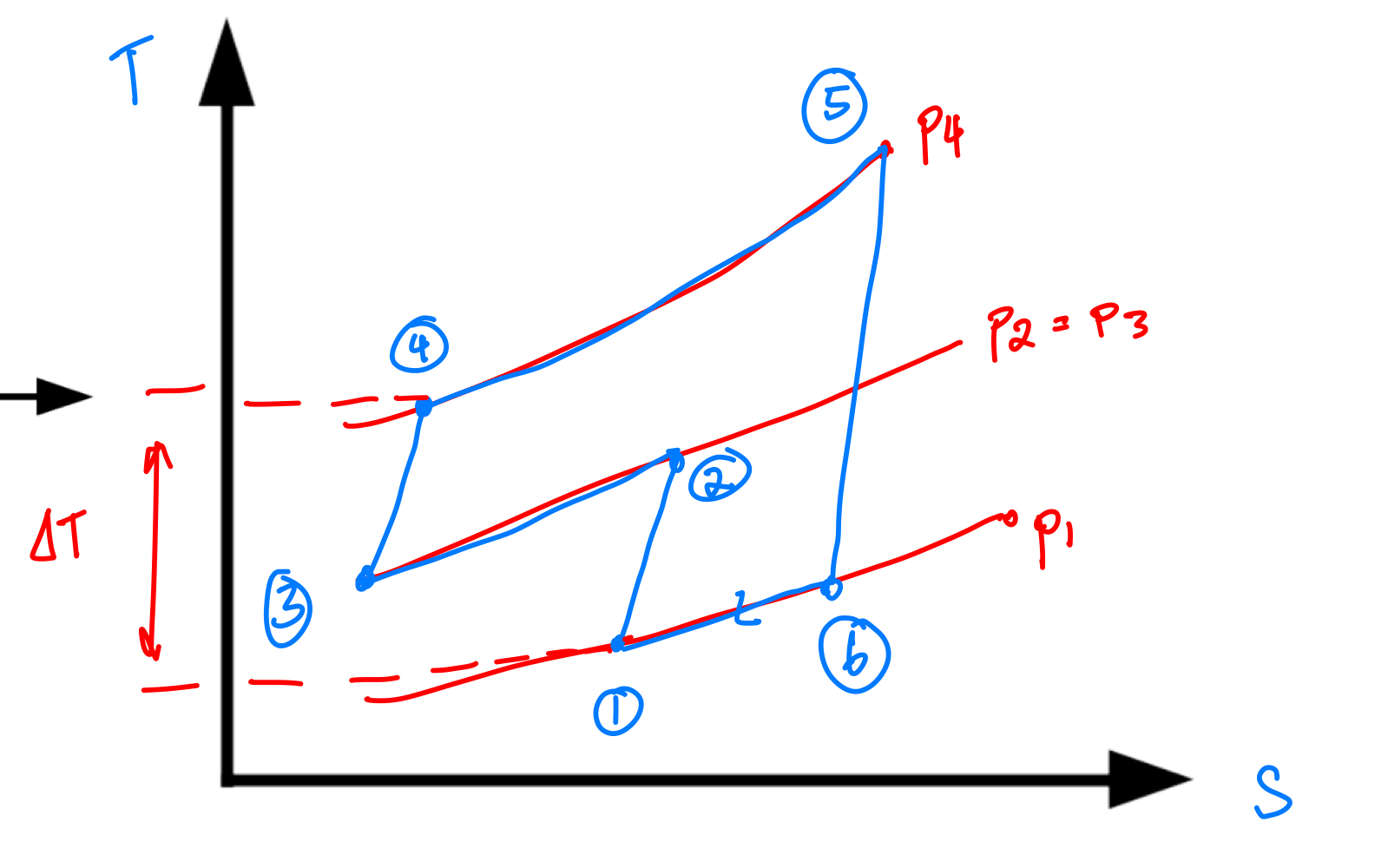
JOULE CYCLE WITH INTERCOOLING
ΔT = T4 - T1
trying to minimise ΔT
dont sum pressure, multiply
(Rp (machine))1/n n = number of stages
reciprocating internal combustion engines
piston moves up and down with each motion being called a stroke. connecting rod and cranshaft are required to convert to rotational motion
not SFEE problem
“suck” = induction stroke piston down
“squeeze” = compression stroke, valves close piston travels up cylinder
“bang”= expansion stroke combustion happens forces piston down
“blow” = exhaust stroke, valve open piston travel up, gases expelled
otto cycle efficiency
n = Wnet/ Q23 (Qin)