A1-Unit 4
 Call Kai
 Learn
Learn Practice Test
 Spaced Repetition
 Match
Match Flashcards
 Knowt Play
1/27

There's no tags or description
Looks like no tags are added yet.
Name | Mastery | Learn | Test | Matching | Spaced | Call with Kai |
|---|
No analytics yet
Send a link to your students to track their progress
28 Terms
C’est par là !
Le festival propose un programme riche pour découvrir des artistes et leurs pratiques.
Its there!
The festival offers a rich program for discover artists and their practices.
Découvrir
Je découvre — ژُ دِکوور
Tu découvres — تو دِکوور
Il/Elle découvre — ایل/اِل دِکوور
Nous découvrons — نو دِکوورون
Vous découvrez — وو دِکووره
Ils/Elles découvrent — ایل/اِل دِکوور
To discover
Dormir
Je dors — ژُ دور
Tu dors — تو دور
Il/Elle dort — ایل/اِل دور
Nous dormons — نو دورمون
Vous dormez — وو دورمه
Ils/Elles dorment — ایل/اِل دورم
To sleep
Il y a des commerces près de chez moi.
Le jardin n’est pas loin du centre… ≠ Il est loin du centre...
There are shopping centers near my house
The garden is not far from center # it is far from center
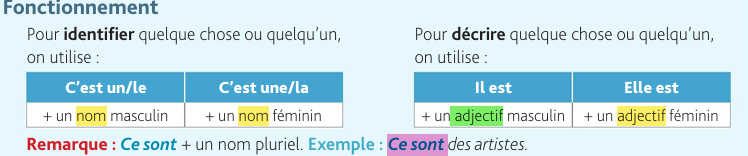
C’est un/le + un nom masculin
C’est une/l + un nom féminin
Ce sont + un nom pluriel. Exemple : Ce sont des artistes.
********************************
Il est + un adjectif masculin
Elle est un adjectif féminin
It is + noun
It is + adj
Dans quels lieux aimez-vous aller ?
J'aime aller dans les musées et les parcs.
Which places do you like to go to?
I like to go to museums and parks.
Je vais souvent dans les jardins et les parcs.
Le dimanche, je marche toujours près du fleuve.
Je ne vais jamais au théâtre. ژُ نُ وِ ژَمِ او تئاتغ.
I often go to gardens and parks.
On Sundays, I always walk near the rive
I never go to the theater.
Les voies
• l’avenue (f.)
• le boulevard
• le fleuve
• la place
• le pont
• la rue
routes, roads,
avenue
boulevard
river (that flows into the sea/ocean)
square, plaza
bridge
street
Les parties de la ville
• la banlieue
• le centre-ville
• le quartier
Parts of the City
suburb
downtown, city center
neighborhood, district, area of a city
Les lieux,
les monuments
• la banque
• le bâtiment
• la bibliothèque
• le commissariat
• l’école (f.)
• l’église (f.)
places, landmarks
bank
building
library
police station
school
church
• la fontaine
• la gare
• le jardin
• la mairie
• le musée
• le parc
• la poste
• le théâtre
fountain
train station
garden
town hall / city hall
museum
park
post office
theater
Les personnes
• les habitants
• les touristes
residents, inhabitants
tourists
les transports en commun sont maintenant gratuits pour les habitants et pour les touristes.
C’est une mesure écologique
C’est aussi une mesure sociale
Se déplacer au Luxembourg, c’est simple avec les transports en commun
public transportation is now free for residents and tourists.
It is an environmental measure
It is also a social measure
Getting around Luxembourg is easy with public transport.
On économise 25 euros par mois !
Vous prenez les transports en commun pour visiter le pays ou la ville.
prenez la ligne T1, descendez à l’arrêt « Eglington », c’est rapide !Marchez 5 minutes et vous êtes au musée.
We save 25 euros per month!
You take public transport to visit the country or the city.
take line T1, get off at the “Eglington” stop, it’s quick! Walk 5 minutes and you are at the museum.
Prendre
Je prends — ژُ پغَن
Tu prends — تو پغَن
Il/Elle prend — ایل/اِل پغَن
Nous prenons — نو پغنون
Vous prenez — وو پغنه
Ils/Elles prennent — ایل/اِل پغن
to take (a bus)
Excusez-moi, on cherche …
Où est l’arrêt de bus (s’il vous plaît) ?
Excuse me, we are looking for…
Where is the bus stop (please)?
Tournez / Prenez à gauche / à droite.
Continuez tout droit.
Prenez la première (1re) / deuxième (2e) / troisième (3e) rue à droite.
Turn / Take left / right.
Go straight ahead.
Take the first / second / third street on the right.
L’impératif یعنی حالت دستوری در فرانسه؛ وقتی به کسی دستور میدهیم، خواهش میکنیم یا راهنمایی میکنیم. فقط برای tu / nous / vous استفاده میشود و فاعل حذف میشود. ساخت آن از شکل حال فعل است: برای افعال -er در حالت tu حرف s حذف میشود (parle !)، و برای nous و vous همان شکل حال میآید (parlons !, parlez !). افعال مهم بیقاعده هم شکل خاص دارند مثل:
être → sois / soyons / soyez، سواْیه سوا سواْیون
avoir → aie / ayons / ayez، اِ اِیون اِیه
aller → va / allons / allez.
L’impératif حالت دستوری
e. Regarde sur ton téléphone !
f. Allons acheter des tickets !
g. Montez dans le bus.
h. N’achetez pas de ticke
Les français utilisent leur voiture parce que c’est pratique. Mais la voiture coûte 5 000 €/an au minimum et elle n’est pas écologique. Comment se déplacer sans polluer et sans payer cher ? Pour faire 1 km, marchez ! Pour faire 2 km, utilisez la trottinette et pour faire entre 2 et 10 km, prenez votre vélo. 2-10 km > 30 km Pour aller plus loin, sans voiture, prenez le métro, le bus ou le tram ! Et pour faire 30 km et plus, la solution, c’est le covoiturage ! Voyagez avec d’autres personnes ! Bien sûr, c’est possible de mixer les moyens de transport. Allez à vélo jusqu’à une station de métro, et après, prenez le bus ou la voiture !
French people use their car because it is practical. But a car costs at least €5,000 per year and it is not eco-friendly. How can we travel without polluting and without paying a lot? To go 1 km, walk! To go 2 km, use a scooter, and for 2 to 10 km, take your bike. To go further without a car, take the metro, bus, or tram! And for 30 km and more, the solution is carpooling! Travel with other people! Of course, it is possible to mix means of transport. Go by bike to a metro station, and then take the bus or the car!
pour + infinitive(مصدر ), Pour aller ….
parce que /Parce qu' (for start with vowel) + clause, Parce que j'ai beaucoup travaillé.
mais, J'aime le café, mais je n'aime pas le thé.
avec + name, avec mon ami, avec le bus
sans + name or verb(infinive), sans vioture, sans manger
in order to / to برای، به منظور
because چون، زیرا
but
with
Without
Les transports
• à pied (m.)
• à trottinette (f.)
• à vélo (m.)
• en bus (m.)
• en métro (m.)
Transportation
on foot / walking
by scooter
by bike / cycling
by bus
by metro / subway
en train (m.)
• en tramway (m.)
• en voiture (f.)
• le covoiturage
• les transports en commun (m.)
by train
by tram / tramway
by car
carpooling / ride-sharing
public transport
Se déplacer سُ دِ-پلا-سِه
• l’arrêt (m.)
• la carte de transport
• l’itinéraire (m.)
• la ligne
• la station
• le ticket
Getting around / to travel
stop (bus stop / stop point)
transport card
route / itinerary
line
station
ticket
dans quel quartier de Toulouse tu habites ?
En septembre, je commence mon travail à la mairie de Toulouse.
mais c’est difficile de choisir un quartier à Toulouse. Il y a beaucoup de quartiers sympas
Les gens adorent pique niquer sur le quai !
beaucoup de choses
In which neighborhood of Toulouse do you live?
In September, I start my job at the Toulouse city hall.
but it is difficult to choose a neighborhood in Toulouse. There are many nice neighborhoods.
People love having picnics on the riverbank!
a lot of things / many things
Vous êtes d’accord pour répondre à mes questions ?
beaucoup de personnes prennent le bus pour aller au centre-ville. C’est pratique.
Il n’y a pas d’eau dans les fontaines en hiver.
Are you okay with answering my questions?
Many people take the bus to go to the city center. It is convenient.
There is no water in the fountains in winter.
comment on va aux Arènes ? À pied ou en bus ?
Allez, Vanessa, sois sympa ! Aie un peu de courage !
Tu lances le GPS ?
Ce n’est pas un problème. Je demande au monsieur.
Allons acheter des tickets !
How do we get to the Arènes? On foot or by bus?
Come on, Vanessa, be nice! Have a little courage!
Are you turning on the GPS?
It’s not a problem. I’m asking the man.
Let’s go buy tickets!
Pour ma fête, rendez-vous demain, à 19 heures chez moi !
Les tickets sont disponibles pendant sept jours au prix de 13,50 euros l’unité.
Vous pouvez demander des informations à l’accueil
For my party, meet tomorrow at 7 p.m. at my place!
Tickets are available for seven days at a price of 13.50 euros each.
You can ask for information at the reception desk.
Allons + verb infinitive (to verb)
Allons faire du shopping !
Allons voir un film
Allons acheter du pain
Allons étudier
Let’s go shopping!
Let’s go watch a movie.
Let’s go buy bread.
Let’s go study.