Phytoplankton Blooms
 Call Kai
 Learn
Learn Practice Test
 Spaced Repetition
 Match
Match Flashcards
 Knowt Play
1/23

There's no tags or description
Looks like no tags are added yet.
Name | Mastery | Learn | Test | Matching | Spaced | Call with Kai |
|---|
No analytics yet
Send a link to your students to track their progress
24 Terms
Characteristics of C strategists in phytoplankton
Called competitors, highly effective cosmopolitan dispersal, r selective, mostly unicellular, small, low light requirements, highly susceptible to grazing, grow fast and get eaten quickly
Characteristics of R strategists in phytoplankton
Called ruderals, widely distributed, r and k selective, often colonial, Large in size, very low light requirements, good grazing protection
Characteristics of S strategists in phytoplankton
Called stress tolerant, tendency to discontinuous distribution, strongly k selective, often colonial, small to large in size, nitrogen fixers, mixotrophic, mist are motile, often undertake controlled migration
what is a phytoplankton bloom
A rapid accumulation of phytoplankton biomass
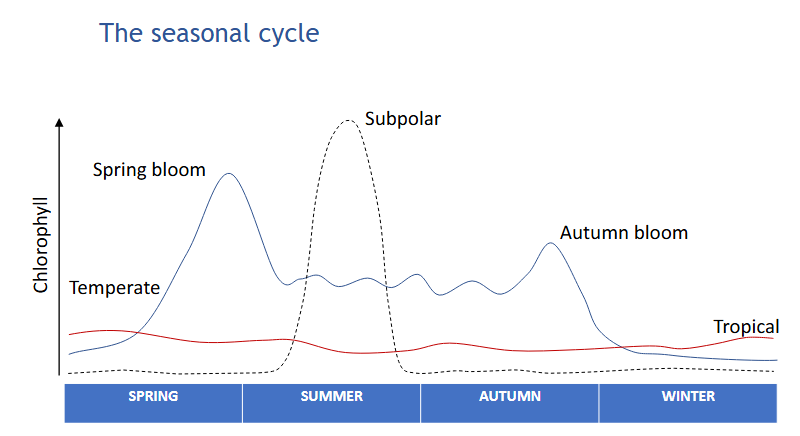
Seasonal cycle for phytoplankton blooms in tropical regions
Chlorophyll levels remain relatively low for the entire year
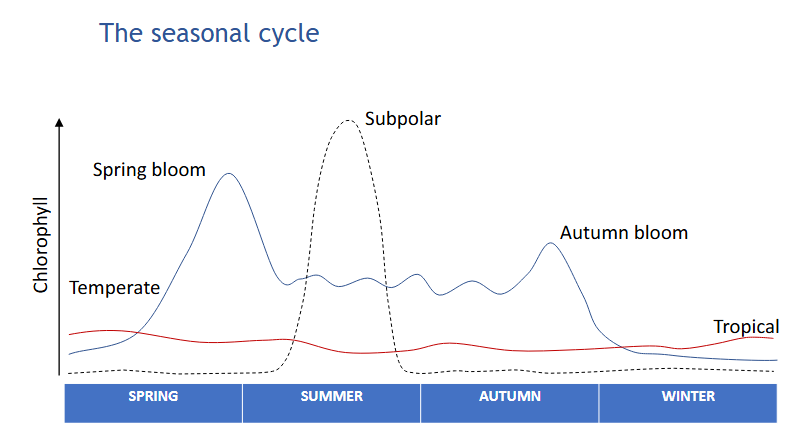
Seasonal cycle for phytoplankton blooms in subpolar regions
Chlorophyl levels are extremely low all year until summer where there is a large bloom
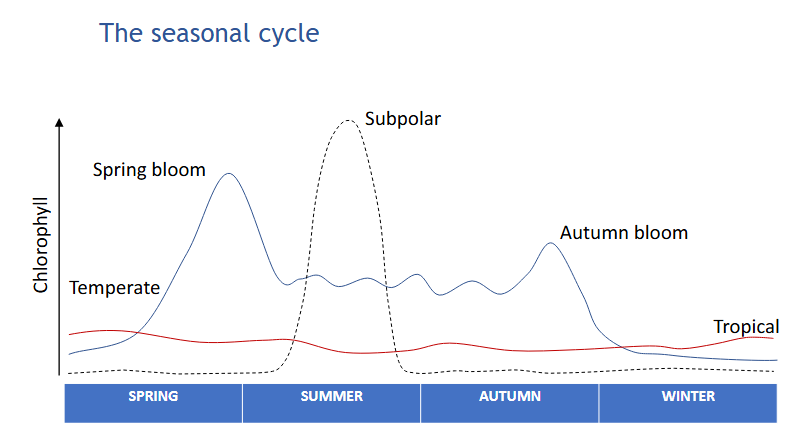
Seasonal cycle for phytoplankton blooms in temperate regions
There are spring and autumn blooms with elevated chlorophyll levels in between and low chlorophyll levels during winter
What are the pros and cons of ocean mixing for phytoplankton
They want to be near the surface to have access to light for photosynthesis, but they can access better nutrient concentrations in deeper waters
What depth is the highest photosynthetic rate
30-80 meters deep
What is the compensation depth
Where the rate of photosynthesis equals the rate of respiration (bottom of euphotic zone)
Critical depth
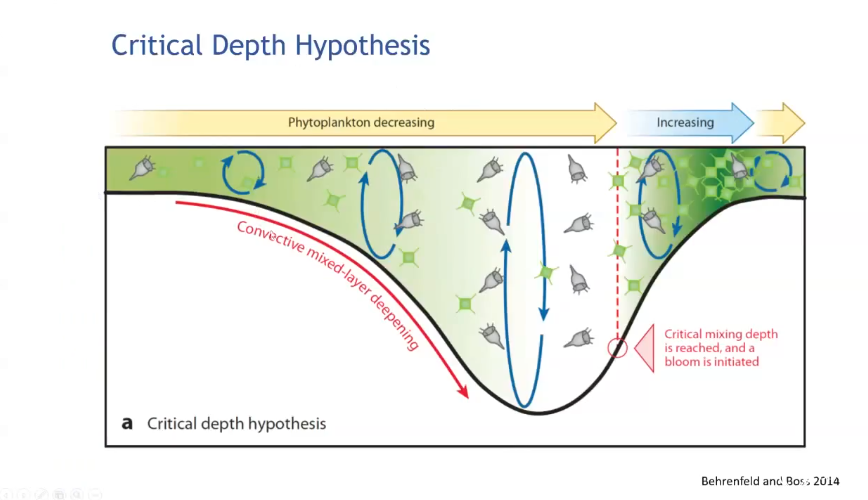
The total energy gained from photosynthesis equals total energy loss through respiration
How does mixing below compensation depth affect phytoplankton
If mixed below compensation depth the phytoplankton will be okay because they spend most of their time above where they produce more energy from photosynthesis than they expend
How does mixing to critical depth affect phytoplankton
If they are mixed to the critical depth that means they are spending an equal amount of time with a net energy gain and a net energy loss which balances out meaning that they can just barely survive because the total photosynthesis = total respiration
How does mixing below critical depth affect phytoplankton
The phytoplankton will die because they spend more time with a net energy loss than with a net energy gain and the cost of respiration is higher than the energy they are gaining
Critical depth hypothesis
Harald Sverdrup “there must be a critical depth such that blooming can occur only if the mixed layer is less than the critical value”
Does the critical depth hypothesis work
Works well in the North Atlantic, but is it the driving force for bloom dynamics
What region does not follow the critical depth hypothesis
Temperate North Pacific
What is different about the North Pacific when it comes to the critical depth hypothesis
There is low phytoplankton biomass all year around but a zooplankton bloom from spring into summer
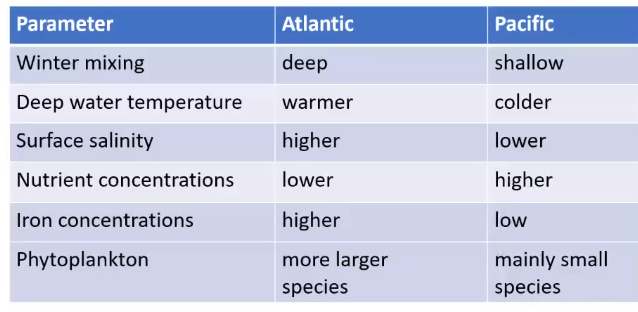
Why is phytoplankton biomass lower and individuals smaller in N Pacific than in N Atlantic
It is one of the places with extremely low iron concentrations which limits phytoplankton primary production which explains low phytoplankton concentrations. Winter mixed layer depth in the N pacific is much shallower compared to N Atlantic, therefore phytoplankton ger more light during winter and growth during winter is higher compared to the N Atlantic. This has a strong impact on zooplankton grazers in spring, the surface water in the N Pacific is more freshwater making it less dense and the deep water is colder making it denser. this creates a larger density barrier leading to less mixing, Nitrate concentrations in N pacific are higher than N Atlantic. This is because N Pacific is iron limited so phytoplankton cannot grow enough to use all nitrate present so it builds up, N Pacific has mostly small species because iron is limited.
Why do Zooplankton populations bloom in the N Pacific despite there being no phytoplankton bloom
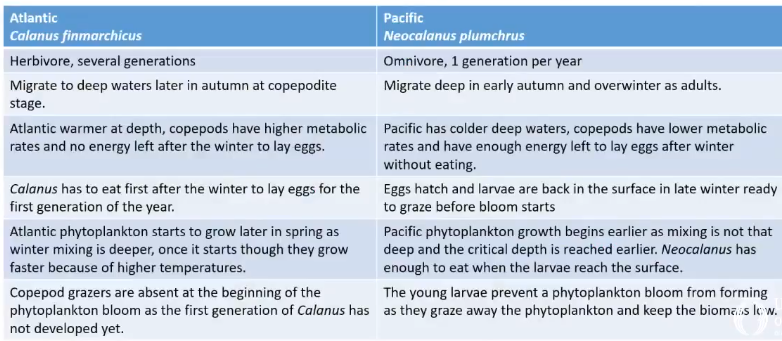
The dominant copepod (grazer) species in the N Pacific (Neocalanus plumchrus) only has one generation per year while the dominant species in the N Atlantic (Calanus finmarchicus) has multiple generations per year. The N Pacific copepod migrates to deep waters in winter where it lays eggs that will hatch and develop by spring. These offspring do not have energy reserves so they travel to the surface and eat so many phytoplankton that they “graze away the bloom before it can happen”
Characteristics of Calanus finmarchicus (N Atlantic copepod)
Herbivore, several generations, migrate to deeper water later in autumn and do not have enough energy to lay eggs after the winter passes. This means they have to eat first before laying eggs. Before copepods develop the phytoplankton bloom begins and then copepods catch up and graze bloom away
Characteristics of Neocalanus plumchrus
Omnivore, 1 generation per year, migrate to deep waters in early autumn where cold pacific waters slow metabolism allowing copepods to lay eggs during winter without eating. Eggs hatch and larvae are back in the surface in late winter ready to graze before bloom starts. Pacific phytoplankton growth begins earlier since mixing is not that deep and critical depth is reached earlier. The copepods have enough to eat when they reach the surface where they prevent the bloom from forming and keep biomass low
Compare primary production between phytoplankton in N Atlantic and Pacific
They are nearly the same despite the very different biomass cycles
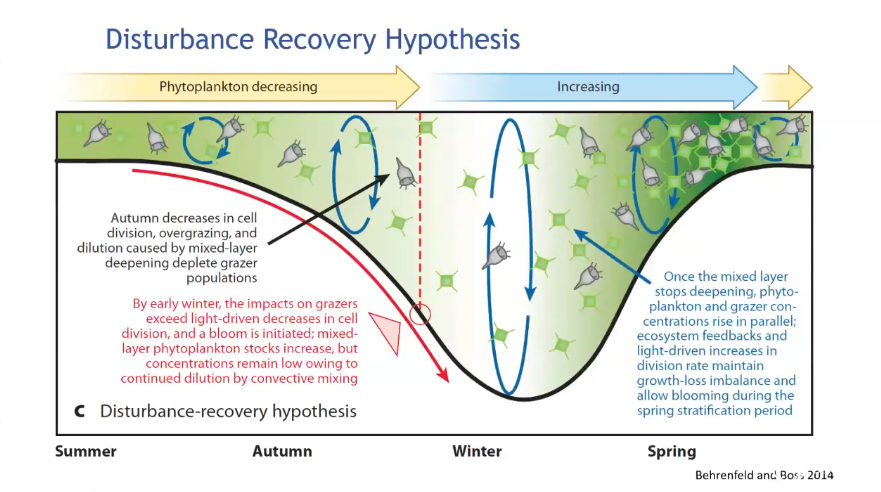
Disturbance recovery hypothesis
Considered critical depth as well as the abundance and impact of grazers