Chapter 4 physics
 Call Kai
 Learn
Learn Practice Test
 Spaced Repetition
 Match
Match Flashcards
 Knowt Play
1/49

There's no tags or description
Looks like no tags are added yet.
Name | Mastery | Learn | Test | Matching | Spaced | Call with Kai |
|---|
No analytics yet
Send a link to your students to track their progress
50 Terms
What can be concluded about the net force on a car moving left with constant velocity?
the net force on the car is zero
Condition required for an object remain at rest
the net force exerted on it is zero
newton’s 1st and 2nd laws (equilibrium)
if an object is at rest, the net force must be zero. (the upward normal force must equal the downward weight)
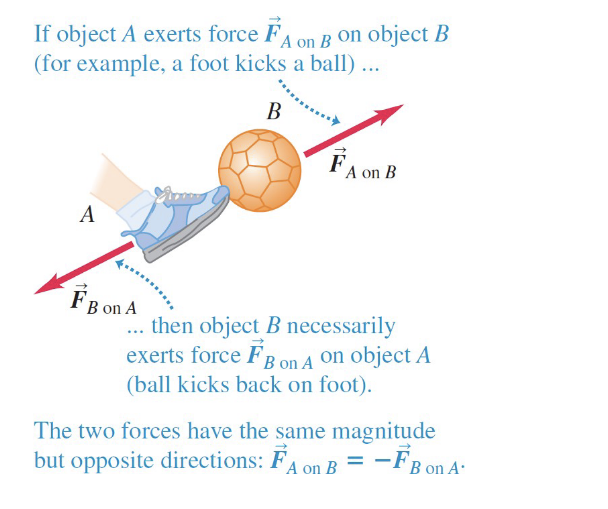
newton’s 3rd law ( action-reaction pairs)
action-reaction forces: are equal in magnitude, opposite in direction, act on different object.
Force =
mass* g(gravity)
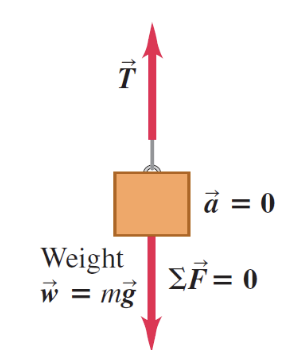
Tension
(mass below P) * g
Newton’s 3rd law
states that a physical interaction always generates a pair of forces on the two interacting bodies
every force has one and only one 3rd law pair force
true
the two forces in each pair act in opposite direction
true
two forces in each pair always act on
different bodies
3rd law pair comes from
one single interaction, not mixed
the two forces of a 3rd law pair always act on different bodies
true
newton’s 3rd law guarantees equal
forces, but accelerations depend on mass
the force on the smaller moon due to the larger earth is
equal in magnitude but antiparallel to the force on the earth due to the moon
Elevator is moving upward at a constant speed, the spring scale will read the exactly the same as it does when everything is at rest
constant speed means zero acceleration. Newton’s laws say that only acceleration changes the apparent weight or the reading on a scale
Newton’s Second Law F =
m*a kg
A force is a push or a
pull
a force is an interaction between
two objects or between an object and its environment
a force is a
vector quantity, with magnitude and direction
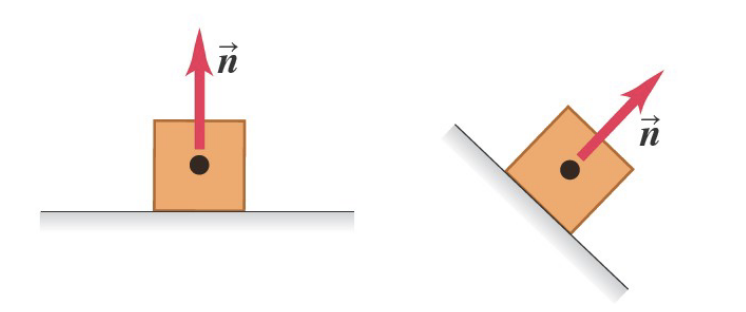
types of forces: normal force n
when an object rests or pushes on a surface, the surface exerts a push on it that is directed perpendicular to the surface (normal force is a contact force)
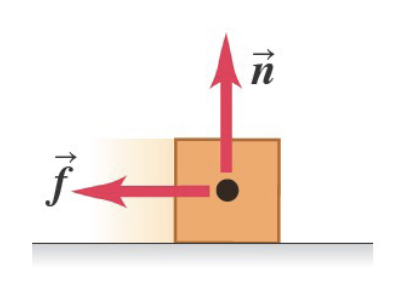
Types of forces: friction force f
a surface may exert a friction force on an object, directed PARALLEL to the surface (is a contact force)
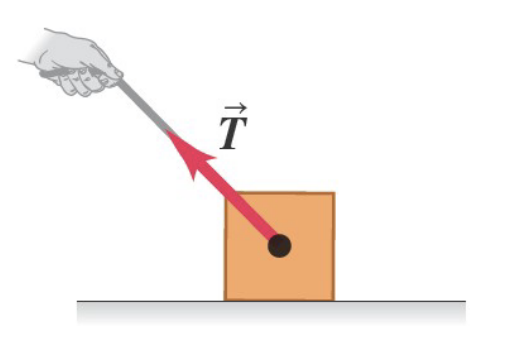
Types of forces: tension force T
a pulling force exerted on an object by a rope, cord, etc. (is a constat force)
Type of forces: weight
the pull of gravity on an object is a long-range force (a force that acts over a distance) (is a long-range force)
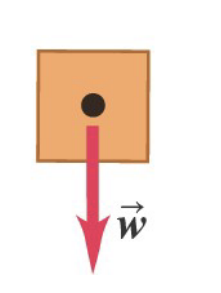
Length of vector shows the …
magnitude
the longer the vector,
the greater the force magnitude
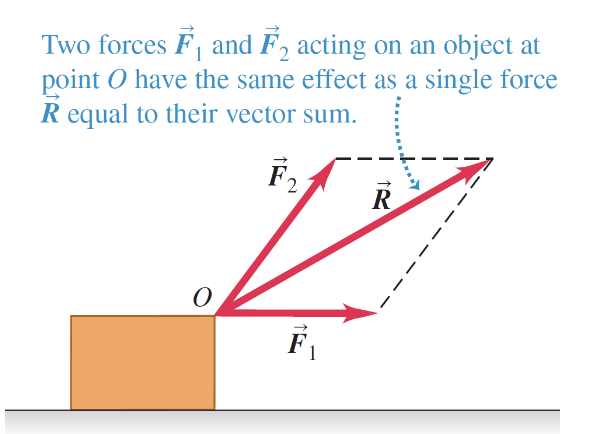
superposition of forces
several forces acting at a point on an object have the same effect as their vector sum acting at the same point
Newto’s First Law
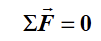
- Equilibrium: object is rest or moving with constant velocity (straight line with constant speed)
- object to be in equilibrium, it must be acted on by no forces, or by several forces such that their vector sum - that is, the net force - is zero

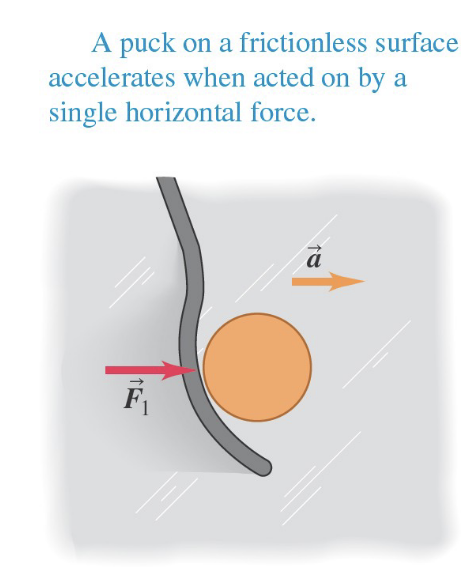
Net Force Causes
Acceleration (accelerates in the direction of a net applied force )
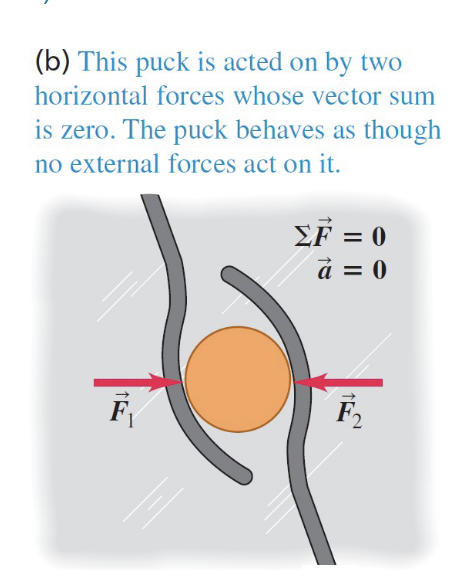
When the net force is zero, the acceleration is
zero, and the pluck is equilibrium
When is Newton’s First Law Valid
- Bus traveling on a straight road and speeding up
- Roller skates on the bus (you move backwards)
inertial frame of reference
a frame of reference in which Newton’s first law is valid is
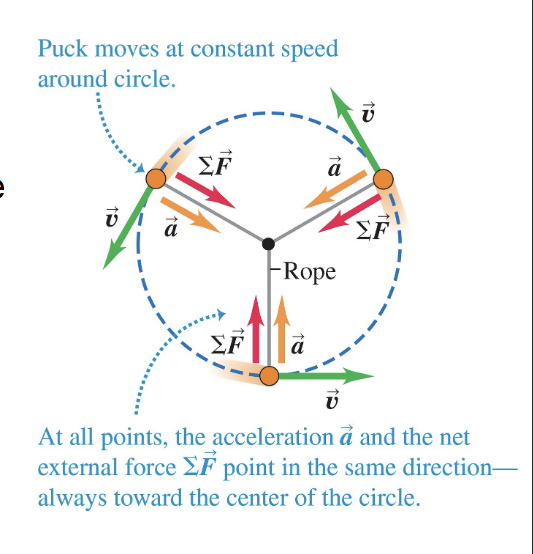
An object in uniform circular motion is accelerated toward the
center of the circle (net external force on the object must point toward the center of the circle)
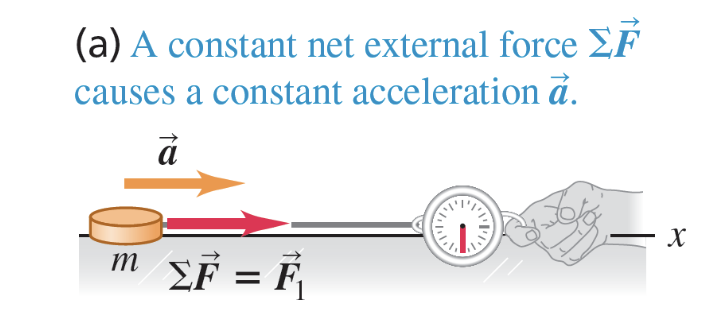
acceleration a of an object is directly proportional to the
net external force F on the object
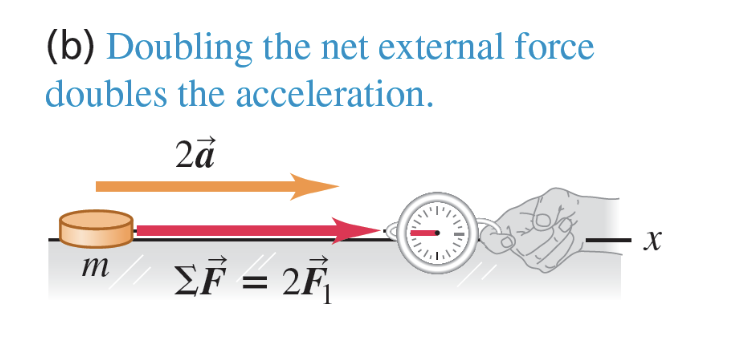
Doubling the net external force doubles the
acceleration
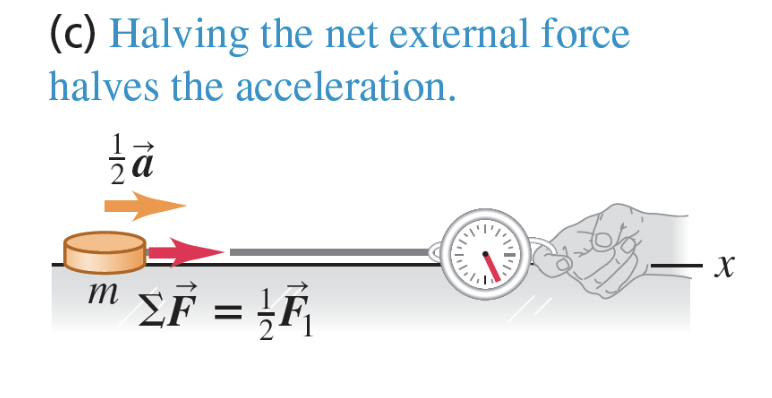
halfling the net external force halves the
acceleration
the acceleration of an object is inversely proportional to the
object’s mass if the net external force remains fixed
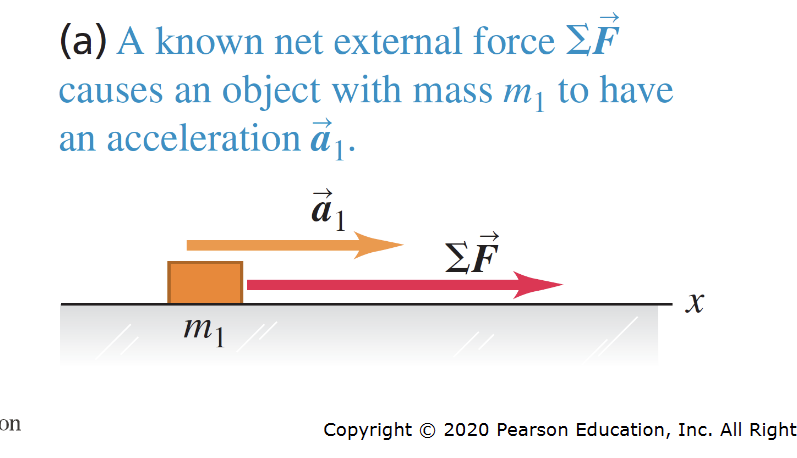
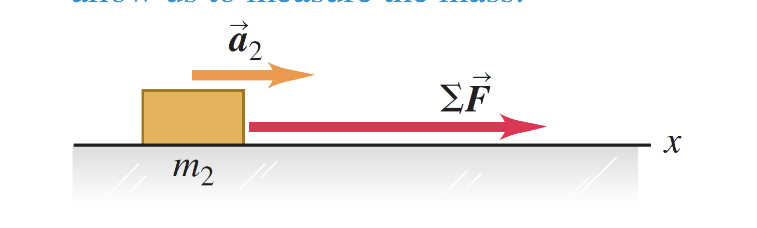
Applying the same net external force F to a second object and noting the acceleration allow us to measure the
mass
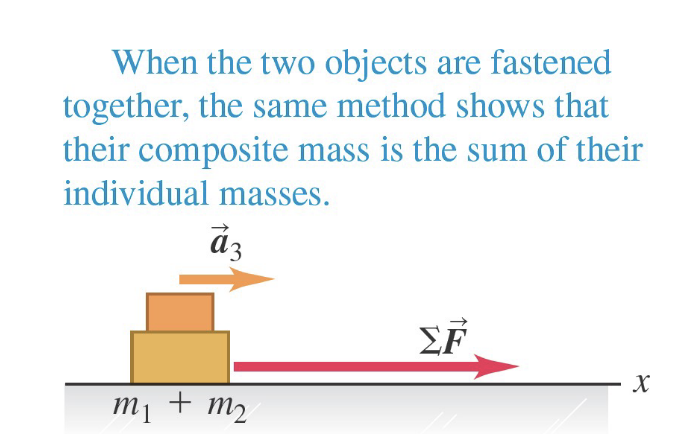
When the two objects are fastened together, the same method shows that their composite mass is the
sum of their individual masses
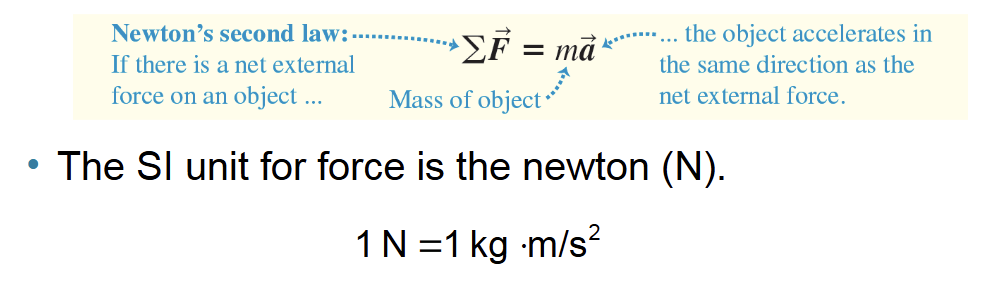
newton’s second law of motion
the acceleration of an object is directly proportional to the net external force acting on it, and inversely proportional to the mass of the object
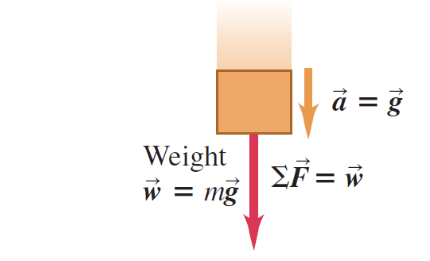
Weight
of an object (on the earth) is gravitational force that the earth exerts on it
w = mg

the value of g depends on the
altitude
Falling object massm
Hanging object, mass m
Newton’s Third Law
The two forces have the same magnitude but opposite directions
Newton’s first law, equilibrium equation
Newton’s second law equation
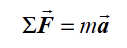
Newton’s second law equation

w =
mg
Newton’s third law

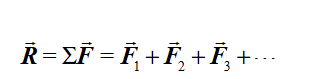
R =