COM 318 Unit 1
 Call Kai
 Learn
Learn Practice Test
 Spaced Repetition
 Match
Match Flashcards
 Knowt Play
1/125

There's no tags or description
Looks like no tags are added yet.
Name | Mastery | Learn | Test | Matching | Spaced | Call with Kai |
|---|
No analytics yet
Send a link to your students to track their progress
126 Terms
Persuasion
involved one or more persons who are engaged in the activity of creating, reinforcing, modifying, or extinguishing beliefs, attitudes, intentions, motivations, and/or behaviors within the constraints of a given communication context
Key concepts of Persuasion
Message: verbal, social media, advertisement
Intention: are they trying to persuade?
Choice: does the person being persuaded have free choice
Attitudes, beliefs, and behaviors
Social Influence
Group conformity
Compliance gaining
Socialization
Persuasion
Group conformity
If we all agree to do something similarly because we are part of some group
Compliance gaining
the process of getting people to be okay with doing something for the betterment of the group
Socialization
Adapting to the social context
Where persuasion started
Rhetoric: Art of persuasion
Ancient field of study
Aristotle (384-322 BCE) said persuasion required:
Ethos: credibility of speak
Pathos: Emotional appeal
Logos: Logical appeals
Ethos
Source credibility or attractiveness
Source are more attractive if:
They are experts and credible
They are like the audience and relatable
They are attractive?
Experts and credible sources
Increases trust in information
They are like the audience and relatable
Increases sense of efficacy - that audience can do what source is doing
If the people in the advertisement are doing thing that say the readers like to do or is similar to things they do
They are attractive? - Ethos
Model in a burger commercial
Research suggest sexual ads attract attention
Result of that attention varies
This is not a generally a good one
Pathos
Emotional appeals
Advertisers often try to make us feel: happy, afraid, guilty
Pathos - Emotions
Happy - if you have this perfume you to with also be smiling and happy
Afraid - get sunscreen or skin cancer is possible
Guilty - the dog ads
These emotions
Cause immediate reactions
Change responses to logically presented information
Logos
Logical appeal
Scientific, rational information for why argument is right
Think about covid and all the ads they had about hand cleaning and wearing a face mask and why we should
Why logic fails
Product choices are often equivalent - no logical choice
Think about different brands
People are "cognitive misers" who are unmotivated to process logical arguments
Processing logic takes more effect and sometimes we just don’t want to do that
People may not be capable of processing and understanding logical arguments
People are not always rational
People don't always do what we expect them to do
Digital and Online Influence
Electronic Word of Mouth (eWOM)
eWOM can be created through sponsored content
eWOM
Create social media buzz
To work, needs to feel genuine and peer-driven
Cannot feel manufactured or forced
Works better amount younger audiences - who's on social media more
eWOM through sponsored content
Paid endorsements for mentioning brand or product
Sponsored content can include native advertising
Ads posing as news stories
Form of paid media where the ad experiences follows the nature form and function of the user experience in which is is placed
Consumers look at native ads 52% more than traditional banner ads
They're successful because they blur the line between advertising and content
Interpersonal Influence
Face-to-Face is the most effective arena for persuasion
You have people's attention, they tend to be more polite and more receptive to what your saying
Mass media has large reach, but low impact
Full range of verbal and non-verbal cues
Ability to adapt the message on the spot
You can read body language and see how they are responding
Harder to say "no" in person
Benefits of studying persuasion
Become a more effective communicator!
Communication competence
Enhance your knowledge and awareness of persuasive processes
Overcome habitual persuasion
Become a more discerning consumer
Defensive function
Understand why persuasion isn't always easy
Debunking function
Improve your sense of well-being
It increases as your persuasive abilities increase
Propaganda
It dehumanizes its audience
It has a power imbalance over its audience
Things rather than people
It has characteristics of close-mindedness
It relies on authority, abstractions, fixed views, all-inclusive categories, simple cause-and-effect relationships, etc
Model for moral persuasion
Minimize harm while maximizing truth telling
Maximizing accountability and transparency, while minimizing loyalty to bad actors
Processing and Persuasion
Cognition, what's going one in our brain when it comes to persuasion
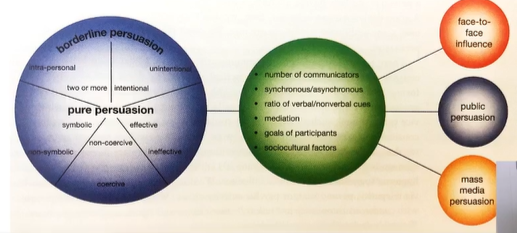
Pure persuasion
When we can all agree persuasion is being attempted or has occurred
You and your friend are talking about where to eat and they suggest you guys go somewhere - they simple persuaded you
Borderline persuasion
Cases where it’s not clear
Consider when it comes to persuasion
intentionality
Effects
Free will
Conscious awareness
Intentionality
Were you trying to persuade someone
Can be an obvious ad
Communication can be intentional
Effects
What if the effects are unsuccessful or even unintended
What if the effects don't match the intention
Free will
Coercion
Does the person being persuaded have a choice
Conscious awareness
Do you need to know that persuasion is happening to you?
Times when persuasion occurs
Consider
Symbolic action
What symbols or actions are part of the persuasive process?
Intrapersonal vs. Interpersonal
Can we persuade ourselves?
Elaboration Likelihood Model
Developed by Petty and Cacioppo
Is a dual-processing model - how likely we are to elaborate
defines 2 types of cognitive processing
Central route
Peripheral Route
Central Route processing
high cognitive happening
You are really paying attention to the situation (the central route)
Really thinking hard
Effortful
Peripheral Route Processing
low cognitive happening
Someone buys a car because it looks nice - not really what the product is all about
Letting yourself be influenced by things that aren't really that important
Predicting Central Route Processing
If your motivation to process is high
Personal relevance
If you don't really care like trying to find somewhere to eat you aren't going to think that hard
If you have the ability to process
Prior experience
Knowledge
Opportunity
If you are high in need for cognition
Enjoying thinking about things
Predicting Peripheral Route Processing
If your motivation to process is high
Personal relevance
If you do not have the ability to process
Prior experience
Knowledge
Opportunity
If you are low in need for cognition
You do no enjoying thinking about things
Peripheral Cues
Authority (parent, doctor)
Your parents telling you what to do
Doctor suggesting this certain medication
Liking (if I like you, Ill like your ideas too)
Commitment (I said IM committed, so I must act)
Contrast (asked for a giant favor, but actual desired favor is small)
Reciprocity (You persuade others to act by offering to return favor later)
Scarcity (Use fear of missing out. FOMO)
Social Proof ("everyone is doing it" bandwagon approach)
Example of ELM
Buying toothpaste - how much time do you actually want to spend time looking at buying toothpaste
How might 2 shoppers process centrally or peripherally
Peripheral Route shopper
I like this label
I have a coupon for this brand
This is the cheapest brand
This is the brand my parents use
Central Route shopper
Evaluates all options
Examines ingredients
Examines health information
Examines cost
Examining Central vs. Peripheral route
Observe their non verbal behaviors - SOLAR
Ask questions
Observing non-verbal behaviors
If you observe behaviors that indicate attentiveness and alertness, they are probably using the central route
Use the acronym SOLER
Squarely faced
Open posture
Leaned in
Eye contact
Relaxed
SOLAR
Squarely faced
Open posture
Leaned in
Eye contact
Relaxed
Heuristic systematic model
One mode: systematic processing is more thoughtful and deliberate
Second mode: relies on more short cuts. It is based on the application of decision rules or heuristic cues that help simplify the thought process
Simultaneous processing of messages is commonplace
Sufficiency principles - states that people strive to know as much as they need to when making a decision but no more or less.
Attitude is…
"a psychological tendency that is expressed by evaluating a particular entity with some degree of favor or disfavor"
Directed toward something
Use evaluative dimensions
Like/dislike
Good/bad
Attitudes are learned
Through family and social interactions
You family believes something
Personal experience
Unique to you
Formal education and training
Through learning and reading
example of an attitude
Paris is the most beautiful city in the world
beauty is subjective
Example of a fact
Last night, my temperature was 99 degrees
this is verifiable and measurable
Measuring attitudes
Explicit attitude
Implicit attitude
Explicit attitude measure
These attitudes are easily identifiable
They're relatively easy to control
They're asked in a way that assumes you can state your attitude
EX. Do you like Purdue University?
Self-report scales
Likert-type scales
Semantic differential scales
Visually oriented scales
Implicit attitude measures
Implicit Association Test (IAT)
Affective Misattribution Procedure (AMP)
Physiological measure
Explicit attitudes - Likert-type
Provides a quantitative measure of attitudes, opinions, or personal values
Scale often ranges from Strongly agree to strongly disagree
A person's attitude is calculated by taking the average of all the rating they provide

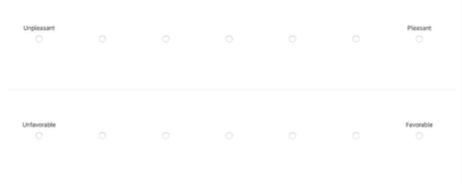
Explicit attitudes - Semantic Differential scale
Bipolar adjectives (opposites) are created
Typically a 1-7 scale
A person's attitudes is calculated by taking the average of all the rating they provide
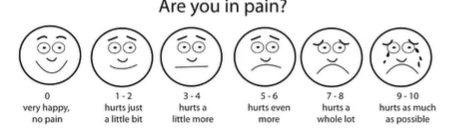
Explicit attitudes - Visually oriented scales
Designed to help participants conceptualize their attitude
They can see where their attitude falls along the scale based on the pictures provided
Problems with explicit attitudes
But what if you're interested in more sensitive questions?
Ex. Sexism is a major issue in the United States
Social Desirability Bias
People tend to under or over report
Non-attitudes
Social desirability bias
Giving the polite or socially acceptable answer
Trying to provide the answer you think the researcher wants
What people tend to under report
Feeling of low self-worth and/or powerlessness
Feeling of bigotry and intolerance
Acts of physical violence
Unsafe sexual behavior
Alcoholism/drug use
What people tend to over report
Patriotism
Voter turnout
Compliance with medicinal dosing schedules
Intellectual achievements
Indicators of charity
Religious service attendance
Non-Attitudes
Sometimes people have not formed their opinions on something
But if you ask, they feel pressured to provide a response
Implicit Attitudes
To better address attitudes that people are less aware of (or less willing to express), researchers study implicit attitudes.
Implicit attitudes are those attitudes we hold that we're not immediately aware of.
They may be unconsciously activated
They may be unintentionally activated
They're much harder to conceal than explicit attitudes
Some researchers have described implicit attitudes as "inescapable"
Implicit Attitudes - Implicit association test (IAT)
Most common test
Uses speed of associations to determine implicit attitudes (ex. Preferences)
Do you associate good with one thing and bad with another
Response latencies are used to determine which associations are fastest/slowest
Faster associations with pictures of light-skinned individuals and "good" as well as dark-skinned individuals and "bad" would indicate an implicit preference for light-skinned individuals
Implicit Attitudes - Affect misattribution Procedure (AMP)
Developed as an alternative to the IAT
Does NOT rely on response times
The initial picture is expected to influence the evaluation of the subsequent object, despite the object's purposeful ambiguity
The instructions are key!
It is important to note that the real-life image can sometimes bias people's judgements of the drawings. Please try your absolute best not to let the real-life image bias your judgment of the drawings! Give an honest assessment of the drawing (the second image), regardless of the image that precedes it
Attitudes → Behaviors
Our behaviors often reflect our attitudes
So when should we expect to see a greater consistency between out attitudes and our behaviors?
When attitudes are stronger
When attitudes are based on personal experience
When attitudes are central to our core belief system
Theory of Reasoned Action
Views intention to behave as the best predictor of behavior
3 things influence intentions
Beliefs and attitudes about the behavior
Normative beliefs
Perceived behavior control
Beliefs and attitudes about the behavior
Beliefs about an object/behavior
Evaluations about the object/behavior
EX. Flu vaccines are effective
It is easy to get vaccinated
It is not painful to get vaccinated
Getting vaccinated is a good idea
These are all attitudes and beliefs about getting a flu vaccine
Normative beliefs
What do you think about what others think or do?
Descriptive norms:
What close others do
Ex. My close friends get vaccinated for the flu
Injunctive norms:
What others ought to do
Ex. College students should get vaccinated for the flu
Perceived behavior control
An individual's confidence that they are capable of performing a behavior
Examples
I am comfortable getting vaccinated
I can afford the flu vaccine
I know where to get the vaccine
Psychological consistency
People desire consistency among their attitudes, beliefs and behaviors
Inconsistency causes psychological discomfort
Consistency car example
You're in the market to buy a car
You want a car that gets good gas mileage
Which car?
Toyota Prius - 58 city/53 highway
Chevrolet Suburban 15 city/22 highway but you think its looks nicer and kinda the one you want
Cognitive dissonance theory
People seek to maintain a stable, positive self-concept
Behavior that contradicts one's beliefs or self-concept causes dissonance
I'm a good person, but I did something bad
I care about fuel economy, but I wanted a big SUV
People rationalize their choices and actions in light of their self-concept
Maintaining consistency
Denial
Bolstering
Bargaining
Differentiation
Transcendence
Modifying one or both attitudes
Denial
Ignoring or denying any inconsistency
"it’s not a big deal that I brough a big SUV. Nothing to worry about"
Bolstering
Adding rationalizations
"I don't need to buy the Prius, because enough other people will buy them"
Bargaining
Striking a balance between alternatives
"if I buy the Suburban, I'll make sure to recycle all of my plastic bottles."
Differentiation
Separating or distinguishing good and bad qualities of a decision
"The Suburban burns a lot of gas, but it's not as bad as some other cars”
Transcendence
Focusing on a greater good, life lesson, higher purpose
"Being environmentally friendly is much bigger than this one purchase decision"
Modifying one or both attitudes
Changing attitudes to fit with the behavior
"Maybe I'm just not that concerned with fuel consumption."
"I'll worry more about the environment when I'm older."
Features of credibility
It's a receiver-based construct
Credibility is in the eye of the beholder
Not entirely controllable by the source
It's a multidimensional construct
Credibility is a composite of source characteristics
It's situation specific
Credibility is contextual in nature
It's dynamic
Credibility can change over time, sometimes suddenly
Credibility and Celebrities
Celebrity endorsements are common
25% of ads use celebrity endorsements
10% of all ad expenditures are used to pay celebrities
Ex. Nike spend %500 million on endorsements in 2016
Celebrity endorsement work better for new products
Celebrity endorsements improve customers' attitudes toward products, but not always their intention to purchase the products
Factors of credibility
Primary dimensions
Expertise
Trustworthiness
Good will
Secondary dimension
Dynamism
composure
sociability
To much of any of these can ruin credibility. Ex. If you are too excited or to calm
Factors of credibility - Expertise
It has the greatest effect on persuasion
Consumers tend to evaluate these sources on the following qualities:
Experienced/inexperienced
Informed/uniformed
Trained/untrained
Qualified/unqualified
Skilled/unskilled
Intelligent/unintelligent
Expert/
Competent/incompetent
Attractiveness and expertise?
There is a study (1970s) that showed that attractiveness and expertise is commonly associated together. Our perception can be false. The person who was attractive was seen as more persuasive
False correlation
Factors of credibility - Trustworthiness
Integrity and honesty
Consumers tend to evaluate these sources on the following qualities:
Honest/dishonest
Trustworthy/
Open-minded/closed minded
Just/unjust
Fair/unfair
Unselfish/selfish
Moral/immoral
Ethical/unethical
Genuine/phony
Factors of credibility - Good will
Conveys respect for the audience, uses empathy
Consumers tend to evaluate these sources on the following qualities:
Cares about me/doesn’t care
Has my interests at heart/doesn't have my interests at heart
Not self-centered/self-centered
Concern with me/non concerned with me
Sensitive/insensitive
Understanding/not understanding
Factors of credibility - Dynamism
Is the source energetic and enthusiastic?
Factors of credibility - composure
Is the source cool, calm, and collected?
If they are frazzled they aren't going to be very persuasive
Factors of credibility - Sociability
Is the source friendly and outgoing?
Sleeper effect
A message from a low-credibility source may increase in persuasiveness over time
Because over time, the audience remembers the message but not the source.
"I remember hearing somewhere that…"
You forget the source but you remember the information itself
And keep in mind that a high-credibility source can also lose influence over time
To improve credibility as a persuader
Be prepared! research all sides of the topic
Cite evidence and sources of evidence
Explain your qualifications to speak on the topic
Build trust with your source
Display goodwill toward your audience
Adapt your language style to your listeners and the context
Avoid powerless language styles
Emphasize similarity, commonality
Credibility - Be prepared
Know your side of the argument
But also know how other might oppose you
Craft responses to those objections
Credibility - Cite evidence and sources of evidence
Make sure your source is reputable and that you trust it
Use sources that other will recognize as credible
Or list the qualifications of your source
Credibility - Explain your qualifications to speak on the topic
Share your qualifications at the beginning of your persuasive attempt
Credibility - Build trust with your source
One way: tell the audience how their compliance with what you're saying benefits you but also stress how it benefits them
Credibility - Display goodwill toward your audience
Show that you care; look interested
One way: If asked a question, repeat it back. Then answer their question. End by asking if you've answered their question.
Credibility - Adapt your language style to your listeners and the context
Use appropriate language based on the audience and situation
But avoid being inauthentic or seeming forced
Credibility - Avoid powerless language style
Avoid hedges, vocal fillers, and qualifiers (ex. Sort of, umm)
Credibility - Emphasize similarity, commonality
But only in topically relevant ways
if you are talking about astrology and things like that you can relate by saying “I’m a Capricorn also!”
Motivation Appeal
"external inducements, often of an emotional nature, that are designed to increase an individual's drive to undertake some course of action"
Incentives that typically seek to alter your mood, feelings, or emotions as a form of persuasion
Intrinsic Motivation
Extrinsic motivation
Intrinsic Motivation
Internal, self-initiative to do something
For the joy, satisfaction you get
Extrinsic Motivation
External incentive or stimulus to do something
Motivation is stimulated outside of you
Created by someone other than you
Logic vs. Emotion
They're not necessarily mutually exclusive
The logic/emotion dichotomy is an artificial distinction
Emotional appeals are generally more persuasive than rational appeals
But purely emotional ads don't typically persuade people, people can snuff it out and we don't typically like it right in our face
Positive emotional appeals (humor) are more effective than negative emotional appeals (fear, guilt)
Stage model of fear appeals
Ex. Cigarette health ads
When exposed to fear, you consider:
The severity of the threat
Your perceived vulnerability to the threat
When both are high, your defensive motivations kick in.
How to stop the fear and stop the threat
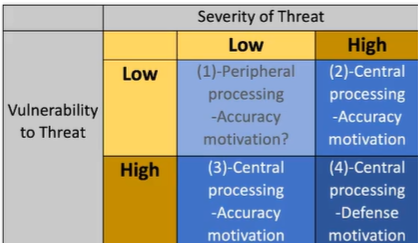
Stage model - Low severity and vulnerability
a person will tend to ignore the threat rely on peripheral processing
Ex. A bee sting hurts, but you’re not allergic