Sem 1 Modern Approach to Economic Growth
 Call Kai
 Learn
Learn Practice Test
 Spaced Repetition
 Match
Match Flashcards
 Knowt Play
1/7

There's no tags or description
Looks like no tags are added yet.
Name | Mastery | Learn | Test | Matching | Spaced | Call with Kai |
|---|
No analytics yet
Send a link to your students to track their progress
8 Terms
Production Function
Defines the technoplgy that translates inputs into outputs.
Y = F(K,N)
If you have CRS then doubling your inputs will double your outputs.
zY = F(zK,zN). So if K and N increase by 5% z = 1.05, therefore output Y increases by 1.05.
Production function when z = 1/N
starting with: Y = F(K,N)
1/N Y = 1/N K, 1/N N =
Y/N = F(K/N, 1)
this means that output per worker is a positive function of capital per worker.
Can be easily written as y= f(k)
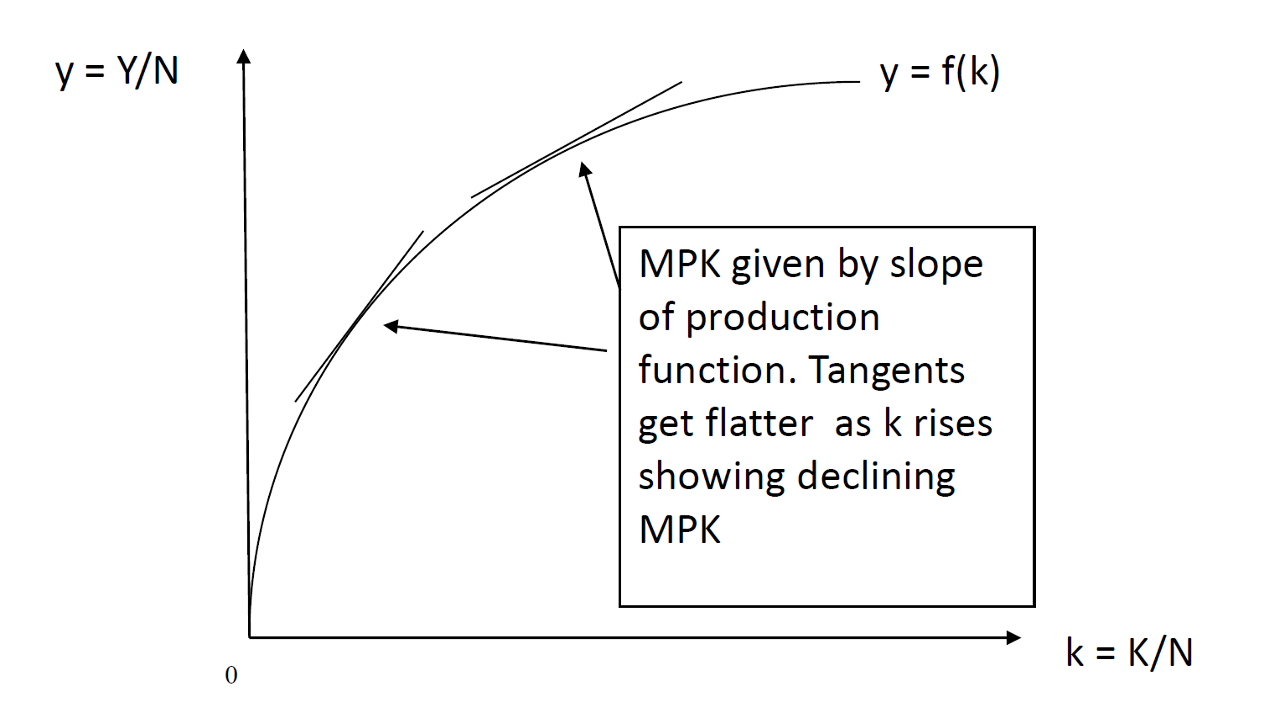
Marginal product of capital (MPK)
With each additional unit of capital, for a constant labour force, the MPK will decline.
Savings in the solow model
As savings are S = sY. If we convert to per worker:
S/N = s(Y/N) → sy = sf(k)
where y = f(k) and Y/N
Investment equation
I = ΔK+𝛿K
where, Δ𝐾 = addition of investment, 𝛿K = depreciation of capital
investment needed to sustain capital per worker
(𝛿+n)k
where, 𝛿 = rate of depreciation, n = rate of growth of labour, k = capital per worker
Savings and investment growth equation
sf(k) = (𝛿+n)
the equation tells us that output, capital and labour grow at rate n